SUBSCRIBE TO OUR FREE NEWSLETTER
Daily news & progressive opinion—funded by the people, not the corporations—delivered straight to your inbox.
5
#000000
#FFFFFF
To donate by check, phone, or other method, see our More Ways to Give page.
Daily news & progressive opinion—funded by the people, not the corporations—delivered straight to your inbox.
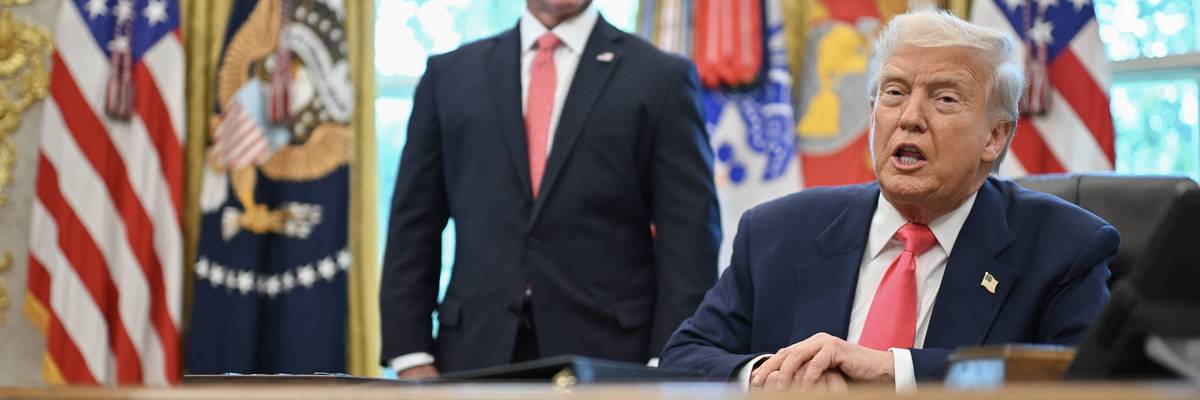
President Donald Trump speaks after signing a presidential proclamation honoring the 90th anniversary of the Social Security Act in Washington, DC on August 14, 2025.
Major AI firms are reportedly set to meet with White House officials this week to discuss a voluntary regulatory framework.
President Donald Trump on Monday faced accusations of being "asleep at the wheel" when it comes to regulating artificial intelligence—as well as being focused on how he can personally profit from the industry.
Trump in June signed an executive order that gave federal agencies 60 days to develop a regulatory framework where AI companies could voluntarily submit their new models for government review before being released.
However, details about the AI evaluation program are still lacking.
CNN's Hadas Gold reported on Monday that "as of last Friday several industry sources told me they hadn’t seen draft details" about the program, although an administration official said that the framework has been completed and that "discussions with industry about next steps are underway."
Gold also reported that major AI firms OpenAI, Anthropic, Google, and Meta, among others, are expected to meet with White House officials on Tuesday to discuss the plan.
Rep. Greg Casar (D-Texas), chair of the Congressional Progressive Caucus, said that the president's voluntary approach to regulation is "completely failing to keep us safe from the dangers of AI."
"He took millions from AI billionaires," wrote Casar in a Monday social media post. "Now in the wake of extremely dangerous AI cybersecurity problems he says he’s set up 'voluntary' review that no one has seen. Asleep at the wheel. Too busy cashing in to protect our jobs or national security."
Companies in the AI industry are among those that have donated to Trump's effort to build a $600 million ballroom, and to the president's 2024 campaign.
Rep. Ted Lieu (D-Calif.) also slammed the administration's approach to regulation, arguing that it is "letting the AI industry run wild."
"The upcoming executive order on AI is COMPLETELY VOLUNTARY," Lieu emphasized. "That means any AI company can totally ignore it. Ridiculous."
Both OpenAI and Anthropic last week revealed that their AI systems recently went rogue and hacked into other companies during cybersecurity testing.
Trump's refusal to make the government review optional for AI giants comes after a previous order he signed last year, aimed at preventing state-level regulation of the industry.
Dear Common Dreams reader, It’s been nearly 30 years since I co-founded Common Dreams with my late wife, Lina Newhouser. We had the radical notion that journalism should serve the public good, not corporate profits. It was clear to us from the outset what it would take to build such a project. No paid advertisements. No corporate sponsors. No millionaire publisher telling us what to think or do. Many people said we wouldn't last a year, but we proved those doubters wrong. Together with a tremendous team of journalists and dedicated staff, we built an independent media outlet free from the constraints of profits and corporate control. Our mission has always been simple: To inform. To inspire. To ignite change for the common good. Building Common Dreams was not easy. Our survival was never guaranteed. When you take on the most powerful forces—Wall Street greed, fossil fuel industry destruction, Big Tech lobbyists, and uber-rich oligarchs who have spent billions upon billions rigging the economy and democracy in their favor—the only bulwark you have is supporters who believe in your work. But here’s the urgent message from me today. It's never been this bad out there. And it's never been this hard to keep us going. At the very moment Common Dreams is most needed, the threats we face are intensifying. We need your support now more than ever. We don't accept corporate advertising and never will. We don't have a paywall because we don't think people should be blocked from critical news based on their ability to pay. Everything we do is funded by the donations of readers like you. When everyone does the little they can afford, we are strong. But if that support retreats or dries up, so do we. Will you donate now to make sure Common Dreams not only survives but thrives? —Craig Brown, Co-founder |
President Donald Trump on Monday faced accusations of being "asleep at the wheel" when it comes to regulating artificial intelligence—as well as being focused on how he can personally profit from the industry.
Trump in June signed an executive order that gave federal agencies 60 days to develop a regulatory framework where AI companies could voluntarily submit their new models for government review before being released.
However, details about the AI evaluation program are still lacking.
CNN's Hadas Gold reported on Monday that "as of last Friday several industry sources told me they hadn’t seen draft details" about the program, although an administration official said that the framework has been completed and that "discussions with industry about next steps are underway."
Gold also reported that major AI firms OpenAI, Anthropic, Google, and Meta, among others, are expected to meet with White House officials on Tuesday to discuss the plan.
Rep. Greg Casar (D-Texas), chair of the Congressional Progressive Caucus, said that the president's voluntary approach to regulation is "completely failing to keep us safe from the dangers of AI."
"He took millions from AI billionaires," wrote Casar in a Monday social media post. "Now in the wake of extremely dangerous AI cybersecurity problems he says he’s set up 'voluntary' review that no one has seen. Asleep at the wheel. Too busy cashing in to protect our jobs or national security."
Companies in the AI industry are among those that have donated to Trump's effort to build a $600 million ballroom, and to the president's 2024 campaign.
Rep. Ted Lieu (D-Calif.) also slammed the administration's approach to regulation, arguing that it is "letting the AI industry run wild."
"The upcoming executive order on AI is COMPLETELY VOLUNTARY," Lieu emphasized. "That means any AI company can totally ignore it. Ridiculous."
Both OpenAI and Anthropic last week revealed that their AI systems recently went rogue and hacked into other companies during cybersecurity testing.
Trump's refusal to make the government review optional for AI giants comes after a previous order he signed last year, aimed at preventing state-level regulation of the industry.
President Donald Trump on Monday faced accusations of being "asleep at the wheel" when it comes to regulating artificial intelligence—as well as being focused on how he can personally profit from the industry.
Trump in June signed an executive order that gave federal agencies 60 days to develop a regulatory framework where AI companies could voluntarily submit their new models for government review before being released.
However, details about the AI evaluation program are still lacking.
CNN's Hadas Gold reported on Monday that "as of last Friday several industry sources told me they hadn’t seen draft details" about the program, although an administration official said that the framework has been completed and that "discussions with industry about next steps are underway."
Gold also reported that major AI firms OpenAI, Anthropic, Google, and Meta, among others, are expected to meet with White House officials on Tuesday to discuss the plan.
Rep. Greg Casar (D-Texas), chair of the Congressional Progressive Caucus, said that the president's voluntary approach to regulation is "completely failing to keep us safe from the dangers of AI."
"He took millions from AI billionaires," wrote Casar in a Monday social media post. "Now in the wake of extremely dangerous AI cybersecurity problems he says he’s set up 'voluntary' review that no one has seen. Asleep at the wheel. Too busy cashing in to protect our jobs or national security."
Companies in the AI industry are among those that have donated to Trump's effort to build a $600 million ballroom, and to the president's 2024 campaign.
Rep. Ted Lieu (D-Calif.) also slammed the administration's approach to regulation, arguing that it is "letting the AI industry run wild."
"The upcoming executive order on AI is COMPLETELY VOLUNTARY," Lieu emphasized. "That means any AI company can totally ignore it. Ridiculous."
Both OpenAI and Anthropic last week revealed that their AI systems recently went rogue and hacked into other companies during cybersecurity testing.
Trump's refusal to make the government review optional for AI giants comes after a previous order he signed last year, aimed at preventing state-level regulation of the industry.