
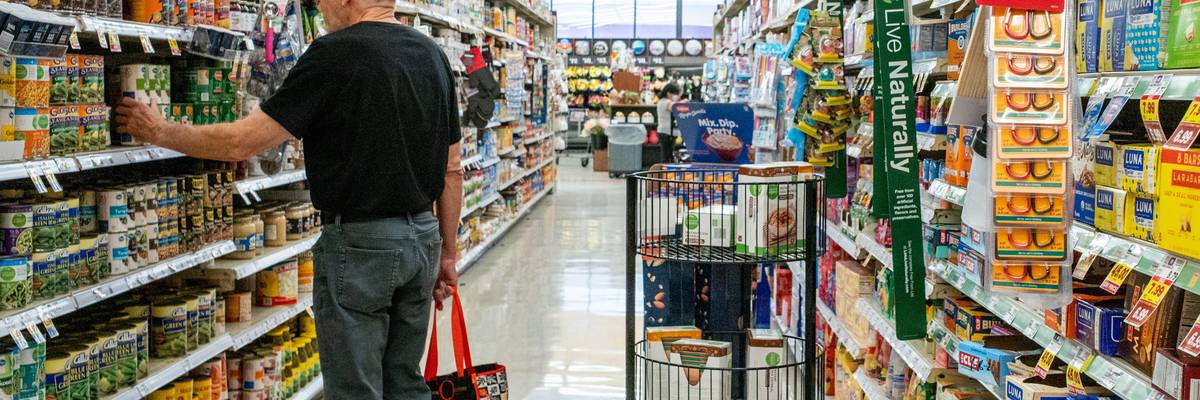
A customer shops in a Kroger grocery store on July 15, 2022 in Houston, Texas.
Major Study Shows US Consumers, Businesses Pay for Vast Majority of Trump's Tariffs
"Every dollar of tariff revenue represents a dollar extracted from American businesses and households."
President Donald Trump has long insisted, in the face of decades of research by economists, that foreign producers are the only ones who are paying for his tariffs on imported goods.
However, a major new study released Monday by the Kiel Institute for the World Economy, an economic think tank based in Germany, shows that US businesses and consumers are shouldering the burden for the vast majority of Trump's tariffs.
After examining more than 25 million shipment records of goods imported to the US last year, the institute found that foreign exporters only absorbed 4% of the $200 billion in tariff payments, with the remaining 96% being passed on to US importers and consumers.
"This finding has profound implications," the study explains. "If foreign exporters do not reduce their prices in response to tariffs, then the entire burden of the tariff falls on US buyers. The tariff functions not as a tax on foreign producers, but as a consumption tax on Americans. Every dollar of tariff revenue represents a dollar extracted from American businesses and households."
The study identifies several factors to explain why exporters did not slash their prices to remain competitive in the lucrative US market, including exporters shifting their sales to other markets where they will not face such high tariffs; firms not being able to shoulder the high price cut that would be needed to overcome the tariff rates set by the president; and companies not wanting to give Trump an incentive for further tariffs by rewarding US consumers with lower prices.
Julian Hinz, research director at the Kiel Institute and an author of the study, described the Trump tariffs as an "own goal" that has harmed Americans far more than it has harmed foreigners.
"The claim that foreign countries pay these tariffs is a myth," explained Hinz. "The data show the opposite: Americans are footing the bill."
The Kiel Institute study came out two days after Trump vowed to slap even more tariffs on European countries opposed to his efforts to take over Greenland.
In an analysis published Monday, economist Dean Baker of the Center for Economic and Policy Research (CEPR) said that the latest Trump tariffs on Europe amounted to a "$75 billion tax increase" in an attempt to fulfill the president's "demented dreams" of taking over the self-governing Danish territory.
"Well over 90% of the cost of a Trump tariff is borne by consumers or importers in the United States, not by the exporting countries," Baker contended. "When Trump starts yelling 'tariff, tariff, tariff,' he is yelling 'tax, tax, tax,' and we’re the ones paying it. And $75 billion is not trivial. It’s 1% of the budget, more than twice the cost of the enhanced premiums for Obamacare policies that Trump says we can’t afford."
We are at a crossroads
This country and this world are at a monumental crossroads. In a few short weeks, US voters will have an opportunity to beat back the forces of fascism and confront the billionaires who are rigging the economy, our media system, and our democracy, making it increasingly impossible for ordinary people to get by. We’re not just talking about the election. We’re talking about what must be done once these fascist elements are vanquished from power. We need a bolder set of solutions than what either major party has so far been willing to offer and a working-class movement ready to fight like hell for it. Trump didn't emerge from nowhere. The conditions that fueled MAGA authoritarianism were created by decades of radical neoliberal economic policies and a corrupt political system dominated by corporate interests. They slashed taxes on the super-rich, promising that the benefits would trickle down. They said giveaways to the corporate titans would make life more affordable for the rest of us. It was all bullshit. And when a bitter, betrayed populace searches for someone to blame, right-wing demagogues have little trouble finding scapegoats. People know when they're being lied to, but you won't hear any of this from the corporate media. Only independent journalism—powered and funded by people who believe in building a better world—can deliver truly trustworthy daily news. Our Fall Campaign is underway, and we need your help. To power our newsroom through the rest of the year, we need to raise $125,000 by midnight on October 31. So if you share our vision, please contribute whatever you can to sustain our work. |
President Donald Trump has long insisted, in the face of decades of research by economists, that foreign producers are the only ones who are paying for his tariffs on imported goods.
However, a major new study released Monday by the Kiel Institute for the World Economy, an economic think tank based in Germany, shows that US businesses and consumers are shouldering the burden for the vast majority of Trump's tariffs.
After examining more than 25 million shipment records of goods imported to the US last year, the institute found that foreign exporters only absorbed 4% of the $200 billion in tariff payments, with the remaining 96% being passed on to US importers and consumers.
"This finding has profound implications," the study explains. "If foreign exporters do not reduce their prices in response to tariffs, then the entire burden of the tariff falls on US buyers. The tariff functions not as a tax on foreign producers, but as a consumption tax on Americans. Every dollar of tariff revenue represents a dollar extracted from American businesses and households."
The study identifies several factors to explain why exporters did not slash their prices to remain competitive in the lucrative US market, including exporters shifting their sales to other markets where they will not face such high tariffs; firms not being able to shoulder the high price cut that would be needed to overcome the tariff rates set by the president; and companies not wanting to give Trump an incentive for further tariffs by rewarding US consumers with lower prices.
Julian Hinz, research director at the Kiel Institute and an author of the study, described the Trump tariffs as an "own goal" that has harmed Americans far more than it has harmed foreigners.
"The claim that foreign countries pay these tariffs is a myth," explained Hinz. "The data show the opposite: Americans are footing the bill."
The Kiel Institute study came out two days after Trump vowed to slap even more tariffs on European countries opposed to his efforts to take over Greenland.
In an analysis published Monday, economist Dean Baker of the Center for Economic and Policy Research (CEPR) said that the latest Trump tariffs on Europe amounted to a "$75 billion tax increase" in an attempt to fulfill the president's "demented dreams" of taking over the self-governing Danish territory.
"Well over 90% of the cost of a Trump tariff is borne by consumers or importers in the United States, not by the exporting countries," Baker contended. "When Trump starts yelling 'tariff, tariff, tariff,' he is yelling 'tax, tax, tax,' and we’re the ones paying it. And $75 billion is not trivial. It’s 1% of the budget, more than twice the cost of the enhanced premiums for Obamacare policies that Trump says we can’t afford."
- Trump GOP's Tax Plans Mean Pain for Families, Windfalls for the Wealthy ›
- Trump Follows Through With High Tariffs on Canada, Mexico, and China ›
- Grocery Chains Are Passing Trump Tariff Costs on to US Consumers With Higher Prices: Report ›
- After Supreme Court Kills Tariffs, Trump Plots '15% Tax Out of YOUR Pockets to Feed HIS Deranged Ego' | Common Dreams ›
- From Healthcare and Fuel Costs to Tariffs, Trump GOP's Policies 'Crushing' Small Businesses | Common Dreams ›
President Donald Trump has long insisted, in the face of decades of research by economists, that foreign producers are the only ones who are paying for his tariffs on imported goods.
However, a major new study released Monday by the Kiel Institute for the World Economy, an economic think tank based in Germany, shows that US businesses and consumers are shouldering the burden for the vast majority of Trump's tariffs.
After examining more than 25 million shipment records of goods imported to the US last year, the institute found that foreign exporters only absorbed 4% of the $200 billion in tariff payments, with the remaining 96% being passed on to US importers and consumers.
"This finding has profound implications," the study explains. "If foreign exporters do not reduce their prices in response to tariffs, then the entire burden of the tariff falls on US buyers. The tariff functions not as a tax on foreign producers, but as a consumption tax on Americans. Every dollar of tariff revenue represents a dollar extracted from American businesses and households."
The study identifies several factors to explain why exporters did not slash their prices to remain competitive in the lucrative US market, including exporters shifting their sales to other markets where they will not face such high tariffs; firms not being able to shoulder the high price cut that would be needed to overcome the tariff rates set by the president; and companies not wanting to give Trump an incentive for further tariffs by rewarding US consumers with lower prices.
Julian Hinz, research director at the Kiel Institute and an author of the study, described the Trump tariffs as an "own goal" that has harmed Americans far more than it has harmed foreigners.
"The claim that foreign countries pay these tariffs is a myth," explained Hinz. "The data show the opposite: Americans are footing the bill."
The Kiel Institute study came out two days after Trump vowed to slap even more tariffs on European countries opposed to his efforts to take over Greenland.
In an analysis published Monday, economist Dean Baker of the Center for Economic and Policy Research (CEPR) said that the latest Trump tariffs on Europe amounted to a "$75 billion tax increase" in an attempt to fulfill the president's "demented dreams" of taking over the self-governing Danish territory.
"Well over 90% of the cost of a Trump tariff is borne by consumers or importers in the United States, not by the exporting countries," Baker contended. "When Trump starts yelling 'tariff, tariff, tariff,' he is yelling 'tax, tax, tax,' and we’re the ones paying it. And $75 billion is not trivial. It’s 1% of the budget, more than twice the cost of the enhanced premiums for Obamacare policies that Trump says we can’t afford."
- Trump GOP's Tax Plans Mean Pain for Families, Windfalls for the Wealthy ›
- Trump Follows Through With High Tariffs on Canada, Mexico, and China ›
- Grocery Chains Are Passing Trump Tariff Costs on to US Consumers With Higher Prices: Report ›
- After Supreme Court Kills Tariffs, Trump Plots '15% Tax Out of YOUR Pockets to Feed HIS Deranged Ego' | Common Dreams ›
- From Healthcare and Fuel Costs to Tariffs, Trump GOP's Policies 'Crushing' Small Businesses | Common Dreams ›