SUBSCRIBE TO OUR FREE NEWSLETTER
Daily news & progressive opinion—funded by the people, not the corporations—delivered straight to your inbox.
5
#000000
#FFFFFF
To donate by check, phone, or other method, see our More Ways to Give page.
Daily news & progressive opinion—funded by the people, not the corporations—delivered straight to your inbox.
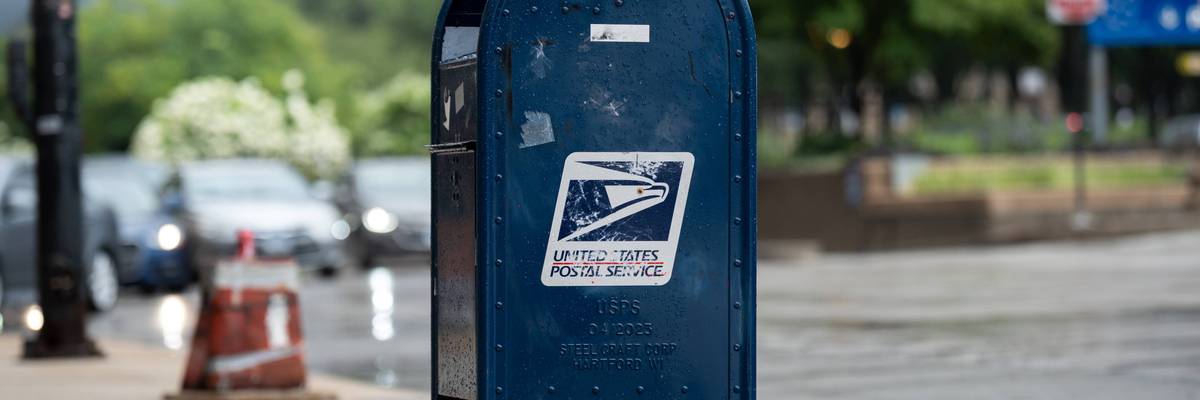
A United States Postal Service mail collection box is seen on a street in Chicago, Illinois, United States, on July 27, 2026.
Postmaster General David Steiner has said that USPS would not deliver ballots in states that don’t hand over their voter rolls to the Trump administration for purging under a since-blocked executive order.
A Democratic congressman is calling for Postmaster General David Steiner to be removed from office for allowing the US Postal Service to turn into what he called "a partisan instrument of voter suppression" for President Donald Trump.
Rep. Raja Krishnamoorthi (Ill.), a senior Democrat on the House Oversight Committee, sent a letter to Steiner and members of the USPS board of governors on Monday criticizing the postmaster general for refusing to clarify if he intends to follow an executive order signed by Trump in March ordering the Postal Service to halt the delivery of mail-in ballots in states that do not turn over lists of voters to be checked against a federal citizenship list.
A federal judge has blocked the administration from implementing the order's provisions that create federal citizenship lists and allow USPS to condition ballot delivery on states submitting voter information, ruling that Trump had usurped powers belonging to the states and Congress.
Last week, the administration and a group of 12 Republican states filed emergency applications asking the US Supreme Court to allow the order to take effect prior to November’s midterms.
Krishnamoorthi said that this filing contains "a troubling contradiction." It argues that Trump had merely issued “general policy guidance” to agencies rather than concrete directives, and that it's therefore premature for courts to rule on its constitutionality.
"USPS's apparent implementation efforts over the past four months tell a different story," Krishnamoorthi wrote.
He pointed out that USPS had sent the rule to the White House Office of Management and Budget for review and had begun to create a federal ballot portal, state voter participation lists, and procedures on accepting ballots.
Steiner, meanwhile, said during a hearing in June—while the order was facing litigation but had not yet been struck down—that he fully intended to block mail-in ballots from states that don't hand over their voter rolls.
Krishnamoorthi also wrote that the administration's argument before the Supreme Court that blocking the order would cause "irreparable harm" does not withstand factual scrutiny.
He noted that noncitizen voting, which the administration claims the order is meant to prevent, is not only already a federal crime, but exceedingly rare. One analysis by the Brookings Institution last year found that in general elections between 2016-22, there were approximately four instances of mail-in voting fraud per 10 million mail ballots cast—about 0.000043% of them.
"The administration has not produced evidence of fraud on a scale capable of affecting an election outcome," Krishnamoorthi wrote. "Disenfranchising millions of eligible voters—including military personnel serving overseas, seniors, rural voters, individuals with disabilities, and working families—is not a proportionate response to fraud rates of this magnitude."
He also wrote that Steiner had repeatedly refused his requests for information about how USPS has implemented the executive order and whether it is still doing so despite the court's order to stop.
"A postmaster general who will not tell Congress whether his agency is complying with a federal court order, and who will not appear to answer for that silence, has already forfeited the trust the office requires," wrote Krishnamoorthi. "I am therefore calling on the Postal Service Board of Governors to remove you as Postmaster General, and I will urge my colleagues on the committee to join that call."
There is already evidence that a voter citizenship registry run by the Trump administration could disenfranchise lawful voters.
In June, a federal judge found that states using an expanded version of the federal government's Systematic Alien Verification for Entitlements, which is used by the federal government to track immigration status, led local voting officials to wrongly cancel the voter registrations of naturalized citizens.
In Travis County, Texas, an investigation found that 25% of the people flagged as "noncitizen matches" had already proven their US citizenship.
Jasleen Singh, a senior counsel and manager in the Brennan Center’s Democracy Program, wrote in June that the administration "has been engaged in a concerted campaign to undermine elections."
"Part of that involves collecting state voter files and using federal data sources to lend pseudolegitimacy to false claims of widespread fraud," she said. "While there may be valid ways to use federal data to support election officials’ efforts to keep voter rolls accurate and up to date, there are notable shortcomings in such data, and it may be misused to spread misinformation."
Dear Common Dreams reader, It’s been nearly 30 years since I co-founded Common Dreams with my late wife, Lina Newhouser. We had the radical notion that journalism should serve the public good, not corporate profits. It was clear to us from the outset what it would take to build such a project. No paid advertisements. No corporate sponsors. No millionaire publisher telling us what to think or do. Many people said we wouldn't last a year, but we proved those doubters wrong. Together with a tremendous team of journalists and dedicated staff, we built an independent media outlet free from the constraints of profits and corporate control. Our mission has always been simple: To inform. To inspire. To ignite change for the common good. Building Common Dreams was not easy. Our survival was never guaranteed. When you take on the most powerful forces—Wall Street greed, fossil fuel industry destruction, Big Tech lobbyists, and uber-rich oligarchs who have spent billions upon billions rigging the economy and democracy in their favor—the only bulwark you have is supporters who believe in your work. But here’s the urgent message from me today. It's never been this bad out there. And it's never been this hard to keep us going. At the very moment Common Dreams is most needed, the threats we face are intensifying. We need your support now more than ever. We don't accept corporate advertising and never will. We don't have a paywall because we don't think people should be blocked from critical news based on their ability to pay. Everything we do is funded by the donations of readers like you. When everyone does the little they can afford, we are strong. But if that support retreats or dries up, so do we. Will you donate now to make sure Common Dreams not only survives but thrives? —Craig Brown, Co-founder |
A Democratic congressman is calling for Postmaster General David Steiner to be removed from office for allowing the US Postal Service to turn into what he called "a partisan instrument of voter suppression" for President Donald Trump.
Rep. Raja Krishnamoorthi (Ill.), a senior Democrat on the House Oversight Committee, sent a letter to Steiner and members of the USPS board of governors on Monday criticizing the postmaster general for refusing to clarify if he intends to follow an executive order signed by Trump in March ordering the Postal Service to halt the delivery of mail-in ballots in states that do not turn over lists of voters to be checked against a federal citizenship list.
A federal judge has blocked the administration from implementing the order's provisions that create federal citizenship lists and allow USPS to condition ballot delivery on states submitting voter information, ruling that Trump had usurped powers belonging to the states and Congress.
Last week, the administration and a group of 12 Republican states filed emergency applications asking the US Supreme Court to allow the order to take effect prior to November’s midterms.
Krishnamoorthi said that this filing contains "a troubling contradiction." It argues that Trump had merely issued “general policy guidance” to agencies rather than concrete directives, and that it's therefore premature for courts to rule on its constitutionality.
"USPS's apparent implementation efforts over the past four months tell a different story," Krishnamoorthi wrote.
He pointed out that USPS had sent the rule to the White House Office of Management and Budget for review and had begun to create a federal ballot portal, state voter participation lists, and procedures on accepting ballots.
Steiner, meanwhile, said during a hearing in June—while the order was facing litigation but had not yet been struck down—that he fully intended to block mail-in ballots from states that don't hand over their voter rolls.
Krishnamoorthi also wrote that the administration's argument before the Supreme Court that blocking the order would cause "irreparable harm" does not withstand factual scrutiny.
He noted that noncitizen voting, which the administration claims the order is meant to prevent, is not only already a federal crime, but exceedingly rare. One analysis by the Brookings Institution last year found that in general elections between 2016-22, there were approximately four instances of mail-in voting fraud per 10 million mail ballots cast—about 0.000043% of them.
"The administration has not produced evidence of fraud on a scale capable of affecting an election outcome," Krishnamoorthi wrote. "Disenfranchising millions of eligible voters—including military personnel serving overseas, seniors, rural voters, individuals with disabilities, and working families—is not a proportionate response to fraud rates of this magnitude."
He also wrote that Steiner had repeatedly refused his requests for information about how USPS has implemented the executive order and whether it is still doing so despite the court's order to stop.
"A postmaster general who will not tell Congress whether his agency is complying with a federal court order, and who will not appear to answer for that silence, has already forfeited the trust the office requires," wrote Krishnamoorthi. "I am therefore calling on the Postal Service Board of Governors to remove you as Postmaster General, and I will urge my colleagues on the committee to join that call."
There is already evidence that a voter citizenship registry run by the Trump administration could disenfranchise lawful voters.
In June, a federal judge found that states using an expanded version of the federal government's Systematic Alien Verification for Entitlements, which is used by the federal government to track immigration status, led local voting officials to wrongly cancel the voter registrations of naturalized citizens.
In Travis County, Texas, an investigation found that 25% of the people flagged as "noncitizen matches" had already proven their US citizenship.
Jasleen Singh, a senior counsel and manager in the Brennan Center’s Democracy Program, wrote in June that the administration "has been engaged in a concerted campaign to undermine elections."
"Part of that involves collecting state voter files and using federal data sources to lend pseudolegitimacy to false claims of widespread fraud," she said. "While there may be valid ways to use federal data to support election officials’ efforts to keep voter rolls accurate and up to date, there are notable shortcomings in such data, and it may be misused to spread misinformation."
A Democratic congressman is calling for Postmaster General David Steiner to be removed from office for allowing the US Postal Service to turn into what he called "a partisan instrument of voter suppression" for President Donald Trump.
Rep. Raja Krishnamoorthi (Ill.), a senior Democrat on the House Oversight Committee, sent a letter to Steiner and members of the USPS board of governors on Monday criticizing the postmaster general for refusing to clarify if he intends to follow an executive order signed by Trump in March ordering the Postal Service to halt the delivery of mail-in ballots in states that do not turn over lists of voters to be checked against a federal citizenship list.
A federal judge has blocked the administration from implementing the order's provisions that create federal citizenship lists and allow USPS to condition ballot delivery on states submitting voter information, ruling that Trump had usurped powers belonging to the states and Congress.
Last week, the administration and a group of 12 Republican states filed emergency applications asking the US Supreme Court to allow the order to take effect prior to November’s midterms.
Krishnamoorthi said that this filing contains "a troubling contradiction." It argues that Trump had merely issued “general policy guidance” to agencies rather than concrete directives, and that it's therefore premature for courts to rule on its constitutionality.
"USPS's apparent implementation efforts over the past four months tell a different story," Krishnamoorthi wrote.
He pointed out that USPS had sent the rule to the White House Office of Management and Budget for review and had begun to create a federal ballot portal, state voter participation lists, and procedures on accepting ballots.
Steiner, meanwhile, said during a hearing in June—while the order was facing litigation but had not yet been struck down—that he fully intended to block mail-in ballots from states that don't hand over their voter rolls.
Krishnamoorthi also wrote that the administration's argument before the Supreme Court that blocking the order would cause "irreparable harm" does not withstand factual scrutiny.
He noted that noncitizen voting, which the administration claims the order is meant to prevent, is not only already a federal crime, but exceedingly rare. One analysis by the Brookings Institution last year found that in general elections between 2016-22, there were approximately four instances of mail-in voting fraud per 10 million mail ballots cast—about 0.000043% of them.
"The administration has not produced evidence of fraud on a scale capable of affecting an election outcome," Krishnamoorthi wrote. "Disenfranchising millions of eligible voters—including military personnel serving overseas, seniors, rural voters, individuals with disabilities, and working families—is not a proportionate response to fraud rates of this magnitude."
He also wrote that Steiner had repeatedly refused his requests for information about how USPS has implemented the executive order and whether it is still doing so despite the court's order to stop.
"A postmaster general who will not tell Congress whether his agency is complying with a federal court order, and who will not appear to answer for that silence, has already forfeited the trust the office requires," wrote Krishnamoorthi. "I am therefore calling on the Postal Service Board of Governors to remove you as Postmaster General, and I will urge my colleagues on the committee to join that call."
There is already evidence that a voter citizenship registry run by the Trump administration could disenfranchise lawful voters.
In June, a federal judge found that states using an expanded version of the federal government's Systematic Alien Verification for Entitlements, which is used by the federal government to track immigration status, led local voting officials to wrongly cancel the voter registrations of naturalized citizens.
In Travis County, Texas, an investigation found that 25% of the people flagged as "noncitizen matches" had already proven their US citizenship.
Jasleen Singh, a senior counsel and manager in the Brennan Center’s Democracy Program, wrote in June that the administration "has been engaged in a concerted campaign to undermine elections."
"Part of that involves collecting state voter files and using federal data sources to lend pseudolegitimacy to false claims of widespread fraud," she said. "While there may be valid ways to use federal data to support election officials’ efforts to keep voter rolls accurate and up to date, there are notable shortcomings in such data, and it may be misused to spread misinformation."