SUBSCRIBE TO OUR FREE NEWSLETTER
Daily news & progressive opinion—funded by the people, not the corporations—delivered straight to your inbox.
5
#000000
#FFFFFF
To donate by check, phone, or other method, see our More Ways to Give page.
Daily news & progressive opinion—funded by the people, not the corporations—delivered straight to your inbox.
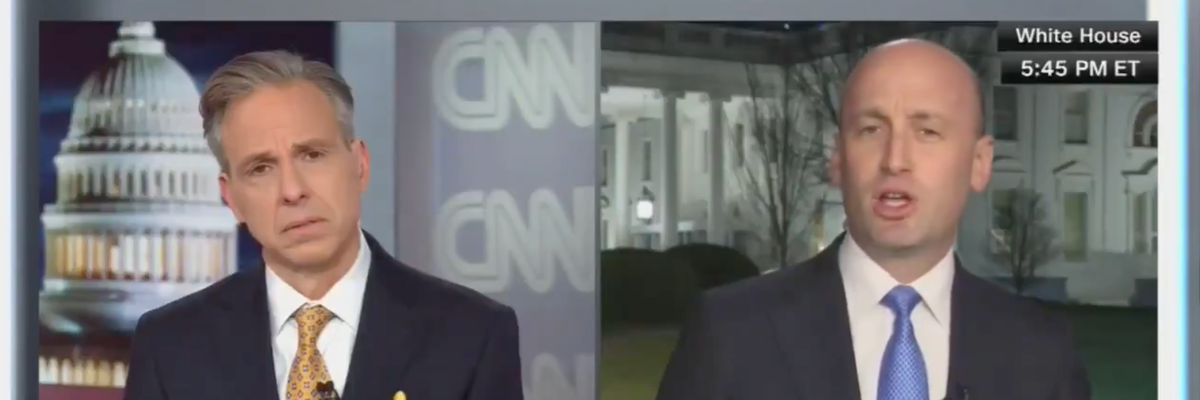
CNN anchor Jake Tapper listens as White House Deputy Chief of Staff Stephen Miller says the US has the right to take over Greenland in an interview on January 5, 2026.
The White House adviser offered "a very good definition of imperialism," said Sen. Bernie Sanders.
"Belligerent" was how one Democratic lawmaker described a diatribe given by top White House adviser Stephen Miller on CNN Monday evening regarding the Trump administration's right to take over Venezuela—or any other country—if doing so is in the supposed interest of the US.
To Sen. Bernie Sanders (I-Vt.), however, Miller was simply providing viewers with "a very good definition of imperialism" as he described the worldview the administration is operating under as it takes control of Venezuela and eyes other countries, including Greenland, that it believes it can and should invade.
"This is what imperialism is all about," Sanders told CNN's Jake Tapper. "And I suspect that people all over the world are saying, ‘Wow, we’re going back to where we were 100 years ago, or 50 years ago, where the big, powerful countries were exploiting poorer countries for their natural resources.'"
The senator spoke to Tapper shortly after Miller's interview, in which the news anchor asked whether President Donald Trump would support holding an election in Venezuela days after the US military bombed the country and abducted President Nicolás Maduro and his wife.
Miller refused to directly engage with the question, saying only that it would be "absurd and preposterous" for the US to install Venezuelan opposition leader María Corina Machado as the leader of the country, before asking Tapper to "give [him] the floor" and allow him to explain the White House's view on foreign policy.
"The United States is using its military to secure our interests unapologetically in our hemisphere," said Miller. "We're a superpower and under President Trump we are going to conduct ourselves as a superpower. It is absurd that we would allow a nation in our backyard to become the supplier of resources to our adversaries but not to us."
Instead of "demanding that elections be held" in Venezuela, he added, "the future of the free world depends on America to be able to assert ourselves and our interests without an apology."
MILLER: The US is using its military to secure our interests unapologetically in our hemisphere. We're a superpower and under President Trump we are going to conduct ourselves as a superpower. It's absurd that we would allow a nation in our backyard to become the supplier of… pic.twitter.com/wXK2UxnqUj
— Aaron Rupar (@atrupar) January 5, 2026
The Trump administration has repeatedly claimed that Venezuela "stole" oil from the United States. The country is believed to have the largest oil reserves in the world, and the government nationalized its petroleum industry in 1976, including projects that had been run by US-based ExxonMobil. The last privately run oil operations were nationalized in 2007 by then-President Hugo Chavez.
Miller offered one of the most explicit explanations of the White House's view yet: that "sovereign countries don’t get sovereignty if the US wants their resources," as Rep. Seth Moulton (D-Mass.) translated in a social media post.
Moulton called Miller's tirade "genuinely unhinged" and "a disturbing window into how this administration thinks about the world."
Miller's remarks followed a similarly blunt statement at a UN Security Council emergency meeting by US Ambassador Michael Waltz.
"You cannot continue to have the largest energy reserves in the world under the control of adversaries of the United States," said Waltz.
Miller's description of the White House's current view on foreign policy followed threats from Trump against countries including Colombia, Mexico, and Greenland, and further comments suggested that the administration could soon move to take control of the latter country—even though it is part of the kingdom of Denmark, which along with the US is a founding member of the North Atlantic Treaty Organization (NATO).
"Greenland should be part of the United States," said Miller. "The president has been very clear about that, that is the formal position of the US government."
Miller: “Greenland has a population of 30,000 people. By what right does Denmark assert control over Greenland? The United States is the power of NATO. Greenland should be part of the United States.”
“Nobody is going to fight the US militarily over the future of Greenland.” pic.twitter.com/d7i2kMXFMD
— Dori Toribio (@DoriToribio) January 5, 2026
He dismissed the idea that the takeover of Greenland, home to about 56,000 people, would involve a military operation—though Trump has said he would not rule out using force—and said that "nobody's going to fight the United States militarily over the future of Greenland."
The vast island is strategically located in the Arctic Circle and has largely untapped reserves of rare-earth minerals.
Danish and Greenlandic officials have condemned Trump's latest threats this week, with Denmark's prime minister, Mette Frederiksen, warning that, in accordance with the NATO treaty, "everything would come to an end" if the US attacks another NATO country.
“The international community as we know it, democratic rules of the game, NATO, the world’s strongest defensive alliance—all of that would collapse if one NATO country chose to attack another," she told Danish news channel Live News on Monday.
The Danish government called an emergency meeting of its Foreign Affairs Committee on Tuesday to discuss "the kingdom's relationship with the United States."
On CNN, Sanders noted that as Trump sets his sights on controlling oil reserves in Venezuela and resources in Greenland, people across the president's own country are struggling under rising costs and financial insecurity.
"Maybe instead of trying to run Venezuela," said Sanders, "the president might try to do a better job running the United States of America."
Dear Common Dreams reader, It’s been nearly 30 years since I co-founded Common Dreams with my late wife, Lina Newhouser. We had the radical notion that journalism should serve the public good, not corporate profits. It was clear to us from the outset what it would take to build such a project. No paid advertisements. No corporate sponsors. No millionaire publisher telling us what to think or do. Many people said we wouldn't last a year, but we proved those doubters wrong. Together with a tremendous team of journalists and dedicated staff, we built an independent media outlet free from the constraints of profits and corporate control. Our mission has always been simple: To inform. To inspire. To ignite change for the common good. Building Common Dreams was not easy. Our survival was never guaranteed. When you take on the most powerful forces—Wall Street greed, fossil fuel industry destruction, Big Tech lobbyists, and uber-rich oligarchs who have spent billions upon billions rigging the economy and democracy in their favor—the only bulwark you have is supporters who believe in your work. But here’s the urgent message from me today. It's never been this bad out there. And it's never been this hard to keep us going. At the very moment Common Dreams is most needed, the threats we face are intensifying. We need your support now more than ever. We don't accept corporate advertising and never will. We don't have a paywall because we don't think people should be blocked from critical news based on their ability to pay. Everything we do is funded by the donations of readers like you. When everyone does the little they can afford, we are strong. But if that support retreats or dries up, so do we. Will you donate now to make sure Common Dreams not only survives but thrives? —Craig Brown, Co-founder |
"Belligerent" was how one Democratic lawmaker described a diatribe given by top White House adviser Stephen Miller on CNN Monday evening regarding the Trump administration's right to take over Venezuela—or any other country—if doing so is in the supposed interest of the US.
To Sen. Bernie Sanders (I-Vt.), however, Miller was simply providing viewers with "a very good definition of imperialism" as he described the worldview the administration is operating under as it takes control of Venezuela and eyes other countries, including Greenland, that it believes it can and should invade.
"This is what imperialism is all about," Sanders told CNN's Jake Tapper. "And I suspect that people all over the world are saying, ‘Wow, we’re going back to where we were 100 years ago, or 50 years ago, where the big, powerful countries were exploiting poorer countries for their natural resources.'"
The senator spoke to Tapper shortly after Miller's interview, in which the news anchor asked whether President Donald Trump would support holding an election in Venezuela days after the US military bombed the country and abducted President Nicolás Maduro and his wife.
Miller refused to directly engage with the question, saying only that it would be "absurd and preposterous" for the US to install Venezuelan opposition leader María Corina Machado as the leader of the country, before asking Tapper to "give [him] the floor" and allow him to explain the White House's view on foreign policy.
"The United States is using its military to secure our interests unapologetically in our hemisphere," said Miller. "We're a superpower and under President Trump we are going to conduct ourselves as a superpower. It is absurd that we would allow a nation in our backyard to become the supplier of resources to our adversaries but not to us."
Instead of "demanding that elections be held" in Venezuela, he added, "the future of the free world depends on America to be able to assert ourselves and our interests without an apology."
MILLER: The US is using its military to secure our interests unapologetically in our hemisphere. We're a superpower and under President Trump we are going to conduct ourselves as a superpower. It's absurd that we would allow a nation in our backyard to become the supplier of… pic.twitter.com/wXK2UxnqUj
— Aaron Rupar (@atrupar) January 5, 2026
The Trump administration has repeatedly claimed that Venezuela "stole" oil from the United States. The country is believed to have the largest oil reserves in the world, and the government nationalized its petroleum industry in 1976, including projects that had been run by US-based ExxonMobil. The last privately run oil operations were nationalized in 2007 by then-President Hugo Chavez.
Miller offered one of the most explicit explanations of the White House's view yet: that "sovereign countries don’t get sovereignty if the US wants their resources," as Rep. Seth Moulton (D-Mass.) translated in a social media post.
Moulton called Miller's tirade "genuinely unhinged" and "a disturbing window into how this administration thinks about the world."
Miller's remarks followed a similarly blunt statement at a UN Security Council emergency meeting by US Ambassador Michael Waltz.
"You cannot continue to have the largest energy reserves in the world under the control of adversaries of the United States," said Waltz.
Miller's description of the White House's current view on foreign policy followed threats from Trump against countries including Colombia, Mexico, and Greenland, and further comments suggested that the administration could soon move to take control of the latter country—even though it is part of the kingdom of Denmark, which along with the US is a founding member of the North Atlantic Treaty Organization (NATO).
"Greenland should be part of the United States," said Miller. "The president has been very clear about that, that is the formal position of the US government."
Miller: “Greenland has a population of 30,000 people. By what right does Denmark assert control over Greenland? The United States is the power of NATO. Greenland should be part of the United States.”
“Nobody is going to fight the US militarily over the future of Greenland.” pic.twitter.com/d7i2kMXFMD
— Dori Toribio (@DoriToribio) January 5, 2026
He dismissed the idea that the takeover of Greenland, home to about 56,000 people, would involve a military operation—though Trump has said he would not rule out using force—and said that "nobody's going to fight the United States militarily over the future of Greenland."
The vast island is strategically located in the Arctic Circle and has largely untapped reserves of rare-earth minerals.
Danish and Greenlandic officials have condemned Trump's latest threats this week, with Denmark's prime minister, Mette Frederiksen, warning that, in accordance with the NATO treaty, "everything would come to an end" if the US attacks another NATO country.
“The international community as we know it, democratic rules of the game, NATO, the world’s strongest defensive alliance—all of that would collapse if one NATO country chose to attack another," she told Danish news channel Live News on Monday.
The Danish government called an emergency meeting of its Foreign Affairs Committee on Tuesday to discuss "the kingdom's relationship with the United States."
On CNN, Sanders noted that as Trump sets his sights on controlling oil reserves in Venezuela and resources in Greenland, people across the president's own country are struggling under rising costs and financial insecurity.
"Maybe instead of trying to run Venezuela," said Sanders, "the president might try to do a better job running the United States of America."
"Belligerent" was how one Democratic lawmaker described a diatribe given by top White House adviser Stephen Miller on CNN Monday evening regarding the Trump administration's right to take over Venezuela—or any other country—if doing so is in the supposed interest of the US.
To Sen. Bernie Sanders (I-Vt.), however, Miller was simply providing viewers with "a very good definition of imperialism" as he described the worldview the administration is operating under as it takes control of Venezuela and eyes other countries, including Greenland, that it believes it can and should invade.
"This is what imperialism is all about," Sanders told CNN's Jake Tapper. "And I suspect that people all over the world are saying, ‘Wow, we’re going back to where we were 100 years ago, or 50 years ago, where the big, powerful countries were exploiting poorer countries for their natural resources.'"
The senator spoke to Tapper shortly after Miller's interview, in which the news anchor asked whether President Donald Trump would support holding an election in Venezuela days after the US military bombed the country and abducted President Nicolás Maduro and his wife.
Miller refused to directly engage with the question, saying only that it would be "absurd and preposterous" for the US to install Venezuelan opposition leader María Corina Machado as the leader of the country, before asking Tapper to "give [him] the floor" and allow him to explain the White House's view on foreign policy.
"The United States is using its military to secure our interests unapologetically in our hemisphere," said Miller. "We're a superpower and under President Trump we are going to conduct ourselves as a superpower. It is absurd that we would allow a nation in our backyard to become the supplier of resources to our adversaries but not to us."
Instead of "demanding that elections be held" in Venezuela, he added, "the future of the free world depends on America to be able to assert ourselves and our interests without an apology."
MILLER: The US is using its military to secure our interests unapologetically in our hemisphere. We're a superpower and under President Trump we are going to conduct ourselves as a superpower. It's absurd that we would allow a nation in our backyard to become the supplier of… pic.twitter.com/wXK2UxnqUj
— Aaron Rupar (@atrupar) January 5, 2026
The Trump administration has repeatedly claimed that Venezuela "stole" oil from the United States. The country is believed to have the largest oil reserves in the world, and the government nationalized its petroleum industry in 1976, including projects that had been run by US-based ExxonMobil. The last privately run oil operations were nationalized in 2007 by then-President Hugo Chavez.
Miller offered one of the most explicit explanations of the White House's view yet: that "sovereign countries don’t get sovereignty if the US wants their resources," as Rep. Seth Moulton (D-Mass.) translated in a social media post.
Moulton called Miller's tirade "genuinely unhinged" and "a disturbing window into how this administration thinks about the world."
Miller's remarks followed a similarly blunt statement at a UN Security Council emergency meeting by US Ambassador Michael Waltz.
"You cannot continue to have the largest energy reserves in the world under the control of adversaries of the United States," said Waltz.
Miller's description of the White House's current view on foreign policy followed threats from Trump against countries including Colombia, Mexico, and Greenland, and further comments suggested that the administration could soon move to take control of the latter country—even though it is part of the kingdom of Denmark, which along with the US is a founding member of the North Atlantic Treaty Organization (NATO).
"Greenland should be part of the United States," said Miller. "The president has been very clear about that, that is the formal position of the US government."
Miller: “Greenland has a population of 30,000 people. By what right does Denmark assert control over Greenland? The United States is the power of NATO. Greenland should be part of the United States.”
“Nobody is going to fight the US militarily over the future of Greenland.” pic.twitter.com/d7i2kMXFMD
— Dori Toribio (@DoriToribio) January 5, 2026
He dismissed the idea that the takeover of Greenland, home to about 56,000 people, would involve a military operation—though Trump has said he would not rule out using force—and said that "nobody's going to fight the United States militarily over the future of Greenland."
The vast island is strategically located in the Arctic Circle and has largely untapped reserves of rare-earth minerals.
Danish and Greenlandic officials have condemned Trump's latest threats this week, with Denmark's prime minister, Mette Frederiksen, warning that, in accordance with the NATO treaty, "everything would come to an end" if the US attacks another NATO country.
“The international community as we know it, democratic rules of the game, NATO, the world’s strongest defensive alliance—all of that would collapse if one NATO country chose to attack another," she told Danish news channel Live News on Monday.
The Danish government called an emergency meeting of its Foreign Affairs Committee on Tuesday to discuss "the kingdom's relationship with the United States."
On CNN, Sanders noted that as Trump sets his sights on controlling oil reserves in Venezuela and resources in Greenland, people across the president's own country are struggling under rising costs and financial insecurity.
"Maybe instead of trying to run Venezuela," said Sanders, "the president might try to do a better job running the United States of America."