Nonviolence Is The Right Choice—It Works
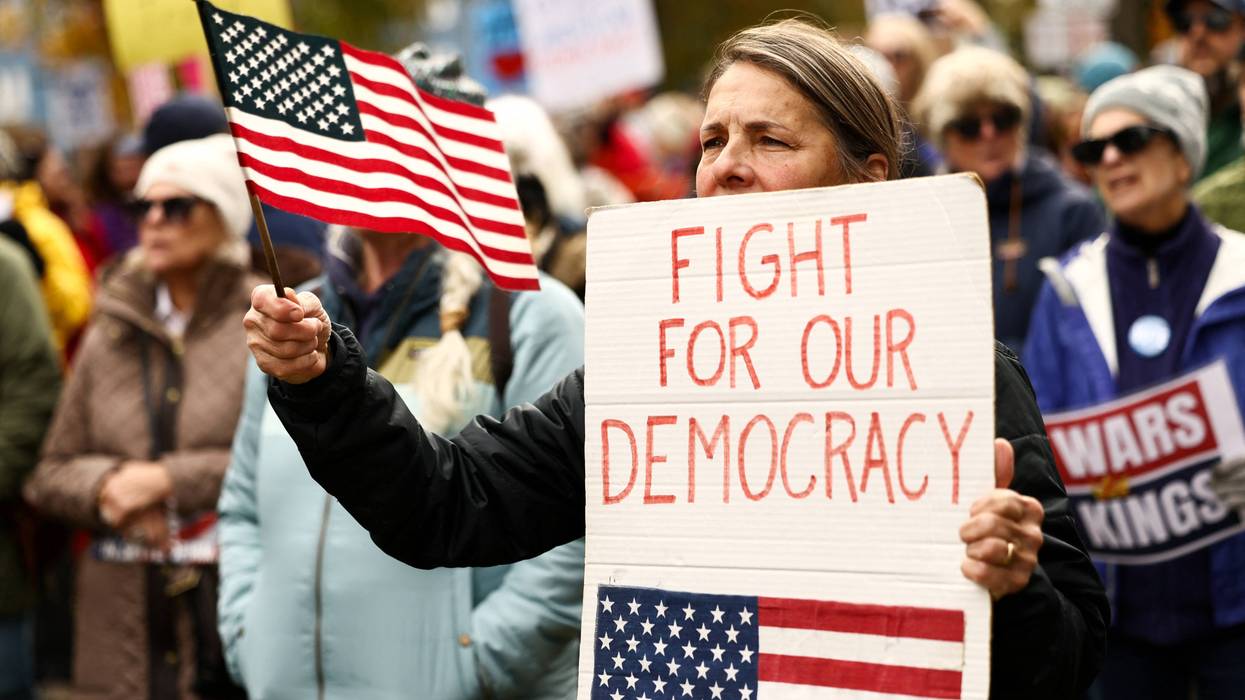
Nonviolent resistance is not only the morally superior choice. It is also twice as effective as the violent variety.
That's the startling and reassuring discovery by Maria Stephan and Erica Chenoweth, who analyzed an astonishing 323 resistance campaigns from 1900 to 2006.
"Our findings show that major nonviolent campaigns have achieved success 53 percent of the time, compared with 26 percent for violent resistance campaigns," the authors note in the journal International Security. (The study is available as a PDF file at http://www.nonviolent-conflict.org)
The result is not that surprising, once you listen to the researchers' reasoning.
"First, a campaign's commitment to nonviolent methods enhances its domestic and international legitimacy and encourages more broad-based participation in the resistance, which translates into increased pressure being brought to bear on the target," they state. "Second, whereas governments easily justify violent counterattacks against armed insurgents, regime violence against nonviolent movements is more likely to backfire against the regime."
In an interesting aside that has relevance for our times, the authors also write that, "Our study does not explicitly compare terrorism to nonviolent resistance, but our argument sheds light on why terrorism has been so unsuccessful."
To their credit, the authors don't gloss over nonviolent campaigns that haven't been successes. They give a clear-eyed assessment of the failure so far of the nonviolent movement in Burma, one of the three detailed case studies in the piece, along with East Timor and the Philippines.
In some sense, the authors have subjected to statistical analysis the notions of Gene Sharp, an influential Boston-based proponent of nonviolent change, someone they cite frequently in the footnotes. In his work, Sharp stresses the practical utility of nonviolence, de-emphasizing the moral aspects of it. He even asserts that for Gandhi, nonviolence was more of a pragmatic tool than a matter of principle, painting a picture that's at variance with much of Gandhian scholarship. In an interview with me in 2006, Sharp declared that he derives his precepts from Gandhi himself.
Gandhi's use of nonviolence "was pure pragmatism," Sharp told me. "At the end of his life, he defends himself. He was accused of holding on to nonviolent means because of his religious belief. He says no. He says, I presented this as a political means of action, and that's what I'm saying today. And it's a misrepresentation to say that I presented this as a purely religious approach. He was very upset about that."
One of the authors of the study, Maria Stephan, is at the International Center on Nonviolent Conflict. The group's founders wrote a related book a few years ago, "A Force More Powerful: A Century of Nonviolent Conflict." Erica Chenoweth is at the John F. Kennedy School of Government at Harvard.
This study is manna for those of us who believe in nonviolent resistance as a method of social change. We don't have to justify it on moral grounds any more. The reason is even simpler now: Nonviolence is much more successful.
Twitter
StumbleUpon
Facebook
Delicious
Digg
Newsvine
Google
Yahoo
Technorati
34 Comments so far
Show AllBarry Clemson
Many of the comments state that nonviolence can't work when the opponent has no conscience or when the opponent has most of the guns. The historical record shows clearly that these are precisely the conditions under which VIOLENT resistance is most likely to fail and the conditions under which nonviolent resistance is likely to succeed.
Violent resistance always justifies the governments use of force against the resistance. The cost to a government of using violence against a nonviolent resistance is very high. These costs include defections by the army/police forces, international condemnation and sanctions, and in many cases massive increases in support for the resistance among the civilian population. This, of course, does not guarantee success as for instance in Burma recently. But the odds of success against a brutal regime are much greater with nonviolence than with violence.
I realize this goes counter to much of our common sense, but nonviolence generally works better than violence against regimes with no conscience.
It is unfortunate that the actual incidents of successful nonviolence are so little known. For instance, there were at least four different nonviolent actions against the Nazis during WW II that succeeded. All of them involved trying to save Jews from the concentration camps and these four examples are the only cases where substantial fractions of a country's Jews were saved. All the instances where violence were used to try to save the Jews were less successful than the nonviolent actions.
Chile's Pinochet was a butcher who killed tens of thousands of his countrymen. He was overthrown and forced out of power by a nonviolent campaign. There are many other examples of nonviolence contending with brutal opponents. Strategic nonviolence is a proven way to enlarge freedom and justice when the opponent is totally evil. If anyone is interested I can provide numerous references to the theory of strategic nonviolence and to many successful examples.
A true apostle of nonviolence, His Holiness the Dalai Lama:
http://query.nytimes.com/gst/fullpage.html?res=9C0CEFD61538F931A35753C1A96E958260
Trotsky on the difference between violence per se, and individual terrorism:
http://www.marxists.de/theory/whatis/terror2.htm
Ernesto Guevara on the need for revolutionary violence, from the perspective a doctor (or anyone in a "helping profession", really):
http://www.marxists.org/archive/guevara/1960/08/19.htm
What most middle class American "nonviolent"/pacifist liberals really do, whether they mean to or not, is condemn the violence of the oppressed while by and large ignoring or vastly downplaying the violence of today's oppressors, which is world-historic in scale. Consider the Vietnam war: wholesale slaughter like that had *never* been seen by the world before, if we are speaking just in terms of pure numbers. Now we are about to elect a leader from the same party as the man who started it and as the man who carried it to its zenith.
The idea that people with families and jobs ever spontaneously break into social violence, when nonviolence would have had even a remote chance of working, has to be the most idiotic and possibly racist thing I've ever heard in my life.
Nonviolence only seems attractive to those of us in industrialized countries because the ruling classes here are so firmly entrenched, and any hope of directly retrenching them seems so remote. But whenever and wherever oppressive power can be completely overthrown, it should be. Small reforms won from the gracious ruling class by our nonviolent protests are not what anyone should consider progress.
"Power concedes nothing without demand. It never has and never will."--Frederick Douglass
The abolitionist John Brown grew tired of all the "talk" of ending slavery so instead he used armed-resistance to try and end it. Frederick Douglass referred to him as "the man who started the war that ended slavery." Will those who oppose violence as an alternative say that Brown and Douglass were wrong?
What a breath of fresh air!!
Violence can never succeed as long as people steadfastly refuse to participate in it. Power cannot be taken from the people, it can only be given away. Verdad?
Don't try to explain the liberal view that we must appeal to pragmatism rather than moralism. There exists no rational explanation, because moralism IS pragmatic. Non-violence is pragmatic because non-violence is moral. Violence is not pragmatic because violence is not moral. Moralism stands despite liberal efforts to squash it. Why can't US liberals accept the Principle of Universality? Maybe something to do with the gravy train? Vote third party progressive for morality-based non-violent change.
I suspect this International Center on Nonviolent Conflict probably has ties to the the US State Department. Kind of like the quite warmongering US Peace Institute.
And, how did they go about measuring the relative efficacy of violent vs. nonviolent tactics? Considering that practically all appeals for redress naturally start nonviolently, then move to violence when their appeals are either ignored or repressed with state violence, might the apparent relative efficacy of nonviolence simply reflect the nonviolence of the states where they were successful?
In other words, if a state is receptive to nonviolent appeal for redress, then the nonviolent campaign will be successful. But, if the state, like most states, is not receptive, then the nonviolent movement will be compelled to turn violent, then be crushed by the superior forces of state violence, and this "International Center" will then say: "See? These violent poeple weren't successful." But they weren't successful as a nonviolent movement either! But his "International Center on Nonviolent Conflict" will only include them in the list of unsuccessful violent movements and never consider that they also gave nonviolence try.
Or simply put, their observation that nonviolent movements being more successful than violent ones is just a reflection of the fact that an unsuccessful nonviolent movement will be compelled to turn violent (or capitulate to injustice) then, due to the usual superiority of a ruthless state's military resources, cause the violent movement to be unsuccessful. But they would have been unsuccessful as a nonviolent movement too!
Of course, this is exactly the situation of the Palestinians, where the overwhelming majority of them participate in nonviolent resistance by simply refusing to be driven from their homeland by the poverty and squalor and brutality imposed on them by the Zionists. But, after 40 years of futility at this form of protest, some of them turn to violence. This causes this "International Center" to wag their finger, patronizingly and tell then "bad Arab; bad, bad Arab!"
This pontificating "nonviolence good, violence bad" - while at the same time, removing any possibility of nonviolent redress, is just another clever rhetorical tool of the oprerssor.
Sioux Rose
USAN: Asute insights!
I take it they are leaving out successes like China, the USSR, and Cuba . Pretty glaring examples to leave out.
The right choice is direct action and disobedience. Whether those actions are violent or nonviolent depends on what you are doing. To say that we must only use nonviolence even in (but especially in) the case that violence is right in front of us is just plain stupid.
The system will not hesitate to use violence on us and insisting that only one tactic (the tactic they give us) is the only one that can be effective is clearly the wrong moral choice. How much change can you make when you're only working with the tools that the system allows you? "You may protest, but don't block this street." "You can write letters, but your congressman/senator doesn't ahve to read them." "You cannot storm the white house with your complaints, we will arrest you." "Do not sit in trees, we need to chop them down."
The only thing that actually WORKS is the very thing this article encourages us not to do.
I would expect that many struggles have had both violent and non-violent resistance at the same time. I would expect that in many cases the power being resisted decided at some point to cut a deal with the latter to undermine the former.
Read Orwell on Gandhi.
Nonviolence should always be the first resort, but it tires me immensely when I hear anyone say it should be the first, last, and only choice for revolutionary activity.
Can our government be nonviolently overthrown? Possibly, but only with the backing of a majority of the Armed Forces and National Guard, and therefore the THREAT of violence if government leaders do not abdicate peacefully.
At any rate, Derrick Jensen offers an interesting alternative view to Amitabh Pal's here: http://essentialdissent.blogspot.com/search?q=derrick+jensen
I was hoping I wouldnt' be the only one to bring up Derrick Jensen.
Non-violence is not the "right" choice, it is the first choice. The efficacy of non-violence exists only in relation to the civility of the oppressor. The first approach should always be a peaceful one, but one should not make a sacrifice which would allow for it to ever be the only one.
In ancient China it went far past a time of reason. An empire became so oppressive that monks, men of peace, realized that it would be less violent to teach the public a means of war, than to remain passive. They then studied how animals fought and created Kung Fu.
The great beacon of non-violence himself, Mahatma Gandhi, said this concerning the oppression of India through gun control:
"Among the many misdeeds of the British rule in India, history will look upon the act depriving a whole nation of arms as the blackest."
Gandhi went on to state that Great Britain, with it's facade of extreme civility (despite having slave plantations, or "colonies" the world over), was the only nation that his passive resistance might have had a chance against. Even so, he had wished that the civilian population be armed.
Why did Gandhi love the gun? One of the lessons in Hindi culture is that of Arjuna on the battlefield, where if he were to kill (which he did not want to do), one well placed shot would save the lives of thousands, and spare thousands more from suffering and oppression. Apathy in the name of peace can result in consequences more violent than would a resistance of force.
Before the Reverend Doctor Martin Luther King Jr. was assassinated, he was beginning to think that non-violence does not work so well, and that Malcom X had perhaps been right. We do have far less racism today, but we have more oppression in general - it's just been diffused more fairly.
Non-violence works as a means, sometimes. A hammer works as a means, sometimes. So people have other tools to use, too. It would be wonderful if the whole world were completely enlightened, and you could just have a happy, agreeable debate to resolve all differences. However, the very nature of an oppresive force makes it near impossible to deal with it passively.
I live with peace, wish for peace, am a vegetarian, and teach my daughter respect for all living beings. I will not, however, go quietly. Never again.
Aloha, salud, lechiem,
- Tobias
http://www.youtube.com/user/tobiasaurusrex
Sioux Rose
TOBIAS: Thought-provoking post. I considered this same morality equation and wrote a story, "The Greater Good" wherein a charismatic Buddhist monk comes to America and violates the "harm none" ethos by teaching his meditation students to simultaneously train their minds on the image of a certain president and his plane going down... given his death wish practiced en masse upon others, this clearly represents the path to preserving more lives. (Your post substantiates this view. Gracias.)
Thank you _ T O B I A S _,
Your words are clear, strong and true -- and speak of ONE VOICE ( your link ) that deserves the support of all of us devoted to PEACE and unity.
The wickedness of neoCONing unbridled greed and their seeking total controlling power over others -- is a battle we all must learn to fight ( as best we can ) at every turn and moment -- because we are so much more powerful united together.
We are the thousand points of LIGHT, and more, that will ultimately win the battle's tide, as our very limited foes are carelessly cloaked in FEAR and feeble attempts at divisive misdirection -- and we are at the source -- in control of unlimited goodness and strength through our LOVE for PEACE.
We are ALL ONE in
___ Namaste ___
P. S. I nonetheless maintain my REVERENCE for ALL LIFE, and although the dharma of Arguna mentioned is about the pure sacrifice of the few to benefit the many, there are in this universe of universes more mysteries than ever imagined before.
We are novice creators of our own realities, that are learning every moment how to be the promise of our limitless possibilities, and imagine that new world where we no longer stand in the way of our own LIGHT.
Please do learn to make better choices, and to choose better thoughts that can free us ALL ( moment by moment ) of pain-focused negative feelings -- to be bathed in the blessed promise of positive feelings enabling joy, LIGHTNESS, excitement, and connection to the path and source of ALL LOVE.
I went to the site and got lost in the discovery of a non-violent protest computer game. Unfortunately it's only made for windoze and I use Linux. But anyway...
political_insurgent October 31st, 2008 3:14 pm: I like the quote.
The essayist says that nonviolence works about half the time. But that is more than violent resistance. Would rather effect change using tactics that have a 1 in 2 chance of working or a 1 in about 4 chance of working. Simple economics makes the choice almost automatic, if one is thinking.
Many years ago, I read a book about the theory of revolutions. Can't remember the title or the author, darn it, but one thing he said that stood out was that violent revolutions tend eventually to revert to the status quo of the time before the revolution, sometimes even with the same players. So I would put violent resistance at a much lower rate of effectiveness.
Non-violent resistance works because of the most powerful emotion: shame. People will do anything to prevent feeling shame. This is why blackmail is so often successful. Essentially, with nonviolence, one is heaping shame on the establishment and baring all for the world to see. That's incredibly uncomfortable for the powerful. And since people will do anything to prevent feeling shame and having others aware of that shame they will resort to any means to shut it down, violence being a top contender. Many people will use anger/rage to hide their shame. I'll go back to the site and get that report. I'm interested in what reasons they came up with to account for the better success rate of nonviolence.
Sioux Rose
DAVID: I think some data came about before the insidious use of "public relations" campaign to so dim the light, smoke the lens, obscure the view of what IS, that shame is not so keen a thing as you might suppose or presume. I mean to those who are in the "faith based" camp, what the rest of us term reality is from their perspective optional.
All life is interconnected and interdependent and so, we are all forced to deal with the war within the individual human heart when ever it erupts into society and issues forth from the political realm.
"Peace is not some distant goal we seek, but a MEANS by which we achieve that goal."-Reverend Martin Luther King
The MEANS is NONVIOLENT.
NONVIOLENT international solidarity and persistent commitment are the ways to achieve peace, justice, security and equal human rights.
The first voyage in August of the FREE GAZA movement was the first of any international ship to reach Gaza in over forty years.
The SS Dignity with twenty-seven crew and passengers from 13 countries arrived in Gaza on Oct. 29 and once again defied and broke the Israeli siege on the Strip.
"Despite the injustice against the Palestinian people we believe in justice and will keep on trying to break Israel's siege. The occupation has divided the Palestinians, but our non-violent resistance has united us."-Mustafa Barghouthi, Secretary-General of the Palestinian National Initiative and PLC member, who was on board the SS Dignity.
1.5 million people have been suffering under an Israeli-led blockade with restrictions on vital goods, food, fuel and medical supplies.
They also suffer for the irresponsibility of leaders who refuse to put an end to their division and instead consider the innocent caught in the crossfire of violent retaliation.
As more NONVIOLENT protesters rise up against violations of human rights Governments will be forced into diplomacy.
Security for Israel requires Justice for Palestine.
Justice will bring an end to the siege and the Israeli military occupation on 1967 Territories.
The Siege of Gaza and the End of Occupation of Palestine will one day be reality because of the good works of concerned, committed international citizens engaging in non-violent solidarity and direct action.
Learn More:
http://www.FreeGaza.org
Eileen Fleming, Citizen Journalist, Author,
Producer "30 Minutes With Vanunu" and
"13 Minutes with Vanunu" FREELY STREAMING
http://www.wearewideawake.org/
Thank you, _ E I L E E N
You're consistently a voice of hope in an often bleak world.
Namaste « Presence »
« We must be the change we wish to see in the world » — Gandhi
« There is a sufficiency in the world for man’s need but not for man’s greed » — Gandhi
« We adopt the means of nonviolence because our end is a community at peace with itself » — ML King
Ahhh, found a quote I was looking for...
"As I have walked among the desperate, rejected and angry young men I have told them that Molotov cocktails and rifles would not solve their problems. I have tried to offer them my deepest compassion while maintaining my conviction that social change comes most meaningfully through nonviolent action. But they asked — and rightly so — what about Vietnam? They asked if our own nation wasn't using massive doses of violence to solve its problems, to bring about the changes it wanted. Their questions hit home, and I knew that I could never again raise my voice against the violence of the oppressed in the ghettos without having first spoken clearly to the greatest purveyor of violence in the world today — my own government."
- Martin Luther King Jr. (Beyond Vietnam, 1967)
- Insurgent
I don't think non-violence works because your enemy is almost always less reasonable and more heavily armed than you are. The US is an excellent example of unreasonableness. All we apparently know how to do is drop bombs on people and send in brainless milita to subjugate the masses.
The Palestinians could fight Israel peacefully all day. Israel would still try to raze them into the ground. Cats with no claws are so easy to kick.
The Blacks fought the racist regime peacefully. No slingshots...no guns...still they got the dogs sicced on 'em, got the hoses, got the billy-clubs, got lynched, got shot.
Peace works when your enemy is honorable and reasonable. The current enemies of the world (US, Israel) are neither. Looks like peace is out. Well, hell, I'm a citizen of the world and I'm going to fight for it if I have to die trying.
- Insurgent
It is very important to put in the context WHERE Non-Violence truly works. Gandhi died a violent death. To manouver through the system with non-violent protest takes the skill of remarkable brilliance.
It does NOT work in every case. The framework must exist for it to work.
Love
Zero
What did Gandhi's death have to do with his non violent resistance against the British?
Religious pacifist drivel tooting their own horn. Pretending to take their religious nonsense and pronounce it to be based on science? Give us a break, Please!
This Gandhi worship thing that American liberals have like the plague keeps getting more and more comical and strange all the time. Soon they might start speaking in tongues even. I wonder if these same pacifists would act as they do if they were living in an occupied country? Imagine if Sam Adams, Lincoln, and others had once thought and acted this way?
Martin Luther King noted:
"But there is another side we must never overlook. Hate is just as injurious to the person who hates. Like an unchecked cancer, hate corrodes the personality and eats away its vital unity. Hate destroys a man's sense of values and his objectivity. It causes him to describe the beautiful as ugly and the ugly as beautiful, and to confuse the true with the false and the false with the true."(...) "Psychiatrists report that many of the strange things that happen in the subconscious, many of our inner conflicts, are rooted in hate. They say "Love or perish". (...)
"Lincoln tried love and left for all history a magnificent drama for reconciliation. When he was campaigning for the presidency one of his archenemies was a man named Stanton. For some reason Stanton hated Lincoln. He used every ounce of his energy to degrade him in the eyes of the public. (...) The day finally came for Lincoln to select a man to fill the all-important post of Secretary of War. Can you imagine whom Lincoln chose to fill this post? None other than the man named Stanton."(...) [at Lincoln's funeral] Standing near the dead body of the man he once hated, Stanton referred to him as one of the greatest men that ever lived and said "he now belongs to the ages".
"We shall so appeal to your heart and conscience that we shall win YOU in the process, and our victory will be a double victory".
Martin Luther King, 1957 - Exerpt from text written while in jail for committing nonviolent civil disobedience during the Mongomery boycott - delivered at the Dexter Avenue Baptist Church in Montgomery, Alabama.
Sioux Rose
OLD GOAT: Most powerful post, thank you for sharing it.
the money spent on the civil war could have bought the freedom of every slave.
something to think about. if you like thinking, that is....
Would that have prevented the enslavement of new victims?
Did the Union Army say, "Hey! I just got back from the future and I know what this whole war will cost us. Let's just buy all the slaves."... "Nah."
Aloha, salud, lechiem,
- Tobias
http://www.youtube.com/user/tobiasaurusrex
You think every slave owner would have sold? What about the hold-outs; tough noogies for their slaves..?
"Oh hey sure, pay me once and ruin my plantation life."
The American civil war is an excellent example of when non-violence would not have done anything.
There is always a creative solution in an infinite universe. What we have suffered from is a failure of imagination.
Violence only begets violence. Case in point--the world. And, of course nonviolence is more pragmatic. There is no difference between life sustaining action and practical action. What we do to the whole of humanity we do to ourselves. That is just a law of physics.
Sioux Rose
READY TO TRANSFORM: Totally true (failure of imagination), but when Mars rules, it's always for and about violence. As for the pragmatism debate, in sheer dollars and "sense," this Iraqi calamity is sure showing where the $ did NOT deliver, not an iota of what it was intended to do: seize oil profitably (not lately), bring democracy (sure, so long as it's exported from the US homeland security base), change the geopolitics of the region (not in the US favor!), rebuild the nation (only US bases are there and most barely function). Calamitous waste!
That's nice. Not so sure that it works when those who seek to do violence against you could care less whether you lived or died (Iraqis) and could care less what the rest of the world thinks if they aren't drinking the getting-the bad-guy koolaide. And not so sure that non-violence works when someone deliberately seeks to kill you (Jews in Europe, Palestinians in ME)
Perhaps we need to start caring if THEY live or die! You know, by casting votes for anti-war candidates.