

Google founders Larry Page and Sergey Brin are shown in September 2003.
How Stock Buybacks Turbocharged the Wealth of Google's Billionaire Co-Founders
When you do the math, Larry Page and Sergey Brin are $55 billion wealthier today than they would be had the limitation on stock buybacks that existed prior to 1982 not been modified.
One of us previously wrote on the tax treatment of stock buybacks. Prior to a rule change by the Securities and Exchange Commission in 1982, publicly traded corporations faced strict limits in the number of shares they could buy back. The 1982 rule change effectively gave corporations a choice: They could use their profits to buy shares on the open market, with no meaningful limit, or they could distribute their profits as dividends to their shareholders, taxable at the same rate as ordinary income.
The rule the Securities and Exchange Commission changed was related to insider trading; the SEC might not care about the tax consequences of share buybacks, but everyone else involved surely does. As noted in the post, the shareholders who don’t sell when a corporation buys back shares are the beneficiaries of the rule change:
To understand the impact of the SEC rule change, focus on the shareholders who don’t sell any shares in connection with a buyback. They’re the ones who reap the tax benefit. The selling shareholders were going to sell anyhow. We’re talking about publicly traded stock here. The decision to sell has nothing to do with the corporation’s decision to buy, and a selling shareholder has no idea who buys their publicly traded shares. The corporation doesn’t benefit either. It’s just shedding cash either way.
The concentration of American wealth—and the accompanying concentration of political power—now poses an existential threat to our democracy. Stock buybacks have made this situation measurably worse than it otherwise would have been.
But not all non-selling shareholders benefit from stock buybacks. If you own stock inside an IRA, the corporation’s decision whether to buy shares or issue dividends is not critical to you. You avoid an immediate income tax consequence either way. And if you don’t want a stock buyback to cause an increase in your ownership interest in the corporation, you can sell a few shares off, also without tax consequence, and create an economic result identical to that of a dividend.
The same applies to shares held by other retirement accounts, pension plans, university endowment funds, and other tax-exempt entities.
That leaves the ultra-rich—and especially the billionaires—as the main beneficiaries of stock buybacks. The benefits are enormous, and become ever larger as we move up the wealth scale.
The situation of Google co-founders Larry Page and Sergey Brin exemplifies the wealth concentrating impact of the SEC rule change. Alphabet, which became the publicly traded parent of Google in a 2015 reorganization, has bought back a lot of shares over the past 11 years. Page and Brin, the third and fourth wealthiest Americans, respectively, have a combined wealth totaling over half a trillion dollars. As of October 16, the two held a combined total of 14,960,019,745 shares of Alphabet stock—778,102,320 for Page and 717,917,425 for Brin—which they’d held at least since Google’s IPO in 2004 (adjusted for stock splits over that period).
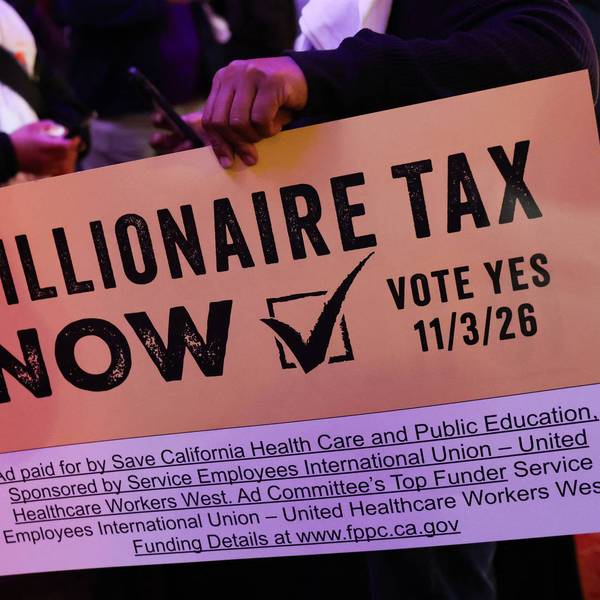
Brin is leading the opposition to California’s Proposition 40, which would impose a one-time wealth tax of 5% on all residents of California as of January 1, 2026 with personal wealth exceeding $1 billion. Brin claims to have changed his state of residence to Nevada prior to that date, although it’s not clear whether the steps he took to accomplish that change were sufficient to avoid California residence for purposes of Proposition 40. To date, Brin has contributed over $100 million to groups opposing Proposition or supporting Propositions 41 and 42, which effectively would nullify Proposition 40.
Page, similarly, has moved to Florida, although it’s not clear if he has avoided being a California resident as of January 1, 2026.
If Proposition 40 passed and if Brin’s attempt to avoid California residency were unsuccessful, his tax liability would be in the $12 billion to $14 billion range. His co-founder Page would face a slightly higher tax liability under Proposition 40. Their total liability would be around $28 billion, give or take a few billion.
I was curious how Page and Brin’s prospective Proposition 40 tax liability compares with the wealth they now hold that’s attributable to the 1982 SEC rule change. Would the one-time tax recoup the windfall bestowed on them by the SEC rule change?
To determine that windfall, we figured that without the rule change the profits used by Alphabet to buyback shares would instead have been distributed as dividends and that the dividends would have been taxable as ordinary income. Yes, the federal tax rate applicable to dividends was reduced in 2003 to equal the long-term capital gains rate, but analyzing the counterfactual of “if there were no SEC rule change” points to the assumption the tax rate applicable to dividends would not have been reduced. Because of the SEC rule change, there was not much point for anyone to oppose lowering the tax rate applicable to dividends in 2003. Corporations could protect their shareholders from the higher rate by buying back stock instead of issuing dividends.
Absent the SEC rule change, then, the revenue cost of a reduction in the tax rate applicable to dividends would have posed a much larger obstacle to enactment. Would the rate nonetheless have been reduced? We’ll never know. But since we’re exploring the potential windfall to Page and Brin attributable to the SEC rule change, the higher of the two possible tax rates on dividends was the logical choice.
To determine the savings to Brin and Page, we calculated the change in their percentage ownership of Alphabet that would have resulted from each stock buyback, beginning with the first stock buyback in 2015, had the amount used in the buyback instead been distributed as a dividend, followed by Page and Brin paying federal and state income tax on the dividend, then purchasing additional Alphabet shares with the after-tax proceeds of the dividend. For simplicity, we assumed a total 50% US and California rate for each year during the period. The actual annual rate during the period, factoring in the full federal deductibility of state income tax prior to 2018, would have been slightly higher.
Under this alternative scenario, Page and Brin would now hold 10.9% of the outstanding shares of Alphabet, some 1.3 percentage points less than the percentage they currently hold.
When you do the math, Page and Brin are $55 billion wealthier today than they would be had the limitation on stock buybacks that existed prior to 1982 not been modified and had dividends continued to be considered ordinary income for federal income tax purposes. [And if you assume the federal rate would have been reduced to the capital gains rate in 2003, they’re still $41 billion wealthier today by virtue of the 1982 SEC rule change.]
Put another way, about 10% of their obscene combined wealth of over half a trillion dollars has been derived from one tax giveaway. And—it’s important to note—that tax giveaway wasn’t even delivered by duly elected members of Congress. Rather, it was ordained by unelected regulators (or, really, anti-regulators) at the SEC.
If Proposition 40 passes and Page and Brin are required to pay the one-time tax, they’ll still be $25 billion ahead. Don’t feel too bad for them.
Page and Brin likely are the most extreme examples of how the 1982 SEC rule change conferred massive additional wealth on the wealthiest Americans. But they’re far from the only examples. Meta, Oracle, Nvidia, and Dell all have distributed tens of billions of dollars in buybacks. Apple has bought back nearly half its shares through stock buybacks over the past decade. In total, stock buybacks have been running in the $1 trillion per year range and may hit $1.5 trillion this year. Today’s billionaires undoubtedly are sitting on several hundred billion dollars of additional wealth courtesy of stock buybacks.
The concentration of American wealth—and the accompanying concentration of political power—now poses an existential threat to our democracy. Stock buybacks have made this situation measurably worse than it otherwise would have been. We can’t do much about the damage that’s already been done. But we could avoid further damage.
This piece was first published on Substack.
We are at a crossroads
This country and this world are at a monumental crossroads. In a few short weeks, US voters will have an opportunity to beat back the forces of fascism and confront the billionaires who are rigging the economy, our media system, and our democracy, making it increasingly impossible for ordinary people to get by. We’re not just talking about the election. We’re talking about what must be done once these fascist elements are vanquished from power. We need a bolder set of solutions than what either major party has so far been willing to offer and a working-class movement ready to fight like hell for it. Trump didn't emerge from nowhere. The conditions that fueled MAGA authoritarianism were created by decades of radical neoliberal economic policies and a corrupt political system dominated by corporate interests. They slashed taxes on the super-rich, promising that the benefits would trickle down. They said giveaways to the corporate titans would make life more affordable for the rest of us. It was all bullshit. And when a bitter, betrayed populace searches for someone to blame, right-wing demagogues have little trouble finding scapegoats. People know when they're being lied to, but you won't hear any of this from the corporate media. Only independent journalism—powered and funded by people who believe in building a better world—can deliver truly trustworthy daily news. Our Fall Campaign is underway, and we need your help. To power our newsroom through the rest of the year, we need to raise $125,000 by midnight on October 31. So if you share our vision, please contribute whatever you can to sustain our work. |
One of us previously wrote on the tax treatment of stock buybacks. Prior to a rule change by the Securities and Exchange Commission in 1982, publicly traded corporations faced strict limits in the number of shares they could buy back. The 1982 rule change effectively gave corporations a choice: They could use their profits to buy shares on the open market, with no meaningful limit, or they could distribute their profits as dividends to their shareholders, taxable at the same rate as ordinary income.
The rule the Securities and Exchange Commission changed was related to insider trading; the SEC might not care about the tax consequences of share buybacks, but everyone else involved surely does. As noted in the post, the shareholders who don’t sell when a corporation buys back shares are the beneficiaries of the rule change:
To understand the impact of the SEC rule change, focus on the shareholders who don’t sell any shares in connection with a buyback. They’re the ones who reap the tax benefit. The selling shareholders were going to sell anyhow. We’re talking about publicly traded stock here. The decision to sell has nothing to do with the corporation’s decision to buy, and a selling shareholder has no idea who buys their publicly traded shares. The corporation doesn’t benefit either. It’s just shedding cash either way.
The concentration of American wealth—and the accompanying concentration of political power—now poses an existential threat to our democracy. Stock buybacks have made this situation measurably worse than it otherwise would have been.
But not all non-selling shareholders benefit from stock buybacks. If you own stock inside an IRA, the corporation’s decision whether to buy shares or issue dividends is not critical to you. You avoid an immediate income tax consequence either way. And if you don’t want a stock buyback to cause an increase in your ownership interest in the corporation, you can sell a few shares off, also without tax consequence, and create an economic result identical to that of a dividend.
The same applies to shares held by other retirement accounts, pension plans, university endowment funds, and other tax-exempt entities.
That leaves the ultra-rich—and especially the billionaires—as the main beneficiaries of stock buybacks. The benefits are enormous, and become ever larger as we move up the wealth scale.
The situation of Google co-founders Larry Page and Sergey Brin exemplifies the wealth concentrating impact of the SEC rule change. Alphabet, which became the publicly traded parent of Google in a 2015 reorganization, has bought back a lot of shares over the past 11 years. Page and Brin, the third and fourth wealthiest Americans, respectively, have a combined wealth totaling over half a trillion dollars. As of October 16, the two held a combined total of 14,960,019,745 shares of Alphabet stock—778,102,320 for Page and 717,917,425 for Brin—which they’d held at least since Google’s IPO in 2004 (adjusted for stock splits over that period).
Brin is leading the opposition to California’s Proposition 40, which would impose a one-time wealth tax of 5% on all residents of California as of January 1, 2026 with personal wealth exceeding $1 billion. Brin claims to have changed his state of residence to Nevada prior to that date, although it’s not clear whether the steps he took to accomplish that change were sufficient to avoid California residence for purposes of Proposition 40. To date, Brin has contributed over $100 million to groups opposing Proposition or supporting Propositions 41 and 42, which effectively would nullify Proposition 40.
Page, similarly, has moved to Florida, although it’s not clear if he has avoided being a California resident as of January 1, 2026.
If Proposition 40 passed and if Brin’s attempt to avoid California residency were unsuccessful, his tax liability would be in the $12 billion to $14 billion range. His co-founder Page would face a slightly higher tax liability under Proposition 40. Their total liability would be around $28 billion, give or take a few billion.
I was curious how Page and Brin’s prospective Proposition 40 tax liability compares with the wealth they now hold that’s attributable to the 1982 SEC rule change. Would the one-time tax recoup the windfall bestowed on them by the SEC rule change?
To determine that windfall, we figured that without the rule change the profits used by Alphabet to buyback shares would instead have been distributed as dividends and that the dividends would have been taxable as ordinary income. Yes, the federal tax rate applicable to dividends was reduced in 2003 to equal the long-term capital gains rate, but analyzing the counterfactual of “if there were no SEC rule change” points to the assumption the tax rate applicable to dividends would not have been reduced. Because of the SEC rule change, there was not much point for anyone to oppose lowering the tax rate applicable to dividends in 2003. Corporations could protect their shareholders from the higher rate by buying back stock instead of issuing dividends.
Absent the SEC rule change, then, the revenue cost of a reduction in the tax rate applicable to dividends would have posed a much larger obstacle to enactment. Would the rate nonetheless have been reduced? We’ll never know. But since we’re exploring the potential windfall to Page and Brin attributable to the SEC rule change, the higher of the two possible tax rates on dividends was the logical choice.
To determine the savings to Brin and Page, we calculated the change in their percentage ownership of Alphabet that would have resulted from each stock buyback, beginning with the first stock buyback in 2015, had the amount used in the buyback instead been distributed as a dividend, followed by Page and Brin paying federal and state income tax on the dividend, then purchasing additional Alphabet shares with the after-tax proceeds of the dividend. For simplicity, we assumed a total 50% US and California rate for each year during the period. The actual annual rate during the period, factoring in the full federal deductibility of state income tax prior to 2018, would have been slightly higher.
Under this alternative scenario, Page and Brin would now hold 10.9% of the outstanding shares of Alphabet, some 1.3 percentage points less than the percentage they currently hold.
When you do the math, Page and Brin are $55 billion wealthier today than they would be had the limitation on stock buybacks that existed prior to 1982 not been modified and had dividends continued to be considered ordinary income for federal income tax purposes. [And if you assume the federal rate would have been reduced to the capital gains rate in 2003, they’re still $41 billion wealthier today by virtue of the 1982 SEC rule change.]
Put another way, about 10% of their obscene combined wealth of over half a trillion dollars has been derived from one tax giveaway. And—it’s important to note—that tax giveaway wasn’t even delivered by duly elected members of Congress. Rather, it was ordained by unelected regulators (or, really, anti-regulators) at the SEC.
If Proposition 40 passes and Page and Brin are required to pay the one-time tax, they’ll still be $25 billion ahead. Don’t feel too bad for them.
Page and Brin likely are the most extreme examples of how the 1982 SEC rule change conferred massive additional wealth on the wealthiest Americans. But they’re far from the only examples. Meta, Oracle, Nvidia, and Dell all have distributed tens of billions of dollars in buybacks. Apple has bought back nearly half its shares through stock buybacks over the past decade. In total, stock buybacks have been running in the $1 trillion per year range and may hit $1.5 trillion this year. Today’s billionaires undoubtedly are sitting on several hundred billion dollars of additional wealth courtesy of stock buybacks.
The concentration of American wealth—and the accompanying concentration of political power—now poses an existential threat to our democracy. Stock buybacks have made this situation measurably worse than it otherwise would have been. We can’t do much about the damage that’s already been done. But we could avoid further damage.
This piece was first published on Substack.
- 'We Should All Be Angry' That Corporations Spent Trump Tax Windfall on Buybacks: Expert ›
- 15 Big Corporations Used Trump Tax Cuts to Pump $839 Billion Into Buybacks, Dividends ›
- Top Low-Wage Corporations Have Dumped $522 Billion Into Stock Buybacks Since 2019 ›
- Dems Unveil Plan to Crack Down on Stock Buybacks as Trump Tax Cuts Fuel $4.8 Trillion 'Bonanza' ›
- Real Patriots Pay Taxes ›
- Report:: Publicly Traded Companies Used PPP Money to Enrich Their Shareholders ›