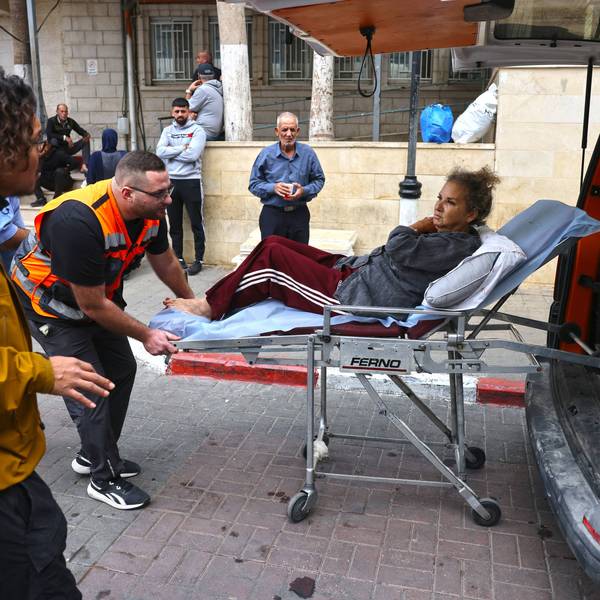
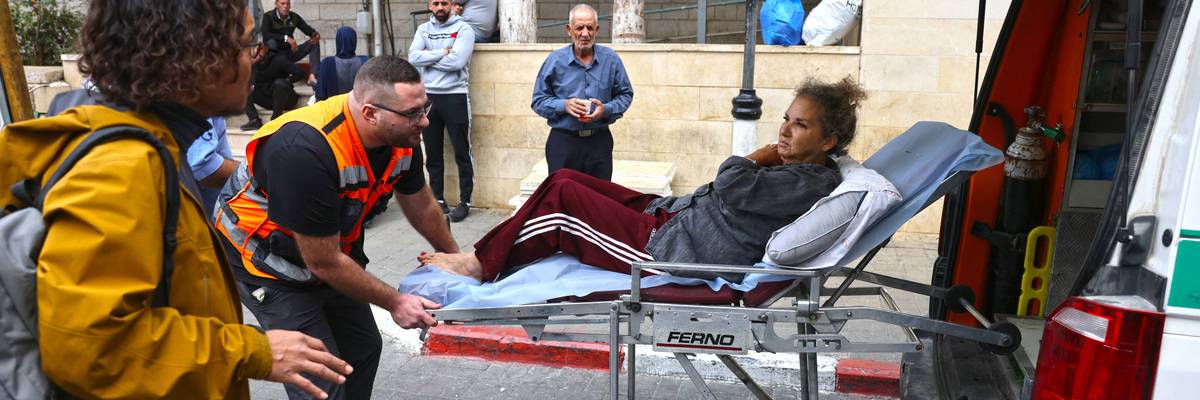
American freelance photojournalist Heidi Levine is transferred on a stretcher into a Palestinian ambulance from the government hospital in the Israeli-occupied city of Ramallah before she is handed over to an Israeli ambulance at a checkpoint for onward transport to a hospital in Tel Aviv, after she was attacked by Israeli settlers while photographing Palestinian farmers harvesting their olives, in the Palestinian village of Abu Falah on October 16, 2026.
Israeli Settler Attack on Post Photographer Must Force a Reckoning in Washington
Levine’s assault has brought renewed focus to the dangerous circumstances Palestinians face daily while tending to their land;
whether that attention matters will depend on whether a response leads to consequences for perpetrators.
Washington Post reporter Heidi Levine traveled to the occupied West Bank to document Palestinians harvesting olives. On Friday, Israeli settlers brutally attacked her, leaving her traumatized and hospitalized.
Despite carrying gear visibly identifying her as a photographer and wearing a protective vest clearly marked “PRESS,” she was surrounded by settlers who shoved her to the ground and relentlessly assaulted her.
According to reports, she suffered four broken vertebrae, a broken rib, severe lacerations across her body, and a finger that was severely split open.
Heidi Levine deserves justice, victims of settler violence deserve accountability, and the evidence warrants action.
In her words: “Luckily I had my flak jacket and helmet, otherwise I probably wouldn’t even be here, because they just kept kicking me and kicking me.”
This assault deserves an investigation and swift prosecution of those responsible.
It also calls on Americans to examine the deeper story she was covering.
If attackers are violently assaulting a photojournalist working for a globally influential publication, what protection can Palestinian farmers expect—especially when the cameras leave?
That question connects olive groves in the occupied West Bank to legislation in the US Senate led by Democratic Maryland Sen. Chris Van Hollen along with Sens. Tim Kaine (D-Va.) and Bernie Sanders (I-Vt.).
Senate Resolution 852 would require the State Department to provide information and assessments concerning investigations into the killings of Americans by Israeli forces or violent settlers, as well as other human rights abuses in the occupied West Bank.
Last month, although a historic 47 senators voted, largely along party lines, to move the measure forward, the Senate ultimately failed to discharge the resolution from the Senate Foreign Affairs Committee.
The assault on Levine is a wake-up call for the senate to reconsider.
This type of targeted violence extends beyond farmers gathering the harvest.
On October 12, at the beginning of this year’s harvest, Israeli forces uprooted and bulldozed 400 olive trees in Beit Rima, northwest of Ramallah, to make way for a new settlement outpost.
This is far from an isolated incident. So far this year alone, Israeli forces and settlers have uprooted and destroyed around 50,000 olive trees.
For a Palestinian family, olive groves equal years of labor. A family tending its trees is earning income and maintaining its connection to land. Destroying the trees or stealing the crop makes life untenable.
In April, the United Nations Office for the Coordination of Humanitarian Affairs reported that at least 45 Palestinian communities had been completely displaced since January 2023 because of settler attacks and related restrictions.
Those figures describe a process often camouflaged behind abstract language.
Journalists documenting the harvest are simultaneously documenting the devastating toll of settler violence on Palestinian lives.
Attacking members of the press threatens individual livelihoods and lives, but also the public’s ability to stay informed and understand what is happening.
Our response must protect the people in the photographs, too. A farmer’s right to safety cannot depend on whether a foreign correspondent is nearby.
Washington has a practical place to begin.
Senate Resolution 852 requests information on Israel’s human rights practices under Section 502B(c) of the Foreign Assistance Act.
The September 29 Senate vote denied American families and victims of settler violence an opportunity to demand accountability for conduct that should inform Congress’ decisions about American security assistance.
The reporting requirement in the resolution is consequential, providing the State Department 30 days to respond.
Lawmakers who believe such a requirement could disrupt an important security relationship must explain why that relationship shouldn’t withstand scrutiny.
Congress should use the findings to pursue credible investigations, examine failures to protect civilians, and enforce applicable human rights conditions.
Levine’s assault has brought renewed focus to the dangerous circumstances Palestinians face daily while tending to their land.
Whether that attention matters will depend on whether a response leads to consequences for perpetrators.
Heidi Levine deserves justice, victims of settler violence deserve accountability, and the evidence warrants action.
The US Senate can begin demanding answers by reviving Senate Resolution 852 and unanimously passing this measure.
We are at a crossroads
This country and this world are at a monumental crossroads. In a few short weeks, US voters will have an opportunity to beat back the forces of fascism and confront the billionaires who are rigging the economy, our media system, and our democracy, making it increasingly impossible for ordinary people to get by. We’re not just talking about the election. We’re talking about what must be done once these fascist elements are vanquished from power. We need a bolder set of solutions than what either major party has so far been willing to offer and a working-class movement ready to fight like hell for it. Trump didn't emerge from nowhere. The conditions that fueled MAGA authoritarianism were created by decades of radical neoliberal economic policies and a corrupt political system dominated by corporate interests. They slashed taxes on the super-rich, promising that the benefits would trickle down. They said giveaways to the corporate titans would make life more affordable for the rest of us. It was all bullshit. And when a bitter, betrayed populace searches for someone to blame, right-wing demagogues have little trouble finding scapegoats. People know when they're being lied to, but you won't hear any of this from the corporate media. Only independent journalism—powered and funded by people who believe in building a better world—can deliver truly trustworthy daily news. Our Fall Campaign is underway, and we need your help. To power our newsroom through the rest of the year, we need to raise $125,000 by midnight on October 31. So if you share our vision, please contribute whatever you can to sustain our work. |
Washington Post reporter Heidi Levine traveled to the occupied West Bank to document Palestinians harvesting olives. On Friday, Israeli settlers brutally attacked her, leaving her traumatized and hospitalized.
Despite carrying gear visibly identifying her as a photographer and wearing a protective vest clearly marked “PRESS,” she was surrounded by settlers who shoved her to the ground and relentlessly assaulted her.
According to reports, she suffered four broken vertebrae, a broken rib, severe lacerations across her body, and a finger that was severely split open.
Heidi Levine deserves justice, victims of settler violence deserve accountability, and the evidence warrants action.
In her words: “Luckily I had my flak jacket and helmet, otherwise I probably wouldn’t even be here, because they just kept kicking me and kicking me.”
This assault deserves an investigation and swift prosecution of those responsible.
It also calls on Americans to examine the deeper story she was covering.
If attackers are violently assaulting a photojournalist working for a globally influential publication, what protection can Palestinian farmers expect—especially when the cameras leave?
That question connects olive groves in the occupied West Bank to legislation in the US Senate led by Democratic Maryland Sen. Chris Van Hollen along with Sens. Tim Kaine (D-Va.) and Bernie Sanders (I-Vt.).
Senate Resolution 852 would require the State Department to provide information and assessments concerning investigations into the killings of Americans by Israeli forces or violent settlers, as well as other human rights abuses in the occupied West Bank.
Last month, although a historic 47 senators voted, largely along party lines, to move the measure forward, the Senate ultimately failed to discharge the resolution from the Senate Foreign Affairs Committee.
The assault on Levine is a wake-up call for the senate to reconsider.
This type of targeted violence extends beyond farmers gathering the harvest.
On October 12, at the beginning of this year’s harvest, Israeli forces uprooted and bulldozed 400 olive trees in Beit Rima, northwest of Ramallah, to make way for a new settlement outpost.
This is far from an isolated incident. So far this year alone, Israeli forces and settlers have uprooted and destroyed around 50,000 olive trees.
For a Palestinian family, olive groves equal years of labor. A family tending its trees is earning income and maintaining its connection to land. Destroying the trees or stealing the crop makes life untenable.
In April, the United Nations Office for the Coordination of Humanitarian Affairs reported that at least 45 Palestinian communities had been completely displaced since January 2023 because of settler attacks and related restrictions.
Those figures describe a process often camouflaged behind abstract language.
Journalists documenting the harvest are simultaneously documenting the devastating toll of settler violence on Palestinian lives.
Attacking members of the press threatens individual livelihoods and lives, but also the public’s ability to stay informed and understand what is happening.
Our response must protect the people in the photographs, too. A farmer’s right to safety cannot depend on whether a foreign correspondent is nearby.
Washington has a practical place to begin.
Senate Resolution 852 requests information on Israel’s human rights practices under Section 502B(c) of the Foreign Assistance Act.
The September 29 Senate vote denied American families and victims of settler violence an opportunity to demand accountability for conduct that should inform Congress’ decisions about American security assistance.
The reporting requirement in the resolution is consequential, providing the State Department 30 days to respond.
Lawmakers who believe such a requirement could disrupt an important security relationship must explain why that relationship shouldn’t withstand scrutiny.
Congress should use the findings to pursue credible investigations, examine failures to protect civilians, and enforce applicable human rights conditions.
Levine’s assault has brought renewed focus to the dangerous circumstances Palestinians face daily while tending to their land.
Whether that attention matters will depend on whether a response leads to consequences for perpetrators.
Heidi Levine deserves justice, victims of settler violence deserve accountability, and the evidence warrants action.
The US Senate can begin demanding answers by reviving Senate Resolution 852 and unanimously passing this measure.
- 'Backing Settler Terrorists Is Its Policy': IDF Ignored Distress Calls Before Attack on European Diplomats ›
- 'Horrific': Masked Israeli Settlers Attack, Injure Palestinian Woman and NBC Crew ›
- US Officials Face Fresh Pressure After Another American 'Brutalized' by Israeli Settlers in West Bank ›
- 'Monstrous': Netanyahu Casts Doubt on Filmed Israeli Settler Attack of American Journalist ›
- Israeli Settlers Brutally Beat Washington Post Journalist Heidi Levine While Attacking Palestinian Olive Farmers ›