Ahead of COP31, 146 Scientists Urge UN to Declare Climate Change a Global Health Emergency
"The health harms of climate change are growing faster than the world's response to them, and in many cases even accelerating."
With less than two weeks to go until the 31st United Nations Climate Change Conference, or COP31, brings world leaders to Antalya, Türkiye to discuss the need to transition away from fossil fuels, nearly 150 international experts warned that climate change brought on by greenhouse gas emissions constitutes a "global health emergency" whose harms are accelerating.
The "2026 Lancet Countdown on Health and Climate Change," written by researchers at University College London and the World Health Organization (WHO) and published in The Lancet, tracks dozens of indicators that link climate change to public health, including drought, extreme hurricanes and flooding, and economic losses.
But one top indicator that planetary heating has caused a worsening public health crisis is the extreme heat that was blamed for more than 50,000 deaths across Europe this summer, and which could lead to 450,000 excess deaths in the coming months as the climate emergency is compounded by this year's "Super El Niño."
According to the report, annual average heat-related deaths have surged by nearly 36% since the Paris climate agreement was signed in 2015, securing pledges from governments to draw down fossil fuel emissions, compared to the decade preceding the deal.
More than 70% of the 710,000 heat-related deaths recorded in 2023 were found to be attributed to climate change, and between 2016-23, 68% of the world's 540,800 heat-related deaths were linked to the warming planet. The previous decade, 55% of deaths caused by extreme heat were blamed on the climate emergency.
"These numbers point to a clear emergency," said climate health researcher Marina Romanello, the executive director of the Lancet Countdown. "The risks become even more profound when you consider how different hazards interact and compound. At the same time, drought is spreading, and the world is swinging to water extremes, some drying out, while others are flooding."
"Progress has been too slow, too small, and isn't reaching those who need it most."
The report was published less than two months after a glacial collapse killed at least 1,000 people in Nepal and Tibet as it sent sudden extreme flooding down a mountain into a number of towns.
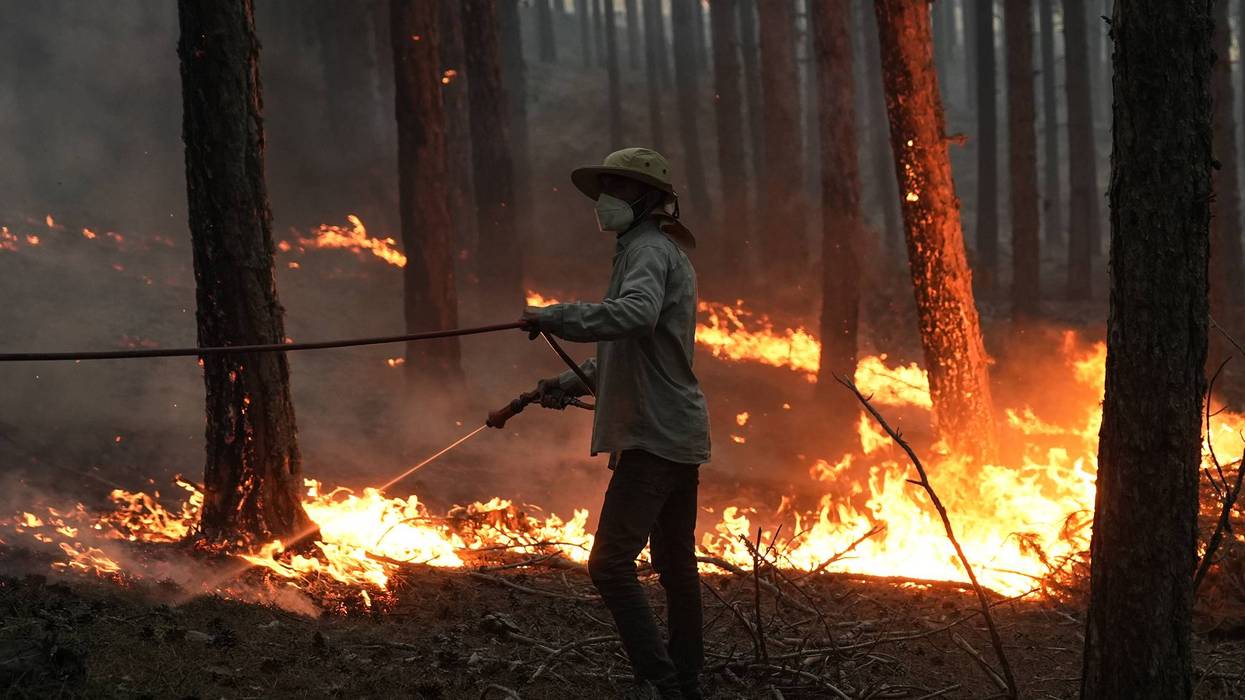
Türkiye, where COP31 is set to begin on November 9, was one place where massive wildfires spread rapidly this summer, while hundreds of thousands of people in Spain and France were also displaced by fast-moving blazes.
And in August, more than 5,000 square miles of forest burned in the Northwest Territories in Canada, sparking public health concerns when smoke drifted thousands of miles south to the continental United States.
"A decade after the Paris Agreement, our findings are unambiguous: The health harms of climate change are growing faster than the world's response to them, and in many cases even accelerating," said Romanello.
Diarmid Campbell-Lendrum, head of the climate change and health unit at WHO, said the report "demonstrates that climate action is a health intervention. Cleaner energy, stronger health systems and early warning systems are saving lives today. As countries prepare for COP31, placing health at the center of climate policies can help protect communities, strengthen resilience, and deliver immediate benefits for people’s health and wellbeing."
The 146 scientists who authored the report noted that strides have been made in some countries in expanding clean energy infrastructure, passing health protection regulations, and preparing health systems for climate-related crises and conditions.
But in the US, the largest historic emitter of greenhouse gases, the Trump administration has blocked renewable energy projects and rolled back regulations meant to reduce people's exposure to harmful emissions.
"Progress has been too slow, too small, and isn't reaching those who need it most," said Romanello. "That is why we are calling for climate change to be formally recognized as a global health emergency, with health placed at the center of every climate decision."
The report was released a week after the UN Environment Program warned that achieving the Paris Agreement's goal of limiting planetary heating to 1.5°C above preindustrial temperatures is no longer possible, and that world leaders must now focus efforts on ensuring the overshoot is as short-lived as possible.
In the Lancet Countdown, the researchers called on the UN to declare that climate change is a public health emergency of international concern, which could require an international response.
"Priorities," said WHO, "include accelerating reductions in greenhouse gas emissions, increasing support for adaptation, and expanding investments that strengthen health system resilience."




 Graphic by The Petek