
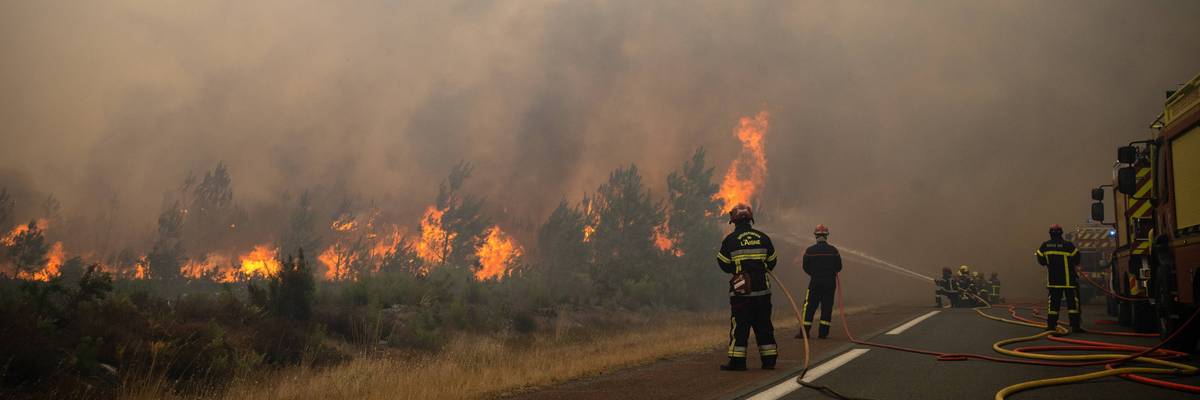
Firefighters spray water along the edge of a forest during a wildfire near the town of Lege-Cap-Ferret, southwestern France on July 25, 2026.
Historic 'Monster' Wildfires Scorch France and Spain
“It is the most painful manifestation of a climate emergency that is making… wildfires more voracious and heatwaves more frequent, and as a result our land more vulnerable," said Spanish Prime Minister Pedro Sánchez.
More than 300,000 people have been displaced as historic wildfires tear across France and Spain, presaging what some have called a climate-fueled "crisis of habitability" across Europe, which is heating faster than anywhere else on the globe.
Record heat and drought have fueled multiple record wildfires around the French wine-growing region of Bordeaux and in central Spain near Madrid. As the region expects to see temperatures above 95°F later this week, firefighters are racing to quell the blaze as it grows out of control.
Across the two countries, at least one person has been killed, and more than 100 have been sickened or injured. In France, 80 firefighters have been injured.
About 448 square miles of terrain have been scorched across France since the beginning of 2026, the highest annual total in modern history, even though it's only July.
The fires in France have grown so powerful and unwieldy that they've formed what the National Firefighters Federation of France described as a “pyrocumulonimbus”—an unprecedented fire-generated thunderstorm cloud that generates its own wind and lightning, which spreads the flames across the landscape.
In Spain, fires around Ávila burned about 193 square miles in five days—an area roughly five times the size of Barcelona—making it the largest wildfire in the nation's history. Civil protection chief Virginia Barcones said her country was facing a "monster."
Extreme wildfires are becoming more common around the world as global temperatures increase. Across Europe, where temperatures have soared twice as fast as the global average, the pattern has been even more intense.
Last year was the worst fire year on record in the European Union, with nearly 4,170 square miles of land burned—almost double the annual average from 2006-24.
Speaking at a climate conference, Spanish Prime Minister Pedro Sánchez emphasized that the fires should not be viewed as isolated incidents.
“It is the most painful manifestation of a climate emergency that is making… wildfires more voracious and heatwaves more frequent, and as a result our land more vulnerable,” Sánchez said. “It is no longer an exception. It is the rule.”
In an op-ed for Le Monde, philosopher Cynthia Fleury and the Socialist mayor of Saint-Médard-en-Jalles in southwestern France, Stéphane Delpeyrat-Vincent, wrote that where previous fires and heatwaves have posed threats to individuals, "the 2026 heatwave has been something else entirely."
"No longer are only individuals at risk, but entire regions," they wrote. "Extreme heat now goes hand in hand with megafires, the destruction of whole landscapes, the collapse of environments and the evacuation of entire towns. The health crisis has become a crisis of habitability."
We are at a crossroads
This country and this world are at a monumental crossroads. In a few short weeks, US voters will have an opportunity to beat back the forces of fascism and confront the billionaires who are rigging the economy, our media system, and our democracy, making it increasingly impossible for ordinary people to get by. We’re not just talking about the election. We’re talking about what must be done once these fascist elements are vanquished from power. We need a bolder set of solutions than what either major party has so far been willing to offer and a working-class movement ready to fight like hell for it. Trump didn't emerge from nowhere. The conditions that fueled MAGA authoritarianism were created by decades of radical neoliberal economic policies and a corrupt political system dominated by corporate interests. They slashed taxes on the super-rich, promising that the benefits would trickle down. They said giveaways to the corporate titans would make life more affordable for the rest of us. It was all bullshit. And when a bitter, betrayed populace searches for someone to blame, right-wing demagogues have little trouble finding scapegoats. People know when they're being lied to, but you won't hear any of this from the corporate media. Only independent journalism—powered and funded by people who believe in building a better world—can deliver truly trustworthy daily news. Our Fall Campaign is underway, and we need your help. To power our newsroom through the rest of the year, we need to raise $125,000 by midnight on October 31. So if you share our vision, please contribute whatever you can to sustain our work. |
More than 300,000 people have been displaced as historic wildfires tear across France and Spain, presaging what some have called a climate-fueled "crisis of habitability" across Europe, which is heating faster than anywhere else on the globe.
Record heat and drought have fueled multiple record wildfires around the French wine-growing region of Bordeaux and in central Spain near Madrid. As the region expects to see temperatures above 95°F later this week, firefighters are racing to quell the blaze as it grows out of control.
Across the two countries, at least one person has been killed, and more than 100 have been sickened or injured. In France, 80 firefighters have been injured.
About 448 square miles of terrain have been scorched across France since the beginning of 2026, the highest annual total in modern history, even though it's only July.
The fires in France have grown so powerful and unwieldy that they've formed what the National Firefighters Federation of France described as a “pyrocumulonimbus”—an unprecedented fire-generated thunderstorm cloud that generates its own wind and lightning, which spreads the flames across the landscape.
In Spain, fires around Ávila burned about 193 square miles in five days—an area roughly five times the size of Barcelona—making it the largest wildfire in the nation's history. Civil protection chief Virginia Barcones said her country was facing a "monster."
Extreme wildfires are becoming more common around the world as global temperatures increase. Across Europe, where temperatures have soared twice as fast as the global average, the pattern has been even more intense.
Last year was the worst fire year on record in the European Union, with nearly 4,170 square miles of land burned—almost double the annual average from 2006-24.
Speaking at a climate conference, Spanish Prime Minister Pedro Sánchez emphasized that the fires should not be viewed as isolated incidents.
“It is the most painful manifestation of a climate emergency that is making… wildfires more voracious and heatwaves more frequent, and as a result our land more vulnerable,” Sánchez said. “It is no longer an exception. It is the rule.”
In an op-ed for Le Monde, philosopher Cynthia Fleury and the Socialist mayor of Saint-Médard-en-Jalles in southwestern France, Stéphane Delpeyrat-Vincent, wrote that where previous fires and heatwaves have posed threats to individuals, "the 2026 heatwave has been something else entirely."
"No longer are only individuals at risk, but entire regions," they wrote. "Extreme heat now goes hand in hand with megafires, the destruction of whole landscapes, the collapse of environments and the evacuation of entire towns. The health crisis has become a crisis of habitability."
More than 300,000 people have been displaced as historic wildfires tear across France and Spain, presaging what some have called a climate-fueled "crisis of habitability" across Europe, which is heating faster than anywhere else on the globe.
Record heat and drought have fueled multiple record wildfires around the French wine-growing region of Bordeaux and in central Spain near Madrid. As the region expects to see temperatures above 95°F later this week, firefighters are racing to quell the blaze as it grows out of control.
Across the two countries, at least one person has been killed, and more than 100 have been sickened or injured. In France, 80 firefighters have been injured.
About 448 square miles of terrain have been scorched across France since the beginning of 2026, the highest annual total in modern history, even though it's only July.
The fires in France have grown so powerful and unwieldy that they've formed what the National Firefighters Federation of France described as a “pyrocumulonimbus”—an unprecedented fire-generated thunderstorm cloud that generates its own wind and lightning, which spreads the flames across the landscape.
In Spain, fires around Ávila burned about 193 square miles in five days—an area roughly five times the size of Barcelona—making it the largest wildfire in the nation's history. Civil protection chief Virginia Barcones said her country was facing a "monster."
Extreme wildfires are becoming more common around the world as global temperatures increase. Across Europe, where temperatures have soared twice as fast as the global average, the pattern has been even more intense.
Last year was the worst fire year on record in the European Union, with nearly 4,170 square miles of land burned—almost double the annual average from 2006-24.
Speaking at a climate conference, Spanish Prime Minister Pedro Sánchez emphasized that the fires should not be viewed as isolated incidents.
“It is the most painful manifestation of a climate emergency that is making… wildfires more voracious and heatwaves more frequent, and as a result our land more vulnerable,” Sánchez said. “It is no longer an exception. It is the rule.”
In an op-ed for Le Monde, philosopher Cynthia Fleury and the Socialist mayor of Saint-Médard-en-Jalles in southwestern France, Stéphane Delpeyrat-Vincent, wrote that where previous fires and heatwaves have posed threats to individuals, "the 2026 heatwave has been something else entirely."
"No longer are only individuals at risk, but entire regions," they wrote. "Extreme heat now goes hand in hand with megafires, the destruction of whole landscapes, the collapse of environments and the evacuation of entire towns. The health crisis has become a crisis of habitability."