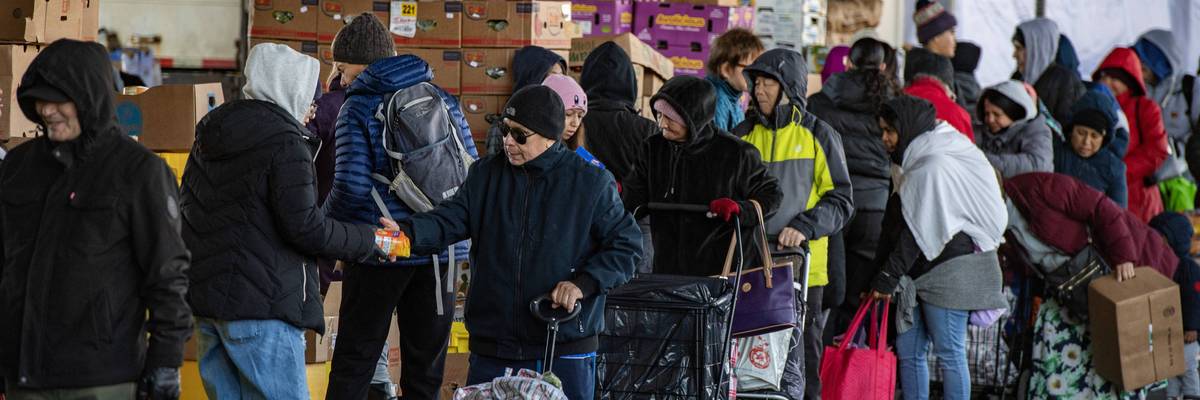
Workers and volunteers hand out food to people in line at La Colaborativa's food pantry in Chelsea, Massachusetts, on November 15, 2025.
'Hunger Disaster Unrolling Before Our Eyes': Alarm Grows Over Trump Food Aid Evisceration
“SNAP participation is falling because the Trump administration has intentionally kicked people off of the program—leaving Americans hungry and still struggling to afford food,” said Sen. Elizabeth Warren.
An analysis published Thursday showed that millions of Americans have lost critical food assistance since President Donald Trump signed last year's massive Republican tax giveaway for the superrich, with soaring grocery prices and cuts to school meals exacerbating the crisis.
According to the Center on Budget and Policy Priorities (CBPP), approximately 5.5 million people, including roughly 2 million children, have lost Supplemental Nutrition Assistance Program (SNAP) assistance since Trump signed the so-called One Big Beautiful Bill Act (OBBBA) in July 2025.
The legislation approved the deepest cuts to SNAP—also known as food stamps—and Medicaid in those programs' histories while slashing billions of dollars from other essential social programs to fund massive tax breaks for billionaires and corporations.
This, at a time when more than 47 million Americans—including 1 in 5 US children—are living in food-insecure households.
The 5.5 million people who have lost SNAP represent 13% of the program's recipients, according to CBPP. The decline is far below projections made by the Congressional Budget Office.
"The declines are especially pronounced in some states," the report noted. "SNAP participation fell in Arizona by nearly 51%... The caseload declines are 20% or more in Arizona, Florida, Illinois, Louisiana, Nebraska, Nevada, and Oklahoma, and—using more recent state data—in Indiana, Kansas, and Texas."
In absolute numbers, Texas saw the biggest loss of SNAP recipients, with 709,435 fewer enrollees. Florida lost 665,935 SNAP enrollees, while Arizona had 408,204 fewer and California lost 333,062.
The CBPP report follows an analysis released Tuesday by Unrig Our Economy and Americans for Tax Fairness that showed how Latino SNAP recipients have been disproportionately affected by food stamp cuts. The groups estimated that 1.5 million Latinos have been kicked off SNAP since Trump signed the OBBBA, with Texas (396,164) and Arizona (200,124) hardest-hit.
More cuts are highly likely, as "starting in October 2027, most states will have to pay between 5-15% of SNAP benefit costs, totaling hundreds of millions of dollars a year in many states," according to CBPP.
"The magnitude of the cost shift and the urgency surrounding error rates incentivized states to take drastic measures to reduce their payment error rates quickly and cut program costs, even if it meant delaying or improperly denying benefits to eligible people," the analysis warns.
The OBBBA's SNAP cuts, combined with stricter eligibility requirements, have forced schools across the country to scale back universal free meal programs amid declining federal reimbursements.
The Washington Post reported Thursday that school districts are experiencing ballooning unpaid lunch bills and struggling to ensure children are fed. In rural Indiana, one district’s share of students qualifying for free or reduced-price meals plunged from 66% to 44% in a year, while its lunch debt has already reached $10,000. In San Antonio, Texas, the number of schools offering free meals to every student under a federal program fell from 48 to 16. Nationwide, the average number of children receiving free school lunches dropped by 600,000 between fiscal years 2025 and 2026.
Making matters worse, many eligible immigrants are not applying for SNAP benefits out of fear it could affect their citizenship prospects.
Food banks and other charities are having to meet needs the government once addressed.
“It’s been getting out of control since last year,” Paco Vélez, president and chief executive of the Feeding South Florida food bank, told the Post. “It’s all created a situation where families are needing more and more assistance.”
The CBPP and Post reports came on the same day as a "Food Misery Index," published by the office of Sen. Elizabeth Warren (D-Mass.), offered a detailed view of how the combined impact of SNAP cuts and skyrocketing grocery prices—exacerbated by Trump policies including tariffs, the deadly immigration crackdown, and the illegal war of choice on Iran—"has stripped more than $22 billion from American families since July 2025."
“SNAP participation is falling because the Trump administration has intentionally kicked people off of the program—leaving Americans hungry and still struggling to afford food,” Warren wrote Wednesday in a letter to US Agriculture Secretary Brooke Rollins.
“Instead of reaching for tools to mitigate these threats to families and working to bring down costs, the administration continues to sit idly by, peddling false narratives about the drop in SNAP participation, while delivering a one-two punch to American families who are struggling to put food on their tables," the senator continued.
"With grocery prices and food insecurity on the rise," Warren added, "I urge the administration to work with Congress to immediately reverse its harmful cuts to SNAP."
We are at a crossroads
This country and this world are at a monumental crossroads. In a few short weeks, US voters will have an opportunity to beat back the forces of fascism and confront the billionaires who are rigging the economy, our media system, and our democracy, making it increasingly impossible for ordinary people to get by. We’re not just talking about the election. We’re talking about what must be done once these fascist elements are vanquished from power. We need a bolder set of solutions than what either major party has so far been willing to offer and a working-class movement ready to fight like hell for it. Trump didn't emerge from nowhere. The conditions that fueled MAGA authoritarianism were created by decades of radical neoliberal economic policies and a corrupt political system dominated by corporate interests. They slashed taxes on the super-rich, promising that the benefits would trickle down. They said giveaways to the corporate titans would make life more affordable for the rest of us. It was all bullshit. And when a bitter, betrayed populace searches for someone to blame, right-wing demagogues have little trouble finding scapegoats. People know when they're being lied to, but you won't hear any of this from the corporate media. Only independent journalism—powered and funded by people who believe in building a better world—can deliver truly trustworthy daily news. Our Fall Campaign is underway, and we need your help. To power our newsroom through the rest of the year, we need to raise $125,000 by midnight on October 31. So if you share our vision, please contribute whatever you can to sustain our work. |
An analysis published Thursday showed that millions of Americans have lost critical food assistance since President Donald Trump signed last year's massive Republican tax giveaway for the superrich, with soaring grocery prices and cuts to school meals exacerbating the crisis.
According to the Center on Budget and Policy Priorities (CBPP), approximately 5.5 million people, including roughly 2 million children, have lost Supplemental Nutrition Assistance Program (SNAP) assistance since Trump signed the so-called One Big Beautiful Bill Act (OBBBA) in July 2025.
The legislation approved the deepest cuts to SNAP—also known as food stamps—and Medicaid in those programs' histories while slashing billions of dollars from other essential social programs to fund massive tax breaks for billionaires and corporations.
This, at a time when more than 47 million Americans—including 1 in 5 US children—are living in food-insecure households.
The 5.5 million people who have lost SNAP represent 13% of the program's recipients, according to CBPP. The decline is far below projections made by the Congressional Budget Office.
"The declines are especially pronounced in some states," the report noted. "SNAP participation fell in Arizona by nearly 51%... The caseload declines are 20% or more in Arizona, Florida, Illinois, Louisiana, Nebraska, Nevada, and Oklahoma, and—using more recent state data—in Indiana, Kansas, and Texas."
In absolute numbers, Texas saw the biggest loss of SNAP recipients, with 709,435 fewer enrollees. Florida lost 665,935 SNAP enrollees, while Arizona had 408,204 fewer and California lost 333,062.
The CBPP report follows an analysis released Tuesday by Unrig Our Economy and Americans for Tax Fairness that showed how Latino SNAP recipients have been disproportionately affected by food stamp cuts. The groups estimated that 1.5 million Latinos have been kicked off SNAP since Trump signed the OBBBA, with Texas (396,164) and Arizona (200,124) hardest-hit.
More cuts are highly likely, as "starting in October 2027, most states will have to pay between 5-15% of SNAP benefit costs, totaling hundreds of millions of dollars a year in many states," according to CBPP.
"The magnitude of the cost shift and the urgency surrounding error rates incentivized states to take drastic measures to reduce their payment error rates quickly and cut program costs, even if it meant delaying or improperly denying benefits to eligible people," the analysis warns.
The OBBBA's SNAP cuts, combined with stricter eligibility requirements, have forced schools across the country to scale back universal free meal programs amid declining federal reimbursements.
The Washington Post reported Thursday that school districts are experiencing ballooning unpaid lunch bills and struggling to ensure children are fed. In rural Indiana, one district’s share of students qualifying for free or reduced-price meals plunged from 66% to 44% in a year, while its lunch debt has already reached $10,000. In San Antonio, Texas, the number of schools offering free meals to every student under a federal program fell from 48 to 16. Nationwide, the average number of children receiving free school lunches dropped by 600,000 between fiscal years 2025 and 2026.
Making matters worse, many eligible immigrants are not applying for SNAP benefits out of fear it could affect their citizenship prospects.
Food banks and other charities are having to meet needs the government once addressed.
“It’s been getting out of control since last year,” Paco Vélez, president and chief executive of the Feeding South Florida food bank, told the Post. “It’s all created a situation where families are needing more and more assistance.”
The CBPP and Post reports came on the same day as a "Food Misery Index," published by the office of Sen. Elizabeth Warren (D-Mass.), offered a detailed view of how the combined impact of SNAP cuts and skyrocketing grocery prices—exacerbated by Trump policies including tariffs, the deadly immigration crackdown, and the illegal war of choice on Iran—"has stripped more than $22 billion from American families since July 2025."
“SNAP participation is falling because the Trump administration has intentionally kicked people off of the program—leaving Americans hungry and still struggling to afford food,” Warren wrote Wednesday in a letter to US Agriculture Secretary Brooke Rollins.
“Instead of reaching for tools to mitigate these threats to families and working to bring down costs, the administration continues to sit idly by, peddling false narratives about the drop in SNAP participation, while delivering a one-two punch to American families who are struggling to put food on their tables," the senator continued.
"With grocery prices and food insecurity on the rise," Warren added, "I urge the administration to work with Congress to immediately reverse its harmful cuts to SNAP."