SUBSCRIBE TO OUR FREE NEWSLETTER
Daily news & progressive opinion—funded by the people, not the corporations—delivered straight to your inbox.
5
#000000
#FFFFFF
To donate by check, phone, or other method, see our More Ways to Give page.
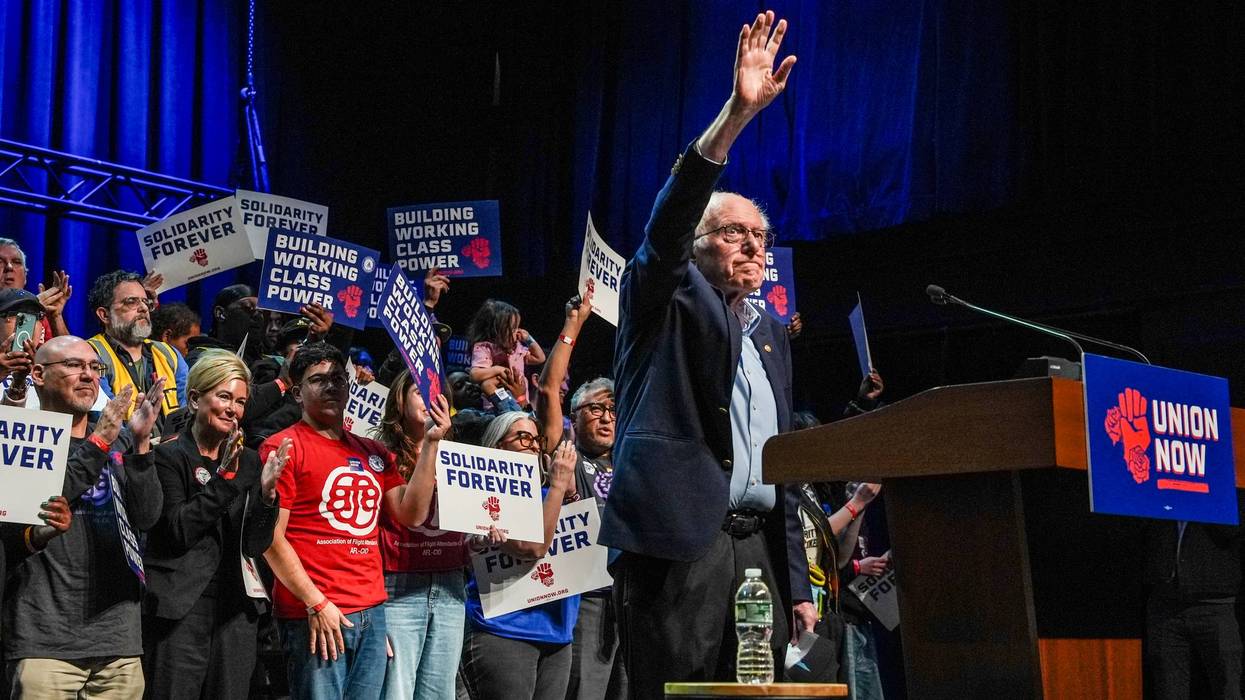

"Boeing's greed offers another perfect example of why we need Medicare for All," Sen. Bernie Sanders (I-Vt.) wrote on social media. "Like other wealthy countries we must guarantee healthcare to every man, woman, and child as a human right, not a job benefit. Whether you're on strike or not, everyone is entitled to healthcare."
Sara Nelson, the international president of the Association of Flight Attendants-CWA (AFA-CWA), wrote on social media that "healthcare should not be tied to employment."
"Also, shame on Boeing!" she added.
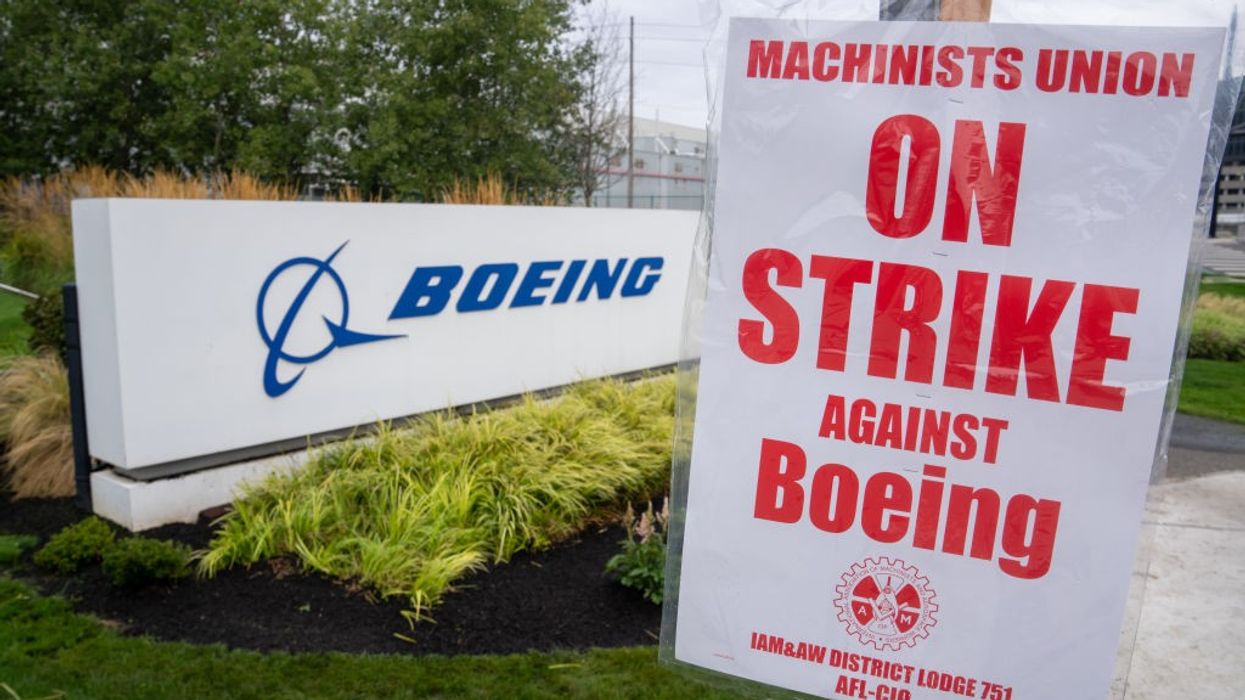
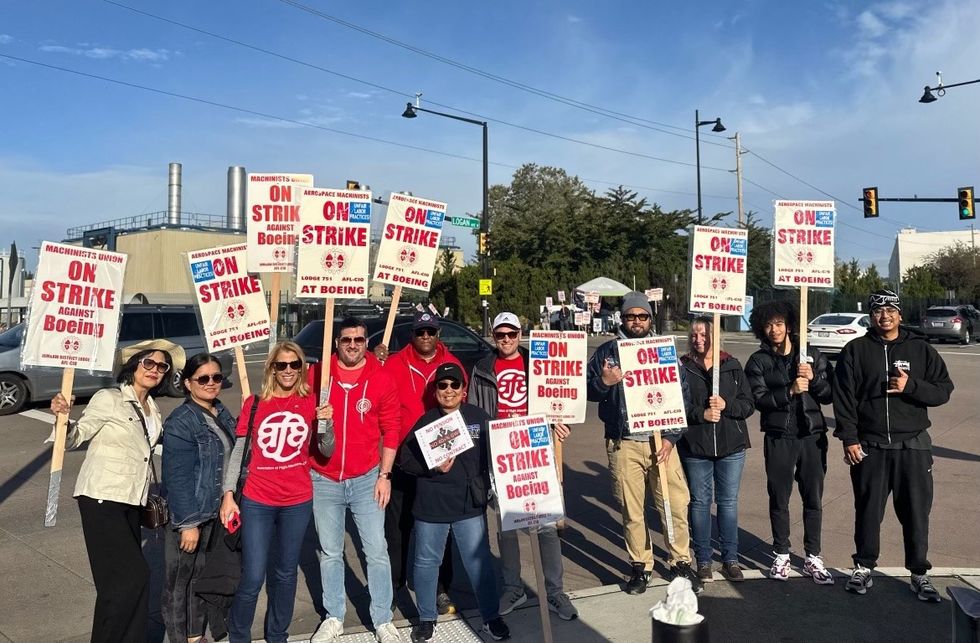 Unionists demonstrate in Renton, Washington on September 26, 2024. (Photo: Taylor Garland)
Many companies have been accused of cutting off healthcare benefits as a strike-breaking tactic. General Motors revoked healthcare benefits to striking workers in 2019, and Warrior Met, a coal mining company, did so in 2021; John Deere, meanwhile, threatened to follow suit during its 2021 strike.
In 2022, House Democrats moved to establish a federal law preventing the maneuver, but the proposed bill didn't pass.
Washington state, which has a Democratic trifecta, did pass legislation this year providing a modicum of support to striking workers. The new law allows workers involved in a labor dispute open enrollment into subsidized healthcare through the state exchange system.
The striking Boeing workers said they plan to remain steadfast despite the cutoff of benefits.
"I'm 50 years old. I've been working since I was 16," Robert Silverman, told a local reporter from the picket line on Monday. "I've been saving for a long time. From day one in my hiring process, they told us about this day, they said to be ready."
The healthcare cutoff followed a month of frenzied negotiations. On September 8, Boeing and IAM reached a tentative deal that could have averted a strike, but the 33,000 workers voted overwhelmingly against it days later, opting to go on strike.
The strike has effectively stopped Boeing's commercial airline production, though most of its 170,000 workforce is not on strike, and the corporation continues production in other domains.
The points of dispute in the negotiations include wages and retirement benefits. The tentative deal included a 25% wage increase by the end of a four-year contract, but employees wanted a 40% increase. On September 23, Boeing proposed a 30% increase, saying that was its "best and final" offer. IAM rejected it, angered by the wording and the fact that the offer was made via the media, rather than directly to the union.
Boeing, once a beacon of U.S. industrial prowess, was already in turmoil before the strike began after a series of scandals in recent years that have raised serious questions about its commitment to safety.
The corporation has also long been in the crosshairs of progressives and working-class advocates who say its management has been especially greedy.
"Boeing could have taken help to keep people on payroll through Covid, but they turned down billions in federal assistance because it came with strings such as banning stock buybacks and capping executive compensation," Nelson, the AFA-CWA leader, told Common Dreams. "This company has bowed repeatedly before the alter of shareholder capitalism."
Nelson said the union's campaign for fair pay and benefits was in fact connected to efforts to improve safety protocols.
"Machinists are fighting... [for] good union jobs and in the process they are fighting for our safety," she said. "We stand with them. This strike is the best chance we have of saving Boeing and making it once again a marvel of engineering and solid maintenance."
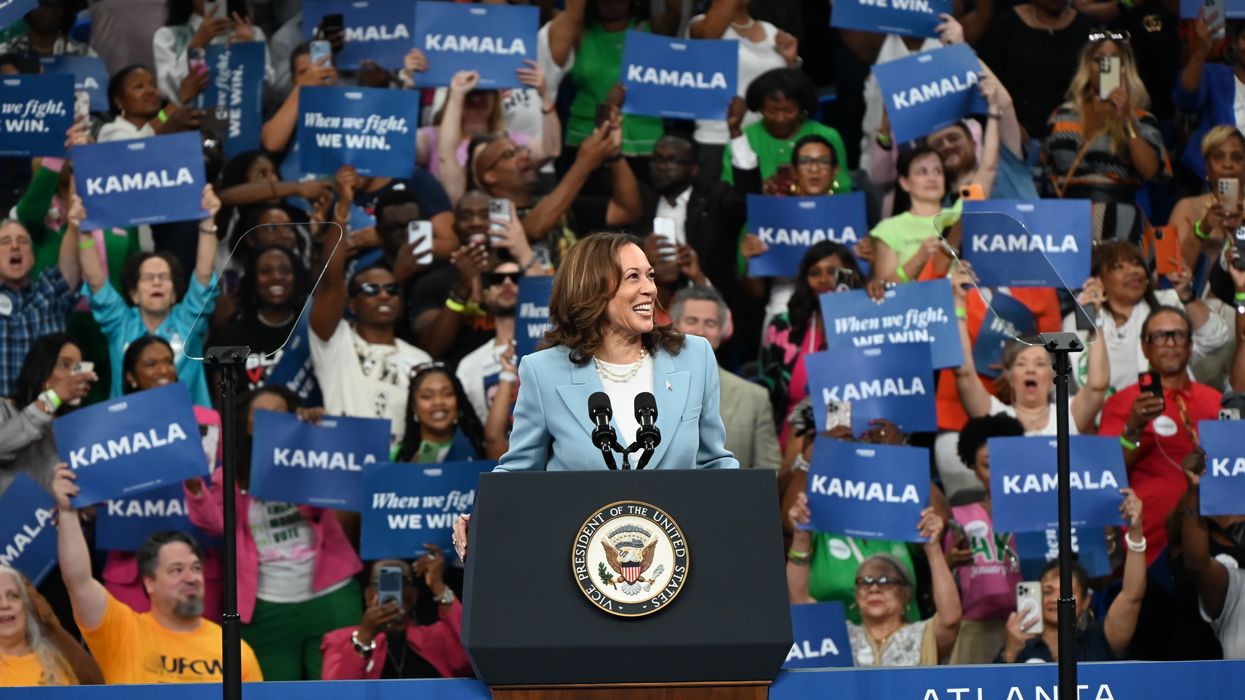
The push for Medicare for All in the U.S., meanwhile, remains muted, despite the failures of the U.S. healthcare system. Vice President Kamala Harris, the Democratic presidential nominee, co-sponsored Medicare for All legislation as a senator, but hasn't included it as part of her 2024 platform.
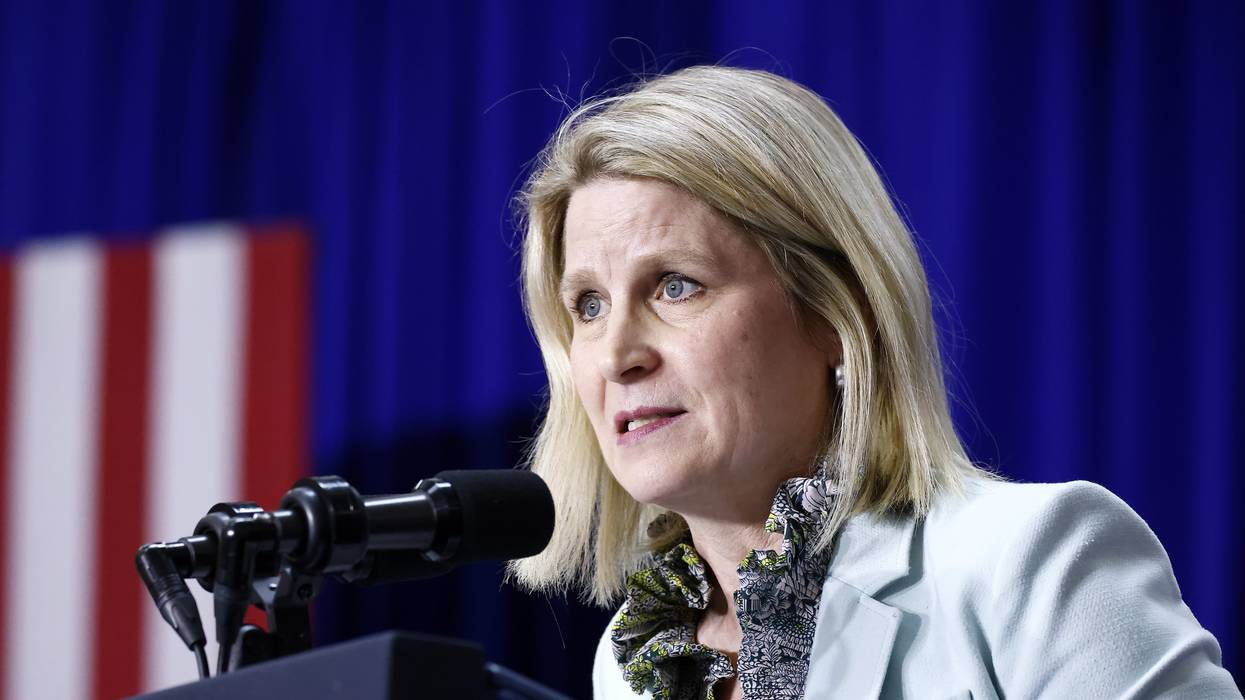
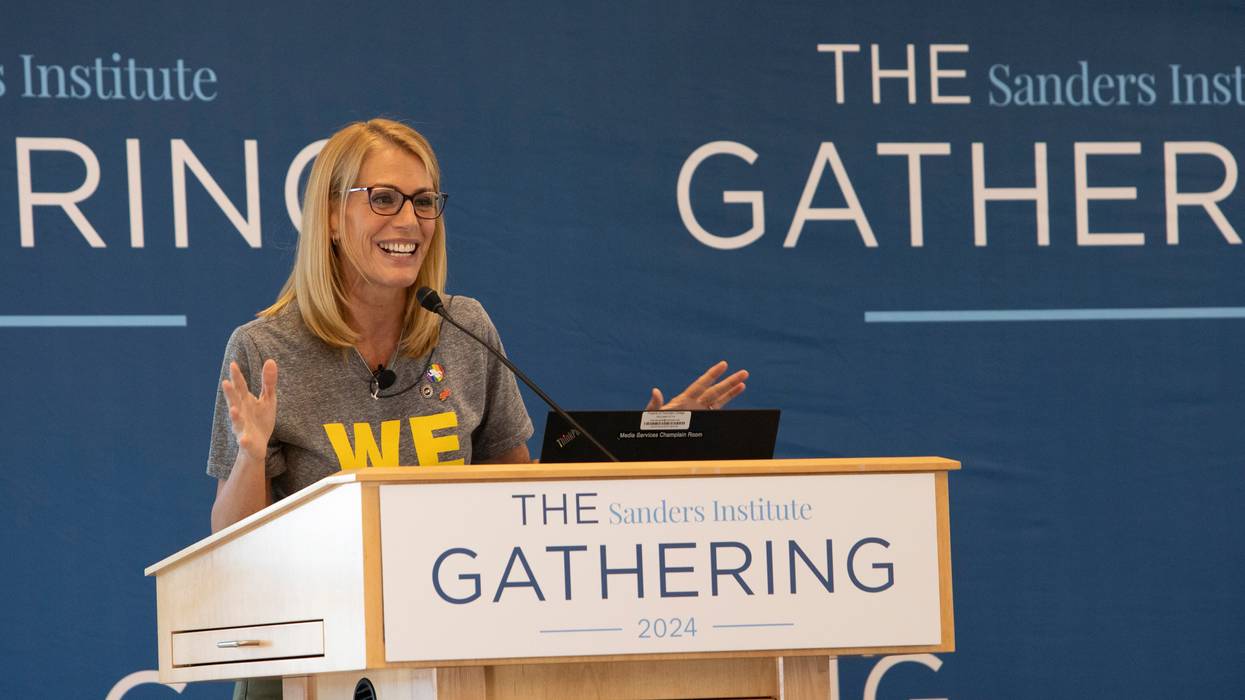
President of the Association of Flight Attendants-CWA (AFA), Nelson argues that what constitutes those specific "issues that really matter" has not changed very much since Franklin Delano Roosevelt promoted his Economic Bill of Rights nearly 80 years ago: a living wage and dignity at work, decent and affordable housing, universal healthcare, quality education for all, retirement security, and a life with recreation and leisure not just toil and labor.
"Stop doing bullshit applause lines and do real work on workers' rights." —AFA president Sara Nelson
While the Republican Party remains the chief political obstacle to achieving those goals, says Nelson—currently at the bargaining table representing her members in contract negotiations with several major airline carriers—the Democrats also have a long way to go. Meanwhile, the corporate interests that pump massive amounts of money into both major parties can only be challenged by a more cohesive and strategically-minded working class.
"Democrats in general," she says, "need to get back to talking about that Economic Bill of Rights fundamentally across the board. And that is what is going to attract people to the party—not just talking about it, but fighting for it and having actual demands."
In a series of discussions during and after The Sanders Institute Gathering that took place in Burlington, Vermont on the first weekend of June, Nelson explained how being "pro-labor," regardless of party affiliation, "has to be more than just not killing labor every single day."
"It has to be more than that," she told Common Dreams during a lengthy interview, "and it has to be more than politicians going to a rally and saying the same tired applause lines that they've been saying for 80 years—things like: 'We like labor because you gave us the 8-hour work day.'"
"I promise you, politician," she continued, "that the vast majority of people in the audience listening to you no longer have an eight-hour day. It is the same with the line about how it was labor who delivered the weekend. I promise you, the vast majority of people in the audience do not have their weekends off anymore. 'Oh, labor that gave us sick leave and vacations!' Same thing again. Stop doing bullshit applause lines and do real work on workers' rights."
In Vermont, Nelson explained to attendees at the Sanders Institute event that "the labor movement"—especially in a nation that is 90 percent non-unionized—"is the entire working class, not just people who currently have a union card."
Saru Jayaraman, a professor at the University of California, Berkeley and president of the advocacy group One Fair Wage, which she co-founded, explained to those at the Gathering how the approximately 13 million restaurant and food service workers her group represents are on the front lines of a largely non-unionized worker movement focused like a laser on improving the material conditions of individual, families, and the wider working class.
During her earlier organizing with the Restaurant Opportunity Center (ROC) in the decade after Sept. 11, 2001, Jayaraman said that workers wherever she went—"from California to the Deep South, to the Midwest, and to the Northeast"—would all say the same thing: "It's my wages, it's my wages, it's my wages."
With a new book titled "One Fair Wage: Ending Subminimum Pay in America," and state-level ballot fights for wage increases this election season in Arizona, Michigan, Ohio, Massachusetts, and elsewhere, Jayaraman says the organizing of workers making less than $15 in real wages is vital within the nation's "absolute largest" private employer sector, the restaurant and food service industry.
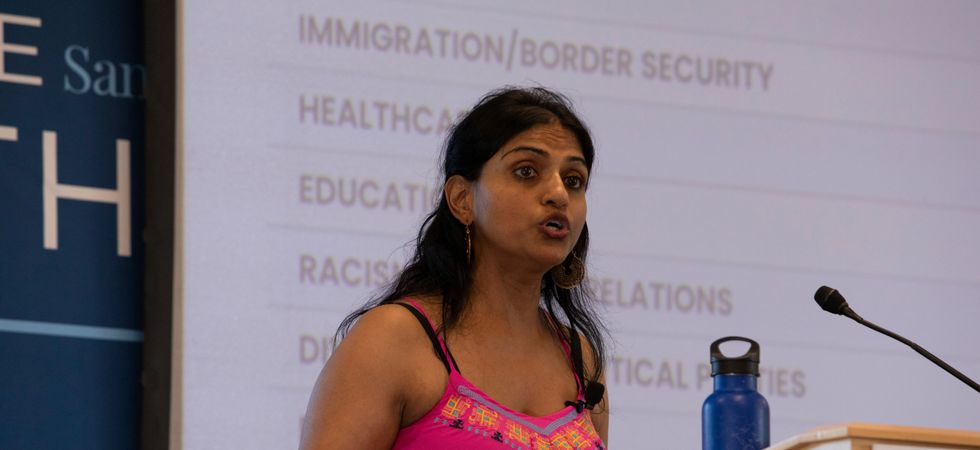 Saru Jayaraman, co-founder and president of One Fair Wage, speaking during the Gathering in Burlington, Vermont on Saturday, June 1, 2024. (Photo: Will Allen / via The Sanders Institute)
After a show of hands from audience members in Burlington who had at one point worked in a restaurant, Jayaraman reminded them how "one in two Americans has worked in the industry at some point in their lives."
"It is the largest private sector employer of women. It is the largest private sector of young people," she said. "It's the largest private sector employer of immigrants, formerly incarcerated individuals, people of color—pretty much everybody—but it is the absolute lowest-paying employer in the United States of America."
With the lobbying power of the National Restaurant Association, founded in 1919—"we call it the other NRA," Jayaraman noted—owners and investors in the food industry have generated massive profits for themselves by paying poverty wages and forcing tipped wages on their employees "for generations."
What this "other NRA" has been able to achieve over the course of its existence, she said, is ensuring that millions of restaurant workers across the country are forbidden from earning more per hour than the $2.13 that such tipped workers currently receive.
In her book, Jayaraman writes, "Subminimum wages are subhuman. They are reflection of the value America has placed on the humanity of the people" who work in those sectors.
Those receiving this paltry hourly wage, still the law in 43 U.S. states, she said in Burlington, is "not some niche group. It's where all of us worked, our kids work. It's the largest employer in America, and it gets to pay $2 an hour because we've let it."
And the current outrage among restaurant workers isn't restricted to that. In context of the Covid-19 pandemic that shook the nation and the world in 2020, Jayaraman spoke with fury about the thousands of food industry workers who "died—no, the 12,000 workers who were murdered—because they were forced to go back to work before it was safe, into an industry that the CDC named as the most dangerous place for adults to be during the pandemic."
"They died because they were poor," she roared. "For those that survived, 60% told us that tips went way down and the women, more than half of women told us harassment went way up. They said, I'm regularly asked, 'Take off your mask so I can see how cute you are before I decide how much I want to tip you.'" Reports like that from workers, she said, are endless and continue to this day.
"The only way it's going to work is that we are going to have this huge base, the ability to mobilize them, but it's got to be a thousand flowers blooming." —Saru Jayaraman, One Fair Wage
It's for these reasons and more that tipped workers are fighting for the Raise the Wage Act, a bill which passed the U.S House in 2021 but failed in the U.S. Senate despite support from Sen. Bernie Sanders (I-Vt.) and other Democrats. After House Democrats lost their House majority in 2022, Sanders reintroduced the bill in the Senate last year, but it has no hope of passing until Republican opposition is vanquished.
Again, Jayaraman pointed to the restaurant industry lobby as the key villain in the workers fight.
"They're the major opposition in every state," she said. "They're the major opposition at the federal level. And there can be no change at the federal level until we defeat the 'other NRA' and we are on our way."
What she sees in her work among non-unionized restaurant workers fighting to destroy sub-minimum wages is that it's workers that must lead.
"We are not trying to mobilize these hundreds of thousands of people in the same way," Jayaraman told Common Dreams. "The only way it's going to work is that we are going to have this huge base, the ability to mobilize them, but it's got to be a thousand flowers blooming. That is how this moment of worker power has happened."
It was workers on their own, she explained, who "started walking out of their restaurants and putting up signs saying: 'We all left. The pay is too low.' Nobody gave them a sign and trained them how to do that. There was a moment of power where they all collectively felt 'I'm worth more' and walked out."
"There's no humanity in capitalism, it's only about extracting as much profit as possible from the entire machinery, which includes human beings." —Sara Nelson
Like Jayaraman, Nelson spoke about the lessons she learned after seeing corporate bosses willing to sacrifice the safety, and even the lives, of workers at the altar of profit.
Speaking passionately about her career in the airline industry—including close colleagues killed on the hijacked planes used in the 9/11 attacks—Nelson describes the AFA as a union that centers the needs of its members but also one that recognizes its role in the broader fight for economic equality and the common good.
In the years after 2001, she saw firsthand how the industry exploited the horrific tragedy of 9/11 to undermine worker power while protecting owners and investors through a bankruptcy process.
"For me, that was real people, those were my friends and it was my friends who died too," she explained to Common Dreams. It was painful, she said, "coming to grips with the fact that there's no sympathy, there's no humanity in capitalism, it's only about extracting as much profit as possible from the entire machinery, which includes human beings."
While the union fought to protect their pensions during that time, executives were clamoring for unlimited compensation packages, Nelson recounted. It was during those battles, she said, "that I got a firsthand experience in the four D's of union busting: divide, delay, distract, and demoralize. And I saw workers go through all of those very divisive tactics."
"So the first question is, why aren't we winning? And the answer is we don't have a working-class base." —Les Leopold, Labor Institute
Joining Jayaraman and Nelson on the Sanders Institute panel focused on workers was Les Leopold, executive director of the Labor Institute and author of the new book, "Wall Street's War on Workers: How Mass Layoffs and Greed Are Destroying the Working Class and What to Do About It."
What Nelson, Jayaraman, and Leopold all argued in separate interviews with Common Dreams during and after the Gathering is that organized workers need to be at the center of fighting for their own economic well-being. A more unified and coordinated working class is also the key missing ingredient if the broader progressive agenda—from voting rights and democracy protection to the climate fight and economic battles over healthcare and housing—is ever to be won.
"There are all these organizations and we're fighting all these good fights on all these issues," Leopold said on the edge of the three-day event, referring to green groups, healthcare advocates, and organizers on a range of social justice issues gathered in Burlington. "So the first question is, why aren't we winning? And the answer is we don't have a working-class base."
Without workers in the fight in a deep and organized way, Leopold argued, progressives can't win—"or can't win substantially"—and that means new structures are needed to galvanize workers. In his book, Leopold identifies years of mass layoffs, driven in large part by stock buybacks and leveraged buyouts by private equity and other powerful investors, as evidence of the battering workers have taken from their corporate bosses and neoliberal capitalism.
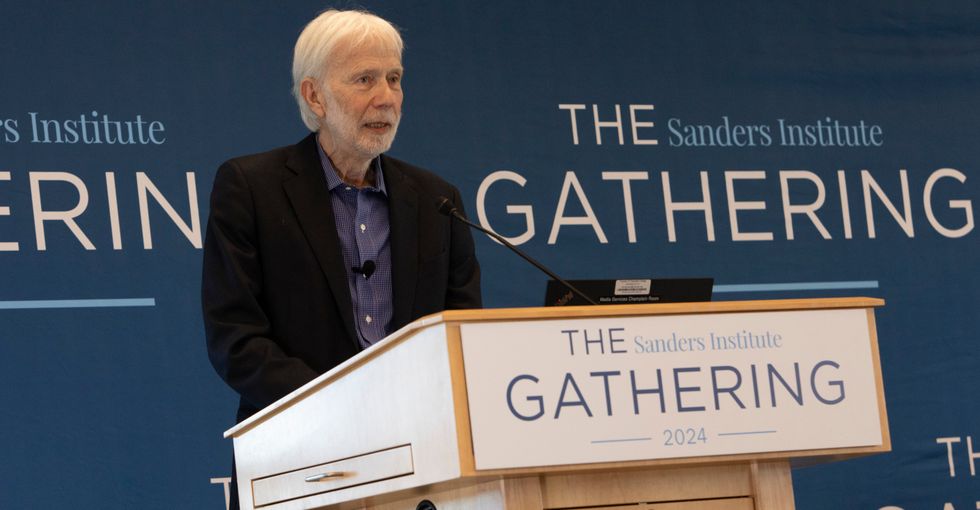 The Labor Institute's executive director Les Leopold addresses the audience in Burlington, as he called for a ban on compulsory mass layoffs for companies with federal government contracts. (Photo: Will Allen / via The Sanders Institute)
"As Wall Street has routinized the financial strip-mining of productive enterprises," Leopold writes in the book, "more than 30 million of us have experienced mass layoffs [over recent decades]. And even more have felt the pain and suffering as our family members lost jobs."
Despite that, he says, the occurrence of mass layoffs has "become so commonplace, so normalized, so routinized, that for-profit and nonprofit executives alike do not hesitate to slash jobs whenever they feel it necessary." But with a working class fractured and pummeled from the decades-long corporate crusade against unionization, Leopold told Common Dreams in Burlington that he believes a fight against mass layoffs could be a way to help turn the tide.
"Why are working class people apathetic about politics?" asked Leopold. "Because politics is completely dominated by corporations and they're totally alienated from that. We've got to fight the class war around politics. We have got to get working-class control over politics."
"The working class is going to save the working class. It's never going to be a party."
Nelson echoed that, saying the policies passed in Congress "are not going to be the policies we need until we extract money from our politics."
Getting corporate money out of politics can't be won in Congress "because we don't have the politicians in office that can vote it out because money is still controlling it," Nelson said. "So the only way to get at it, the only way to change our politics is to have workers in a massive way organize their unions and take the money from capital so that they don't have it to spend in our politics."
In Leopold's mind, a worker-centered politics and a "class war" framework is something "we can sell anywhere." It can work with organized workers already with labor unions like Nelson's AFA, the United Auto Workers (UAW), and other major trade unions. It can also be the linchpin for workers who are not yet organized within unions, like Jayaraman's approach with One Fair Wage.
It can work for "Trump people" that have looked to the far-right because they saw Democrats year after year not fighting for their interests, he said, and it can work for "not Trump people," who are simply looking for allies to stand with them in the demand for better wages, job security, healthcare, housing costs, and more.
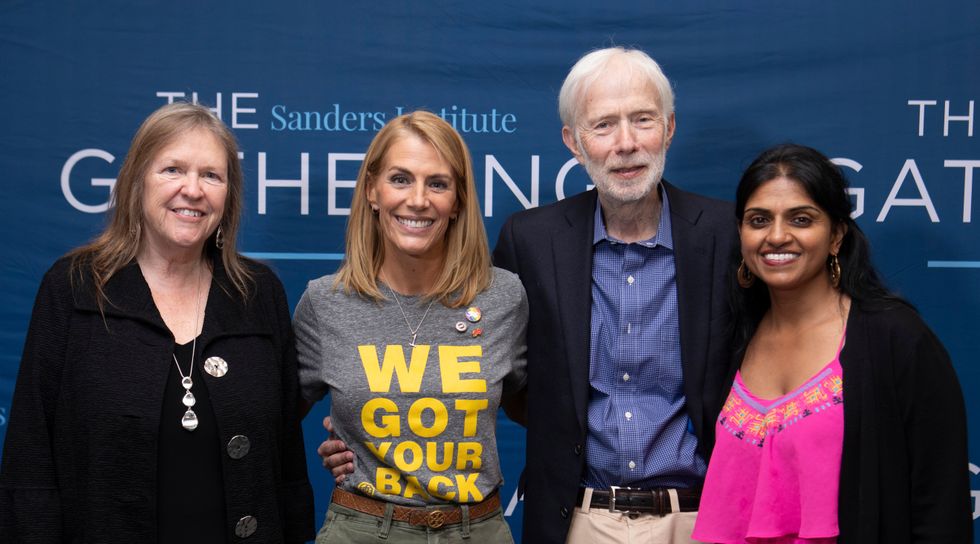 (From left) Sanders Institute co-founder Jane O'Meara Sanders, AFA president Sara Nelson, the Labor Institute's Les Leopold, and Saru Jayaraman of One Fair Wage pose for a picture together at the Gathering in Burlington, Vt. on Saturday, June 1, 2024. (Photo: Will Allen / via The Sanders Institute)
Offering a concrete example for workers to rally around, Leopold proposed in Vermont—something he has written about extensively in recent months, including for Common Dreams—is the idea of putting a target on mass layoffs and stock buybacks by large employers to help galvanize working-class power.
What he's calling for is a provision that would prohibit any company that receives a government contract from carrying out a compulsory mass layoff—defined as the termination of 50 jobs or more at one time.
"Think about how easy it is to add one sentence to a federal contract, which says: 'If you take this contract, no compulsory layoffs, no stock buybacks," Leopold told Common Dreams. Having calculated the amount of money flowing through such contracts for large corporations at about $700 billion, he admits it's not clear exactly how many jobs that could save—but it would be a significant number.
"Well, $700 billion worth of no layoffs is a lot of no layoffs," he said, but even more important is this: "It would be a fight." And if the Democratic Party was willing to put such a proposal into its 2024 platform it would be a signal that the party was willing to go to bat for working people in ways it has not done in a very long time.
"If they fight for that plank, people will hear them," said Leopold. "It would show there's a fight going on in Democratic Party on behalf of the working class. Then labor can rally. Then progressive organizations can rally. But there has to be a fight."
"You're going to conduct a mass layoff or spend billions on stock buybacks while there's layoffs, then you don't get the federal contract. The federal government has a lot of power with the purse strings that they need to use."
Last week, Leopold wrote an op-ed calling for President Joe Biden to intervene on behalf John Deere workers facing mass layoffs by the owners of the iconic tractor company. "Come on Joe, go to bat for these workers," Leopold wrote. "Put the heat on John Deere and show the working class that you’re tougher than Trump when it comes to saving American jobs."
And Nelson agrees that the onus is on the Democrats to be much bolder than they have been.
"The Democratic Party has to put working peoples central to its platform and put in its platform things like Les Leopold's idea on mass layoffs," she told Common Dreams.
"It's a very simple idea," Nelson continued, but it's exactly on the right track. "You're going to conduct a mass layoff or spend billions on stock buybacks while there are layoffs, then you don't get the federal contract. The federal government has a lot of power with the purse strings that they need to use."
Despite the hopes for big labor's abilities to get something dramatic accomplished in the coming months and years, both in their own contract fights and building up their own unions, Leopold said they also need to use their size and resources to help build "an organization for unorganized workers."
Leopold happens to think the mass layoffs could be a vehicle for that, though he admits it's not been tested and would need a much larger buy-in as a strategy before it could be proven effective. Jayaraman noted in her discussion with Common Dreams that low wages is a more likely issue for the broader working class to organize around.
"If we're waiting for the law to change, we're just going to keep waiting until we're completely extinct."
Nelson recognized the value of a number of approaches, and said unions and the unorganized workforce must go much further than they've gone since Reagan busted the PATCO strike in 1981.
"We have to organize like never before," she said, noting how large established unions like the UAW have been putting resources and energy into helping non-unionized works in the south, including Tennessee and Alabama, win recognition. "That's important," Nelson explained, "but it's also not enough if we're really going to do the kind of organizing that can truly put a check on capital and change the political environment."
When it comes to the Pro Act, or Protecting the Right to Organize Act, which would enhance workers rights and that Democrats tried but failed to pass during the first half of Biden's term, Nelson said it is very much "a chicken and egg situation." The legislation, she said, "is not going to come before we organize more workers" in order to tilt the political scales that would make passage possible.
"So if we're waiting for the law to change," she warned, "we're just going to keep waiting until we're completely extinct."
Referencing an effort by United Auto Worker's president Shawn Fain to align as many contract fights as possible around May 1, 2028 in an effort to further create broader worker solidarity and increase pressure across various trade and service union sectors and industries, Nelson expressed hope for Leopold's mass layoff idea and what Fain has proposed.
Both show, she said, "the working class that there is a way to be strategic" and can wake people up to "the power we have in standing together," whether it be on wages, firings, union card campaigns, or contract fights.
And it may not take as long as May of 2028, Nelson added. "The moment may come to us before then, but talking about and really defining the problems—which we're doing over and over again—is key, showing that these are not isolated issues," she said. "The issue with housing, the issue with gun violence, the issue with healthcare, the issue with education and debt—these are not isolated issues. The issue is pure and simple corporate greed, and that's what we have to organize against."
"The issue with housing, the issue with gun violence, the issue with healthcare, the issue with education and debt—these are not isolated issues. The issue is pure and simple corporate greed, and that's what we have to organize against."
"Solidarity is our power," Nelson explained during her interview with Common Dreams. "And so the strike is not itself the most powerful weapon here. It is the consciousness of worker power and the threat of the strike that is going to make change in our economy and in people's lives."
In a podcast interview with Sen. Bernie Sanders earlier this week, Fain of the UAW spoke along similar lines.
"We have to harness that power" of working-class power led by organized labor, Fain said to Sanders.
"Union or not, we have to bring workers together all over, not just in America, but all over the globe," Fain continued. "We want to see working-class people all over this globe come together. The only way we're going to beat the corporate global fight is by standing together globally and fighting for better standards for everyone and standard wages for everyone. So we lift everyone up everywhere. And to a lot of people, that seems like a pipe dream. I don't believe it is."
It was during the panel discussion in Burlington that Nelson looked out at the audience where Sen. Sanders—"our organizer-in-chief," she called him—was seated and thanked him for the leadership he showed in both 2016 and 2020 while seeking the Democratic nomination for president.
"We want to see working-class people all over this globe come together." —UAW president Shawn Fain
"One of the reasons that unions are one of the most popular ideas in this country is because Bernie Sanders went around this country telling people that the trade union movement is the only way for us to lift up the standards for the working class," Nelson said. "It is the only way to get back to the issues that we were talking about a hundred years ago and pushing forward on them. It is the only way to build the power that we need to change our politics. It is the only way to give working people agency to feel the democracy is something that they own, not what the capital class does."
While speaking of Trump—who "lives the very antithesis of what it means to be union"—and his Republican Party with outright contempt as enemies of working people everywhere, Nelson was clear that nobody should think the Democratic Party is riding courageously to the rescue of the tens of millions of workers who toil and sweat to provide themselves and their families a decent life.
"The working class is going to save the working class," she said. "It's never going to be a party. We are going to bring politics to us if we do our jobs right. It doesn't happen the other way around."