SUBSCRIBE TO OUR FREE NEWSLETTER
Daily news & progressive opinion—funded by the people, not the corporations—delivered straight to your inbox.
5
#000000
#FFFFFF
To donate by check, phone, or other method, see our More Ways to Give page.
Daily news & progressive opinion—funded by the people, not the corporations—delivered straight to your inbox.
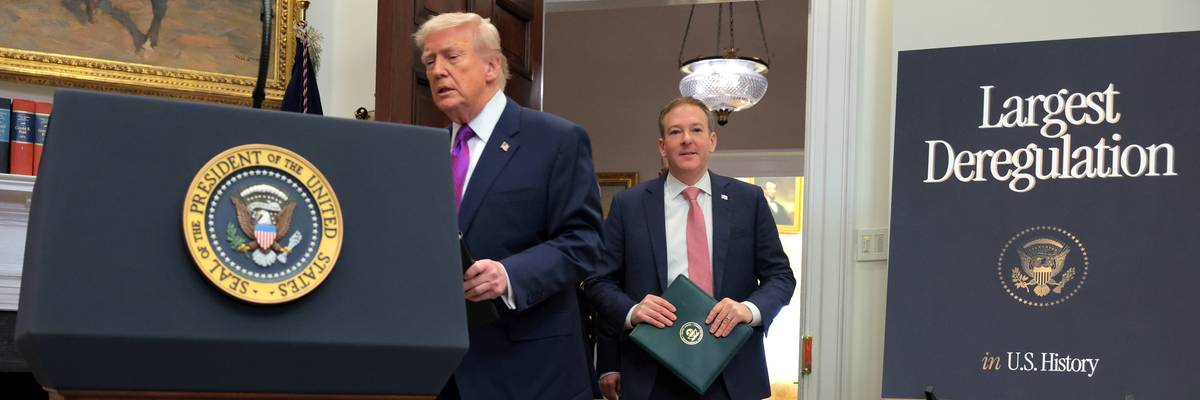
US President Donald Trump and Environmental Protection Agency Administrator Lee Zeldin arrive for an event to announce a rollback of the 2009 endangerment finding in the Roosevelt Room at the White House in Washington, DC on February 12, 2026.
"The fossil fuel industry and this administration's policies are adding fuel to the fire, and ordinary ratepayers are the ones getting burned," said one campaigner.
The Trump administration's rollback of clean energy policies will cost American consumers $650 billion in additional energy bills by 2040, according to an analysis published Wednesday by a nonpartisan think tank.
Energy Innovation, a San Francisco-based energy and climate policy think tank, said in its report that "federal policy changes since January 2025 will increase energy prices, slow economic growth and job creation, increase air pollution and healthcare costs, and worsen grid reliability."
The analysis examines seven major policy shifts during the second term of President Donald Trump, who—for the third time—ran on an aggressively pro-fossil fuel and anti-clean energy platform:
According to the analysis, "Households will pay an additional $650 billion for energy—an average of $460 per household in 2035 and $490 in 2040."
Additionally, the report states that "cutting policies that drive innovation and efficiency in the transportation sector will inflate gasoline prices 14% in 2035 and 26% in 2040, atop near-term upward pressure from the Iran War and other market forces."
"OBBBA and reduced federal support for domestic manufacturing and innovation will cost the US economy 820,000 jobs per year on average over the next decade, in addition to the 144,000 clean energy jobs lost within the past 18 months," the publication forecasts.
"Slowing down electrification and domestic energy manufacturing will lower [gross domestic product] in all years, totaling $2.3 trillion cumulative lost GDP, with effects flowing into other economic sectors," the study warns. "The US economy will lose $150 billion in GDP in 2030, peaking at a $250 billion net loss in 2032, then reverting to losses of $200 billion in 2035 and $120 billion in 2040."
Furthermore, "worsening local air pollution will raise healthcare costs by $43 billion, with annual increases of $4 billion in 2035 and $4.5 billion in 2040, contributing to rising household costs alongside rising energy prices and goods inflation."
Energy Innovation stressed that states must act to mitigate the costs and harms of federal inaction. The report recommends helping wind and solar projects qualify for expiring tax credits under safe harbor rules, removing barriers to additional clean energy development, boosting electric vehicles, supporting energy efficient electrification, and stimulating investment in new clean industries.
The new analysis—whose findings are disputed by the Trump administration—comes amid an unabated affordability crisis that Trump vowed to tackle, and as electricity prices soar in much of the nation as a heat dome, fueled by human burning of fossil fuels, broils large swaths of the country in what many experts warn is the new normal in a worsening climate emergency.
Responding to the analysis, Candice Fortin, US campaigns manager at the climate action group 350.org, said: "This report puts numbers on something households are already feeling in their bills and their blackouts. We were told cutting clean energy would lower costs. Instead, we’re seeing the opposite: rates spiking, grids failing under record heat, and households paying more while data centers’ electricity use explodes."
"You can’t fix an affordability crisis by blocking the cheapest, fastest power we have to build," Fortin added. "The fossil fuel industry and this administration’s policies are adding fuel to the fire, and ordinary ratepayers are the ones getting burned.”
Dear Common Dreams reader, It’s been nearly 30 years since I co-founded Common Dreams with my late wife, Lina Newhouser. We had the radical notion that journalism should serve the public good, not corporate profits. It was clear to us from the outset what it would take to build such a project. No paid advertisements. No corporate sponsors. No millionaire publisher telling us what to think or do. Many people said we wouldn't last a year, but we proved those doubters wrong. Together with a tremendous team of journalists and dedicated staff, we built an independent media outlet free from the constraints of profits and corporate control. Our mission has always been simple: To inform. To inspire. To ignite change for the common good. Building Common Dreams was not easy. Our survival was never guaranteed. When you take on the most powerful forces—Wall Street greed, fossil fuel industry destruction, Big Tech lobbyists, and uber-rich oligarchs who have spent billions upon billions rigging the economy and democracy in their favor—the only bulwark you have is supporters who believe in your work. But here’s the urgent message from me today. It's never been this bad out there. And it's never been this hard to keep us going. At the very moment Common Dreams is most needed, the threats we face are intensifying. We need your support now more than ever. We don't accept corporate advertising and never will. We don't have a paywall because we don't think people should be blocked from critical news based on their ability to pay. Everything we do is funded by the donations of readers like you. When everyone does the little they can afford, we are strong. But if that support retreats or dries up, so do we. Will you donate now to make sure Common Dreams not only survives but thrives? —Craig Brown, Co-founder |
The Trump administration's rollback of clean energy policies will cost American consumers $650 billion in additional energy bills by 2040, according to an analysis published Wednesday by a nonpartisan think tank.
Energy Innovation, a San Francisco-based energy and climate policy think tank, said in its report that "federal policy changes since January 2025 will increase energy prices, slow economic growth and job creation, increase air pollution and healthcare costs, and worsen grid reliability."
The analysis examines seven major policy shifts during the second term of President Donald Trump, who—for the third time—ran on an aggressively pro-fossil fuel and anti-clean energy platform:
According to the analysis, "Households will pay an additional $650 billion for energy—an average of $460 per household in 2035 and $490 in 2040."
Additionally, the report states that "cutting policies that drive innovation and efficiency in the transportation sector will inflate gasoline prices 14% in 2035 and 26% in 2040, atop near-term upward pressure from the Iran War and other market forces."
"OBBBA and reduced federal support for domestic manufacturing and innovation will cost the US economy 820,000 jobs per year on average over the next decade, in addition to the 144,000 clean energy jobs lost within the past 18 months," the publication forecasts.
"Slowing down electrification and domestic energy manufacturing will lower [gross domestic product] in all years, totaling $2.3 trillion cumulative lost GDP, with effects flowing into other economic sectors," the study warns. "The US economy will lose $150 billion in GDP in 2030, peaking at a $250 billion net loss in 2032, then reverting to losses of $200 billion in 2035 and $120 billion in 2040."
Furthermore, "worsening local air pollution will raise healthcare costs by $43 billion, with annual increases of $4 billion in 2035 and $4.5 billion in 2040, contributing to rising household costs alongside rising energy prices and goods inflation."
Energy Innovation stressed that states must act to mitigate the costs and harms of federal inaction. The report recommends helping wind and solar projects qualify for expiring tax credits under safe harbor rules, removing barriers to additional clean energy development, boosting electric vehicles, supporting energy efficient electrification, and stimulating investment in new clean industries.
The new analysis—whose findings are disputed by the Trump administration—comes amid an unabated affordability crisis that Trump vowed to tackle, and as electricity prices soar in much of the nation as a heat dome, fueled by human burning of fossil fuels, broils large swaths of the country in what many experts warn is the new normal in a worsening climate emergency.
Responding to the analysis, Candice Fortin, US campaigns manager at the climate action group 350.org, said: "This report puts numbers on something households are already feeling in their bills and their blackouts. We were told cutting clean energy would lower costs. Instead, we’re seeing the opposite: rates spiking, grids failing under record heat, and households paying more while data centers’ electricity use explodes."
"You can’t fix an affordability crisis by blocking the cheapest, fastest power we have to build," Fortin added. "The fossil fuel industry and this administration’s policies are adding fuel to the fire, and ordinary ratepayers are the ones getting burned.”
The Trump administration's rollback of clean energy policies will cost American consumers $650 billion in additional energy bills by 2040, according to an analysis published Wednesday by a nonpartisan think tank.
Energy Innovation, a San Francisco-based energy and climate policy think tank, said in its report that "federal policy changes since January 2025 will increase energy prices, slow economic growth and job creation, increase air pollution and healthcare costs, and worsen grid reliability."
The analysis examines seven major policy shifts during the second term of President Donald Trump, who—for the third time—ran on an aggressively pro-fossil fuel and anti-clean energy platform:
According to the analysis, "Households will pay an additional $650 billion for energy—an average of $460 per household in 2035 and $490 in 2040."
Additionally, the report states that "cutting policies that drive innovation and efficiency in the transportation sector will inflate gasoline prices 14% in 2035 and 26% in 2040, atop near-term upward pressure from the Iran War and other market forces."
"OBBBA and reduced federal support for domestic manufacturing and innovation will cost the US economy 820,000 jobs per year on average over the next decade, in addition to the 144,000 clean energy jobs lost within the past 18 months," the publication forecasts.
"Slowing down electrification and domestic energy manufacturing will lower [gross domestic product] in all years, totaling $2.3 trillion cumulative lost GDP, with effects flowing into other economic sectors," the study warns. "The US economy will lose $150 billion in GDP in 2030, peaking at a $250 billion net loss in 2032, then reverting to losses of $200 billion in 2035 and $120 billion in 2040."
Furthermore, "worsening local air pollution will raise healthcare costs by $43 billion, with annual increases of $4 billion in 2035 and $4.5 billion in 2040, contributing to rising household costs alongside rising energy prices and goods inflation."
Energy Innovation stressed that states must act to mitigate the costs and harms of federal inaction. The report recommends helping wind and solar projects qualify for expiring tax credits under safe harbor rules, removing barriers to additional clean energy development, boosting electric vehicles, supporting energy efficient electrification, and stimulating investment in new clean industries.
The new analysis—whose findings are disputed by the Trump administration—comes amid an unabated affordability crisis that Trump vowed to tackle, and as electricity prices soar in much of the nation as a heat dome, fueled by human burning of fossil fuels, broils large swaths of the country in what many experts warn is the new normal in a worsening climate emergency.
Responding to the analysis, Candice Fortin, US campaigns manager at the climate action group 350.org, said: "This report puts numbers on something households are already feeling in their bills and their blackouts. We were told cutting clean energy would lower costs. Instead, we’re seeing the opposite: rates spiking, grids failing under record heat, and households paying more while data centers’ electricity use explodes."
"You can’t fix an affordability crisis by blocking the cheapest, fastest power we have to build," Fortin added. "The fossil fuel industry and this administration’s policies are adding fuel to the fire, and ordinary ratepayers are the ones getting burned.”