SUBSCRIBE TO OUR FREE NEWSLETTER
Daily news & progressive opinion—funded by the people, not the corporations—delivered straight to your inbox.
5
#000000
#FFFFFF
To donate by check, phone, or other method, see our More Ways to Give page.
Daily news & progressive opinion—funded by the people, not the corporations—delivered straight to your inbox.
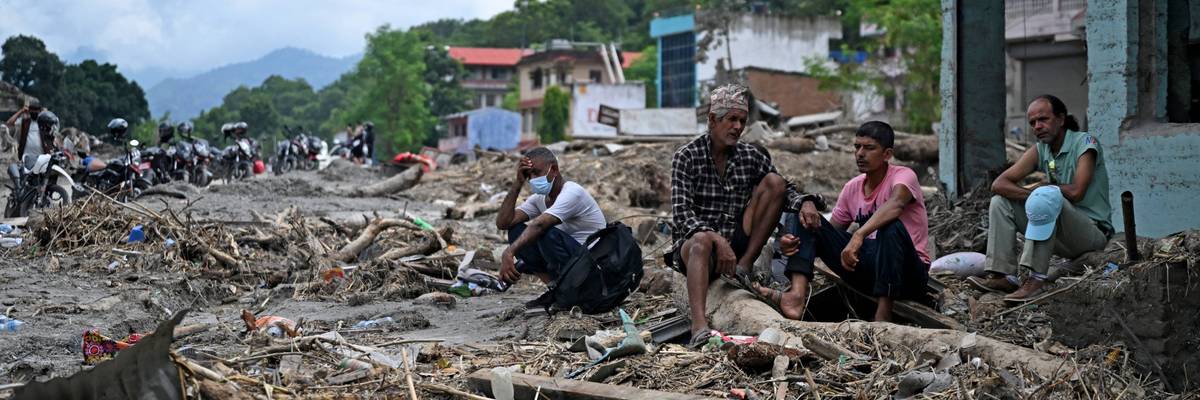
Residents sit beside debris following flash floods in Devighat, in Nepal's Nuwakot district, on August 31, 2026.
"The glacial collapse and deluge," one scientist said, "was the structural failure of a mountain itself, nature's latest commentary on the deadly consequences of human-caused planetary warming."
With more than 1,000 people dead as of Tuesday and rescue teams still searching for the thousands missing after a glacial collapse in the Himalayas that created a flooding crisis in Nepal and Tibet last week, campaigners, politicians, and scientists reiterated the need for global climate action.
China confirmed at least 16 people are dead and 546 are missing in Tibet, including 261 foreign nationals, while Nepal reported 1,003 deaths and 3,916 more unaccounted for, including 583 foreigners, according to The Associated Press. Among those missing in Nepal are about 900 workers from a dozen hydropower projects, 500 of whom are believed to be trapped in tunnels.
Thousands have been rescued since last Wednesday, and as the AP noted, "authorities in Nepal have been burying bodies in temporary graves until they can be identified. They are preserving DNA samples, photographing distinguishing facial features, and recording other identifying details. Each body is assigned a reference number to help families identify and claim the remains later."
Nepali Prime Minister Balendra Shah has emphasized in recent days that "the flood in the Bhote Koshi River in Rasuwa was not an ordinary flood," and "it is now time for us to strongly raise with the international community the issue of the disasters we are experiencing as a result of climate change."
In a Monday interview with The New York Times, Maheshwar Dhakal from Nepal's Ministry of Agriculture, Forest, and Environment also linked the disaster to human-caused climate change and said that "those who have contributed the least are suffering the most."
Dhakal estimated the recovery cost at $5 billion, and shared his government's letter to the United Nations' fund for such disasters, which says in part that "early action in Nepal would send a signal that the fund is capable of responding with humanity, speed, flexibility, and solidarity when climate-vulnerable countries face losses and damages beyond their capacity to address alone."
Declare a world-wide #climate emergency www.nytimes.com/live/2026/08... #nepal #floods #flooding
[image or embed]
— Nikolas Kozloff (@nikolaskozloff.bsky.social) August 27, 2026 at 4:29 PM
Stefan Rahmstorf, a scientist at the Potsdam Institute for Climate Impact Research in Germany, highlighted on social media Tuesday that experts have long warned about the kinds of disasters seen in the Himalayas over the past week.
"Why are climate scientists not surprised about mountains being destabilized by glacier melt and permafrost thaw?" he asked. "Because they have long predicted that as a result of global heating."
Bill McGuire, professor emeritus of geophysical and climate hazards at University College London, wrote in a Tuesday column for The Guardian that "the increasingly temperamental behavior of the Earth beneath our feet teaches us that global heating is all-pervasive. It will intrude into every aspect of our lives and livelihoods, and leave no part of the planet untouched. As the world processes the horror of the events in Nepal and Tibet, it is a lesson that we ignore at our peril."
Also writing for the British newspaper on Tuesday, Michael Mann, a renowned climate scientist at the University of Pennsylvania, similarly stressed that "the glacial collapse and deluge in Nepal and Tibet was not a freak weather event; it was the structural failure of a mountain itself, nature's latest commentary on the deadly consequences of human-caused planetary warming. And it was the exclamation point on a summer of extremes, illustrating with a sole unnatural disaster the apocalyptic future that lies in store if we fail to take dramatic climate action."
Mann pointed to the lack of such action in the United States—the world's largest historical climate polluter—where President Donald Trump openly courted Big Oil on the campaign trail and has served the climate-wrecking fossil fuel industry's interests since returning to the White House last year, from declaring a national energy emergency and ditching the Paris Agreement, again, to waging a war on renewable power projects.
"Trump and enabling congressional Republicans continue to double down on policies favoring fossil fuel extraction and dependence at the very time we need to be moving even more quickly away from fossil fuels toward clean energy," Mann wrote. "These extreme events underscore the urgency of taking action now, and—while there are many things we can do—one of the greatest opportunities Americans will have to affect climate policy is the upcoming midterm election. You can make support for urgent and dramatic climate action a litmus test issue as you go to the voting booth."
Highlighting that dozens of Americans are among those still missing in Asia, the US-based watchdog group Public Citizen argued on social media Tuesday that "this isn't just a climate change catastrophe. It's a crime. For decades, Big Oil knew fossil fuels would lead to disasters like this. Big Oil must be held accountable."
In 2024, the group published a legal memo detailing how local or state prosecutors in the United States could bring criminal charges against Big Oil for deaths from extreme heat made more likely by the fossil fuel-driven climate emergency. With rapidly advancing attribution science, the approach could also be applied to other disasters linked to the human-caused crisis.
Greenpeace International also demanded accountability for the industry on Tuesday, saying that "it makes us SICK to think of people losing their homes, their livelihoods, and the people they love to fires, floods, and storms, while fossil fuel companies make billions. A FRACTION of those obscene profits could help communities rebuild. MAKE POLLUTERS PAY."
"Make oil, coal, and gas corporations pay their fair share for the damage they cause," the advocacy group added. "Introduce new taxes or fines on them to help communities at home and around the world rebuild from climate disasters and invest in climate solutions."
Dear Common Dreams reader, It’s been nearly 30 years since I co-founded Common Dreams with my late wife, Lina Newhouser. We had the radical notion that journalism should serve the public good, not corporate profits. It was clear to us from the outset what it would take to build such a project. No paid advertisements. No corporate sponsors. No millionaire publisher telling us what to think or do. Many people said we wouldn't last a year, but we proved those doubters wrong. Together with a tremendous team of journalists and dedicated staff, we built an independent media outlet free from the constraints of profits and corporate control. Our mission has always been simple: To inform. To inspire. To ignite change for the common good. Building Common Dreams was not easy. Our survival was never guaranteed. When you take on the most powerful forces—Wall Street greed, fossil fuel industry destruction, Big Tech lobbyists, and uber-rich oligarchs who have spent billions upon billions rigging the economy and democracy in their favor—the only bulwark you have is supporters who believe in your work. But here’s the urgent message from me today. It's never been this bad out there. And it's never been this hard to keep us going. At the very moment Common Dreams is most needed, the threats we face are intensifying. We need your support now more than ever. We don't accept corporate advertising and never will. We don't have a paywall because we don't think people should be blocked from critical news based on their ability to pay. Everything we do is funded by the donations of readers like you. When everyone does the little they can afford, we are strong. But if that support retreats or dries up, so do we. Will you donate now to make sure Common Dreams not only survives but thrives? —Craig Brown, Co-founder |
With more than 1,000 people dead as of Tuesday and rescue teams still searching for the thousands missing after a glacial collapse in the Himalayas that created a flooding crisis in Nepal and Tibet last week, campaigners, politicians, and scientists reiterated the need for global climate action.
China confirmed at least 16 people are dead and 546 are missing in Tibet, including 261 foreign nationals, while Nepal reported 1,003 deaths and 3,916 more unaccounted for, including 583 foreigners, according to The Associated Press. Among those missing in Nepal are about 900 workers from a dozen hydropower projects, 500 of whom are believed to be trapped in tunnels.
Thousands have been rescued since last Wednesday, and as the AP noted, "authorities in Nepal have been burying bodies in temporary graves until they can be identified. They are preserving DNA samples, photographing distinguishing facial features, and recording other identifying details. Each body is assigned a reference number to help families identify and claim the remains later."
Nepali Prime Minister Balendra Shah has emphasized in recent days that "the flood in the Bhote Koshi River in Rasuwa was not an ordinary flood," and "it is now time for us to strongly raise with the international community the issue of the disasters we are experiencing as a result of climate change."
In a Monday interview with The New York Times, Maheshwar Dhakal from Nepal's Ministry of Agriculture, Forest, and Environment also linked the disaster to human-caused climate change and said that "those who have contributed the least are suffering the most."
Dhakal estimated the recovery cost at $5 billion, and shared his government's letter to the United Nations' fund for such disasters, which says in part that "early action in Nepal would send a signal that the fund is capable of responding with humanity, speed, flexibility, and solidarity when climate-vulnerable countries face losses and damages beyond their capacity to address alone."
Declare a world-wide #climate emergency www.nytimes.com/live/2026/08... #nepal #floods #flooding
[image or embed]
— Nikolas Kozloff (@nikolaskozloff.bsky.social) August 27, 2026 at 4:29 PM
Stefan Rahmstorf, a scientist at the Potsdam Institute for Climate Impact Research in Germany, highlighted on social media Tuesday that experts have long warned about the kinds of disasters seen in the Himalayas over the past week.
"Why are climate scientists not surprised about mountains being destabilized by glacier melt and permafrost thaw?" he asked. "Because they have long predicted that as a result of global heating."
Bill McGuire, professor emeritus of geophysical and climate hazards at University College London, wrote in a Tuesday column for The Guardian that "the increasingly temperamental behavior of the Earth beneath our feet teaches us that global heating is all-pervasive. It will intrude into every aspect of our lives and livelihoods, and leave no part of the planet untouched. As the world processes the horror of the events in Nepal and Tibet, it is a lesson that we ignore at our peril."
Also writing for the British newspaper on Tuesday, Michael Mann, a renowned climate scientist at the University of Pennsylvania, similarly stressed that "the glacial collapse and deluge in Nepal and Tibet was not a freak weather event; it was the structural failure of a mountain itself, nature's latest commentary on the deadly consequences of human-caused planetary warming. And it was the exclamation point on a summer of extremes, illustrating with a sole unnatural disaster the apocalyptic future that lies in store if we fail to take dramatic climate action."
Mann pointed to the lack of such action in the United States—the world's largest historical climate polluter—where President Donald Trump openly courted Big Oil on the campaign trail and has served the climate-wrecking fossil fuel industry's interests since returning to the White House last year, from declaring a national energy emergency and ditching the Paris Agreement, again, to waging a war on renewable power projects.
"Trump and enabling congressional Republicans continue to double down on policies favoring fossil fuel extraction and dependence at the very time we need to be moving even more quickly away from fossil fuels toward clean energy," Mann wrote. "These extreme events underscore the urgency of taking action now, and—while there are many things we can do—one of the greatest opportunities Americans will have to affect climate policy is the upcoming midterm election. You can make support for urgent and dramatic climate action a litmus test issue as you go to the voting booth."
Highlighting that dozens of Americans are among those still missing in Asia, the US-based watchdog group Public Citizen argued on social media Tuesday that "this isn't just a climate change catastrophe. It's a crime. For decades, Big Oil knew fossil fuels would lead to disasters like this. Big Oil must be held accountable."
In 2024, the group published a legal memo detailing how local or state prosecutors in the United States could bring criminal charges against Big Oil for deaths from extreme heat made more likely by the fossil fuel-driven climate emergency. With rapidly advancing attribution science, the approach could also be applied to other disasters linked to the human-caused crisis.
Greenpeace International also demanded accountability for the industry on Tuesday, saying that "it makes us SICK to think of people losing their homes, their livelihoods, and the people they love to fires, floods, and storms, while fossil fuel companies make billions. A FRACTION of those obscene profits could help communities rebuild. MAKE POLLUTERS PAY."
"Make oil, coal, and gas corporations pay their fair share for the damage they cause," the advocacy group added. "Introduce new taxes or fines on them to help communities at home and around the world rebuild from climate disasters and invest in climate solutions."
With more than 1,000 people dead as of Tuesday and rescue teams still searching for the thousands missing after a glacial collapse in the Himalayas that created a flooding crisis in Nepal and Tibet last week, campaigners, politicians, and scientists reiterated the need for global climate action.
China confirmed at least 16 people are dead and 546 are missing in Tibet, including 261 foreign nationals, while Nepal reported 1,003 deaths and 3,916 more unaccounted for, including 583 foreigners, according to The Associated Press. Among those missing in Nepal are about 900 workers from a dozen hydropower projects, 500 of whom are believed to be trapped in tunnels.
Thousands have been rescued since last Wednesday, and as the AP noted, "authorities in Nepal have been burying bodies in temporary graves until they can be identified. They are preserving DNA samples, photographing distinguishing facial features, and recording other identifying details. Each body is assigned a reference number to help families identify and claim the remains later."
Nepali Prime Minister Balendra Shah has emphasized in recent days that "the flood in the Bhote Koshi River in Rasuwa was not an ordinary flood," and "it is now time for us to strongly raise with the international community the issue of the disasters we are experiencing as a result of climate change."
In a Monday interview with The New York Times, Maheshwar Dhakal from Nepal's Ministry of Agriculture, Forest, and Environment also linked the disaster to human-caused climate change and said that "those who have contributed the least are suffering the most."
Dhakal estimated the recovery cost at $5 billion, and shared his government's letter to the United Nations' fund for such disasters, which says in part that "early action in Nepal would send a signal that the fund is capable of responding with humanity, speed, flexibility, and solidarity when climate-vulnerable countries face losses and damages beyond their capacity to address alone."
Declare a world-wide #climate emergency www.nytimes.com/live/2026/08... #nepal #floods #flooding
[image or embed]
— Nikolas Kozloff (@nikolaskozloff.bsky.social) August 27, 2026 at 4:29 PM
Stefan Rahmstorf, a scientist at the Potsdam Institute for Climate Impact Research in Germany, highlighted on social media Tuesday that experts have long warned about the kinds of disasters seen in the Himalayas over the past week.
"Why are climate scientists not surprised about mountains being destabilized by glacier melt and permafrost thaw?" he asked. "Because they have long predicted that as a result of global heating."
Bill McGuire, professor emeritus of geophysical and climate hazards at University College London, wrote in a Tuesday column for The Guardian that "the increasingly temperamental behavior of the Earth beneath our feet teaches us that global heating is all-pervasive. It will intrude into every aspect of our lives and livelihoods, and leave no part of the planet untouched. As the world processes the horror of the events in Nepal and Tibet, it is a lesson that we ignore at our peril."
Also writing for the British newspaper on Tuesday, Michael Mann, a renowned climate scientist at the University of Pennsylvania, similarly stressed that "the glacial collapse and deluge in Nepal and Tibet was not a freak weather event; it was the structural failure of a mountain itself, nature's latest commentary on the deadly consequences of human-caused planetary warming. And it was the exclamation point on a summer of extremes, illustrating with a sole unnatural disaster the apocalyptic future that lies in store if we fail to take dramatic climate action."
Mann pointed to the lack of such action in the United States—the world's largest historical climate polluter—where President Donald Trump openly courted Big Oil on the campaign trail and has served the climate-wrecking fossil fuel industry's interests since returning to the White House last year, from declaring a national energy emergency and ditching the Paris Agreement, again, to waging a war on renewable power projects.
"Trump and enabling congressional Republicans continue to double down on policies favoring fossil fuel extraction and dependence at the very time we need to be moving even more quickly away from fossil fuels toward clean energy," Mann wrote. "These extreme events underscore the urgency of taking action now, and—while there are many things we can do—one of the greatest opportunities Americans will have to affect climate policy is the upcoming midterm election. You can make support for urgent and dramatic climate action a litmus test issue as you go to the voting booth."
Highlighting that dozens of Americans are among those still missing in Asia, the US-based watchdog group Public Citizen argued on social media Tuesday that "this isn't just a climate change catastrophe. It's a crime. For decades, Big Oil knew fossil fuels would lead to disasters like this. Big Oil must be held accountable."
In 2024, the group published a legal memo detailing how local or state prosecutors in the United States could bring criminal charges against Big Oil for deaths from extreme heat made more likely by the fossil fuel-driven climate emergency. With rapidly advancing attribution science, the approach could also be applied to other disasters linked to the human-caused crisis.
Greenpeace International also demanded accountability for the industry on Tuesday, saying that "it makes us SICK to think of people losing their homes, their livelihoods, and the people they love to fires, floods, and storms, while fossil fuel companies make billions. A FRACTION of those obscene profits could help communities rebuild. MAKE POLLUTERS PAY."
"Make oil, coal, and gas corporations pay their fair share for the damage they cause," the advocacy group added. "Introduce new taxes or fines on them to help communities at home and around the world rebuild from climate disasters and invest in climate solutions."