

SUBSCRIBE TO OUR FREE NEWSLETTER
Daily news & progressive opinion—funded by the people, not the corporations—delivered straight to your inbox.
5
#000000
#FFFFFF
To donate by check, phone, or other method, see our More Ways to Give page.
Daily news & progressive opinion—funded by the people, not the corporations—delivered straight to your inbox.
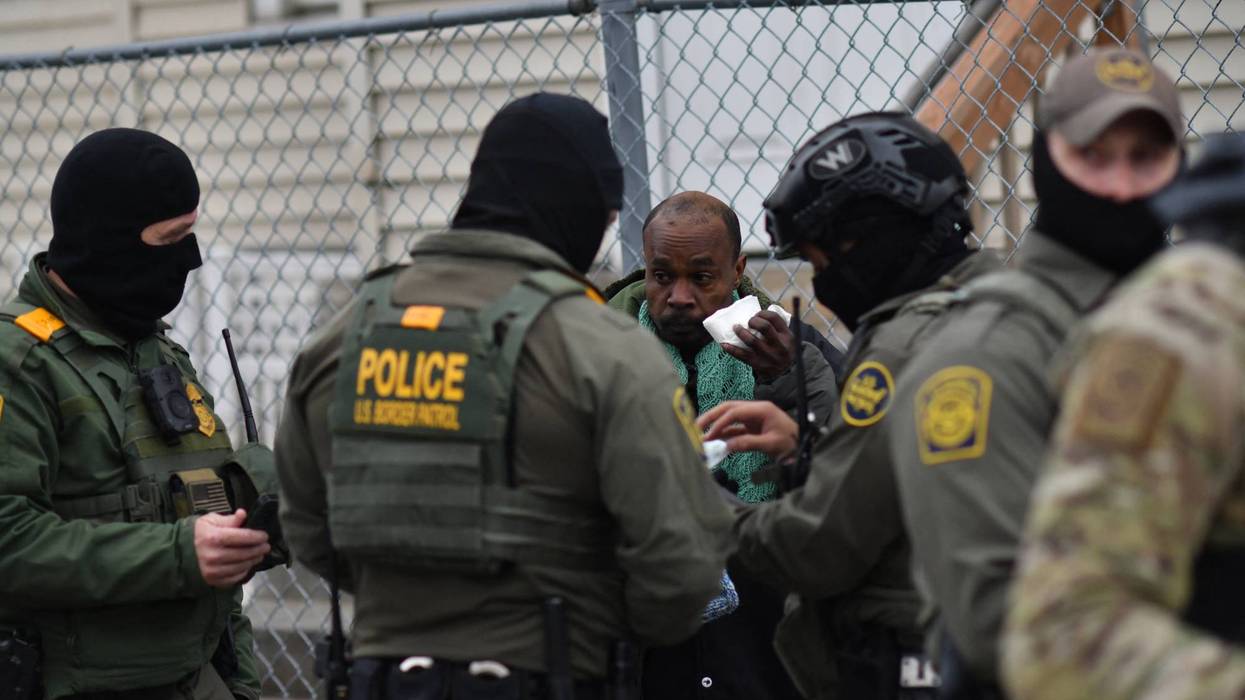
American democracy can’t survive this sort of assault for long; it has to be stopped.
Back when I was a kid in Lansing, Michigan, my father used to tell me that the difference between America and the places his Army buddies had fought through in Europe and Asia wasn’t the size of our buildings or the strength of our army.
It was, he said, that here a cop couldn’t kick in your door without a judge first deciding there was a good reason, a president couldn’t help himself to the treasury, and he can’t take a king’s gift or send soldiers overseas to kill people without the people’s representatives saying yes. Even the cop shows we watched on TV had police regularly being turned away from people’s doors for lack of a warrant.
Dad believed that with the uncomplicated faith of a man who’d watched what happened when those rules disappeared in other countries, and he passed that faith on to me as if it were the most ordinary thing in the world, which, for an American of his generation, it was.
I’ve been thinking about my Eisenhower Republican father a lot lately, because the thing he assumed could never happen in America is now happening here, openly, daily, and with a kind of swagger that suggests the people doing it don’t believe there will ever be a price to pay.
Consider what we learned just yesterday morning. The Justice Department announced the creation of a $1.776 billion fund to compensate Donald Trump’s allies who claim they were unfairly targeted by the previous administration. It’s an unprecedented mechanism that lets the president pay his own supporters — or fund his own private army — out of a government agency he controls with taxpayer money, with no functional constraints on who he can give that money to.
Representative Jamie Raskin, the top Democrat on the House Judiciary Committee, called it plainly what it is, a political grievance fund Trump can use to pay off his friends, and the obvious beneficiaries are the roughly fifteen hundred people he already pardoned for storming the Capitol on January 6th.
The Fourteenth Amendment, written in the blood of the Civil War, says in Section 4 that this is blatantly illegal:
“[N]either the United States nor any State shall assume or pay any debt or obligation incurred in aid of insurrection or rebellion against the United States.”
The men who stormed the Capitol to stop the certification of a presidential election engaged in exactly the kind of insurrection that language was written to address — several were even convicted by juries for seditious conspiracy — and now Trump wants to write them checks that could be as much as $1 million per person.
This isn’t some obscure or gray area of the law or the Constitution: that’s the document telling us all “No” in language a child could understand, and the answer coming back from the Trump regime is a number chosen, with a wink, to evoke 1776.
It would be one thing if this were an isolated outrage, but it isn’t. Instead of the exception, this kind of criminal activity is now the norm: this is the most corrupt, lawless administration in American history and, so far, they’re getting away with almost all of it. For example:
— Article I of the Constitution gives the power to make war exclusively to Congress, not the president, and the War Powers Act that Congress passed over Richard Nixon’s veto in 1973 spells out the only exception, which is that a president may use force when the nation has been attacked or such an attack is imminent, and even then he must come to Congress within sixty days for permission to continue.
Iran represented no threat to the US, there was no attack or imminent attack, and yet Trump bombed the country anyway without even notifying, much less asking permission from, Congress. And now far more than 60 days have passed and he and the toadies in his regime are giving the middle finger to us, the Constitution, and the law.
— Trump’s also been bombing small boats in the Caribbean and the eastern Pacific since September of 2025, killing well over a hundred people he’s never bothered to identify, charge, or even produce a shred of evidence against. This is a naked violation of both US laws against murder and is an explicit war crime under international law and treaties.
When the Senate unsuccessfully tried to rein him in, he posted on his failing, Nazi-infested social media sewer that the War Powers Act is “unconstitutional” — as if he’s ever read the Constitution — and that the five Republicans who voted to constrain him should never be elected to office again.
Human Rights Watch described these strikes flatly as a campaign of “extrajudicial executions” carried out “without any credible legal basis.” The worst of them, the September 2nd strike, became what military lawyers call a double-tap, because after the first missile left two men clinging to the burning wreckage for forty minutes, the order came down, according to the ACLU’s account of the reporting, to hit them again and finish them off.
Killing shipwrecked survivors is a war crime under treaties we wrote and signed, and the Pentagon’s own manual says so, but we did it anyway, and the men who ordered and carried it out went on television and bragged about it.
— Similarly, the Constitution forbids in two separate places, Article I and Article II, the acceptance of gifts from foreign governments without the consent of Congress, a provision the framers wrote because George Washington’s generation understood, having just thrown off a king, exactly how a foreign prince could buy an American official’s loyalty one favor at a time.
Trump accepted a four-hundred-million-dollar Boeing 747 from the royal family of Qatar, a flying palace destined for his presidential library, and his son-in-law Jared Kushner took a two-billion-dollar investment from a Saudi sovereign wealth fund run by Mohammed bin Salman within months of leaving his White House job.
When Congressman (and constitutional law professor) Jamie Raskin pointed out that the Constitution says no present of any kind whatever may be accepted from a foreign state without congressional permission, the White House press secretary called the very question ridiculous. She literally laughed at the law and the Constitution.
— The Fourth Amendment says no home shall be entered and no person seized except on a warrant issued by a judge after sworn testimony about a crime:
“The right of the people to be secure in their persons, houses, papers, and effects, against unreasonable searches and seizures, shall not be violated, and no Warrants shall issue, but upon probable cause, supported by Oath or affirmation, and particularly describing the place to be searched, and the persons or things to be seized.”
Nonetheless, a leaked internal ICE memo, revealed by the Associated Press through a whistleblower, instructs agents that they may break down the doors of private homes on the strength of an “administrative warrant” ICE writes for itself, with no judge anywhere in the process.
This is precisely what the founding generation called a “general warrant” that the Fourth Amendment was written to forbid, and a Minnesota judge has already ruled that one such raid violated a man’s constitutional rights. They keep doing it anyway.
— The Impoundment Control Act of 1974 requires the president to spend the money Congress appropriates, and the nonpartisan Government Accountability Office has now found the administration in violation of the law at least six times. The GAO’s general counsel has testified in dozens of open investigations and wrote that the Constitution grants the president no unilateral authority to withhold funds Congress has commanded him to spend.
Ignoring it all, Trump is withholding money from disaster aid to Medicaid funds to states and laughing at the law.
— The Epstein Files Transparency Act, which Trump himself signed in November and which passed the House with only one single dissenting vote, required the full release of the files by last December 19th and explicitly forbade withholding anything to spare a public figure embarrassment.
Trump’s Justice Department, though, released fewer than half of the records, then quietly went back and added new redactions to documents it had already posted. You don’t have to wonder very hard why a president whose name reportedly appears in those files more than thirty thousand times might want them buried.
I could keep going, and that’s the part that would have blown my father’s mind. There’s the Logan Act being violated by Kushner, there’s the Hatch Act being trampled by Hegseth campaigning in Kentucky, there’s the Take Care Clause of Article II that obliges a president to faithfully execute the laws rather than treat the ones he dislikes as suggestions.
Several ICE agents are accused of murdering Renee Goode and Alex Pretti in Minnesota, but the state has been unable to investigate and prosecute the case because Trump is hiding the evidence from them. That’s a felony reminiscent of the old Confederacy.
Pile them up and instead of a handful of unrelated scandals like during Nixon, we see a method, the same method Hannah Arendt described when she wrote about how authoritarian movements don’t merely break individual laws but work to destroy the very idea that law constrains power at all, so that eventually the only question anyone bothers to ask is what dear leader wants.
Germany and Japan were here before, in the last century, and we didn’t like how it ended up requiring us to sacrifice blood and treasure to restore democracy and the rule of law to Europe and Asia.
The deepest damage, however, isn’t to any single statute. It’s to the thing my father believed in, the global understanding that America was the country where the law applied even to the powerful, even to the president, especially to the president.
Every dictator and strongman on Earth is watching the most powerful office in the world demonstrate that constitutions can be treated like paper tigers, that war crimes carry no consequences, that a leader can pay his own mob and pocket a king’s airplane and the system simply absorbs it.
They’re taking notes, and the next time an American diplomat lectures a foreign despot about the rule of law that strongman is going to laugh out loud.
What chafes me the most is the hypocrisy, because I remember, and you do, too. When Barack Obama used prosecutorial discretion to shield DREAMers from deportation, Republicans fought it in court; Speaker Paul Ryan declared it a major victory in the fight to restore the separation of powers and warned that the president is not permitted to write laws, only Congress is.
When Obama delayed an Obamacare employer mandate, Jonathan Turley warned that if a president can suspend federal laws then the legislative process becomes a pretense, and the Heritage Foundation thundered about “lawlessness” and “dangerous precedents” that weaken our constitutional balance.
Those same voices, confronted today with a president paying off insurrectionists, taking foreign jets, ignoring six GAO impoundment findings, violating the Fourth, Fifth, and Fourteenth Amendments, breaking the law on war, engaging in insider trading, and defying a transparency law he signed himself, have gone silent or, worse, become his cheerleaders.
For Republicans, apparently the principle was never about principle. It was, instead, always about whose side you were on.
American democracy can’t survive this sort of assault for long; it has to be stopped. And Democrats can’t afford to repeat the paralysis of the first two years of the Biden administration, when Merrick Garland’s Justice Department moved with such deliberate caution on Trump’s crimes that the clock simply ran out.
Democratic members of Congress should be forming investigative working groups right now, today.
One for the boat killings, one for the emoluments, one for the impoundment defiance, one for the Epstein noncompliance, one for the warrantless raids, one for tearing down part of the White House, one for his insider stock trading, one for taking us to war illegally, etc., gathering the documents and the testimony and the timelines while memories are fresh and witnesses are reachable.
They should be holding public hearings on each of these issues now, in the open, not as a campaign promise but as the constitutional oversight that is literally their job, so that when power changes hands, as it always eventually does, there’s no eighteen-month ramp-up and no excuse for one.
You have a role in this too, and it isn’t a small one. Call your senators and representative through the Capitol switchboard at 202-224-3121 and tell them you want public hearings on these violations of the law and you want them now, not after the next election.
Make sure you’re registered and that everyone you know is registered at vote.org, because elections remain, as the law professors testifying about presidential power keep reminding us, the ultimate check on a lawless executive.
Track what your state legislature is doing at openstates.org, because the defense of constitutional government is being fought in statehouses too.
And if this piece said something you think other people need to hear, please share it, and support independent journalism at hartmannreport.com and elsewhere, because the work of holding power accountable has never depended on the powerful; it has always depended on ordinary citizens who refused to look away.
My father’s generation believed America was the country where the rules apply to everyone, and fought a brutal war to defend that ideal. Whether they were right is, finally, now up to you and me.
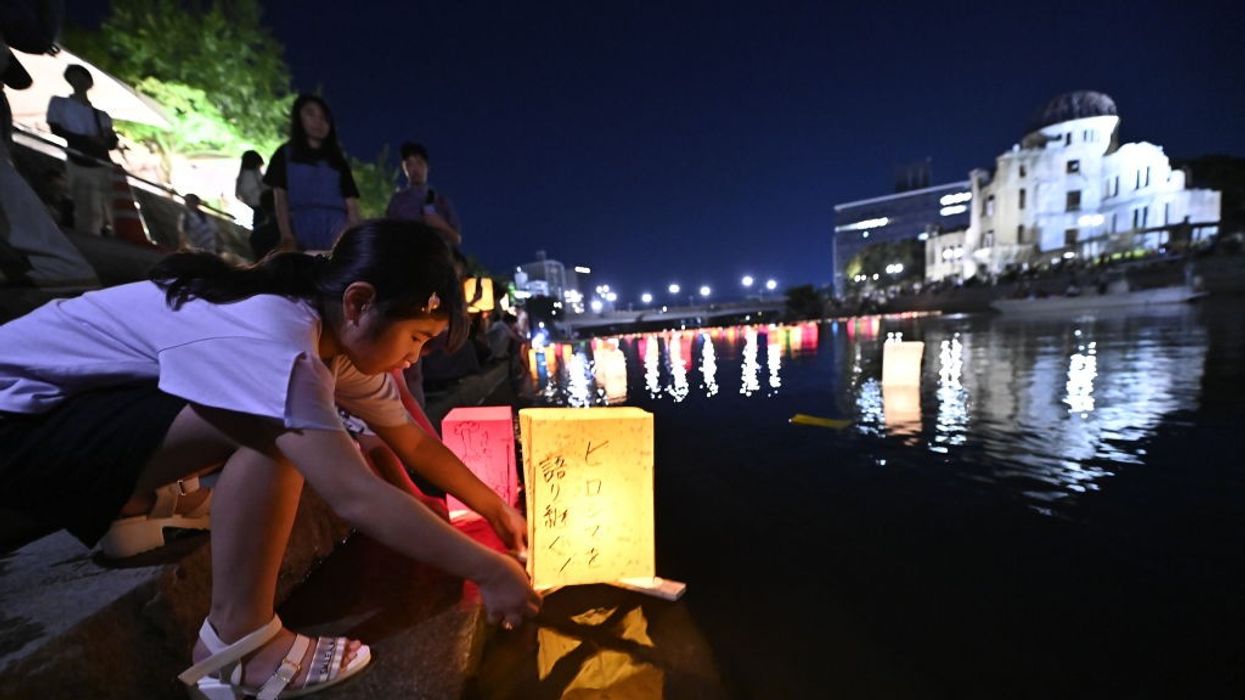
"The world needs to stop nuclear war from ever happening again," said one hibakusha. "But when I turn on the news, I see politicians talk about deploying more weapons, more tanks. How could they?"
As the number of people who survived the U.S. atomic bombings of Hiroshima and Nagasaki rapidly dwindles 79 years after the attacks, hibakusha—the Japanese word for the survivors—and others are imploring humanity to do everything possible to avert another nuclear war.
"People still don't get it. The atomic bomb isn't a simple weapon. I speak as someone who suffers until this day: The world needs to stop nuclear war from ever happening again," Shigeaki Mori, who was an 8-year-old boy on his way to school on the morning of August 6, 1945,
told The New York Times. "But when I turn on the news, I see politicians talk about deploying more weapons, more tanks. How could they? I wish for the day they stop that."
Keiko Aguro was also 8 years old and standing on a road near her home in Hiroshima when a U.S. B-29 Superfortress dropped one bomb over Hiroshima that exploded with the force of 16 kilotons of TNT. The explosion destroyed nearly everything and everyone within about a 1-mile (1.62 km) radius. As many as 90,000 people died from the heat, blast wave, and ensuing inferno. Tens of thousands of others were injured, many of them mortally. Tens of thousands more would perish from radiation over the following weeks, months, and years.
"As survivors, we cannot do anything but tell our story," Aguro said. "'For we shall not repeat the evil'—this is the pledge of survivors. Until we die, we want to tell our story, because it's difficult to imagine."
"Now what survivors worry about is to die and meet our family in heaven," Aguro added. "I heard many survivors say, 'What shall I do? On this planet there are still many many nuclear weapons, and then I'll meet my daughter I couldn't save. I'll be asked: Mom, what did you do to abolish nuclear weapons?' There is no answer I can tell them."
Three days after Hiroshima, Nagasaki was obliterated in a 20-kiloton air burst that killed as many as 75,000 people that day, with a similar number of people wounded and tens of thousands more dying later from radiation.
The authors of the Times piece—Kathleen Kingsbury, W.J. Hennigan, and Spencer Cohen—wrote that "as another anniversary of August 6 passes, it is necessary for Americans—and the globe, really—to listen to the stories of the few human beings who can still speak to the horror nuclear weapons can inflict before this approach is taken again."
However, they note that "countries like the United States, China, and Russia are spending trillions of dollars to modernize their stockpiles," while "many of the safeguards that once lowered nuclear risk are unraveling and the diplomacy needed to restore them is not happening."
"The threat of another blast can't be relegated to history," the trio wrote. But they added that nearly eight decades later, many Americans still hail the bombings as "necessary and heroic acts that brought the war to an end."
But the prevailing U.S. historical narrative—which portrays the bombings as critical to ending the war—ignores the lack of consensus and grave misgivings among senior military commanders about dropping the bombs. Seven of the eight five-star generals and admirals at the time opposed its use. One of them, Gen. Dwight D. Eisenhower, later said as president that "the Japanese were ready to surrender and it wasn't necessary to hit them with that awful thing."
The International Campaign to Abolish Nuclear Weapons (ICAN)—which won the 2017 Nobel Peace Prize for its work on the landmark Treaty on the Prohibition of Nuclear Weapons—marked this year's ignominious anniversary with a report focusing on how children are affected by nuclear war and the threat thereof.
The report contains graphic descriptions of the effects of the Hiroshima and Nagasaki bombs, and of nuclear weapons testing on children around the world. It also explains how fear of thermonuclear annihilation affected children during the Cold War and how humanity can protect children by disarming.
"Today, several thousand nuclear weapons still exist in the arsenals of nine countries, posing a unique existential threat to people everywhere, especially children. Many have vastly greater explosive yields than the atomic bombs dropped on Hiroshima and Nagasaki," the ICAN report states.
"To protect humanity from the catastrophic harm that nuclear weapons are designed to inflict, governments must act with urgency to eliminate them completely—the only guarantee against their further use and testing," the publication continues. "This would be a great service to the current generation of children and to all future generations, who would grow up free from the threat of nuclear war."
"The alternative is to pass on to them a world still teetering on the brink of catastrophe," ICAN added. "Or, quite unthinkable, a world reeling from the horrors of another nuclear attack, perhaps with a death toll orders of magnitude greater than that of the atomic bombings of 1945."
Echoing ICAN, Hiroshima Gov. Hidehiko Yuzaki said during the annual commemoration of the bombing at Hiroshima Peace Park that "as long as nuclear weapons exist, they will surely be used again someday."
"Nuclear weapons abolition is not an ideal to achieve far in the future," Yuzaki stressed. "Instead, it is a pressing and real issue that we should desperately engage in at this moment since nuclear problems involve an imminent risk to human survival."
Only an exceptional president could resist the endless war-profiteering of this mammoth war machine; alas, Biden doesn’t even try.
When it comes to foreign policy, the president of the United States has two essential roles. The first is to rein in the military-industrial complex, or MIC, which is always pushing for war. The second is to rein in U.S. allies that expect the U.S. to go to war on their behalf. A few savvy presidents succeed, but most fail. Joe Biden is certainly a failure.
One of the savviest presidents was Dwight Eisenhower. In late 1956, he confronted two simultaneous crises. The first was a disastrously misguided war launched by the United Kingdom, France, and Israel to overthrow the Egyptian government and retake control of the Suez Canal following its nationalization by Egypt. Eisenhower forced the allies to stop their brazen and illegal attack, including through a U.S.-sponsored United Nations General Assembly resolution. The second crisis was the Hungarian Uprising against Soviet domination of Hungary. While Eisenhower sympathized with the uprising, he wisely kept the U.S. out of Hungary and thereby avoided a dangerous military showdown with the Soviet Union.
Eisenhower’s historic farewell address to the American people in January 1961 alerted the public to the growing power of the MIC:
In the councils of government, we must guard against the acquisition of unwarranted influence, whether sought or unsought, by the military-industrial complex. The potential for the disastrous rise of misplaced power exists and will persist.
We must never let the weight of this combination endanger our liberties or democratic processes. We should take nothing for granted. Only an alert and knowledgeable citizenry can compel the proper meshing of the huge industrial and military machinery of defense with our peaceful methods and goals, so that security and liberty may prosper together.
Even Eisenhower did not fully rein in the military-industrial complex, especially the Central Intelligence Agency. No president has done so entirely. The CIA was created in 1947 with two distinct roles. The first and valid one was as an intelligence agency. The second and disastrous one was as a covert army for the president. In the latter capacity, the CIA has led one calamitous failure after another from Eisenhower’s time till now, including coups, assassinations, and stage-managed “color revolutions,” all of which have produced endless havoc and destruction.
Following Eisenhower, John F. Kennedy brilliantly resolved the 1962 Cuban Missile Crisis, narrowly avoiding nuclear Armageddon by facing down his own war-mongering advisers to reach a peaceful solution with the Soviet Union. The following year he successfully negotiated the Partial Nuclear Test Ban Treaty with the Soviet Union, over Pentagon objections, and then won Senate ratification, thereby pulling the U.S. and Soviet Union back from the brink of war. Many believe that Kennedy’s peace initiatives led to his assassination at the hands of rogue CIA officials. Biden has joined the long line of presidents that have kept classified or redacted thousands of documents that would shed more light on the assassination.
Sixty years onward, the MIC has an iron grip on American foreign policy. As I’ve recently described, foreign policy has become an insider racket, with the MIC in control of the White House, Pentagon, State Department, the Armed Services Committees of the Congress, and of course the CIA, all in a tight embrace with the major arms contractors. Only an exceptional president could resist the endless war-profiteering of this mammoth war machine.
Alas, Biden doesn’t even try. Throughout his long political career, Biden has been supported by the MIC and has in turn enthusiastically supported wars of choice, massive arms sales, CIA-backed coups, and NATO enlargement.
America foreign policy is rudderless, with a president whose only foreign policy recipe is war.
Biden’s 2024 military budget breaks all records, reaching at least $1.5 trillion in outlays for the Pentagon, CIA, homeland security, non-Pentagon nuclear arms programs, subsidized foreign weapons sales, other military-linked outlays, and interest payments on past war-related debts. On top of this mountain of military spending, Biden is seeking an additional $50 billion in “emergency supplemental funding” for America’s “defense industrial base” to keep shipping munitions to Ukraine and Israel.
Biden doesn’t have any realistic plans for Ukraine, and even rejected a peace agreement between Russia and Ukraine in March 2022 that would have ended the conflict based on Ukrainian neutrality by ending Ukraine’s futile bid to join NATO (futile because Russia will never accept it). Ukraine is big business for the MIC—tens and potentially hundreds of billions of dollars of arms contracts, manufacturing facilities across the U.S,, the opportunity to develop and test new weapons systems—so Biden keeps the war going despite the destruction of Ukraine on the battlefield, and the tragic and needless deaths of hundreds of thousands of Ukrainians. The MIC, and hence Biden, continue to shun negotiations, even though direct U.S.-Russia negotiations regarding NATO and other security issues (such as U.S. missile placements in Eastern Europe) could end the war.
In Israel, Biden’s failure is even more on display. Israel is led by an extremist government that reviles the two-state solution, according to which Israelis and Palestinians should live side by side in two sovereign peaceful and secure states, or indeed any solution that grants Palestinians their political rights. The two-state solution is deeply embedded in international law, including U.N. Security Council and General Assembly resolutions and supposedly in U.S. foreign policy. The Arab and Islamic leaders are committed to normalizing and securing safe relations with Israel in the context of the two-state solution.
Yet Israel is led by violent zealots who make the messianic claim that God has given Israel all the land of today’s Palestine, including the West Bank, Gaza, and East Jerusalem. These zealots therefore insist on political domination over the millions of Palestinians in their midst, or their annihilation or expulsion. Netanyahu and his colleagues don’t even hide their genocidal intentions, though most foreign observers don’t fully understand the biblical references that the Israeli leaders invoke to justify their ongoing mass slaughter of the Palestinian people.
Israel now faces highly credible charges of genocide in the International Court of Justice in a case brought by South Africa. The documentary record presented by South Africa and others is as clear as it is chilling. Israeli politics is not the politics of pragmatism and certainly not the politics of peace. It is the politics of biblical apocalypse.
Biden nonetheless provides Israel with the munitions to carry out its massive war crimes. Instead of acting like Eisenhower and pressing Israel to end its slaughter in contravention of international law including the Genocide Convention, Biden continues to ship munitions, even bypassing congressional review to the maximum extent he can. The result is U.S. diplomatic isolation from the rest of the world, and the growing involvement of the U.S. military in a war that is rapidly and all-too-predictably expanding across Lebanon, Syria, Iraq, Iran, and Yemen. In the recent U.N. General Assembly vote backing political self-determination for the people of Palestine, the U.S. and Israel stood alone save two votes: Micronesia (bound by compact to vote with the U.S.) and Nauru (population 12,000).
America foreign policy is rudderless, with a president whose only foreign policy recipe is war. With the U.S. already up to its neck in the wars in Ukraine and the Middle East, Biden also intends to ship more arms to Taiwan despite China’s strident objections that the U.S. is thereby violating long-standing U.S. commitments to the One-China policy, including the commitment made 42 years ago in the U.S.-PRC Joint Communique that the U.S. government “does not seek to carry out a long-term policy of arms sales to Taiwan.” Eisenhower’s dire prophecy has been confirmed. The military-industrial complex threatens our liberty, our democracy, and our very survival.
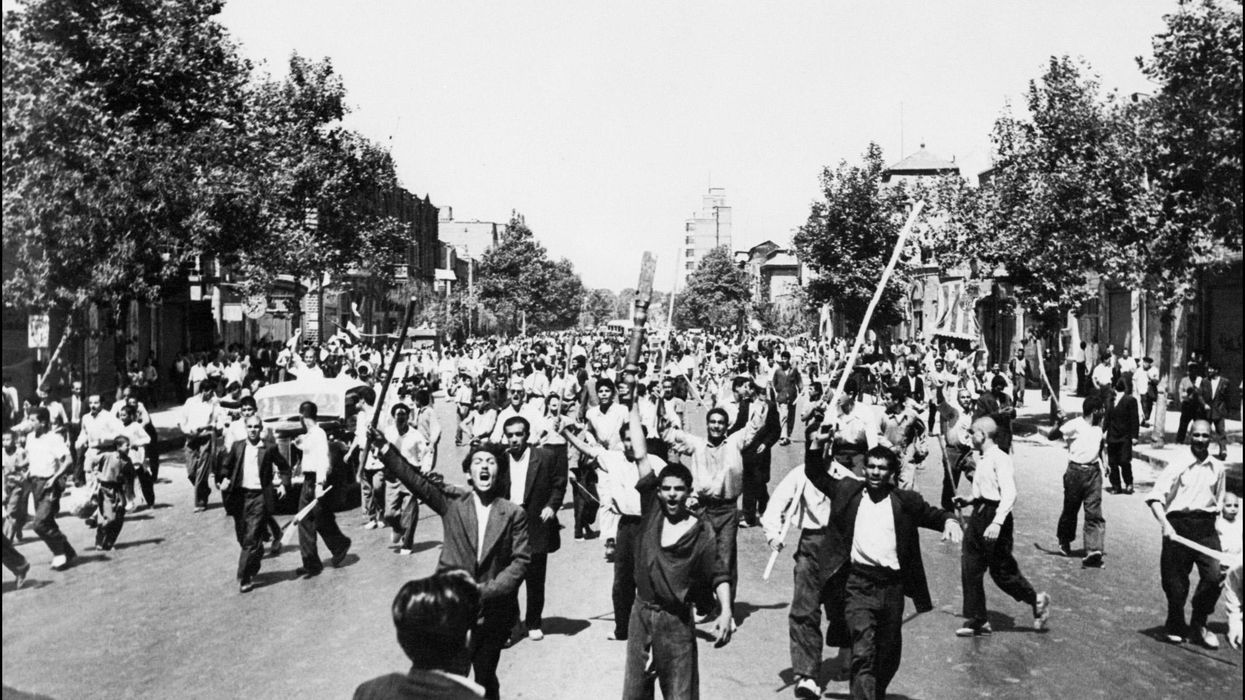
Since the CIA-backed coup in 1953, both nations have a long list of nefarious things that the other side has done to them; some may be more legitimate than others.
The history of U.S.-Iranian relations dates to the time when the once mighty Persian Empire, thanks to the Great Game played by Russia and Great Britain, was anything but mighty.
The “Yengi Donya” or new world, as the Persians called the United States, was an emerging global power with no colonial aspirations in Persia. Iranians admired America for its ideals of liberalism, democracy, and individual freedom. For Iranians, the U.S. was the land of Howard Baskerville, the martyr of their 1906 Constitutional Revolution, and Morgan Shuster, the young financier who tried against all odds to help Iran stand on its feet against British and Russian colonialism. That history is long forgotten, however.
The romantic relationship that once existed between the two countries came to an abrupt end when Washington played a critical role in toppling the government of Prime Minister Mohammad Mosaddegh on August 19, 1953.
Unbeknownst to Iranians, Eisenhower had personally approved “Operation Ajax,” which we know now was assisted by the U.S. Central Intelligence Agency and British intelligence, to remove Mosaddegh. The U.S. had committed its “original sin” in Iran.
In the runup to the coup, Washington cut off its financial assistance to Iran, which, due to a British-sponsored boycott of Iranian oil, was facing a severe financial crisis. Indeed, President Dwight D. Eisenhower, in response to Mosaddegh’s pleas for an emergency loan, had asserted that “it would not be fair to the American taxpayers… to extend any considerable amount of economic aid to Iran.” After the coup, Eisenhower approved an emergency loan in the amount of $45 million to help the new Iranian government.
But unbeknownst to Iranians, Eisenhower had personally approved “Operation Ajax,” which we know now was assisted by the U.S. Central Intelligence Agency and British intelligence, to remove Mosaddegh. The U.S. had committed its “original sin” in Iran.
This episode marked the transformation of the U.S. image from a benevolent power sympathetic to Iranian aspirations to one similar to that of the British and Russians. To many Americans, however, the significance of the coup remains unknown.
Indeed, in the middle of the 1979-80 U.S. embassy hostage crisis, President Jimmy Carter called Mossadegh’s ouster “ancient history” and “something that happened 30 years ago.” But, for many Iranians, the episode’s trauma remains a living memory. Iranian students who stormed the embassy in November 1979, including Ebrahim Asgharzadeh, believed that Washington was “plotting” another coup in Iran by giving refuge to the ailing, exiled Shah. But, with the embassy seizure and subsequent hostage crisis, Iran, too, had committed its “original sin.”
These two episodes have left a deep wound in the relationship between the two countries. As the veteran American diplomat John Limbert observes, “The hostage crisis still casts its long shadow over how America and Americans view Iran. The event lurks behind some American analysts’… descriptions [of Iran] as rogue state, axis of evil…” Indeed, other than sporadic and tactical cooperation on issues of mutual interest, Iran and America have failed to overcome the ghosts of their history.
Obama’s presidency offered an exceptional opportunity to overcome the past decades of squandered opportunities. Except for the breakthrough on the nuclear issue, however, he was faced with Ayatollah Khamenei’s “clenched fist.” Trump’s renunciation of Washington’s commitments under the JCPOA only exacerbated Khamenei’s deeply held suspicions of the U.S.
Recently, Iran’s former foreign minister, Ali Akbar Salehi, who had advised Khamenei to accept secret talks with the U.S. over the nuclear issue, urged the leadership to hold more comprehensive talks with Washington on the broadest possible range of issues.
“Because of our tensions with the west, especially with the U.S., they pressure us at every opportunity… It is time to sit and talk with the U.S…. maybe we call it political negotiations,” he observed. Salehi, who also served as chief of the Atomic Energy Organization of Iran, warned that so long as Iran was at loggerheads with the U.S. it cannot sustain healthy relations with any country, even including its most powerful partners, China and Russia.
Iran’s nuclear program has long been a source of tension between the two countries. The dispute actually dates back to the Shah’s time when Tehran and Washington fought over Iran’s rights under the nuclear Non-Proliferation Treaty. After the 1979 Islamic Revolution, the U.S. categorically rejected the existing nuclear program in Iran and pressured other countries not to cooperate with Tehran to reconstitute it.
A negotiating framework that addresses mutual interests and concerns, such as the security of the Persian Gulf, is not only desirable and long overdue; it’s necessary.
Realizing that Iran would never agree to halt all uranium enrichment, President Barack Obama accepted a limited but strongly verified program, which led to the signing of JCPOA (which included the four other members of the U.N. Security Council plus Germany) in 2015. However, Trump’s withdrawal from JCPOA unshackled Tehran’s nuclear program from the limits established by the 2015 accord.
While President Joe Biden promised to return to the agreement during his presidential campaign in 2020, the two sides have failed to come to a formal understanding in the two-and-a-half years that followed his inauguration. The Biden administration has thus been pursuing its own “maximum pressure” campaign although its rhetoric has been considerably more diplomatic than the Trump administration’s.
Dismantling Iran’s nuclear program might be an ideal outcome for the U.S., but it is very unlikely that any ruling regime would accept it. Thus, the only viable solution for the U.S. is an agreement that verifiably keeps Iran’s nuclear program checked. For now, the prisoner swap and Iran’s dilution of its 60% enriched-uranium stockpile is a positive step toward deescalation.
Another source of tension between Iran and the U.S. is Iran’s regional ambitions, especially its activities in the Persian Gulf. Washington sees Iran’s harassment of foreign-flagged oil tankers as a threat to international maritime security and the free flow of oil. For the Islamic Republic, as it was for the Shah, the security of the Persian Gulf is indispensable to Iran’s security. When Washington, in violation of international law, confiscated Iranian oil shipments, Iranians responded by seizing and harassing foreign-flagged tankers in the Persian Gulf.
Most recently, the U.S. has escalated by dispatching 3,000 troops to the region with the aim of deterring Iran.
However, the U.S. already has a substantial military presence in the region that is fully capable of deterring Iran. Dispatching more troops will only increase Iran’s insecurities in its immediate periphery. Accidents and miscalculation could drag both sides into an unwanted direct conflict at a time when Washington is more focused on the Ukrainian war and tensions with China over Taiwan and the larger Indo-Pacific region.
Because of its size, population, and strategic location, Iran is one of the pillars of security and stability in the region and cannot be excluded from regional calculations or be expected to capitulate to U.S. ultimatums. Former Secretary of State Mike Pompeo’s 2018 list of 12 demands on Iran totally failed to address any of Iran’s legitimate concerns. This is why the “maximum pressure” policy pursued by Trump, who insisted rhetorically that he would talk to the Iranians without preconditions, failed miserably.
A negotiating framework that addresses mutual interests and concerns, such as the security of the Persian Gulf, is not only desirable and long overdue; it’s necessary.
Iran and the U.S. both have a long list of nefarious things that the other side has done to them; some may be more legitimate than others. But, in the words of former President Ronald Reagan, “between American and Iranian basic national interests there need be no permanent conflict.” It is time for Iran and the U.S. to talk based on recognition of the other party’s core interests and mutual respect.

The real needs of humanity haven’t changed since Ike's time. Whether in 1953 or 2023, more guns won't serve the cause of peace.
In April 1953, newly elected President Dwight D. Eisenhower, a retired five-star Army general who had led the landings on D-Day in France in June 1944, gave his most powerful speech. It would become known as his “Cross of Iron” address. In it, Ike warned of the cost humanity would pay if Cold War competition led to a world dominated by wars and weaponry that couldn’t be reined in. In the immediate aftermath of the death of Soviet dictator Josef Stalin, Ike extended an olive branch to the new leaders of that empire. He sought, he said, to put America and the world on a “highway to peace.” It was, of course, never to be, as this country’s emergent military-industrial-congressional complex (MICC) chose instead to build a militarized (and highly profitable) highway to hell.
Eight years later, in his famous farewell address, a frustrated and alarmed president called out “the military-industrial complex,” prophetically warning of its anti-democratic nature and the disastrous rise of misplaced power that it represented. Only an alert and knowledgeable citizenry, fully engaged in corralling, containing, and constraining it, he concluded, could save democracy and bolster peaceful methods and goals.
The MICC’s response was, of course, to ignore his warning, while waging a savage war on communism in the name of containing it. In the process, atrocious conflicts would be launched in Vietnam, Laos, and Cambodia as the contagion of war spread. Threatened with the possibility of peace in the aftermath of the Soviet Union’s collapse in 1991, the MICC bided its time with operations in Iraq (Desert Storm), Bosnia, and elsewhere, along with the expansion of NATO, until it could launch an unconstrained Global War on Terror in the aftermath of the attacks of September 11, 2001. Those “good times” (filled with lost wars) lasted until 2021 and the chaotic U.S. withdrawal from Afghanistan.
Only Americans, Ike once said, can truly hurt America. Meaning, to put the matter in a more positive context, only we can truly help save America. A vital first step is to put the word “peace” back in our national vocabulary.
Not to be deterred by the fizzling of the nightmarish war on terror, the MICC seized on a “new cold war” with China and Russia, which only surged when, in 2022, Vladimir Putin so disastrously invaded Ukraine (as the U.S. had once invaded Afghanistan and Iraq). Yet again, Americans were told that they faced implacable foes that could only be met with overwhelming military power and, of course, the funding that went with it — again in the name of deterrence and containment.
In a way, in 1953 and later in 1961, Ike, too, had been urging Americans to launch a war of containment, only against an internal foe: what he then labeled for the first time “the military-industrial complex.” For various reasons, we failed to heed his warnings. As a result, over the last 70 years, it has grown to dominate the federal government as well as American culture in a myriad of ways. Leaving aside funding where it’s beyond dominant, try movies, TV shows, video games, education, sports, you name it. Today, the MICC is remarkably uncontained. Ike’s words weren’t enough and, sadly, his actions too often conflicted with his vision (as in the CIA’s involvement in a coup in Iran in 1953). So, his worst nightmare did indeed come to pass. In 2023, along with much of the world, America does indeed hang from a cross of iron, hovering closer to the brink of nuclear war than at any time since the Cuban Missile Crisis of 1962.
Updating Ike’s Cross of Iron Speech for Today
Perhaps the most quoted passage in that 1953 speech addressed the true cost of militarism, with Ike putting it in homespun, easily grasped, terms. He started by saying, “Every gun that is made, every warship launched, every rocket fired signifies, in the final sense, a theft from those who hunger and are not fed, those who are cold and are not clothed.” (An aside: Can you imagine Donald Trump, Joe Biden, or any other recent president challenging Pentagon spending and militarism so brazenly?)
Ike then added:
“This world in arms is not spending money alone. It is spending the sweat of its laborers, the genius of its scientists, the hopes of its children. The cost of one modern heavy bomber is this: a modern brick school in more than 30 cities. It is two electric power plants, each serving a town of 60,000 population. It is two fine, fully equipped hospitals. It is some fifty miles of concrete pavement. We pay for a single fighter plane with a half million bushels of wheat. We pay for a single destroyer with new homes that could have housed more than 8,000 people.”
He concluded with a harrowing image: “This is not a way of life at all, in any true sense. Under the cloud of threatening war, it is humanity hanging from a cross of iron.”
Ike’s cost breakdown of guns versus butter, weapons versus civilian goods, got me thinking recently: What would it look like if he could give that speech today? Are we getting more bang for the military megabucks we spend, or less? How much are Americans sacrificing to their wasteful and wanton god of war?
Let’s take a closer look. A conservative cost estimate for one of the Air Force’s new “heavy” strategic nuclear bombers, the B-21 Raider, is $750 million. A conservative estimate for a single new fighter plane, in this case the F-35 Lightning II, is $100 million. A single Navy destroyer, a Zumwalt-class ship, will be anywhere from $4 to $8 billion, but let’s just stick with the lower figure. Using those weapons, and some quick Internet sleuthing, here’s how Ike’s passage might read if he stood before us now:
“The cost of one modern heavy bomber is this: a modern brick-veneer and reinforced concrete school in 75 cities. It is five electric power plants, each serving a town with 60,000 inhabitants. It is five fine, fully equipped hospitals. It is some 150 miles of pavement. We pay for a single fighter plane with more than 12 million bushels of wheat. We pay for a single destroyer with new homes that could have housed more than 64,000 people.”
(Quick and dirty figures for the calculations above: $10 million per elementary school; $150 million per power plant [$5,000/kilowatt for 30,000 homes]; $150 million per hospital; $5 million per new mile of road; $8 per bushel of wheat; $250,000 per home for four people.)
Grim stats indeed! Admittedly, those are just ballpark figures, but taken together they show that the tradeoff between guns and butter — bombers and jet fighters on the one hand, schools and hospitals on the other — is considerably worse now than in Ike’s day. Yet Congress doesn’t seem to care, as Pentagon budgets continue to soar irrespective of huge cost overruns and failed audits (five in a row!), not to speak of failed wars.
Without irony, today’s MICC speaks of “investing” in weapons, yet, unlike Ike in 1953, today’s generals, the CEOs of the major weapons-making corporations, and members of Congress never bring up the lost opportunity costs of such “investments.” Imagine the better schools and hospitals this country could have today, the improved public transportation, more affordable housing, even bushels of wheat, for the cost of those prodigal weapons and the complex that goes with them. And perish the thought of acknowledging in any significant way how so many of those “investments” have failed spectacularly, including the Zumwalt-class destroyers and the Navy’s Freedom-class littoral combat ships that came to be known in the Pentagon as “little crappy ships.”Speaking of wasteful warships, Ike was hardly the first person to notice how much they cost or what can be sacrificed in building them. In his prescient book The War in the Air, first published in 1907, H.G. Wells, the famed author who had envisioned an alien invasion of Earth in The War of the Worlds, denounced his own epoch’s obsession with ironclad battleships in a passage that eerily anticipated Ike’s powerful critique:
The cost of those battleships, Wells wrote, must be measured by:
“The lives of countless men… spent in their service, the splendid genius and patience of thousands of engineers and inventors, wealth and material beyond estimating; to their account we must put stunted and starved lives on land, millions of children sent to toil unduly, innumerable opportunities of fine living undeveloped and lost. Money had to be found for them at any cost—that was the law of a nation’s existence during that strange time. Surely they were the weirdest, most destructive and wasteful megatheria in the whole history of mechanical invention.”
Little could he imagine our own era’s “wasteful megatheria.” These days, substitute nuclear intercontinental ballistic missiles, strategic bombers, aircraft carriers, and similar “modern” weapons for the ironclads of his era and the sentiment rings at least as true as it did then. (Interestingly, all those highly touted ironclads did nothing to avert the disaster of World War I and had little impact on its murderous course or ponderous duration.)
Returning to 1953, Eisenhower didn’t mince words about what the world faced if the iron cross mentality won out: at worst, nuclear war; at best, “a life of perpetual fear and tension; a burden of arms draining the wealth and labor of all peoples; a wasting of strength that defies the American system, or the Soviet system, or any system to achieve true abundance and happiness for the peoples of this earth.”
Ike’s worst-case scenario grows ever more likely today. Recently, Russia suspended the START treaty, the final nuclear deal still in operation, that oversaw reductions in strategic nuclear weapons. Instead of reductions, Russia, China, and the United States are now pursuing staggering “modernization” programs for their nuclear arsenals, an effort that may cost the American taxpayer nearly $2 trillion over the coming decades (though even such a huge sum matters little if most of us are dead from nuclear war).
In any case, the United States in 2023 clearly reflects Ike’s “cross of iron” scenario. It’s a country that’s become thoroughly militarized and so is slowly wasting away, marked increasingly by fear, deprivation, and unhappiness.
It’s Never Too Late to Change Course
Only Americans, Ike once said, can truly hurt America. Meaning, to put the matter in a more positive context, only we can truly help save America. A vital first step is to put the word “peace” back in our national vocabulary.
“The peace we seek,” Ike explained 70 years ago, “founded upon a decent trust and cooperative effort among nations, can be fortified, not by weapons of war but by wheat and by cotton, by milk and by wool, by meat and timber and rice. These are words that translate into every language on earth. These are the needs that challenge this world in arms.”
The real needs of humanity haven’t changed since Ike’s time. Whether in 1953 or 2023, more guns won’t serve the cause of peace. They won’t provide succor. They’ll only stunt and starve us, to echo the words of H.G. Wells, while imperiling the lives and futures of our children.
This is no way of life at all, as Ike certainly would have noted, were he alive today.
Which is why the federal budget proposal released by President Biden for 2024 was both so painfully predictable and so immensely disappointing. Calamitously so. Biden’s proposal once again boosts spending on weaponry and war in a Pentagon budget now pegged at $886 billion. It will include yet more spending on nuclear weapons and envisions only further perpetual tensions with “near-peer” rivals China and Russia.
This past year, Congress added $45 billion more to that budget than even the president and the Pentagon requested, putting this country’s 2023 Pentagon budget at $858 billion. Clearly, a trillion-dollar Pentagon budget is in our collective future, perhaps as early as 2027. Perish the thought of how high it could soar, should the U.S. find itself in a shooting war with China or Russia (as the recent Russian downing of a U.S. drone in the Black Sea brought to mind). And if that war were to go nuclear…
The Pentagon’s soaring war budget broadcast a clear and shocking message to the world. In America’s creed, blessed are the warmakers and those martyrs crucified on its cross of iron.
This was hardly the message Ike sought to convey to the world 70 years ago this April. Yet it’s the message the MICC conveys with its grossly inflated military budgets and endless saber-rattling.
Yet one thing remains true today: it’s never too late to change course, to order an “about-face.” Sadly, lacking the wisdom of Dwight D. Eisenhower, such an order won’t come from Joe Biden or Donald Trump or Ron DeSantis or any other major candidate for president in 2024. It would have to come from us, collectively. It’s time to wise up, America. Together, it’s time to find an exit ramp from the highway to hell that we’ve been on since 1953 and look for the on-ramp to Ike’s highway to peace.
And once we’re on it, let’s push the pedal to the metal and never look back.

Since the day it ended, in 1975, there have been efforts to rehabilitate the Vietnam War, to make it acceptable, even honorable. After all, there were so many sides to the story, weren't there? It was so complex, so nuancical. There was real heroism among the troops.
Of course, all of this is true, but it's true of every war so it doesn't redeem any war. The Vietnam War is beyond redemption and must be remembered and condemned for the calamity that it was. The Vietnam War was "one of the greatest American foreign policy disasters of the twentieth century."
Those are not the words of a leftist pundit or a scribbling anti-American. They are the words of H.R. McMaster, the sitting National Security Advisor to the President of the United States.
Why must Vietnam be remembered and condemned for the debacle it actually was?"It's important to remember that neither Vietnam, nor Laos, nor Cambodia for that matter, ever attacked the United States. They never wanted to attack. They never tried to attack. They never had the capacity to attack. They had simply wanted their own way of life."
First, the U.S. betrayed its own ideals in the War. In 1946, Vietnamese president Ho Chi Minh approached U.S. president Harry Truman asking for the U.S.'s help in evicting the French who had occupied Vietnam as a colony since the 1860s. Hadn't the U.S. itself once fought a war of independence to rid itself of European colonial domination?
Indeed, the opening words to the Vietnamese Declaration of Independence were borrowed in sacramental reverence from the American Declaration. They echo to every patriotic American: "All men are created equal. They are endowed by their Creator with certain unalienable rights, and among these are Life, Liberty, and the pursuit of Happiness."
But Ho was a communist. So, Truman turned him down and helped the French instead. That was the "original sin" that made it impossible for the U.S. to ever "win the hearts and minds" of the Vietnamese people. It is what ultimately doomed the War to failure. But that wasn't the only cardinal sin the U.S. committed against its own putative ideals.
Eisenhower violated the 1954 Geneva accords that had settled the war with the French and set up a puppet regime in the south. Hence "South" Vietnam, which, not surprisingly, quickly disappeared once the Americans left. He crammed a wealthy Catholic mandarin from New Jersey--Ngo Diem--on the people who were overwhelmingly poor, Buddhist, and peasants.
Diem, with Eisenhower's blessing, then boycotted the elections for national unification that had been agreed to in the accords. Eisenhower wrote later that the reason for the boycott was that "Our guys would have lost." When Diem could no longer suppress the swelling rebellion against his divisive, hyper-oppressive rule, Kennedy had him assassinated.
Second, the U.S. carried out apocalyptic violence on Vietnam, vastly beyond any conceivable moral standard of proportionality. It dropped three times more tons of bombs on Vietnam than were used by all sides in all theaters in all of World War II combined. Vietnam is about the size of New Mexico and at the time had a population greater than New York and California put together.
The U.S. lost 58,000 lives in the War. But more than four million southeast Asians--Vietnamese, Cambodians, Laotians--were killed, most of them civilians. That's 69 southeast Asians killed for every 1 American. That is not a war. That is a massacre, and on a scale approaching the Holocaust.
The U.S. sprayed 21 million gallons of carcinogenic defoliants on Vietnam, including the notorious Agent Orange. More than half of the nation's forests were destroyed. Vietnam was the greatest intentionally man-made environmental catastrophe in the history of the world. Children are still being born with birth defects from the residual poisoning.
On neighboring Laos, which, in 1965 had a population of 2.4 million, the U.S. dropped 270 million cluster bombs. That's 113 cluster bombs for every man, woman, and child in the country. More than 80 million of the bombs are still unexploded today.
It's important to remember that neither Vietnam, nor Laos, nor Cambodia for that matter, ever attacked the United States. They never wanted to attack. They never tried to attack. They never had the capacity to attack. They had simply wanted their own way of life.
Finally, the War was founded on and prosecuted with relentless lying. Your mother once taught you, as all good mothers do, that if you have to lie about something it's wrong.
The "intelligence" agencies lied to us, unremittingly, about the threat from a nation of pre-Industrial Age farmers on the other side of the world who, after nearly a century of colonial domination, simply wanted to be left alone by western imperial powers.
Five successive presidents lied to the American people about the need for the War and its likely winnability. None of them wanted to appear to be "soft on communism." None wanted to be "the first American president to lose a war."
The Pentagon Papers revealed that the military was saturated with lies, from field level body counts to strategic reviews of progress. Truth tellers were drummed out of the service, ensuring that only lies got passed up the chain. The lies wouldn't be discovered until it was too late.
In fact, it is precisely our lying about the Vietnam War, both then and now, and our knowledge of those lies, without ever having openly, unambiguously repudiated them, that continues to make the War seem dishonorable.
The dishonor, of course, belongs not to the millions of soldiers who served there but rather to the War itself. It belongs to the institutions--both public and private--that profited from the War and lied to justify it, and to the people whose silence and knowing acquiescence made them complicit in the lies.
It belongs to those who put our soldiers, our children, in the perverse situation not of doing honorable things honorably, but of having to try to do dishonorable things honorably. For, despite the loftiest motives we might invent for its beginnings, that is unquestionably what the War ultimately became.
In March 1965, before the insertion of American ground troops that would make the War irreversible, before the vast majority of the bombings and killings would be perpetrated, a Pentagon briefing for Johnson stated that the true goals in the War were, "...70% to avoid a humiliating U.S. defeat; 20% to keep South Vietnam (and adjacent territories) from Chinese hands; and 10% to permit the people of Vietnam a better, freer way of life."
That is what the psychotic savagery of Vietnam was all about. It was not bumbling goodwill gone awry as the rehabilitationists would have us believe. It was not to bring democracy; not to defend against communism; not to help the Vietnamese people. It was "to avoid a humiliating U.S. defeat." Those are the official, though at the time secret, words of the U.S. government.
We can summon an even greater authority than H.R. McMaster to confirm that the War was wrong. Robert McNamara was the U.S. Secretary of Defense in both the Kennedy and Johnson administrations. He is the unquestioned architect and chief strategist of the War.
In his memoirs McNamara wrote, "We of the Kennedy and Johnson administrations who participated in the decisions on Vietnam acted according to what we thought were the principles and traditions of this nation. We made our decisions in light of those values. Yet we were wrong, terribly wrong. We owe it to future generations to explain why."
There are no two more disparate authorities on the War than these two men. They represent the old and the new, Democrat and Republican, civilian and soldier, actor and critic, introspective and retrospective. Yet they reach the same, damning conclusion.
There is enormous pressure and a lot of money working to rehabilitate Vietnam, to put the guilt and the shame of it behind us. But it was precisely the guilt of the people, their shame at what was being done in their name, and their courage to denounce it that made it impossible for their government to carry out the savagery any longer. Would that we had that kind of guilt, shame, and courage among us today.
Remember: if we had to lie about it, it was wrong. That is as true today as it was then, is it not? And wrong does not get made right by the louder or repeated repetition of original lies. Or, by the artful contrivance of newer, slicker, more personable ones.
Forgetting that lesson, or, worse, laundering it out of our memory so that we might go forward with cleansed consciences and fortified zeal for still more predation, would be a betrayal of itself that only the American people can resist.
The Cuban Missile Crisis and Ownership of the World
The world stood still 50 years ago during the last week of October, from the moment when it learned that the Soviet Union had placed nuclear-armed missiles in Cuba until the crisis was officially ended -- though unknown to the public, only officially.
The image of the world standing still is the turn of phrase of Sheldon Stern, former historian at the John F. Kennedy Presidential Library, who published the authoritative version of the tapes of the ExComm meetings where Kennedy and a close circle of advisers debated how to respond to the crisis. Those meetings were secretly recorded by the president, which might bear on the fact that his stand throughout the recorded sessions is relatively temperate compared to other participants, who were unaware that they were speaking to history.
Stern has just published an accessible and accurate review of this critically important documentary record, finally declassified in the late 1990s. I will keep to that here. "Never before or since," he concludes, "has the survival of human civilization been at stake in a few short weeks of dangerous deliberations," culminating in "the week the world stood still."
There was good reason for the global concern. A nuclear war was all too imminent, a war that might "destroy the Northern Hemisphere," President Dwight Eisenhower had warned. Kennedy's own judgment was that the probability of war might have been as high as 50%. Estimates became higher as the confrontation reached its peak and the "secret doomsday plan to ensure the survival of the government was put into effect" in Washington, as described by journalist Michael Dobbs in his well-researched bestseller on the crisis (though he doesn't explain why there would be much point in doing so, given the likely nature of nuclear war).
Dobbs quotes Dino Brugioni, "a key member of the CIA team monitoring the Soviet missile buildup," who saw no way out except "war and complete destruction" as the clock moved to "one minute to midnight," the title of his book. Kennedy's close associate, historian Arthur Schlesinger, described the events as "the most dangerous moment in human history." Defense Secretary Robert McNamara wondered aloud whether he "would live to see another Saturday night," and later recognized that "we lucked out" -- barely.
"The Most Dangerous Moment"
A closer look at what took place adds grim overtones to these judgments, with reverberations to the present moment.
There are several candidates for "the most dangerous moment." One is October 27th, when U.S. destroyers enforcing a quarantine around Cuba were dropping depth charges on Soviet submarines. According to Soviet accounts, reported by the National Security Archive, submarine commanders were "rattled enough to talk about firing nuclear torpedoes, whose 15 kiloton explosive yields approximated the bomb that devastated Hiroshima in August 1945."
In one case, a reported decision to assemble a nuclear torpedo for battle readiness was aborted at the last minute by Second Captain Vasili Arkhipov, who may have saved the world from nuclear disaster. There is little doubt what the U.S. reaction would have been had the torpedo been fired, or how the Russians would have responded as their country was going up in smoke.
Kennedy had already declared the highest nuclear alert short of launch (DEFCON 2), which authorized "NATO aircraft with Turkish pilots ... [or others] ... to take off, fly to Moscow, and drop a bomb," according to the well-informed Harvard University strategic analyst Graham Allison, writing in the major establishment journal Foreign Affairs.
Another candidate is October 26th. That day has been selected as "the most dangerous moment" by B-52 pilot Major Don Clawson, who piloted one of those NATO aircraft and provides a hair-raising description of details of the Chrome Dome (CD) missions during the crisis -- "B-52s on airborne alert" with nuclear weapons "on board and ready to use."
October 26th was the day when "the nation was closest to nuclear war," he writes in his "irreverent anecdotes of an Air Force pilot," Is That Something the Crew Should Know? On that day, Clawson himself was in a good position to set off a likely terminal cataclysm. He concludes, "We were damned lucky we didn't blow up the world -- and no thanks to the political or military leadership of this country."
The errors, confusions, near-accidents, and miscomprehension of the leadership that Clawson reports are startling enough, but nothing like the operative command-and-control rules -- or lack of them. As Clawson recounts his experiences during the 15 24-hour CD missions he flew, the maximum possible, the official commanders "did not possess the capability to prevent a rogue-crew or crew-member from arming and releasing their thermonuclear weapons," or even from broadcasting a mission that would have sent off "the entire Airborne Alert force without possibility of recall." Once the crew was airborne carrying thermonuclear weapons, he writes, "it would have been possible to arm and drop them all with no further input from the ground. There was no inhibitor on any of the systems."
About one-third of the total force was in the air, according to General David Burchinal, director of plans on the Air Staff at Air Force Headquarters. The Strategic Air Command (SAC), technically in charge, appears to have had little control. And according to Clawson's account, the civilian National Command Authority was kept in the dark by SAC, which means that the ExComm "deciders" pondering the fate of the world knew even less. General Burchinal's oral history is no less hair-raising, and reveals even greater contempt for the civilian command. According to him, Russian capitulation was never in doubt. The CD operations were designed to make it crystal clear to the Russians that they were hardly even competing in the military confrontation, and could quickly have been destroyed.
From the ExComm records, Stern concludes that, on October 26th, President Kennedy was "leaning towards military action to eliminate the missiles" in Cuba, to be followed by invasion, according to Pentagon plans. It was evident then that the act might have led to terminal war, a conclusion fortified by much later revelations that tactical nuclear weapons had been deployed and that Russian forces were far greater than U.S. intelligence had reported.
As the ExComm meetings were drawing to a close at 6 p.m. on the 26th, a letter arrived from Soviet Prime Minister Nikita Khrushchev, sent directly to President Kennedy. His "message seemed clear," Stern writes: "the missiles would be removed if the U.S. promised not to invade Cuba."
The next day, at 10 am, the president again turned on the secret tape. He read aloud a wire service report that had just been handed to him: "Premier Khrushchev told President Kennedy in a message today he would withdraw offensive weapons from Cuba if the United States withdrew its rockets from Turkey" -- Jupiter missiles with nuclear warheads. The report was soon authenticated.
Though received by the committee as an unexpected bolt from the blue, it had actually been anticipated: "we've known this might be coming for a week," Kennedy informed them. To refuse public acquiescence would be difficult, he realized. These were obsolete missiles, already slated for withdrawal, soon to be replaced by far more lethal and effectively invulnerable Polaris submarines. Kennedy recognized that he would be in an "insupportable position if this becomes [Khrushchev's] proposal," both because the Turkish missiles were useless and were being withdrawn anyway, and because "it's gonna -- to any man at the United Nations or any other rational man, it will look like a very fair trade."
Keeping U.S. Power Unrestrained
The planners therefore faced a serious dilemma. They had in hand two somewhat different proposals from Khrushchev to end the threat of catastrophic war, and each would seem to any "rational man" to be a fair trade. How then to react?
One possibility would have been to breathe a sigh of relief that civilization could survive and to eagerly accept both offers; to announce that the U.S. would adhere to international law and remove any threat to invade Cuba; and to carry forward the withdrawal of the obsolete missiles in Turkey, proceeding as planned to upgrade the nuclear threat against the Soviet Union to a far greater one -- only part, of course, of the global encirclement of Russia. But that was unthinkable.
The basic reason why no such thought could be contemplated was spelled out by National Security Adviser McGeorge Bundy, former Harvard dean and reputedly the brightest star in the Camelot firmament. The world, he insisted, must come to understand that "[t]he current threat to peace is not in Turkey, it is in Cuba," where missiles were directed against the U.S. A vastly more powerful U.S. missile force trained on the much weaker and more vulnerable Soviet enemy could not possibly be regarded as a threat to peace, because we are Good, as a great many people in the Western hemisphere and beyond could testify -- among numerous others, the victims of the ongoing terrorist war that the U.S. was then waging against Cuba, or those swept up in the "campaign of hatred" in the Arab world that so puzzled Eisenhower, though not the National Security Council, which explained it clearly.
Of course, the idea that the U.S. should be restrained by international law was too ridiculous to merit consideration. As explained recently by the respected left-liberal commentator Matthew Yglesias, "one of the main functions of the international institutional order is precisely to legitimate the use of deadly military force by western powers" -- meaning the U.S. -- so that it is "amazingly naive," indeed quite "silly," to suggest that it should obey international law or other conditions that we impose on the powerless. This was a frank and welcome exposition of operative assumptions, reflexively taken for granted by the ExComm assemblage.
In subsequent colloquy, the president stressed that we would be "in a bad position" if we chose to set off an international conflagration by rejecting proposals that would seem quite reasonable to survivors (if any cared). This "pragmatic" stance was about as far as moral considerations could reach.
In a review of recently released documents on Kennedy-era terror, Harvard University Latin Americanist Jorge Dominguez observes, "Only once in these nearly thousand pages of documentation did a U.S. official raise something that resembled a faint moral objection to U.S.-government sponsored terrorism": a member of the National Security Council staff suggested that raids that are "haphazard and kill innocents... might mean a bad press in some friendly countries."
The same attitudes prevailed throughout the internal discussions during the missile crisis, as when Robert Kennedy warned that a full-scale invasion of Cuba would "kill an awful lot of people, and we're going to take an awful lot of heat on it." And they prevail to the present, with only the rarest of exceptions, as easily documented.
We might have been "in even a worse position" if the world had known more about what the U.S. was doing at the time. Only recently was it learned that, six months earlier, the U.S. had secretly deployed missiles in Okinawa virtually identical to those the Russians would send to Cuba. These were surely aimed at China at a moment of elevated regional tensions. To this day, Okinawa remains a major offensive U.S. military base over the bitter objections of its inhabitants who, right now, are less than enthusiastic about the dispatch of accident-prone V-22 Osprey helicopters to the Futenma military base, located at the heart of a heavily populated urban center.
An Indecent Disrespect for the Opinions of Humankind
The deliberations that followed are revealing, but I will put them aside here. They did reach a conclusion. The U.S. pledged to withdraw the obsolete missiles from Turkey, but would not do so publicly or put the offer in writing: it was important that Khrushchev be seen to capitulate. An interesting reason was offered, and is accepted as reasonable by scholarship and commentary. As Dobbs puts it, "If it appeared that the United States was dismantling the missile bases unilaterally, under pressure from the Soviet Union, the [NATO] alliance might crack" -- or to rephrase a little more accurately, if the U.S. replaced useless missiles with a far more lethal threat, as already planned, in a trade with Russia that any "rational man" would regard as very fair, then the NATO alliance might crack.
To be sure, when Russia withdrew Cuba's only deterrent against an ongoing U.S. attack -- with a severe threat to proceed to direct invasion still in the air -- and quietly departed from the scene, the Cubans would be infuriated (as, in fact, they understandably were). But that is an unfair comparison for the standard reasons: we are human beings who matter, while they are merely "unpeople," to adapt George Orwell's useful phrase.
Kennedy also made an informal pledge not to invade Cuba, but with conditions: not just the withdrawal of the missiles, but also termination, or at least "a great lessening," of any Russian military presence. (Unlike Turkey, on Russia's borders, where nothing of the kind could be contemplated.) When Cuba is no longer an "armed camp," then "we probably wouldn't invade," in the president's words. He added that, if it hoped to be free from the threat of U.S. invasion, Cuba must end its "political subversion" (Stern's phrase) in Latin America. "Political subversion" had been a constant theme for years, invoked for example when Eisenhower overthrew the parliamentary government of Guatemala and plunged that tortured country into an abyss from which it has yet to emerge. And these themes remained alive and well right through Ronald Reagan's vicious terror wars in Central America in the 1980s. Cuba's "political subversion" consisted of support for those resisting the murderous assaults of the U.S. and its client regimes, and sometimes even perhaps -- horror of horrors -- providing arms to the victims.
The usage is standard. Thus, in 1955, the Joint Chiefs of Staff had outlined "three basic forms of aggression." The first was armed attack across a border, that is, aggression as defined in international law. The second was "overt armed attack from within the area of each of the sovereign states," as when guerrilla forces undertake armed resistance against a regime backed or imposed by Washington, though not of course when "freedom fighters" resist an official enemy. The third: "Aggression other than armed, i.e., political warfare, or subversion." The primary example at the time was South Vietnam, where the United States was defending a free people from "internal aggression," as Kennedy's U.N. Ambassador Adlai Stevenson explained -- from "an assault from within" in the president's words.
Though these assumptions are so deeply embedded in prevailing doctrine as to be virtually invisible, they are occasionally articulated in the internal record. In the case of Cuba, the State Department Policy Planning Council explained that "the primary danger we face in Castro is... in the impact the very existence of his regime has upon the leftist movement in many Latin American countries... The simple fact is that Castro represents a successful defiance of the US, a negation of our whole hemispheric policy of almost a century and a half," since the Monroe Doctrine announced Washington's intention, then unrealizable, to dominate the Western hemisphere.
Not the Russians of that moment then, but rather the right to dominate, a leading principle of foreign policy found almost everywhere, though typically concealed in defensive terms: during the Cold War years, routinely by invoking the "Russian threat," even when Russians were nowhere in sight. An example of great contemporary import is revealed in Iran scholar Ervand Abrahamian's important upcoming book of the U.S.-U.K. coup that overthrew the parliamentary regime of Iran in 1953. With scrupulous examination of internal records, he shows convincingly that standard accounts cannot be sustained. The primary causes were not Cold War concerns, nor Iranian irrationality that undermined Washington's "benign intentions," nor even access to oil or profits, but rather the way the U.S. demand for "overall controls" -- with its broader implications for global dominance -- was threatened by independent nationalism.
That is what we discover over and over by investigating particular cases, including Cuba (not surprisingly) though the fanaticism in that particular case might merit examination. U.S. policy towards Cuba is harshly condemned throughout Latin America and indeed most of the world, but "a decent respect for the opinions of mankind" is understood to be meaningless rhetoric intoned mindlessly on July 4th. Ever since polls have been taken on the matter, a considerable majority of the U.S. population has favored normalization of relations with Cuba, but that too is insignificant.
Dismissal of public opinion is of course quite normal. What is interesting in this case is dismissal of powerful sectors of U.S. economic power, which also favor normalization, and are usually highly influential in setting policy: energy, agribusiness, pharmaceuticals, and others. That suggests that, in addition to the cultural factors revealed in the hysteria of the Camelot intellectuals, there is a powerful state interest involved in punishing Cubans.
Saving the World from the Threat of Nuclear Destruction
The missile crisis officially ended on October 28th. The outcome was not obscure. That evening, in a special CBS News broadcast, Charles Collingwood reported that the world had come out "from under the most terrible threat of nuclear holocaust since World War II" with a "humiliating defeat for Soviet policy." Dobbs comments that the Russians tried to pretend that the outcome was "yet another triumph for Moscow's peace-loving foreign policy over warmongering imperialists," and that "[t]he supremely wise, always reasonable Soviet leadership had saved the world from the threat of nuclear destruction."
Extricating the basic facts from the fashionable ridicule, Khrushchev's agreement to capitulate had indeed "saved the world from the threat of nuclear destruction."
The crisis, however, was not over. On November 8th, the Pentagon announced that all known Soviet missile bases had been dismantled. On the same day, Stern reports, "a sabotage team carried out an attack on a Cuban factory," though Kennedy's terror campaign, Operation Mongoose, had been formally curtailed at the peak of the crisis. The November 8th terror attack lends support to Bundy's observation that the threat to peace was Cuba, not Turkey, where the Russians were not continuing a lethal assault -- though that was certainly not what Bundy had in mind or could have understood.
More details are added by the highly respected scholar Raymond Garthoff, who also had rich experience within the government, in his careful 1987 account of the missile crisis. On November 8th, he writes, "a Cuban covert action sabotage team dispatched from the United States successfully blew up a Cuban industrial facility," killing 400 workers according to a Cuban government letter to the U.N. Secretary General.
Garthoff comments: "The Soviets could only see [the attack] as an effort to backpedal on what was, for them, the key question remaining: American assurances not to attack Cuba," particularly since the terrorist attack was launched from the U.S. These and other "third party actions" reveal again, he concludes, "that the risk and danger to both sides could have been extreme, and catastrophe not excluded." Garthoff also reviews the murderous and destructive operations of Kennedy's terrorist campaign, which we would certainly regard as more than ample justification for war, if the U.S. or its allies or clients were victims, not perpetrators.
From the same source we learn further that, on August 23, 1962, the president had issued National Security Memorandum No. 181, "a directive to engineer an internal revolt that would be followed by U.S. military intervention," involving "significant U.S. military plans, maneuvers, and movement of forces and equipment" that were surely known to Cuba and Russia. Also in August, terrorist attacks were intensified, including speedboat strafing attacks on a Cuban seaside hotel "where Soviet military technicians were known to congregate, killing a score of Russians and Cubans"; attacks on British and Cuban cargo ships; the contamination of sugar shipments; and other atrocities and sabotage, mostly carried out by Cuban exile organizations permitted to operate freely in Florida. Shortly after came "the most dangerous moment in human history," not exactly out of the blue.
Kennedy officially renewed the terrorist operations after the crisis ebbed. Ten days before his assassination he approved a CIA plan for "destruction operations" by U.S. proxy forces "against a large oil refinery and storage facilities, a large electric plant, sugar refineries, railroad bridges, harbor facilities, and underwater demolition of docks and ships." A plot to assassinate Castro was apparently initiated on the day of the Kennedy assassination. The terrorist campaign was called off in 1965, but reports Garthoff, "one of Nixon's first acts in office in 1969 was to direct the CIA to intensify covert operations against Cuba."
We can, at last, hear the voices of the victims in Canadian historian Keith Bolender's Voices From the Other Side, the first oral history of the terror campaign -- one of many books unlikely to receive more than casual notice, if that, in the West because the contents are too revealing.
In the current issue of Political Science Quarterly, the professional journal of the association of American political scientists, Montague Kern observes that the Cuban missile crisis is one of those "full-bore crises... in which an ideological enemy (the Soviet Union) is universally perceived to have gone on the attack, leading to a rally-'round-the-flag effect that greatly expands support for a president, increasing his policy options."
Kern is right that it is "universally perceived" that way, apart from those who have escaped sufficiently from the ideological shackles to pay some attention to the facts. Kern is, in fact, one of them. Another is Sheldon Stern, who recognizes what has long been known to such deviants. As he writes, we now know that "Khrushchev's original explanation for shipping missiles to Cuba had been fundamentally true: the Soviet leader had never intended these weapons as a threat to the security of the United States, but rather considered their deployment a defensive move to protect his Cuban allies from American attacks and as a desperate effort to give the U.S.S.R. the appearance of equality in the nuclear balance of power." Dobbs, too, recognizes that "Castro and his Soviet patrons had real reasons to fear American attempts at regime change, including, as a last resort, a U.S. invasion of Cuba... [Khrushchev] was also sincere in his desire to defend the Cuban revolution from the mighty neighbor to the north."
"Terrors of the Earth"
The American attacks are often dismissed in U.S. commentary as silly pranks, CIA shenanigans that got out of hand. That is far from the truth. The best and the brightest had reacted to the failure of the Bay of Pigs invasion with near hysteria, including the president, who solemnly informed the country: "The complacent, the self-indulgent, the soft societies are about to be swept away with the debris of history. Only the strong... can possibly survive." And they could only survive, he evidently believed, by massive terror -- though that addendum was kept secret, and is still not known to loyalists who perceive the ideological enemy as having "gone on the attack" (the near universal perception, as Kern observes). After the Bay of Pigs defeat, historian Piero Gleijeses writes, JFK launched a crushing embargo to punish the Cubans for defeating a U.S.-run invasion, and "asked his brother, Attorney General Robert Kennedy, to lead the top-level interagency group that oversaw Operation Mongoose, a program of paramilitary operations, economic warfare, and sabotage he launched in late 1961 to visit the 'terrors of the earth' on Fidel Castro and, more prosaically, to topple him."
The phrase "terrors of the earth" is Arthur Schlesinger's, in his quasi-official biography of Robert Kennedy, who was assigned responsibility for conducting the terrorist war, and informed the CIA that the Cuban problem carries "[t]he top priority in the United States Government -- all else is secondary -- no time, no effort, or manpower is to be spared" in the effort to overthrow the Castro regime. The Mongoose operations were run by Edward Lansdale, who had ample experience in "counterinsurgency" -- a standard term for terrorism that we direct. He provided a timetable leading to "open revolt and overthrow of the Communist regime" in October 1962. The "final definition" of the program recognized that "final success will require decisive U.S. military intervention," after terrorism and subversion had laid the basis. The implication is that U.S. military intervention would take place in October 1962 -- when the missile crisis erupted. The events just reviewed help explain why Cuba and Russia had good reason to take such threats seriously.
Years later, Robert McNamara recognized that Cuba was justified in fearing an attack. "If I were in Cuban or Soviet shoes, I would have thought so, too," he observed at a major conference on the missile crisis on the 40th anniversary.
As for Russia's "desperate effort to give the U.S.S.R. the appearance of equality," to which Stern refers, recall that Kennedy's very narrow victory in the 1960 election relied heavily on a fabricated "missile gap" concocted to terrify the country and to condemn the Eisenhower administration as soft on national security. There was indeed a "missile gap," but strongly in favor of the U.S.
The first "public, unequivocal administration statement" on the true facts, according to strategic analyst Desmond Ball in his authoritative study of the Kennedy missile program, was in October 1961, when Deputy Secretary of Defense Roswell Gilpatric informed the Business Council that "the U.S. would have a larger nuclear delivery system left after a surprise attack than the nuclear force which the Soviet Union could employ in its first strike." The Russians of course were well aware of their relative weakness and vulnerability. They were also aware of Kennedy's reaction when Khrushchev offered to sharply reduce offensive military capacity and proceeded to do so unilaterally. The president failed to respond, undertaking instead a huge armaments program.
Owning the World, Then and Now
The two most crucial questions about the missile crisis are: How did it begin, and how did it end? It began with Kennedy's terrorist attack against Cuba, with a threat of invasion in October 1962. It ended with the president's rejection of Russian offers that would seem fair to a rational person, but were unthinkable because they would have undermined the fundamental principle that the U.S. has the unilateral right to deploy nuclear missiles anywhere, aimed at China or Russia or anyone else, and right on their borders; and the accompanying principle that Cuba had no right to have missiles for defense against what appeared to be an imminent U.S. invasion. To establish these principles firmly it was entirely proper to face a high risk of war of unimaginable destruction, and to reject simple and admittedly fair ways to end the threat.
Garthoff observes that "in the United States, there was almost universal approbation for President Kennedy's handling of the crisis." Dobbs writes, "The relentlessly upbeat tone was established by the court historian, Arthur M. Schlesinger, Jr., who wrote that Kennedy had 'dazzled the world' through a 'combination of toughness and restraint, of will, nerve and wisdom, so brilliantly controlled, so matchlessly calibrated.'" Rather more soberly, Stern partially agrees, noting that Kennedy repeatedly rejected the militant advice of his advisers and associates who called for military force and the dismissal of peaceful options. The events of October 1962 are widely hailed as Kennedy's finest hour. Graham Allison joins many others in presenting them as "a guide for how to defuse conflicts, manage great-power relationships, and make sound decisions about foreign policy in general."
In a very narrow sense, that judgment seems reasonable. The ExComm tapes reveal that the president stood apart from others, sometimes almost all others, in rejecting premature violence. There is, however, a further question: How should JFK's relative moderation in the management of the crisis be evaluated against the background of the broader considerations just reviewed? But that question does not arise in a disciplined intellectual and moral culture, which accepts without question the basic principle that the U.S. effectively owns the world by right, and is by definition a force for good despite occasional errors and misunderstandings, one in which it is plainly entirely proper for the U.S. to deploy massive offensive force all over the world while it is an outrage for others (allies and clients apart) to make even the slightest gesture in that direction or even to think of deterring the threatened use of violence by the benign global hegemon.
That doctrine is the primary official charge against Iran today: it might pose a deterrent to U.S. and Israeli force. It was a consideration during the missile crisis as well. In internal discussion, the Kennedy brothers expressed their fears that Cuban missiles might deter a U.S. invasion of Venezuela, then under consideration. So "the Bay of Pigs was really right," JFK concluded.
These principles still contribute to the constant risk of nuclear war. There has been no shortage of severe dangers since the missile crisis. Ten years later, during the 1973 Israel-Arab war, National Security Advisor Henry Kissinger called a high-level nuclear alert (DEFCON 3) to warn the Russians to keep their hands off while he was secretly authorizing Israel to violate the cease-fire imposed by the U.S. and Russia. When Reagan came into office a few years later, the U.S. launched operations probing Russian defenses and simulating air and naval attacks, while placing Pershing missiles in Germany with a five-minute flight time to Russian targets, providing what the CIA called a "super-sudden first strike" capability. Naturally this caused great alarm in Russia, which unlike the U.S. has repeatedly been invaded and virtually destroyed. That led to a major war scare in 1983. There have been hundreds of cases when human intervention aborted a first strike minutes before launch, after automated systems gave false alarms. We don't have Russian records, but there's no doubt that their systems are far more accident-prone.
Meanwhile, India and Pakistan have come close to nuclear war several times, and the sources of the conflict remain. Both have refused to sign the Non-Proliferation Treaty, along with Israel, and have received U.S. support for development of their nuclear weapons programs -- until today in the case of India, now a U.S. ally. War threats in the Middle East, which might become reality very soon, once again escalate the dangers.
In 1962, war was avoided by Khrushchev's willingness to accept Kennedy's hegemonic demands. But we can hardly count on such sanity forever. It's a near miracle that nuclear war has so far been avoided. There is more reason than ever to attend to the warning of Bertrand Russell and Albert Einstein, almost 60 years ago, that we must face a choice that is "stark and dreadful and inescapable: Shall we put an end to the human race; or shall mankind renounce war?"