

SUBSCRIBE TO OUR FREE NEWSLETTER
Daily news & progressive opinion—funded by the people, not the corporations—delivered straight to your inbox.
5
#000000
#FFFFFF
To donate by check, phone, or other method, see our More Ways to Give page.
Daily news & progressive opinion—funded by the people, not the corporations—delivered straight to your inbox.
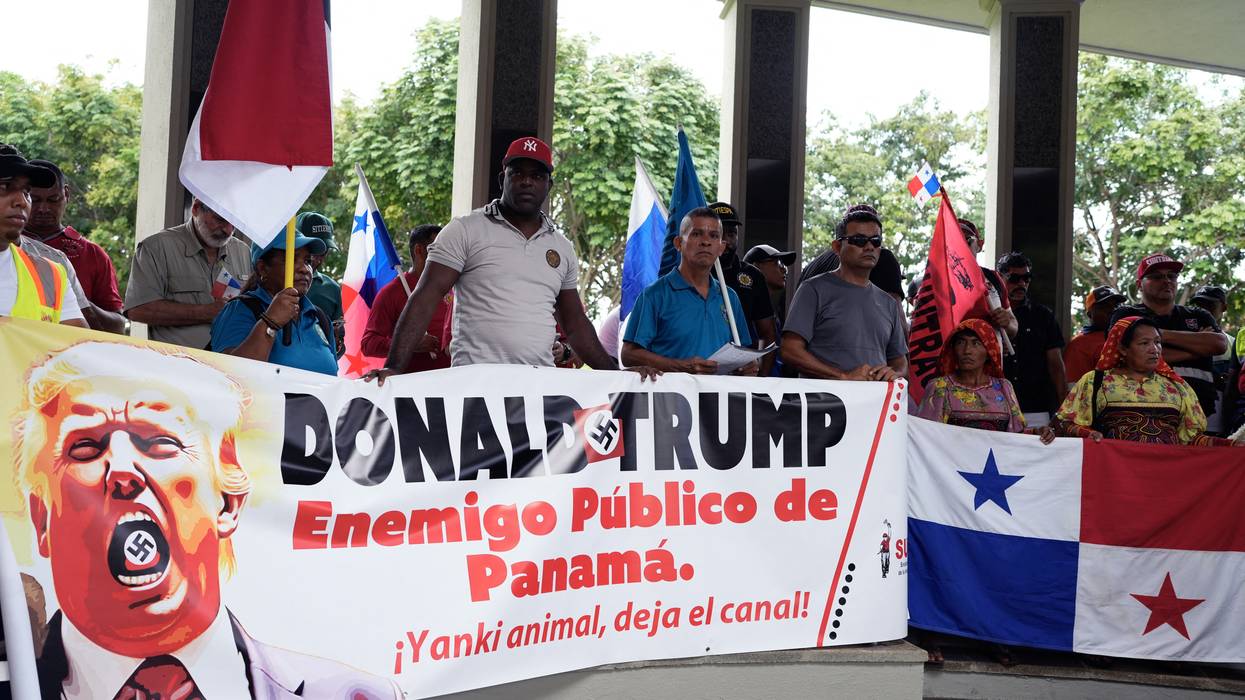
Trump claimed both the canal and the Danish territory are needed for U.S. "economic security."
U.S. President-elect Donald Trump has been rebuked in recent days by the leaders of both Panama and Denmark for his insistence that the Panama Canal and Danish territory Greenland must be under American control, and his latest comments on Tuesday were expected to garner more anger—and eye-rolling—from abroad.
At a press conference at his Florida resort, Mar-a-Lago, the Republican leader refused to rule out using military force to take over the canal and Greenland.
"It might be that you'll have to do something. The Panama Canal is vital to our country," said Trump. "We need Greenland for national security purposes."
He added that both the canal and Greenland, the world's largest island and home to a U.S. military base, are needed for U.S. "economic security."
Under President Jimmy Carter, who died late last month, the U.S. signed a treaty returning the Panama Canal Zone to Panama in 1979, and the waterway connecting the Atlantic and Pacific Oceans has been solely controlled by the Panamanian government since 1999.
Trump repeated a false claim that the canal is being "operated by China."
Last month, after the president-elect demanded "that the Panama Canal be returned to the United States of America in full, quickly and without question," Panamanian President José Raúl Mulino posted a video to social media in response.
"As president, I want to clearly state that every square meter of the Panama Canal and its adjoining zone is Panama's and will remain so," Mulino said. "The sovereignty and independence of our country is non-negotiable."
Trump's comments came as his son, Donald Trump Jr., joined right-wing activist Charlie Kirk and other Trump allies on a visit to Greenland.
The president-elect suggested in a social media post that the trip was made in an official capacity, writing: "The reception has been great. They, and the Free World, need safety, security, strength, and PEACE! This is a deal that must happen. MAGA. MAKE GREENLAND GREAT AGAIN!"
But Greenland officials clarified that Trump Jr. was visiting only as a "private individual" and said no representatives would be meeting with him.
Trump said at his press conference that "people really don't even know if Denmark has any legal right to [Greenland], but if they do they should give it up because we need it for national security."
Greenland is home to 60,000 people, and is self-ruling with its own legislature while its foreign and defense policy are controlled by Denmark. The Arctic island lies in a region where global powers are vying for military and economic control.
Trump also expressed a desire to purchase Greenland during his first term, a goal that was dismissed at the time as "absurd" by Danish Prime Minister Mette Frederiksen.
"Greenland belongs to the Greenlanders," Frederiksen reiterated on Tuesday.
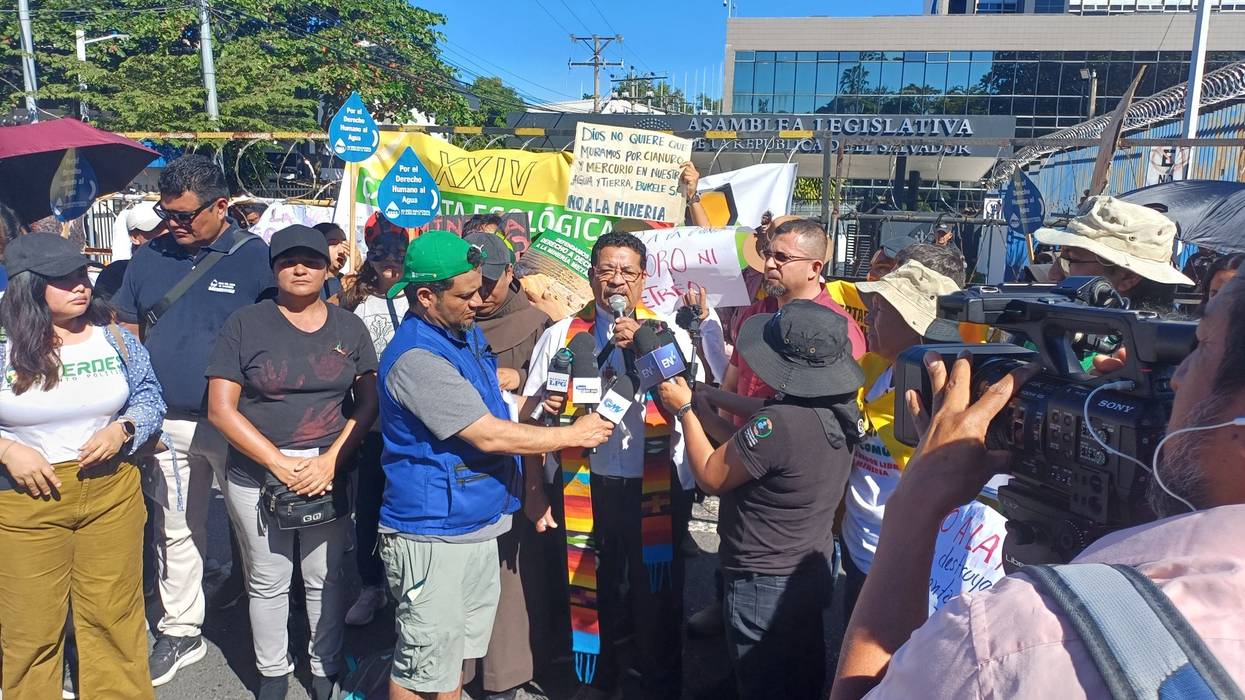
One group called it "the biggest attack on water, health, and life in El Salvador," highlighting "opposition from churches, universities, social organizations, and the majority of the population."
In a win for Salvadoran President Nayib Bukele, who has dubbed himself "the world's coolest dictator," the Legislative Assembly of El Salvador on Monday overturned the Central American country's 2017 ban on metal mining.
Bukele has fought to reverse the historic ban since taking office in 2019. Despite a prohibition in the Salvadoran Constitution, he ran for and won a second term in February, after his Nueva Ideas (New Ideas) party purged the judiciary.
Reporting on Monday's mining reversal, the Financial Times noted that "Bukele's party and its allies hold 57 of 60 seats in the legislature, and all 57 voted to overturn the ban while giving the Salvadoran government sole authority over mining activities."
As the British newspaper detailed:
He has claimed that El Salvador sits on gold reserves potentially worth $3 trillion, citing an undisclosed study, although that has been treated with skepticism by experts.
There has been limited exploration in El Salvador. El Dorado, the most advanced of more than two dozen exploration projects prior to the ban, was once estimated to hold 1.4 million ounces of gold, which would be worth roughly $3.6 billion today, without considering production expenses.
El Salvador's gold belt runs across its northern provinces and the watershed of the Lempa River, which is the small and densely populated country's main source of water.
In a statement earlier this month, the Washington, D.C.-based Institute for Policy Studies (IPS) warned that "El Salvador's 2017 prohibition against metallic mining is a widely popular measure and overturning it would be a death sentence for the small and densely populated country with its scarce water sources, many of which are already contaminated."
"The historic ban, passed in a unanimous 70-0 vote by El Salvador's Legislative Assembly in 2017, was the result of a decadelong campaign to value life over transnational mining corporations' pursuit of profits," IPS explained. "The campaign was ultimately supported by a wide coalition of civil society organizations, educational institutions, some business sectors, legislators and ministers from across the political spectrum, as well as two archbishops. They were all persuaded by substantial evidence of gold mining's destructive effects, and the deleterious impacts of cyanide used in gold mining."
"The struggle also cost the lives of several beloved water defender activists who stood up to the mining companies in Cabañas: Marcelo Rivera, Ramiro Rivera, student Juan Francisco Durán Ayala, and Dora Alicia Recinos Sorto, who was eight months pregnant when murdered, and whose 2-year-old child witnessed and was wounded in the attack," the group added.
The IPS statement came in response to a November 26 ruling that ordered a retrial for the Economic and Social Development Association of Santa Marta (ADES) "Santa Marta Five" water defenders—Miguel Ángel Gámez, Alejandro Laínez García, Pedro Antonio Rivas Laínez, Teodoro Antonio Pacheco, and Saúl Agustín Rivas Ortega—a development the group denounced.
ADES forcefully condemned the mining ban reversal on social media Monday, calling it "the biggest attack on water, health, and life in El Salvador," and pointing to "opposition from churches, universities, social organizations, and the majority of the population."
The Salvadoran group also shared images of opponents who gathered outside the Legislative Assembly on Monday.
Luis Gonzalez, one of the environmentalists outside the building,
told Reuters, "We oppose metals mining because it has been technically and scientifically proven that mining is not viable in the country."
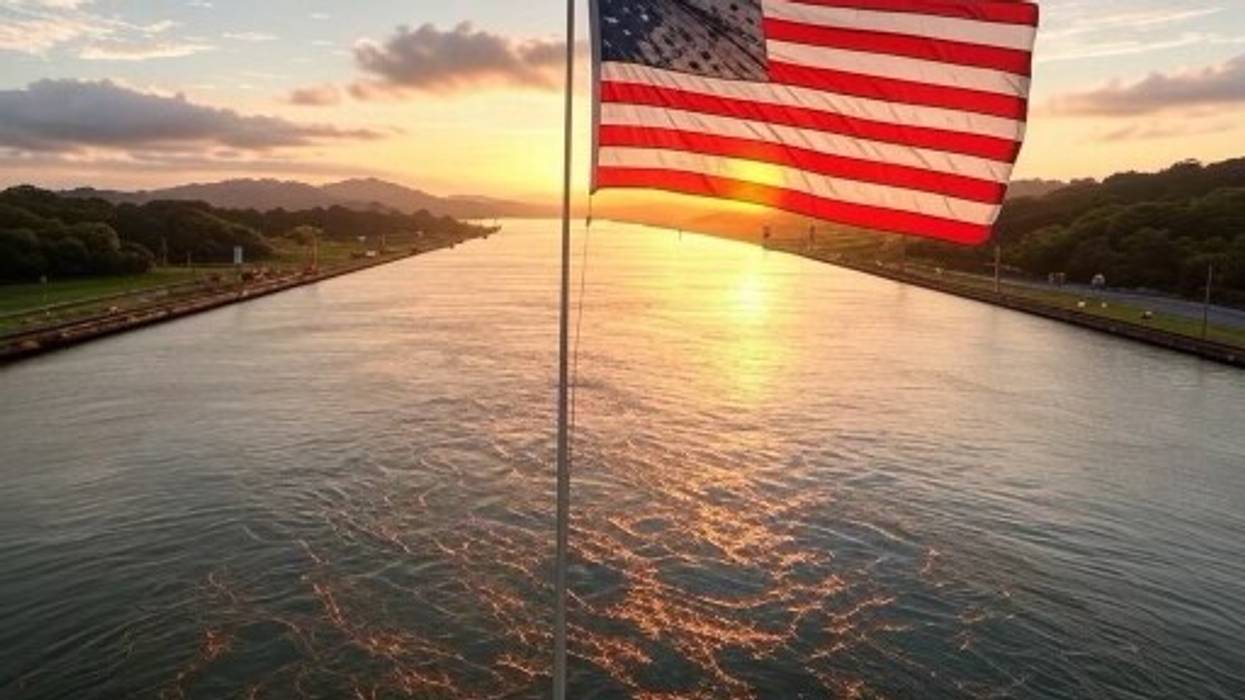
On December 22, 2024, the elected president of the United States, Donald Trump, announced that he would demand that Panama "give him back the canal."
Washington, D.C. January 22, 1903—Secretary of State John Hay and the Colombian commercial attaché in the United States, Tomás Herrán, signed the treaty that would give the United States the right to resume construction of the Panama Canal that the French had abandoned when they were almost halfway done. Colombia would agree to cede a strip of land on its isthmus to the United States for 100 years in exchange for ten million in a single payment and $250,000 per year. A few miles off the coast of Panama, the warship Wisconsin remains stranded to provide moral support for the negotiations.
Congress in Washington immediately approved the treaty, but it was rejected in Bogotá. There were doubts about sovereignty and about the benefits derived from this agreement. Mathematics, also practiced in that country, said that it would take the Colombian people 120 years to receive the same compensation that had been offered to be paid in one lump sum to the New Panama Canal Co.
On April 15, the United States envoy, Mr. Beaupre, sent a telegram to the secretary of state about the mood of the Colombian people: “There is at least one clear fact. If the treaty were put to the free consideration of the people, it would not be approved.” The Colombian Senate voted unanimously against its ratification.
Without ever having set foot outside his country, on August 27, President Theo Roosevelt wrote three letters describing the Colombians as “ignorant,” “greedy,” “despicable little men,” and “corrupting idiots and murderers.” Also, “I could never respect a country full of that kind of people… Trying to deal with Colombia as one deals with Switzerland, Belgium, or Holland is simply absurd.” Days later, he sends some packages with dollars to organize a revolt that will be called Revolution.
Problem solved. On November 18, the Hay-Bunau-Varilla treaty was signed in Washington, by which “the United States guarantees the freedom of Panama” in exchange for Panama ceding authority and all rights over the canal, free of any tax. As usual, the Panamanians were not invited to sign the new treaty. The $250,000 annually previously offered to Colombia would not be paid until a decade after the canal’s opening. There is nothing like having a powerful navy to do good business. The previous Treaty of Peace and Commerce signed by Colombia and the United States in 1846 was also violated. As in Cuba, as in Puerto Rico, article, now article 136 assured Washington the power to intervene in any inconvenient situation. Still, rebellions are symbolic. Washington has decreed that citizens of that country cannot acquire weapons. Imperial practice is old: Treaties are signed so the weak will comply.
In the United States, voices are raised against what several congressmen call dishonesty and imperialism. Sen. Edward Carmack protests, “The idea of a revolution in Panama is a crude lie; the only man who took up arms was our president.” Sen. George Frisbie Hoar, a member of the commission investigating the war crimes that will go unpunished in the Philippines, rejects the versions about the Revolution in Panama and adds, “I hope not to live long enough to see the day when the interests of my country are put above its honor.”
Of course, this matter of honor can be fixed. The president resorts to the old resource of “we were attacked first.” As President James Polk did to justify the invasion of Mexico in 1846 or President William McKinley to occupy Cuba in 1898, Roosevelt invents a story about threats to the security of certain American citizens in the area. Like Secretary of State Henry Kissinger, when he denied in front of television cameras any involvement in the military coup in Chile in 1973, Roosevelt assured Congress and the public that Washington was not involved in the Revolution in Panama. On December 6, 1904, he gave a speech before Congress on the need to once again expand the Monroe Doctrine “to see our neighbors stable, orderly, and prosperous.” Otherwise, “intervention by a civilized nation will be necessary… The United States must, whether it wants to or not, intervene to solve any serious problem by exercising the power of international police.”
In 1906, Roosevelt visited the construction sites in Panama. He would be the first American president to dare to leave his country. On board, the USS Louisiana, Roosevelt wrote to his son Kermit, “With admirable energy, men, and machines work together; the whites supervise the construction sites and operate the machines while tens of thousands of blacks do the hard work where it is not worth the trouble to use machines.”
Despite the hard work of Panamanians, they are portrayed as lazy. Journalist Richard Harding Davis had already echoed the sentiment of the time: “[Panama] has fertile lands, iron, and gold, but it has been cursed by God with lazy people and corrupt men who govern it… These people are a menace and an insult to civilization.”
In 1909, the Senate Foreign Affairs Committee, based on Roosevelt’s boastful statements to a class at a California university, investigated “the unilateral decision of a former president to take Panama from the Republic of Colombia without consulting Congress.” Considering Colombia’s requests to The Hague, the commission will question different protagonists. On November 6, 1903, three days after the revolution in Panama, the State Department sent a cable to its consul in Colombia informing that “the people of Panama, apparently unanimously, have resolved to dissolve their ties with the Republic of Colombia.”
Congressman Henry Thomas Rainey reads the cable from Washington in Congress. Rainey clarifies: “I do not believe any of this is true… When the Revolution occurred, only 10 or 12 rebels knew of the plans, apart from the Panama Railroad and Steamship Co. managers.”
It would be necessary to wait until 1977 when President Jimmy Carter’s government signed an agreement that the United States would return the canal to Central American country on the last day of 1999, three years before the mandatory rental period expired. A year earlier, at an event in Texas, the former governor of California and future president, Ronald Reagan, would declare: “It does not matter which ram dictator is in power in Panama. We built it! We paid for the canal! It’s ours, and we’re going to keep it.”
Omar Torrijos will be the dictator Reagan alluded to. Torrijos will claim sovereignty over the canal and will die, like other rebel leaders from the south, in a plane crash.
Imperialism is a disease that not only kills those who resist it but also does not let those who carry it inside live.

"As long as humans fill the atmosphere with fossil-fuel emissions, the heat will only get worse—vulnerable people will continue to die," an author of the analysis said.
Scientists on Thursday released an analysis showing the likely role of climate change in creating the deadly heatwave that hit areas including Mexico and the U.S. south in late May and early June.
Record-breaking heat caused by a heat dome, which engulfed areas from Nevada to Honduras, was hotter and more likely to occur due to the climate crisis, with five-day maximum daytime temperatures 35 times more likely than in pre-industrial times and nighttime temperatures 200 times more likely, scientists at World Weather Attribution (WWA) found.
At least 35 died of related illness in just one week in early June in Mexico, and the total death toll may have been much higher. The scientists emphasized that the extreme weather causing the death and suffering was brought about by fossil fuel emissions.
"Unsurprisingly, heatwaves are getting deadlier," Friederike Otto, a co-author of the study and climate scientist at Imperial College London, told The Guardian. "We've known about the dangers of climate change at least since the 1970s. But thanks to spineless politicians, who give in to fossil-fuel lobbying again and again, the world continues to burn huge amounts of oil, gas, and coal."
Deadly heat that would have been very rare without climate change & even relatively rare just 20 years ago, now common event due to continued increase in emissions from burning fossil fuels. We now this is happening, but we are not prepared. https://t.co/M93eB8TiIu pic.twitter.com/4U8lIXB8xN
— Dr Friederike Otto (@FrediOtto) June 20, 2024
The analysis was published on the same day that the Energy Institute reported that fossil fuel consumption climbed to a record high in 2023, with coal, oil, and gas still making up more than 80% of the global energy mix, though the figure fell below 70% in Europe for the first time.
May was the 12th consecutive month that was the hottest on record globally, compared to the same time period in previous years. And June has proved to be dangerously hot in many areas, with hundreds dying in the Hajj pilgrimage in Saudi Arabia as temperatures rose above 124°F and Balkan countries, as well as much of the U.S., currently under extreme heat advisories.
The WWA scientists sought to connect the May-June heatwave to these larger trends, and repeatedly explained the cause of the problem.
"As long as humans fill the atmosphere with fossil-fuel emissions, the heat will only get worse—vulnerable people will continue to die and the cost of living will continue to increase," Izidine Pinto, a co-author and researcher at the Royal Netherlands Meteorological Institute, told The Guardian.
The heatwave coincided with a drought in Mexico, exacerbating already dire conditions as water supplies dwindled and electricity systems faltered. It also followed, and may have helped prolong, a terrible outbreak of dengue in Latin America and the Caribbean that caused over 1,800 deaths. "Every heatwave is a push that builds up dengue transmission," an expert told Scientific American in April. Dengue cases have begun to decline but still persist, according to Dialogue Earth.
The May-June heatwave was notable for especially high nighttime temperatures, which prevent the body from resting and recovering from the daytime heat—a process that's only possible below about 80°F. Certain places in the study area saw nighttime temperatures "with return periods of up to 1000 years."
The climate crisis is changing the likelihood of such weather. "The extreme heat slamming the eastern U.S. this week may be a sign of things to come," The Hill's Zach Budryk wrote Thursday.
That was similar to the message of the WWA scientists.
"These trends will continue with future warming and events like the one observed in 2024 will be very common in a 2°C world," according to their analysis, which refers to a time when the planet has heated 2°C above preindustrial levels; it's already heated up by more than 1°C.
In the analysis, the authors called for warning systems, action plans, laws to protect outdoor workers, and other resilience measures such as better grid systems and more green spaces.
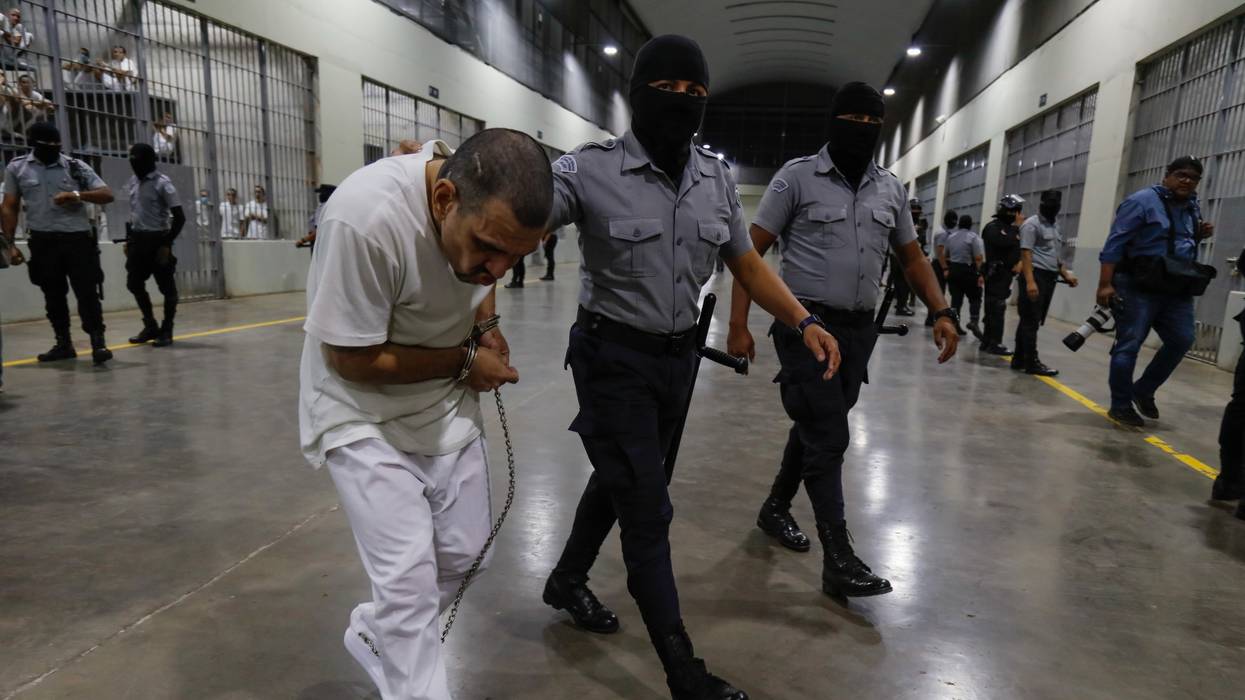
"Reducing gang violence by replacing it with state violence cannot be a success," said one Amnesty International official.
Two years after Salvadoran President Nayib Bukele declared a "state of exception" that was originally adopted for a 30-day period in response for a spate of apparent gang killings, the government is boasting that its policies have driven down the homicide rate by 70%—but international rights defenders on Wednesday warned the crackdown has plunged the country into a human rights crisis.
Amnesty International said that according to local victims' movements and human rights groups, El Salvador's former murder rate has been replaced by 327 cases of forced disappearances since March 2022, as well as 78,000 arbitrary detentions as police have raided neighborhoods, particularly in low-income areas.
"A total of approximately 102,000 people [are] now deprived of their freedom in the country—a situation of prison overcrowding of approximately 148% percent and at least 235 deaths in state custody," said Amnesty.
Bukele adopted the state of emergency after El Salvador reported its deadliest peak in apparent gang violence in recent history, with gangs blamed for 92 people's deaths over three days in March 2022.
Under the emergency order, authorities have suspended the right to privacy in communications, to be informed of the reason for one's arrest, and to be taken before a judge within 72 hours of an arrest. A report by Human Rights Watch in December 2022 also warned of "torture, or other cruel, inhumane, or degrading treatment against people accused of crimes." Officers told people during arrests only that they were following "orders from the president," and in some cases, told people they were being taken to a police station for "questioning" when they were actually under arrest.
"The insistence of Nayib Bukele's government on maintaining the state of emergency, the adoption of disproportionate measures, and the denial, minimization, and concealment of reported serious human rights violations reflect the government's unwillingness to fulfill its duty to respect and promote human rights in the country," Ana Piquer, Amnesty International's Americas director, said Wednesday. "It also demonstrates its inability to design comprehensive long-term measures to address the root causes of violence and criminality without forcing the population to choose between security and freedom."
Amnesty's statement came a day after Justice and Security Minister Gustavo Villatoro said Bukele's government plans to continue its strategy to "eradicate this endemic evil."
"This war against these terrorists will continue," said Villatoro in a televised address.
Despite outcry from domestic and international human rights groups, Bukele won his reelection campaign in a landslide last month. El Faro reported that Bukele's government had violated some election rules including airing ads within three days of the election and campaigning on Election Day. Some poll workers also wore clothes identifying them as supporters of Bukele's Nueva Ideas party, and police allegedly blocked journalists from working near polling locations, prompting accusations of intimidation and harassment by the Association of Journalists of El Salvador.
The Due Process of Law Foundation released a report Tuesday warning that Bukele's government could be guilty of crimes against humanity as it continues its crackdown.
"Well over 76,000 people, including minors, have been detained under the state of exception, accused of having ties to gangs," wrote the group. "Many or most of these detentions appear to be occurring without any reasonable grounds for suspecting that the person may have committed a crime. Mere physical appearance—including having tattoos—seems to be enough to put people at risk of arrest, with young men from poor districts a particular target. Arrests of this nature are in themselves discriminatory, and may well qualify as arbitrary. According to the United Nations Working Group on Arbitrary Detention, under customary
international law, 'The legal basis justifying... detention must be accessible, understandable, nonretroactive, and applied in a consistent and predictable way.'"
Amnesty noted on Wednesday that human rights defenders and dissidents also face "increased risk" under the state of emergency, "as they are criminalized." As Common Dreams reported this week, five water defenders are scheduled to stand trial on April 3 for allegedly killing a military informant, an accusation for which the government has produced no proof.
"In the absence of any kind of evaluation and checks and balances within the country, and with only a timid response from the international community, the false illusion has been created that President Bukele has found the magic formula to solve the very complex problems of violence and criminality in a seemingly simple way. But reducing gang violence by replacing it with state violence cannot be a success," said Piquer. "The authorities in El Salvador must focus the state response on comprehensive policies that respect human rights and seek long-term solutions."
"The international community," she added, "must respond in a robust, articulate and forceful manner, condemning any model of public security that is based on human rights violations."
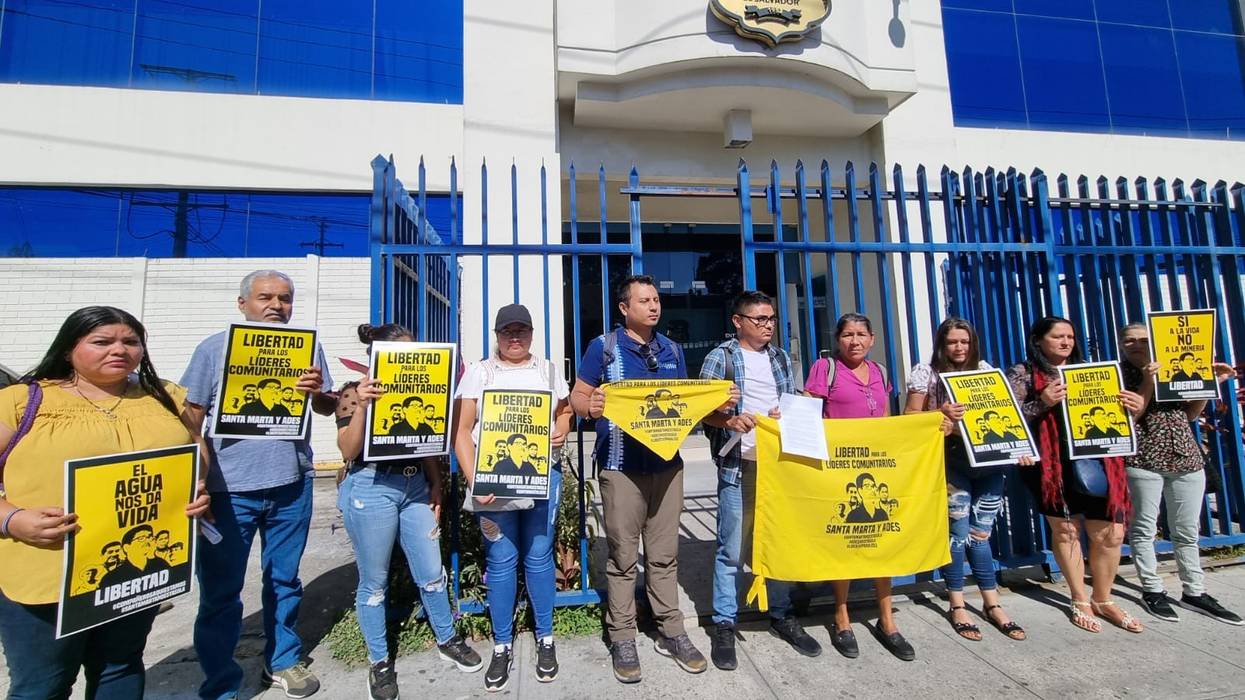
"We need the continued support of the international community to ensure that basic human rights, such as the right to due process, are upheld in El Salvador," said one local campaigner.
In the wake of right-wing Salvadoran President Nayib Bukele recent reelection, 245 groups from 31 countries on Friday renewed calls for his government to drop all charges against five Salvadoran water defenders known globally for their anti-mining work.
Miguel Ángel Gámez, Alejandro Laínez García, Pedro Antonio Rivas Laínez, Teodoro Antonio Pacheco, and Saúl Agustín Rivas Ortega—who fought for a 2017 legislative ban on metal mining in El Salvador—were arrested over a year ago. They are accused of murdering an alleged military informant during a civil war more than three decades ago. While they were released to house arrest in September, the "Santa Marta Five" still face charges that critics call politically motivated.
In a joint statement published in English and Spanish, the global coalition pointed to reporting that Bukele's government is "considering overturning the mining ban" due to economic issues in the Central American country as well as his administration's "crusade to criminalize, persecute, and demobilize its political opponents."
"We call on the Salvadoran government to drop all charges against the five prominent water defenders and to protect, not undermine, the human rights of all Salvadorans."
"Rather than investigate or prosecute those responsible for the dozens of cases of human rights violations and crimes against humanity that members of the Salvadoran military committed against the Santa Marta community (including the murders of the Lempa River massacre in 1980, where 30 people were assassinated and 189 were disappeared), the government is now re-victimizing the community by targeting their leaders, who have been outspoken against the policies of the current government," the groups said.
"Over this past year, the Salvadoran government has produced no evidence of guilt for the five, and legal experts argue that the five are covered under a 1992 amnesty that was part of a National Reconciliation Law that passed that year," the coalition continued. "At the same time, hundreds of civil society organizations, elected officials from the U.S., Canada, and Spain, and U.N. special rapporteurs have called for their exoneration."
The Santa Marta Five are among over 75,000 people arrested during El Salvador's state of exception, a nationwide crackdown on gangs that began in March 2022. Human rights organizations say many of those imprisoned are innocent and have documented widespread abuse by security forces.
A U.S.-Canadian delegation visited El Salvador in October and last month released a report on their findings—in English and Spanish. In addition to highlighting the "tens of thousands of innocent people" imprisoned under Bukele and "compelling evidence" that he wants to violate the mining ban, the report states that the president "has taken a series of steps to reduce the independence of the judiciary, to violate basic human rights, and to suspend civil liberties and the rule of law."
The report also emphasizes that "representatives of the executive branches of the governments of the United States, Canada, Mexico, and the European Union have chosen to ignore these massive violations of human rights as they drop their criticism of Bukele's actions and supply financial aid to his government."
Report co-author John Cavanagh is a senior adviser at the Institute for Policy Studies, which is one of the groups behind the new joint statement and in 2009 honored the National Roundtable on Metals Mining, a coalition the arrested water defenders helped build, with its annual Letelier-Moffitt Human Rights Award.
"We were shocked by the level of fear of arbitrary arrest among ordinary people in El Salvador today," Cavanagh said Friday. "We call on the Salvadoran government to drop all charges against the five prominent water defenders and to protect, not undermine, the human rights of all Salvadorans."
Vidalina Morales, president of the Association of Economic and Social Development Santa Marta (ADES), stressed that "at this time, when President Nayib Bukele has consolidated his dictatorial control of all the democratic institutions of the Salvadoran state, we need the continued support of the international community to ensure that basic human rights, such as the right to due process, are upheld in El Salvador."

"The force of this victory is going to make it clear that there is no place for the attempts to derail the electoral process," Arévalo said following his win.
In a blow to Guatemala's right-wing political establishment, former diplomat Bernardo Arévalo won the nation's presidential election on Sunday, pledging to fight corruption that has eroded the country's institutions and entrenched massive levels of inequality and poverty.
Voters chose Arévalo over former first lady Sandra Torres in a landslide, putting the anti-corruption advocate on track to become the most progressive Guatemalan leader since Jacobo Árbenz, who was ousted in a U.S.-sponsored coup in 1954.
As The Washington Post noted, "Arévalo's father, Juan José, is widely known as a leader of the 'Guatemalan spring,' a period of democratic rule that began in 1944 when he was elected president." The ouster of Árbenz, Juan José's successor, marked the start of decades of brutal military rule bolstered by U.S. support.
The question now is whether Arévalo will be permitted to take office. Ahead of Sunday's contest, Guatemalan authorities barred several candidates from the ballot, including leftist Indigenous leader Thelma Cabrera.
During his victory speech late Sunday, Arévalo acknowledged possible efforts by Guatemala's political establishment to prevent him from assuming office.
"We know that there is a political persecution underway that is being carried out through the institutions and prosecutor's offices and judges that have been corruptly co-opted," Arévalo said, alluding to the nation's crackdowns on officials, journalists, and activists who have worked to combat graft.
"We want to think that the force of this victory is going to make it clear that there is no place for the attempts to derail the electoral process," said Arévalo. "The Guatemalan people have spoken forcefully."
Arévalo—who is set to be sworn in on January 14, 2024—stunned political observers when he came in second place in the first round of voting in late June. What followed offers a possible preview of coming efforts by political elites to block certification of Arévalo's win.
Rafael Curruchiche, a Guatemalan prosecutor who has himself been accused of corruption, pushed for the suspension of Arévalo's party following the first round of votes, claiming to have uncovered evidence that more than 5,000 signatures for the party's campaign were unlawfully obtained.
While Guatemala's Supreme Electoral Tribunal ultimately rejected Curruchiche's effort, citing laws preventing the suspension of political parties during the election process, the court's ruling could still be appealed to Guatemala's Constitutional Court.
Allan Nairn, an American investigative journalist who has covered Guatemala for decades, wrote before Sunday's election that in the case of an Arévalo victory, Guatemala's conservative elites "have made it clear that they will do what's needed to prevent" him from taking office.
"Merely winning the vote will not be enough; to take office he must first win big, and then many thousands will have to be ready to take to the streets if circumstances demand," Nairn added.
We need to push back on the GOP narrative that immigration is a bad thing, and that the militarized approach on immigration is helpful.
I recently came across a tweet from Stephen Miller, Donald Trump’s architect of the absolutely unconscionable family separation policy at the border. The tweet reads, “Joe Biden is the trafficker-in-chief. No one on earth is responsible for more child trafficking than Joe Biden.”
This tweet is absurd on its face because Joe Biden is not actively engaging in human trafficking, unlike Governors Ron DeSantis of Florida and Greg Abbott of Texas, who have utilized public funds and fraud to send migrants to Martha’s Vineyard and Vice President Kamala Harris’ home, using people who have fled from desperate situations as human props. Even though this tweet is ridiculous, it is useful because it perfectly encapsulates the conservative narrative on immigration. As immigrant advocates and progressives, we need to understand their narrative and have a clear recognition that it is completely backward. They will tell you that some fictitious “open border” policy is the cause of the crisis at the border, but the reality is that right wing policies in different areas overlap to create the perfect storm where people are desperately fleeing their home countries, only to be turned away by the U.S. and forced to cross the border in a dangerous manner.
Miller’s narrative essentially boils down to this: Joe Biden’s “open border” policies make it too easy for people to come to the U.S., which causes human trafficking. This is illogical on its face because people would not resort to using “coyotes” to get themselves and their loved ones into the U.S. if they had a practical and legal method to immigrate, and they wouldn’t be so desperate to escape in the first place if there weren’t so many dangerous situations at home. The many disruptions in their home countries caused by right-wing U.S. policy, coupled with the lack of a legal option for immigrating to the U.S., are the principal causes of the crisis at the border.
A useful thought experiment would be to ask yourself this question: What kind of situation would you have to be in that would cause you to flee from your home country through dangerous conditions, only to arrive in a foreign country that may or may not take you in? It is helpful to keep this in mind because it counters the traditional right wing thinking that people arriving at the southern border are “bad hombres” as Donald Trump famously put it. I would argue that most people would only leave their lives behind and embark on this journey if they felt like they had no other option.
President Biden’s record on immigration has been mixed at best, but there is one policy he is pursuing that has the potential to help alleviate the crisis at the border.
Why do citizens of countries like El Salvador, Honduras, Guatemala, Haiti, and many others, feel like they have to leave their home countries? U.S. policies have disrupted the affairs of these countries for years in numerous ways. For example, the right wing U.S. Supreme Court effectively gave the green light to unlimited gun sales through its decision in D.C. v. Heller. Many of these guns flow south to our neighboring countries, where criminals and gangs use them to commit violence against the citizenry. This “iron river” has created a situation where nearly 70% of the guns recovered from crimes in Mexico are U.S. sourced. That number is a staggering 80% in the Caribbean. Organized crime and gang violence are a significant cause of people fleeing their home countries. They are made much deadlier by U.S. weapons manufactured and sold under the current, conservative interpretation of the 2nd amendment.
Another example of right-wing U.S. policy causing people to flee their home countries is climate change induced drought and hurricanes. The U.S. is the biggest historical emitter of greenhouse gasses, meaning that most of the extra global warming causing gas in the atmosphere came from the U.S. Instead of embracing a Green New Deal that would transition us off fossil fuels and create good jobs, the U.S. has continuously ignored the urgency of climate change and doubled down on fossil fuel production. Climate change intensifies weather patterns like droughts and hurricanes, causing crop failure, property damage, and extreme poverty. Relentless droughts and hurricanes in Central America drove large numbers of people to flee their home countries recently. This will only continue to get worse until the U.S. adopts a progressive climate change policy and begins to reverse the damage already being done.
A final example of right-wing U.S. policy causing people to flee their home countries is political interference. The U.S. has a long history of manipulating the political processes of Latin American countries in order to install leaders that are friendly to the U.S. and U.S. business interests. In the infamous “Roosevelt Corollary” to the Monroe Doctrine, Theodore Roosevelt asserted that the U.S. had the right to intervene in the affairs of our neighbors to the south. This concept has never disappeared from U.S. policy.
In El Salvador, the U.S. propped up a repressive government that took power through a coup in 1979. This government killed its own citizens, causing a mass exodus to the U.S. Many of these refugees were later deported back to El Salvador, where they brought the U.S. gang culture with them back home, leading to the explosion of gang violence by MS-13. In Honduras, former President Obama and then Secretary of State Hillary Clinton tacitly allowed and refused to condemn the coup of reformist President Manuel Zelaya, which paved the way for a repressive government that was actively involved in drug trafficking, most notably under former President Juan Orlando Hernández. Finally, U.S. sanctions on Venezuela have crippled that country’s economy, while U.S. attempts to overthrow its leftist government, most notably when former President Trump and John Bolton attempted to install Juan Guaidó as the leader by officially recognizing him as President in 2019, have created long term political and social instability.
There are many more examples I could give, but the point should be clear that many of the policies championed by conservatives create the destabilizing conditions that cause people to flee their home countries and seek refuge at the southern border. “America first” is essentially a euphemism for, “We don’t care what happens to our neighbors to the south.”
The second part of the problem is that migrants at the southern border do not have a better way to come to the U.S. because of our militarized border and immigration policy. If they had a legal, safe, and humane way to come to the U.S., I am certain they would prefer to use that method instead of crossing the southern deserts, hoping not to die of thirst and heat exhaustion, or fall prey to kidnappers, cartels, and gangs. This is where Miller’s narrative falls apart. Human trafficking happens because our immigration policies make it essentially impossible for people seeking refuge to come to the U.S. in a normalized manner. Migrants at the border without a practical way to enter the U.S. hire “coyotes” or other smugglers to help get them or their loved ones across the border safely. This creates a human rights catastrophe that could be avoided if we stopped treating migrants like an invading army and started treating them like people who need help.
If the situation in their home country is desperate enough, people are going to try to seek refuge however they can. Let’s think back to the thought experiment above. If there was a gang menacing your family, and your options were to stay at home and wait to be killed, or cross the U.S. border without documentation to ask for asylum, what would you do? Now ask yourself this, if you were fleeing for your life, would you rather come to the U.S. by showing up at a port of entry at the border and being lawfully admitted into the country, or would you rather cross the desert and hope to get caught by Border Patrol so you can be detained and ask for asylum? Clearly, anyone in this situation would rather come to the U.S. in a lawful, orderly fashion if they could, but absent such a way to come to the U.S., they are going to choose crossing the border any way they can instead of staying at home and facing death.
President Biden’s record on immigration has been mixed at best, but there is one policy he is pursuing that has the potential to help alleviate the crisis at the border. He has begun using his authority under the Immigration and Nationality Act, section 212(d)(5)(A) to allow migrants at the southern border into the U.S. under “humanitarian parole”. Congress unambiguously gave the President the authority to “parole,” i.e., to allow people to enter the U.S., for urgent humanitarian reasons or significant public benefit. President Biden has directed U.S. Customs and Border Protection to begin allowing migrants into the U.S. using this authority as they seek refuge from dangerous situations back home.
As the Center for American Progress details, this parole program has already been shown to reduce the number of encounters with people crossing the border illegally. The data clearly shows that if you give people a way to come to the U.S. legally, they will do so, which will improve the lives of migrants at the border and reduce human trafficking. Unfortunately, President Biden is coupling this parole program with restrictions on asylum. It seems that Democratic administrations can never fully embrace immigration and always try to have it both ways by opening new avenues to help immigrants on the one hand, while simultaneously shutting down others. The Biden Administration should keep access to asylum open while also implementing new ways for people to apply for humanitarian parole instead of opening one door while closing another.
Miller’s implied argument that “weak” immigration laws cause human trafficking is false. In fact, the “tough” approach that conservatives support is largely to blame. We need to push back on the conservative narrative that immigration is a bad thing, and that the militarized approach of the GOP on immigration is helpful. The next time you engage with someone who uses this narrative, ask them why they support policies that cause people to flee their home countries, and why they support policies that force them to cross the border without documentation instead of giving them a safe way to seek refuge.

The march began a month after 40 people, including some who had been expelled from the U.S. and sent to Mexico, were killed in a detention center fire in Ciudad Juarez.
As the Biden administration seeks to expand its anti-immigration policies at the U.S.-Mexico border, thousands of Central and South American asylum-seekers are taking part in a march that began Sunday in southern Mexico to protest the detention centers where migrants are being held in the country—some after being expelled from the United States.
Roughly 3,000 people from countries including El Salvador, Venezuela, Ecuador, and Cuba began the march in Tapachula, near the Mexico-Guatemala border, and expect to walk for 10 days before reaching Mexico City.
Organizer Irineo Mújica of the Pueblos Sin Fronteras advocacy group told the Associated Press that the marchers are demanding the dissolution of the National Migration Institute (NMI), which runs detention centers like the one in Ciudad Juarez where 40 people were killed in a fire last month, and an end to the use of such facilities, which Mújica likened to "jails."
"In this viacrucis," said Mújica, using the word for a stations of the cross procession, "we are asking the government that justice be done to the killers, for them to stop hiding high-ranking officials. We are also asking that these jails be ended."
As Common Dreams reported after the fire, rights groups have blamed both U.S. and Mexican migration policies for the deadly blaze, which detained migrants reportedly started during a protest over guards' refusal to provide them with drinking water in their overcrowded cells. Surveillance footage showed guards walking away from the scene as smoke filled the facility.
"It could well have been any of us," Salvadoran migrant Miriam Argueta told the AP. "In fact, a lot of our countrymen died. The only thing we are asking for is justice, and to be treated like anyone else."
Mexico's top immigration official for the northern state of Chihuahua, Salvador González, faces homicide charges over the fire. Francisco Garduño, who heads the NMI, is also scheduled to appear in court this month and prosecutors have found "a pattern of irresponsibility and repeated omissions" about conditions at detention centers.
At least some of the victims had been sent back over Mexico's northern border by American immigration authorities after crossing into the United States, and according to the BBC and Reuters, the march to Mexico City is also aimed at demanding changes to the U.S. asylum system and for asylum requests to be sped up.
Some migrants taking part in the march are carrying wooden crosses, while others are carrying signs reading, "Government crime" and "The government killed them."
The marchers made it about nine miles on Sunday, stopping in Alvaro Obregon.
Earlier this year, U.S. President Joe Biden announced an expansion of Title 42, the Trump-era anti-asylum rule. Under the program, up to 30,000 people from Cuba, Haiti, and Nicaragua are being sent to Mexico each month unless they arrive in the U.S. through a humanitarian parole program that requires them to find sponsorship and afford a plane ticket to the United States.
A public comment period on another anti-immigration rule ended this month. Under the so-called "transit ban," migrants who pass through other countries and don't claim asylum there before reaching the U.S. would be deported.
Both rules have been condemned by international human rights authorities.

Parents forcibly separated from their children during then-President Donald Trump's "zero tolerance" immigration crackdown continue to suffer enduring trauma and should be justly compensated by a Biden administration that's instead defending its predecessor in court, according to a report published Tuesday by a prominent human rights group.
"Separated families continue to endure significant distress, functional impairment, and mental health disorders."
The Physicians for Human Rights (PHR) study examines the enduring psychological damage of Trump's "zero tolerance" immigration policy on a group of 13 parents who were deported from the United States, most of whom were separated from their children for three to four years. The publication also highlights the successes--and shortcomings--of the Biden administration's response to its predecessor's policy.
"The psychological evaluations conducted by PHR clinicians show that separated families continue to endure significant distress, functional impairment, and mental health disorders," PHR medical director Dr. Michele Heisler, who conducted an evaluation for the report, said in a statement.
"This ongoing trauma is a consequence of being forcibly separated from their children by the U.S. government and later deported to face persecution in their countries of origin," she added. "These new findings make it clear that reparations and redress are not an optional policy choice. It is the bare minimum fulfillment of the U.S. government's obligation owed to victims as a result of its violations of international and domestic law."
Between 2017 and at least late 2018, more than 5,000 children--most of them fleeing violence and impoverishment in Central America--were seized from their parents by a xenophobic administration seeking to stem undocumented immigration at the U.S.-Mexico border. Separated parents and children were often detained in facilities that numerous critics called "concentration camps."
The parents in the study described being forcibly separated from their children by unsympathetic officials who offered little or no information about the reason for the action, where their children were being taken, and for how long.
Most of the parents in the PHR report were deported to "dangerous situations," with more than half saying they "continue to live in constant fear of persecution and hiding from gangs or cartels who threatened them before."
Related Content

As a result of the separation policy, both parents and children--who were often told by U.S. officials that they would never see each other again--have suffered tremendous emotional and psychological trauma that PHR has called "torture" and "state-sanctioned child abuse."
According to the report:
Although in most cases the separation had taken place several years before, the parents' despair was evident in the reporting of current symptoms at the time of the PHR evaluation. Almost universally, parents noted continued disturbances in sleep, nightmares, loss of appetite, loss of interest, fear for the future, constant worry, hopelessness, and loss of the ability to concentrate.
One mother said, "I don't know if I will ever be able to ever recover from what I have experienced."
Another mother said that being separated from her daughter felt like something "choking me from the inside." One father explained that separation physically hurt because his son was "part of my heart that was torn away from me."
"It's a very immense pain," said yet another parent. "I don't know if I will ever be able to recover from what I have experienced."
"I don't know if I will ever be able to recover from what I have experienced."
Eleven of the 13 parents documented post-traumatic stress disorder diagnoses, while the other two suffered from symptoms of PTSD just below the clinical level.
One Honduran man who was not part of the study reportedly killed himself nearly four years ago while jailed in Texas following separation from his three-year-old child.
"Many parents subjectively described the separation event as the worst thing they had ever experienced, even compared with other severe forms of trauma, such as assault," the study notes. "In virtually every case encountered, PHR's expert evaluators noted that the trauma suffered by the parents and the children warranted further intervention and ongoing therapeutic support, because the events were causing 'significant distress' and ongoing functional impairment."
The report asserts that "the persistent and damaging psychological effects documented by PHR call out for acknowledgment, accountability, redress, and rehabilitation."
The paper continues:
In response to these U.S. government abuses and subsequent psychological effects, parents called for a formal public apology by the government, an investigation such as a truth commission, financial compensation and funding for rehabilitation expenses, legal reforms to prevent repetition, and, importantly, permanent immigration status in the United States, to ensure that they would not be separated from their children again.
These measures are all strongly supported in international human rights law, which requires states that inflict torture to ensure prompt and effective remedies for victims and survivors. Reparation is not a policy choice; it is the fulfillment of the U.S. government's obligation owed to victims as a result of its unlawful breach of international and domestic law.
While President Joe Biden--who in February 2021 signed an executive order establishing a family reunification task force--has said that separated families "deserve some compensation," their advocates were deeply disappointed when his administration withdrew from settlement negotiations with the migrants' lawyers last December.
Related Content

Continuing a pattern repeated by past presidents, the Biden administration is seeking to protect, rather than hold accountable, its predecessor. As the president's former boss--then-President Barack Obama--shielded George W. Bush administration and Central Intelligence Agency officials accused of torture in the War on Terror, Biden is defending Trump's family separation policy in court. This forces families who often lack the means to pay for legal representation to either give up or relive the trauma of separation in "protracted, adversarial court proceedings."
"The Biden administration should immediately return to the global settlement negotiations it shamefully walked away from in December," asserted PHR Asylum Program deputy director Kathryn Hampton. "Rather than defending Trump's family separation practices in court, the Justice Department should instead provide redress and rehabilitation."
In June 2021, Biden's reunification task force said it had identified at least 3,913 children who were separated under Trump's "zero tolerance" policy. According to PHR, at least 324 children were in the process of being reunified as of February 2022, while 1,228 children had not yet been returned to their parents.