SUBSCRIBE TO OUR FREE NEWSLETTER
Daily news & progressive opinion—funded by the people, not the corporations—delivered straight to your inbox.
5
#000000
#FFFFFF
To donate by check, phone, or other method, see our More Ways to Give page.
Daily news & progressive opinion—funded by the people, not the corporations—delivered straight to your inbox.
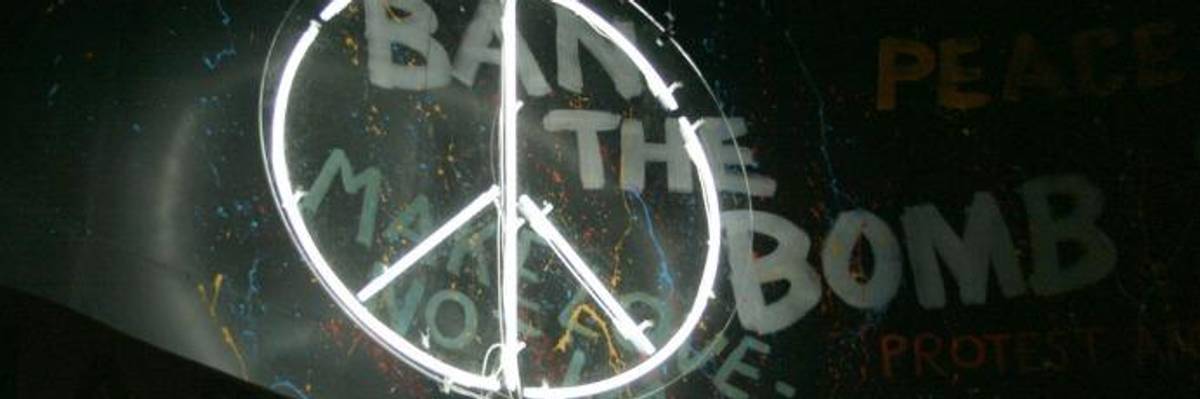
"The ban treaty is the start of a new worldwide movement that gives the United States an opportunity to break from its self-destructive nuclear weapons policy," said Jeff Carter, executive director of Physicians for Social Responsibility. (Photo: Lamerie/flickr/cc)
The United States has joined a small group of global outliers on Friday after a historic United Nations treaty to ban nuclear weapons was adopted by a majority of the world's nations.
"The adoption of the nuclear weapons ban treaty marks an historic turning point in the centuries-old battle to eliminate all weapons of mass destruction," said Jeff Carter, executive director of Physicians for Social Responsibility.
Ahead of its adoption, Elayne Whyte Gomez, Coasta Rica's ambassador to the U.N. and president of the United Nations Conference to Negotiate a Legally Binding Instrument to Prohibit Nuclear Weapons, championed the "historic"agreement, calling it "the first multilateral nuclear disarmament treaty to be concluded in more than 20 years."
Noting that the landmark moment comes 72 years after the atomic-bombing of Hiroshima and Nagasaki, an editorial in Japan's Mainichi said: "The international community's firm determination not to repeat these tragedies is the linchpin of the convention."
One hundred twenty-two nations agreed to the final draft text after weeks of negotiations that were not attended by any of the nine nuclear-armed states, which include the U.S., Russia, and North Korea. (Among those signing on, however, are two of the other "axis of evil" states: Iran and Iraq.) The Netherlands cast the sole vote against the treaty.
"The nuclear weapons states' boycott of the ban treaty negotiations," Carter said last month, "illustrates a denial of medical science," referring to "empirically known consequences of the use, testing, and development of these weapons on human lives."
The treaty is based in humanitarian law and prohibits the development, testing, production, possession, or stockpiling of nuclear weapons or other nuclear explosive devices, the transfer of such weapons, and also bans not only their use but the threat of their use. It also calls for states to undertake environmental remediation for areas contaminated by nuclear weapons use or testing, and for states to provide assistance to victims "including medical care, rehabilitation, and psychological support, as well as provide for their social and economic inclusion."
As John Loretz, program director at International Physicians for the Prevention of Nuclear War, explained Friday:
The nuclear-armed and nuclear-dependent states have been provided with practical and flexible ways to comply with those prohibitions once they decide to join. If they persist in defying the norms established by the treaty, they will be outlaw states.
The treaty refutes the claim made by a handful of states that they need nuclear weapons to ensure their own security, and that humanitarian consequences must somehow be balanced with those needs. Not only does the treaty insist that the dangers posed by nuclear weapons "concern the security of all humanity," but it also calls the long-overdue elimination of nuclear weapons "a global public good of the highest order, serving both national and collective security interests."
The International Campaign to Abolish Nuclear Weapons (ICAN) said Thursday it was "overwhelmingly positive about the draft treaty," adding: "We are on the cusp of a truly historic moment--when the international community declares, unambiguously, for the first time, that nuclear weapons are not only immoral, but also illegal. There should be no doubt that the draft before us establishes a clear, categorical ban on the worst weapons of mass destruction."
The New York Times writes: "The new agreement is partly rooted in the disappointment among non-nuclear-armed nations that the Nonproliferation Treaty's disarmament aspirations have not worked."
Indeed, said Dr. Matthew McKinzie, Natural Resources Defense Council Senior Scientist and director of NRDC's nuclear program, at a U.N. media briefing last month, "Both the U.S. and Russia are modernizing their nuclear arsenals."
"That reveals an expectation that instead of reducing and eliminating nuclear arsenals, we will have these weapons for generations to come. That's not the future we want," he said.
Further explaining this trend, Matt Taibbi wrote at Rolling Stone:
This slowing of the disarmament movement began during Barack Obama's last term, coinciding with the collapse of relations between the U.S. and Russia. Particularly since 2011, when the U.S. and Russia concluded the "New START" treaty on the reduction of each others' arsenals, dialogue has almost completely ended on the subject.
Whatever you want to point to as the reason--the much-condemned Russian adventurism in Ukraine, or maybe the 2012 passage of the Magnitsky Act sanctioning Russia for human rights abuses, a law that outraged Putin and inspired a vicious ban on American adoption of Russian children--communication between Russia and the United States had long ago dropped to almost nil. This was before last summer's election, the DNC hack, or the rise of Trump.
As a result, the two countries who maintain about 90 percent of the world's warheads have stopped talking about nuclear reduction, and the rest of the world--which was promised disarmament--has noticed, leading to protest moves like this new treaty ban.
"Right now," Carter added, "the U.S. government defies its existing disarmament obligations under the Nonproliferation Treaty by planning to fund an extensive buildup of its nuclear arsenal. The ban treaty is the start of a new worldwide movement that gives the United States an opportunity to break from its self-destructive nuclear weapons policy."
"In the twenty-first century, we can no longer pretend that these doomsday devices are instruments of security. The active conscience of the American health community calls on the United States to sign the nuclear weapons ban treaty to ensure that we safeguard our world for the next generation. It's past time that we part from this untenable path. Prohibiting and eliminating these weapons of mass destruction is the only responsible course of action for U.S. nuclear weapons policy," Carter continued.
Added Jon Rainwater, executive director of Peace Action: "Preaching temperance from a barstool never works. The U.S. can not lead the push for nuclear non-proliferation on the Korean peninsula while it spends billions to maintain one of the world's two biggest nuclear arsenals. It's time for the U.S. to get off of the barstool and lead by example."
States can sign on to the treaty starting September 20, 2017.
Dear Common Dreams reader, It’s been nearly 30 years since I co-founded Common Dreams with my late wife, Lina Newhouser. We had the radical notion that journalism should serve the public good, not corporate profits. It was clear to us from the outset what it would take to build such a project. No paid advertisements. No corporate sponsors. No millionaire publisher telling us what to think or do. Many people said we wouldn't last a year, but we proved those doubters wrong. Together with a tremendous team of journalists and dedicated staff, we built an independent media outlet free from the constraints of profits and corporate control. Our mission has always been simple: To inform. To inspire. To ignite change for the common good. Building Common Dreams was not easy. Our survival was never guaranteed. When you take on the most powerful forces—Wall Street greed, fossil fuel industry destruction, Big Tech lobbyists, and uber-rich oligarchs who have spent billions upon billions rigging the economy and democracy in their favor—the only bulwark you have is supporters who believe in your work. But here’s the urgent message from me today. It's never been this bad out there. And it's never been this hard to keep us going. At the very moment Common Dreams is most needed, the threats we face are intensifying. We need your support now more than ever. We don't accept corporate advertising and never will. We don't have a paywall because we don't think people should be blocked from critical news based on their ability to pay. Everything we do is funded by the donations of readers like you. When everyone does the little they can afford, we are strong. But if that support retreats or dries up, so do we. Will you donate now to make sure Common Dreams not only survives but thrives? —Craig Brown, Co-founder |
The United States has joined a small group of global outliers on Friday after a historic United Nations treaty to ban nuclear weapons was adopted by a majority of the world's nations.
"The adoption of the nuclear weapons ban treaty marks an historic turning point in the centuries-old battle to eliminate all weapons of mass destruction," said Jeff Carter, executive director of Physicians for Social Responsibility.
Ahead of its adoption, Elayne Whyte Gomez, Coasta Rica's ambassador to the U.N. and president of the United Nations Conference to Negotiate a Legally Binding Instrument to Prohibit Nuclear Weapons, championed the "historic"agreement, calling it "the first multilateral nuclear disarmament treaty to be concluded in more than 20 years."
Noting that the landmark moment comes 72 years after the atomic-bombing of Hiroshima and Nagasaki, an editorial in Japan's Mainichi said: "The international community's firm determination not to repeat these tragedies is the linchpin of the convention."
One hundred twenty-two nations agreed to the final draft text after weeks of negotiations that were not attended by any of the nine nuclear-armed states, which include the U.S., Russia, and North Korea. (Among those signing on, however, are two of the other "axis of evil" states: Iran and Iraq.) The Netherlands cast the sole vote against the treaty.
"The nuclear weapons states' boycott of the ban treaty negotiations," Carter said last month, "illustrates a denial of medical science," referring to "empirically known consequences of the use, testing, and development of these weapons on human lives."
The treaty is based in humanitarian law and prohibits the development, testing, production, possession, or stockpiling of nuclear weapons or other nuclear explosive devices, the transfer of such weapons, and also bans not only their use but the threat of their use. It also calls for states to undertake environmental remediation for areas contaminated by nuclear weapons use or testing, and for states to provide assistance to victims "including medical care, rehabilitation, and psychological support, as well as provide for their social and economic inclusion."
As John Loretz, program director at International Physicians for the Prevention of Nuclear War, explained Friday:
The nuclear-armed and nuclear-dependent states have been provided with practical and flexible ways to comply with those prohibitions once they decide to join. If they persist in defying the norms established by the treaty, they will be outlaw states.
The treaty refutes the claim made by a handful of states that they need nuclear weapons to ensure their own security, and that humanitarian consequences must somehow be balanced with those needs. Not only does the treaty insist that the dangers posed by nuclear weapons "concern the security of all humanity," but it also calls the long-overdue elimination of nuclear weapons "a global public good of the highest order, serving both national and collective security interests."
The International Campaign to Abolish Nuclear Weapons (ICAN) said Thursday it was "overwhelmingly positive about the draft treaty," adding: "We are on the cusp of a truly historic moment--when the international community declares, unambiguously, for the first time, that nuclear weapons are not only immoral, but also illegal. There should be no doubt that the draft before us establishes a clear, categorical ban on the worst weapons of mass destruction."
The New York Times writes: "The new agreement is partly rooted in the disappointment among non-nuclear-armed nations that the Nonproliferation Treaty's disarmament aspirations have not worked."
Indeed, said Dr. Matthew McKinzie, Natural Resources Defense Council Senior Scientist and director of NRDC's nuclear program, at a U.N. media briefing last month, "Both the U.S. and Russia are modernizing their nuclear arsenals."
"That reveals an expectation that instead of reducing and eliminating nuclear arsenals, we will have these weapons for generations to come. That's not the future we want," he said.
Further explaining this trend, Matt Taibbi wrote at Rolling Stone:
This slowing of the disarmament movement began during Barack Obama's last term, coinciding with the collapse of relations between the U.S. and Russia. Particularly since 2011, when the U.S. and Russia concluded the "New START" treaty on the reduction of each others' arsenals, dialogue has almost completely ended on the subject.
Whatever you want to point to as the reason--the much-condemned Russian adventurism in Ukraine, or maybe the 2012 passage of the Magnitsky Act sanctioning Russia for human rights abuses, a law that outraged Putin and inspired a vicious ban on American adoption of Russian children--communication between Russia and the United States had long ago dropped to almost nil. This was before last summer's election, the DNC hack, or the rise of Trump.
As a result, the two countries who maintain about 90 percent of the world's warheads have stopped talking about nuclear reduction, and the rest of the world--which was promised disarmament--has noticed, leading to protest moves like this new treaty ban.
"Right now," Carter added, "the U.S. government defies its existing disarmament obligations under the Nonproliferation Treaty by planning to fund an extensive buildup of its nuclear arsenal. The ban treaty is the start of a new worldwide movement that gives the United States an opportunity to break from its self-destructive nuclear weapons policy."
"In the twenty-first century, we can no longer pretend that these doomsday devices are instruments of security. The active conscience of the American health community calls on the United States to sign the nuclear weapons ban treaty to ensure that we safeguard our world for the next generation. It's past time that we part from this untenable path. Prohibiting and eliminating these weapons of mass destruction is the only responsible course of action for U.S. nuclear weapons policy," Carter continued.
Added Jon Rainwater, executive director of Peace Action: "Preaching temperance from a barstool never works. The U.S. can not lead the push for nuclear non-proliferation on the Korean peninsula while it spends billions to maintain one of the world's two biggest nuclear arsenals. It's time for the U.S. to get off of the barstool and lead by example."
States can sign on to the treaty starting September 20, 2017.
The United States has joined a small group of global outliers on Friday after a historic United Nations treaty to ban nuclear weapons was adopted by a majority of the world's nations.
"The adoption of the nuclear weapons ban treaty marks an historic turning point in the centuries-old battle to eliminate all weapons of mass destruction," said Jeff Carter, executive director of Physicians for Social Responsibility.
Ahead of its adoption, Elayne Whyte Gomez, Coasta Rica's ambassador to the U.N. and president of the United Nations Conference to Negotiate a Legally Binding Instrument to Prohibit Nuclear Weapons, championed the "historic"agreement, calling it "the first multilateral nuclear disarmament treaty to be concluded in more than 20 years."
Noting that the landmark moment comes 72 years after the atomic-bombing of Hiroshima and Nagasaki, an editorial in Japan's Mainichi said: "The international community's firm determination not to repeat these tragedies is the linchpin of the convention."
One hundred twenty-two nations agreed to the final draft text after weeks of negotiations that were not attended by any of the nine nuclear-armed states, which include the U.S., Russia, and North Korea. (Among those signing on, however, are two of the other "axis of evil" states: Iran and Iraq.) The Netherlands cast the sole vote against the treaty.
"The nuclear weapons states' boycott of the ban treaty negotiations," Carter said last month, "illustrates a denial of medical science," referring to "empirically known consequences of the use, testing, and development of these weapons on human lives."
The treaty is based in humanitarian law and prohibits the development, testing, production, possession, or stockpiling of nuclear weapons or other nuclear explosive devices, the transfer of such weapons, and also bans not only their use but the threat of their use. It also calls for states to undertake environmental remediation for areas contaminated by nuclear weapons use or testing, and for states to provide assistance to victims "including medical care, rehabilitation, and psychological support, as well as provide for their social and economic inclusion."
As John Loretz, program director at International Physicians for the Prevention of Nuclear War, explained Friday:
The nuclear-armed and nuclear-dependent states have been provided with practical and flexible ways to comply with those prohibitions once they decide to join. If they persist in defying the norms established by the treaty, they will be outlaw states.
The treaty refutes the claim made by a handful of states that they need nuclear weapons to ensure their own security, and that humanitarian consequences must somehow be balanced with those needs. Not only does the treaty insist that the dangers posed by nuclear weapons "concern the security of all humanity," but it also calls the long-overdue elimination of nuclear weapons "a global public good of the highest order, serving both national and collective security interests."
The International Campaign to Abolish Nuclear Weapons (ICAN) said Thursday it was "overwhelmingly positive about the draft treaty," adding: "We are on the cusp of a truly historic moment--when the international community declares, unambiguously, for the first time, that nuclear weapons are not only immoral, but also illegal. There should be no doubt that the draft before us establishes a clear, categorical ban on the worst weapons of mass destruction."
The New York Times writes: "The new agreement is partly rooted in the disappointment among non-nuclear-armed nations that the Nonproliferation Treaty's disarmament aspirations have not worked."
Indeed, said Dr. Matthew McKinzie, Natural Resources Defense Council Senior Scientist and director of NRDC's nuclear program, at a U.N. media briefing last month, "Both the U.S. and Russia are modernizing their nuclear arsenals."
"That reveals an expectation that instead of reducing and eliminating nuclear arsenals, we will have these weapons for generations to come. That's not the future we want," he said.
Further explaining this trend, Matt Taibbi wrote at Rolling Stone:
This slowing of the disarmament movement began during Barack Obama's last term, coinciding with the collapse of relations between the U.S. and Russia. Particularly since 2011, when the U.S. and Russia concluded the "New START" treaty on the reduction of each others' arsenals, dialogue has almost completely ended on the subject.
Whatever you want to point to as the reason--the much-condemned Russian adventurism in Ukraine, or maybe the 2012 passage of the Magnitsky Act sanctioning Russia for human rights abuses, a law that outraged Putin and inspired a vicious ban on American adoption of Russian children--communication between Russia and the United States had long ago dropped to almost nil. This was before last summer's election, the DNC hack, or the rise of Trump.
As a result, the two countries who maintain about 90 percent of the world's warheads have stopped talking about nuclear reduction, and the rest of the world--which was promised disarmament--has noticed, leading to protest moves like this new treaty ban.
"Right now," Carter added, "the U.S. government defies its existing disarmament obligations under the Nonproliferation Treaty by planning to fund an extensive buildup of its nuclear arsenal. The ban treaty is the start of a new worldwide movement that gives the United States an opportunity to break from its self-destructive nuclear weapons policy."
"In the twenty-first century, we can no longer pretend that these doomsday devices are instruments of security. The active conscience of the American health community calls on the United States to sign the nuclear weapons ban treaty to ensure that we safeguard our world for the next generation. It's past time that we part from this untenable path. Prohibiting and eliminating these weapons of mass destruction is the only responsible course of action for U.S. nuclear weapons policy," Carter continued.
Added Jon Rainwater, executive director of Peace Action: "Preaching temperance from a barstool never works. The U.S. can not lead the push for nuclear non-proliferation on the Korean peninsula while it spends billions to maintain one of the world's two biggest nuclear arsenals. It's time for the U.S. to get off of the barstool and lead by example."
States can sign on to the treaty starting September 20, 2017.