

SUBSCRIBE TO OUR FREE NEWSLETTER
Daily news & progressive opinion—funded by the people, not the corporations—delivered straight to your inbox.
5
#000000
#FFFFFF
To donate by check, phone, or other method, see our More Ways to Give page.
Daily news & progressive opinion—funded by the people, not the corporations—delivered straight to your inbox.
Jennifer Kavanagh, senior fellow and director of military analysis at Defense Priorities, said US military retrenchment is needed on a global scale.
President Donald Trump's illegal war with Iran has gone so poorly that it portends the end of the American-led global order, foreign policy scholar Jennifer Kavanagh wrote in an analysis published Monday by The American Conservative.
Despite Trump's repeated declarations of a total US victory over Iran, Kavanagh wrote that the continued closure of the Strait of Hormuz has revealed the limits of the American military, which in 2025 had a budget of nearly $1 trillion.
Kavanagh, senior fellow and director of military analysis at Defense Priorities, argued that the Iran war has been particularly damaging to US power because it has drained US munitions supplies and has still achieved none of the major objectives Trump outlined at the start of the conflict.
"Some estimates suggest the United States has burned through 1,000 Tomahawk missiles, nearly 50% of its Patriot and THAAD stockpiles, and significant portions of advanced stand-off weapons like PRSM and JASSM missiles," Kavanagh wrote. "The constraints on US military power created by these shortages will be consequential and enduring."
In practical terms, Kavanagh said, this means the US simply cannot meet key commitments for the foreseeable future, such as supporting the defense of Taiwan in the case of an attack by China.
Kavanagh emphasized that American policymakers should reduce US military commitments around the world and not cling to a global order that is no longer sustainable.
"The period of US military dominance—and of American empire—is over," Kavanagh wrote. "The resulting future will be less comfortable for the United States, but its changes are overdue and its challenges manageable. With the right moves today, American retrenchment can leave the United States, and the world, better off."
This retrenchment, wrote Kavanagh, would refocus American defense strategy solely on defending US territory and "ensuring access to key economic markets." In practice, this would mean closing military bases and ending deployments in Europe and the Middle East, a "narrowing" of security guarantees to NATO allies, and explicitly stating that it would not defend Taiwan in the face of an attack from China, which Kavanagh said would "reduce the risk of a war with China that at this point the United States is unprepared to fight."
"These changes in posture and alliance commitments would amount to a massive transformation of American foreign policy," Kavanagh acknowledged, "but the result would be a sustainable military position, consistent with US capabilities and resources and tailored to protecting US interests."
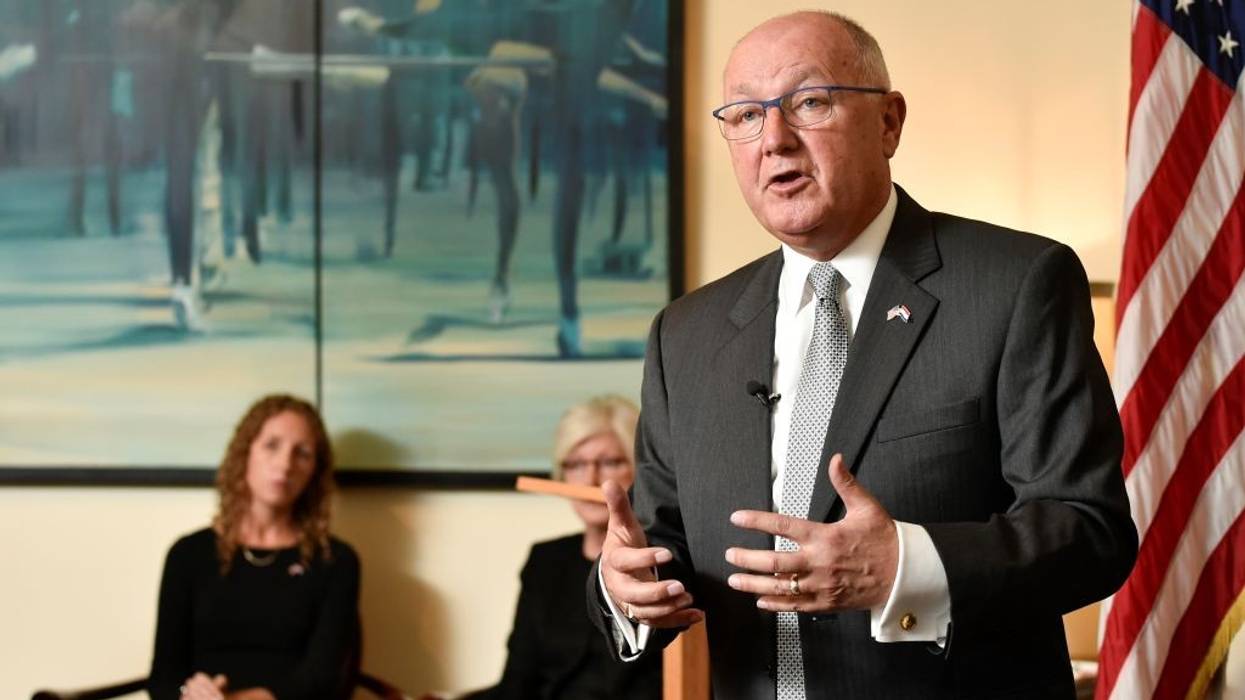
As long as U.S. policy is one of annexation and domination, Hoekstra deserves to be treated as a hostile guest—not an ambassador worthy of distinction or trust.
On February 22nd, the Michigan Republican Party met in Huntington Place in Detroit to elect a new chair. After the ballots were counted, State Senator Jim Runestand prevailed over President Donald Trump’s choice, “fake elector” Meshawn Maddock. Even though he had delivered Michigan to the GOP column, incumbent Peter Hoekstra didn’t run again. He couldn’t, because as of November he is awaiting confirmation by the U.S. Senate to be Trump’s ambassador to Canada.
During his three-decade plus career in government, Hoekstra has amassed quite the right-wing record. In the 90s, he was a fierce foe of workplace safety and union reformers. Teamster warehouse director Tom Leedham called Hoekstra “a congressman who tried to eliminate the forty-hour workweek, and gut overtime and job safety laws.” As chair of the House Committee on Education and Workforce, Hoekstra led a witch hunt into the Teamsters that ended up removing Ron Carey, the only reform president ever elected in Teamsters history, from office shortly after the union won a hard fought battle against UPS. Hoekstra proclaimed in 2000 that if he and his allies “had not acted, Ron Carey would still be president of the Teamsters.”
On foreign policy, Hoekstra’s tenure was similarly malicious. After voting for the Iraq War, Heokstra remained convinced well into 2006 that Iraq had possessed weapons of mass destruction. To that effect, he announced that U.S. troops had actually found WMDs that year. Too bad for Hoekstra they turned out to be defunct weapons that predated the Persian Gulf War. The WMD lie remained just that, a lie. He also palled around with David Yarushalmi, an anti-Muslim bigot who once called Blacks “the most murderous of peoples.”
Hoekstra’s views and previous tenure as a diplomat should make his appointment a complete joke, but there’s danger in his appointment as well.
In 2012, Hoekstra attempted to unseat Democratic Senator Debbie Stabenhow. His campaign’s Super Bowl ad featured an Asian woman, bicycling through a rice paddy, who castigated “Debbie Spend It Now” in broken English. A clear attempt to resuscitate the “Yellow Peril,” a journalist called it “the most racist political ad of the year.” Heokstra’s campaign floundered and he lost in a landslide.
Hoekstra’s post-Congress years saw him argue that the CIA’s torture program, euphemistically referred to as “enhanced interrogation,” produced “actionable intelligence.” He took time in 2016 to defame Hillary Clinton advisor Huma Abedin over her “egregious” ties to the Muslim Brotherhood. After co-chairing Donald Trump’s winning Michigan campaign in 2016, Hoekstra was back in government. For his services, he was rewarded with an ambassadorship to the Netherlands, his birthplace.
As Trump’s ambassador, Hoekstra was dogged by reporters over his false 2015 claims that there were Muslim “no-go zones” in the Netherlands, in which cars and politicians were “being burned.” In 2020, the official Twitter account for the U.S. Ambassador to the Netherlands posted a bizarre image of a graveyard containing German soldiers from World War II. The account said the graves were a “terrible reminder of the cost of going to war and why we must always work towards peace,” seemingly forgetting what side the U.S. was on during the war. The whole thing was reminiscent of when President Reagan went to a graveyard containing bodies of Hitler’s SS to declare the dead Nazis were “victims just as surely as the victims in the concentration camps.”
Hoekstra’s tenure was marked by accusations that he openly interfered in Dutch politics. In 2019 he hosted a party for the far-right Forum for Democracy whose anti-Islam, anti-immigrant views nicely dovetailed with his own. Diplomats are prohibited from interfering in their host countries politics by the 1969 Vienna Convention on the Law of Treaties. Although other political parties in the Netherlands complained, Trump lost the following year’s presidential election and Hoekstra was out. Or was he? Hoekstra’s reward for helping Trump win the Mitten State, is once again, an ambassadorship, but this time to Canada.
Hoekstra’s views and previous tenure as a diplomat should make his appointment a complete joke, but there’s danger in his appointment as well. Given that he has already violated diplomatic protocol via his involvement in the domestic politics of the host country, and that a stated goal of the Trump administration is the annexation of Canada as the 51st state, it stands to reason that Hoekstra will use any available means to further that project as ambassador. In short, he will attempt to undermine Canadian sovereignty under the guise of diplomacy.
Although Peter Hoekstra will almost certainly be confirmed by the U.S. Senate, that’s no reason for him to be treated as just another ambassador in Canada. As long as U.S. policy is one of annexation and domination, Hoekstra deserves to be treated as someone who will undermine Canadian independence in the service of American empire.

Private military contractors are now an essential part of America's increasingly privatized wars and will continue to be so, in seemingly ever greater numbers.
The way mercenary leader Yevgeny Prigozhin and his private army have been waging a significant part of Vladimir Putin’s war in Ukraine has been well covered in the American media, not least of all because his firm, the Wagner Group, draws most of its men from Russia’s prison system. Wagner offers “freedom” from Putin’s labor camps only to send those released convicts to the front lines of the conflict, often on brutal suicide missions.
At least the Russian president and his state-run media make no secret of his regime’s alliance with Wagner. The American government, on the other hand, seldom acknowledges its own version of the privatization of war — the tens of thousands of private security contractors it’s used in its misguided war on terror, involving military and intelligence operations in a staggering 85 countries.
At least as far back as the Civil War through World Wars I and II, the Korean and Vietnam Wars, and the first Gulf War, “contractors,” as we like to call them, have long been with us. Only recently, however, have they begun playing such a large role in our wars, with an estimated 10% to 20% of them directly involved in combat and intelligence operations.
Contractors have both committed horrific abuses and acted bravely under fire (because they have all too often been under fire). From torture at Abu Ghraib prison in Iraq to interrogations at the Guantánamo Bay detention camp, from employees of the private security firm Blackwater indiscriminately firing on unarmed Iraqi civilians to contractors defending a U.S. base under attack in Afghanistan, they have been an essential part of the war on terror. And yes, they both killed Afghans and helped some who had worked as support contractors escape from Taliban rule.
The involvement of private companies has allowed Washington to continue to conduct its operations around the globe, even if many Americans think that our war on terror in Afghanistan, Iraq, and elsewhere has ended. I tried looking for any kind of a survey of how many of us realize that it continues in Iraq and elsewhere, but all I could find was pollster Nate Silver’s analysis of “lessons learned” from that global conflict, as if it were part of our history. And unless respondents were caring for a combat-wounded veteran, they tended not to look unfavorably on sending our troops into battle in distant lands — so scratch that as a lesson learned from our forever wars.
None of this surprises me. American troops are no longer getting killed in significant numbers, nor are as many crowding the waitlists at backlogged Veterans Affairs hospitals as would be the case if those troops had been the only ones doing the fighting.
At points during this century’s war on terror, in fact, the U.S. used more civilian contractors in its ongoing wars than uniformed military personnel. In fact, as of 2019, according to Brown University’s Costs of War Project, which I co-founded, there were 50% more contractors than troops in the U.S. Central Command region that includes Afghanistan, Iraq, and 18 other countries in the Middle East, as well as Central and South Asia. As recently as December 2022, the Pentagon had about 22,000 contractors deployed throughout that region, with nearly 8,000 concentrated in Iraq and Syria. To be sure, most of those workers were unarmed and providing food service, communications aid, and the like. Even more tellingly, roughly two thirds of them were citizens of other countries, particularly lower-income ones.
In 2020, retired Army Officer Danny Sjursen offered an interesting explanation for how the war on terror was then becoming ever more privatized: the Covid-19 pandemic had changed the Pentagon’s war-making strategy as the public began to question how much money and how many lives were being expended on war abroad rather than healthcare at home. As a result, Sjursen argued, the U.S. had begun deploying ever more contractors, remote drones, CIA paramilitaries, and (often abusive) local forces in that war on terror while U.S. troops were redeployed to Europe and the Pacific to contain a resurgent Russia and China. In other words, during the pandemic, Washington placed ever more dirty work in corporate and foreign hands.
(Not) Counting Contractors
It’s been a challenge to write about private security contractors because our government does anything but a good job of counting them. Though the Defense Department keeps quarterly records of how many civilian contractors it employs and where, they exclude employees contracted with the Central Intelligence Agency or the State Department.
When Costs of War first tried to count contractor deaths by searching official government sources, we came up short. The spouse of a gravely wounded armed contractor directed me to her blog, where she had started to compile a list of just such deaths based on daily Google searches, even as she worked hard caring for her spouse and managing his disability paperwork. She and I eventually lost touch and it appears that she stopped compiling such numbers long ago. Still, we at the project took a page from her book, while adding reported war deaths among foreign nationals working for the Pentagon to our formula. Costs of War researchers then estimated that 8,000 contractors had been killed in our wars in the Middle East as of 2019, or about 1,000 more than the U.S. troops who died during the same period.
Social scientists Ori Swed and Thomas Crosbie have tried to extrapolate from reported contractor deaths in order to paint a picture of who they were while still alive. They believe that most of them were white veterans in their forties; many were former Special Forces operatives and a number of former officers with college degrees).
Limited Choices for Veterans
How do people of relative racial, economic, and gendered privilege end up in positions that, while well-paid, are even more precarious than being in the armed forces? As a therapist serving military families and as a military spouse, I would say that the path to security contracting reflects a deep cultural divide in our society between military and civilian life. Although veteran unemployment rates are marginally lower than those in the civilian population, many of them tend to seek out what they know best and that means military training, staffing, weapons production — and, for some, combat.
I recently spoke with one Marine infantry veteran who had completed four combat tours. He told me that, after leaving the service, he lacked a community that understood what he had been through. He sought to avoid social isolation by getting a government job. However, after applying for several in law enforcement agencies, he “failed” lie detector tests (owing to the common stress reactions of war-traumatized veterans). Having accidentally stumbled on a veteran-support nonprofit group, he ultimately found connections that led him to decide to return to school and retrain in a new profession. But, as he pointed out, “many of my other friends from the Marines numbed their pain with drugs or by going back to war as security contractors.”
Not everyone views contracting as a strategy of last resort. Still, I find it revealing of the limited sense of possibility such veterans experience that the top five companies employing them are large corporations servicing the Department of Defense through activities like information technology support, weapons production, or offers of personnel, both armed and not.
The Corporate Wounded
And keep in mind that such jobs are anything but easy. Many veterans find themselves facing yet more of the same — quick, successive combat deployments as contractors.
Anyone in this era of insurance mega-corporations who has ever had to battle for coverage is aware that doing so isn’t easy. Private insurers can maximize their profits by holding onto premium payments as long as possible while denying covered services.
A federal law called the Defense Base Act (1941) (DBA) requires that corporations fund workers’ compensation claims for their employees laboring under U.S. contracts, regardless of their nationalities, with the taxpayer footing the bill. The program grew exponentially after the start of the war on terror, but insurance companies have not consistently met their obligations under the law. In 2008, a joint investigation by the Los Angeles Times and ProPublica found that insurers like Chicago-based CAN Financial Corps were earning up to 50% profits on some of their war-zone policies, while many employees of contractors lacked adequate care and compensation for their injuries.
Even after Congress called on the Pentagon and the Department of Labor to better enforce the DBA in 2011, some companies continued to operate with impunity vis–à–vis their own workers, sometimes even failing to purchase insurance for them or refusing to help them file claims as required by law. While insurance companies made tens of millions of dollars in profits during the second decade of the war on terror, between 2009 and 2021, the Department of Labor fined insurers of those contracting corporations a total of only $3,250 for failing to report DBA claims.
Privatizing Foreign Policy
At its core, the war on terror sought to create an image of the U.S. abroad as a beacon of democracy and the rule of law. Yet there is probably no better evidence of how poorly this worked in practice at home and abroad than the little noted (mis)use of security contractors. Without their ever truly being seen, they prolonged that global set of conflicts, inflicting damage on other societies and being damaged themselves in America’s name. Last month, the Costs of War Project reported that the U.S. is now using subcontractors Bancroft Global Development and Pacific Architects and Engineers to train the Somali National Army in its counterterrorism efforts. Meanwhile, the U.S. intervention there has only helped precipitate a further rise in terrorist attacks in the region.
The global presence created by such contractors also manifests itself in how we respond to threats to their lives. In March 2023, a self-destructing drone exploded at a U.S. maintenance facility on a coalition base in northeastern Syria, killing a contractor employed by the Pentagon and injuring another, while wounding five American soldiers. After that drone was found to be of Iranian origin, President Biden ordered an air strike on facilities in Syria used by Iranian-allied forces. Defense Secretary Lloyd Austin stated, “No group will strike our troops with impunity.” While he later expressed condolences to the family of the contractor who was the only one killed in that attack, his statement could have more explicitly acknowledged that contractors are even more numerous than troops among the dead from our forever wars.
In late December 2019, a contractor working as an interpreter on a U.S. military base in Iraq was killed by rockets fired by an Iranian-backed militia. Shortly afterward, then-President Trump ordered an air strike that killed the commander of an elite Iranian military unit, sparking concern about a dangerous escalation with that country. Trump later tweeted, “Iran killed an American contractor, wounding many. We strongly responded, and always will.”
I can’t believe I’m saying this, but Trump’s tweet was more honest than Austin’s official statement: such contractors are now an essential part of America’s increasingly privatized wars and will continue to be so, in seemingly ever greater numbers. Even though retaliating for attacks on their lives has little to do with effective counterterrorism (as the Costs of War Project has long made clear), bearing witness to war casualties in all their grim diversity is the least the rest of us can do as American citizens. Because how can we know whether — and for whom — our shadowy, shape-shifting wars “work” if we continue to let our leaders wage an increasingly privatized version of them in ways meant to obscure our view of the carnage they’ve caused?
In their remarks to the nation following the Orlando massacre, Hillary Clinton and Donald Trump made their differences--and disturbing similarities--crystal clear.
Trump attacked Hillary Clinton for refusing to label the violence carried out by mentally disturbed American-born gunmen of Muslim background as a manifestation of "radical Islam." He reiterated his call to ban Muslims from entering the United States and to subject American Muslims to special surveillance and restrictions.
To her credit, Hillary Clinton rejected such bigotry. However, she called for returning to the "spirit of 9/12," ignoring how that reaction to 9/11 resulted in a major crackdown on civil liberties and preparation for war. She stated:
"The attack in Orlando makes it even more clear, we cannot contain this threat. We must defeat it."
Though there is no evidence of any operational ties between ISIS and the lone Orlando gunman, she piled on, saying:
"We should keep the pressure on ramping up the air campaign, accelerating support for our friends fighting to take and hold ground."
Sam Adler-Bell, a journalist and policy associate with The Century Foundation, observed:
"I fear we've already begun to enlist the 49 dead into the project of American empire, here and abroad, into the endless, borderless war that began on 9/12."
In previous weeks, both incipient nominees had given what has been called "major foreign policy addresses." Though both lacked detail and substance, Clinton made a strong case that Trump really does not have the experience, knowledge, or temperament to be commander-in-chief.
Still, while former Secretary of State Clinton would be among the most experienced and knowledgeable nominees on foreign policy in modern history, she is probably the most hawkish Democratic nominee in decades.
Phyllis Bennis of the Institute for Policy Studies noted:
"She talked about all of the crazy stuff that Donald Trump has said. That's easy to do, [but] the choice between the kind of chaos of Trump's policy, that's so incredibly dangerous, versus a very clear militaristic commitment to regime change and U.S. domination in [Clinton's] foreign policy, is not much of a choice."
In certain areas, Clinton has even placed herself to the right of the incipient GOP nominee. For example, Trump has questioned why Americans must pay for overseas bases, carrier groups, and other forward deployment to defend wealthy European, Middle Eastern, and Western Pacific allies who could afford to defend themselves, but whose military budgets are only a fraction of those of the United States. Clinton has denounced what she refers to as his threat "to abandon our allies in NATO."
She has denounced Trump for wanting to negotiate directly with North Korean leader Kim Jong-un and calls instead for a U.S.-led military buildup in East Asia, including a costly missile defense system in Japan. Harkening back to the rhetoric once used against liberal Democrats by their hawkish electoral opponents, Clinton said that if her opponent is elected, "they'll be celebrating in the Kremlin."
Rather than support collective security arrangements, a stronger United Nations, expanding nuclear-free zones, or other multilateral efforts, Clinton insists that "if America doesn't lead, we leave a vacuum--and that will either cause chaos, or other countries will rush in to fill the void." Anything short of U.S. primacy "is not an outcome we can live with."
This drew a rebuke from Columbia University's Jeffrey Sachs:
"This kind of arrogance--that America and America alone must run the world--has led straight to overstretch: perpetual wars that cannot be won, and unending and escalating confrontations with Russia, China, Iran, and others that make the world more dangerous. It doesn't seem to dawn on Clinton that in today's world, we need cooperation, not endless bravado."
Clinton falsely accused Trump of saying he would "stay neutral on Israel's security." In reality, Trump said that in order to effectively mediate the Israeli-Palestinian peace process, the United States should take a more neutral position in the negotiations. A longstanding assumption in the field of conflict resolution is that mediators shouldn't take sides.
The sad fact is that American voters this November will probably be forced to choose between a Republican nominee who thinks the United States should ban Muslims from entering the country versus a Democratic nominee who thinks the United States has a right to invade Muslim countries, a Republican nominee who agrees with George W. Bush that it's okay to torture prisoners in the name of fighting terrorism versus a Democratic nominee who agrees with Benjamin Netanyahu that it's okay to bombard crowded civilian neighborhoods in the name of fighting terrorism; a Republican nominee who supports building a wall on the border to keep Mexicans out of the United States versus a Democratic nominee who supports Israel building a wall far beyond its border to keep Palestinians out of Palestine.
Overall, Trump may be the bigger militarist. Though he has attacked Clinton for backing the invasion of Iraq and the bloody counter-insurgency war that followed, archived interviews have indicated that Trump did not actually oppose the war as he's claimed. Same with the U.S. intervention in Libya. Indeed, in both cases, Trump called for an even greater use of force, including the seizure of oil fields for U.S. economic benefit. He also agrees with Clinton to militarily intervene in Syria to create "safe zones" for refugees and to escalate U.S. bombing against ISIS.
Trump's call for pulling U.S. forces back from overseas is accompanied by a call for such countries as Japan, South Korea, and Saudi Arabia to develop their own nuclear weapons. He opposes the nuclear agreement with Iran. He has falsely accused President Obama of having "supported the ouster of a friendly regime in Egypt . . . and then helped bring the Muslim Brotherhood to power in its place." He charges that Obama, whose administration has given unprecedented amounts of aid to Israel and blocked the United Nations from addressing human rights concerns, "has not been a friend to Israel," saying the President has "snubbed and criticized" what he calls "the one true Democracy in the Middle East."
Trump also claims "our nuclear weapons arsenal"--on which Obama plans to spend nearly $1 trillion over the next thirty years--"has been allowed to atrophy and is desperately in need of modernization and renewal." He has criticized Obama's cancellation of the missile defense program despite extraordinary cost and highly dubious efficacy. He pledges to dramatically increase military spending.
"Our military," he laments, "is depleted, and we're asking our generals and military leaders to worry about global warming"--which, according to Trump, does not exist.
Clinton, throughout her career, has been a hawk. Not only did she support the Iraq War, but she also backed the Israeli and Moroccan occupations, the Honduras coup, various allied dictatorships, higher military spending, and a more interventionist foreign policy. She's thumbed her nose at the International Court of Justice, the International Criminal Court, and various reputable international human rights and arms control agencies.
Yet, ironically, her foreign policy agenda will likely be treated as the "left" wing of the debate by the mainstream media this fall, and perhaps for the next four to eight years.
This is why those of us who have a truly progressive vision of foreign policy need to mobilize and put on the pressure.
The good news is that Clinton has been forced to downplay her hawkish tendencies in order to get the Democratic nomination, while Trump is on the verge of winning the Republican nomination by exaggerating his dovish tendencies. This indicates that an increasing number of American voters are questioning the militarization of U.S. foreign policy.
With only a few exceptions, virtually every change in U.S. foreign policy--including ending the Vietnam War, accepting the Central American peace plan, imposing sanctions on apartheid South Africa, curbing the nuclear arms race, ceasing support for Indonesia's occupation of East Timor, and phasing out most U.S. involvement in Iraq--came not from the initiative of enlightened politicians but from the American public.
Elections are important. Yet just as important are the other forms of pressure we can provide to force a saner and less militaristic foreign policy.
On Thursday, the United States' globe-spanning military dispatched a "small armada" into the South China Sea, reported the Navy Times, in the latest show of American force in the contested territory since the widely condemned patrol of a Navy destroyer within Chinese waters last October.
"We inhabit a war culture and machine with a vast reach and capacity never seen before," antiwar group United for Peace and Justice wrote on Wednesday as it called for a global refocus on diplomacy instead of military action. The group warned that "the U.S. and China, another nuclear-armed nation, are facing off against each other."
This week's "deployment of thousands of U.S. sailors" was to a region that a top U.S. official has characterized as "increasingly militarized by China," reported the
Washington Post.
"Talking about militarization, if you look into it carefully, the advanced aircraft, warships in and out of the South China Sea, aren't most of them deployed by America?"
Fortune quoted China's National People's Party spokesperson Fu Ying as she responded to the U.S. Navy's actions on Friday.
Ying argued, "America made an important decision, which is deploying over 60% of its navy to the Asia-Pacific region ... [The U.S.] is strengthening military deployments with its alliances in the Asia-Pacific region. If we're talking about militarization, what's this? Isn't it militarization?"
Michael Klare, a professor of Peace and World Security Studies at Hampshire College, warned in The Nation on Thursday, History suggests that such [jostling for geopolitical advantage] tends to create an atmosphere of ever-increasing tension and suspicion, where one provocation too many can lead to crisis, panic, miscalculation, and a resort to arms--exactly the scenario that led to the outbreak of World War I just over 100 years ago."
In a lecture at Harvard in February, Klare made similar points, arguing that the Obama Administration's "China pivot"--its refocusing military resources to contain what it perceives as China's growing hegemony in East Asia, of which its South China Sea deployments is a part-- is "turning the entire Chinese population against the United States and also pushing China closer to Russia...in strategic terms."
Klare characterized an anti-U.S. alliance between the two nations as another step toward war--a particularly sobering possibility considering the nuclear armaments of all countries involved.
"What could be done to prevent that kind of escalation of events that led to WWI?" the professor asked. "That's the way we have to think today. How do we reduce this geopolitical competition, the muscle flexing, and reduce the unintended escalation that would lead to a real war?"
Klare's full lecture can be viewed here:
On Friday, Okinawa officials filed a lawsuit against the central Japanese government in a new bid to block the slated construction of a U.S. military base in the prefecture's Henoko region.
"We will do whatever it takes to stop the new Henoko base," Okinawa Gov. Takeshi Onaga said during a press conference Friday. "Okinawa's argument is legitimate, and I believe that it will be certainly understood."
Residents and officials charge that the Japanese government's Ministry of Land, Infrastructure, Transport, and Tourism illegally intervened in Onaga's order earlier this year to halt preliminary work on the base. The prefecture said the ministry acted unlawfully when it suspended Onaga's permit cancellation for work needed to move the U.S. Marine Corps Air Station Futenma to its slated spot in Henoko.
The legal challenge is the latest effort to block the continued militarization of the southern Japanese island, which has long served as the home base for more than half of the 50,000 American military service members in Japan, as well as over two-thirds of U.S. bases in the country. In late October, hundreds of Okinawa residents, largely elders, linked arms and physically blocked vehicles transporting building materials to the base.
"Don't the people of Okinawa have sovereignty?" one protester, 70-year-old Katsuhiro Yoshida, told Japanese paper The Asahi Shimbun at the time. "This reminds me of the scenes of rioting against the U.S. military before Okinawa was returned to Japan (in 1972). Now, we are facing off against our own government. It is so contemptible."
Residents have long expressed anger and frustration over the crime and pollution they say comes along with the presence of foreign troops.
"Democracy and local self-determination in Japan are in severe condition," Onaga, who was elected on an anti-base platform, said Friday. "We want the rest of the world to know how the Japan-U.S. security treaty is affecting us."
The photographs in the New York Times told contrasting stories last week. One showed two Taliban soldiers in civilian clothes and sandals, with their rifles, standing in front of a captured U.N. vehicle. The Taliban forces had taken the northern provincial capital of Kunduz. The other photograph showed Afghan army soldiers fully equipped with modern gear, weapons, and vehicles.
Guess who is winning? An estimated thirty thousand Taliban soldiers with no air force, navy, or heavy weapons have been holding down ten times more Afghan army and police and over 100,000 U.S. soldiers with the world's most modern weaponry - for eight years.
ISIS forces from Syria have taken over large areas of northern and western Iraq, including its second-largest city, Mosul, and the battered city of Fallujah. ISIS forces in Iraq and Syria are estimated to number no more than 35,000. Like the Taliban, ISIS fighters, who vary in their military training, primarily have light weaponry. That is when they are not taking control of the fleeing, much larger, Iraqi army's armored vehicles and ammunition from the United States.
Against vastly greater numbers of Iraqi soldiers, backed by U.S. weapons, U.S. planes bombing daily, 24/7 aerial surveillance, and U.S. military advisors at the ground level, so far, ISIS is still holding most of its territory and is still dominant in large parts of Syria.
The American people are entitled to know how all this military might and the trillions of dollars spent in Iraq and Afghanistan, since 2003 and 2001, respectively, can produce such negative fallouts.
Certainly, these failures have little to do with observing the restraints of international law. Presidents Bush and Obama have sent military power anywhere and everywhere, regardless of national boundaries and the resulting immense civilian casualties, in those tragic, blown-apart countries.
The current perception of the U.S. in these countries is that of invaders on a rampage. Recruiting motivated fighters, including a seemingly endless supply of suicide bombers, is easier when the invaders come from Western countries that for over a century have been known for attacking, carving up boundaries for artificial states, intervening, overthrowing, propping up domestic dictators, and generally siding with oligarchic or colonizing interests that brutalize the mass of the people.
It hasn't helped for these invasions to be supported by an alien culture rooted in the Christian crusades against Islam centuries ago, whose jingoism in the U.S. continues among some evangelical groups today.
But of course, more contemporary situations are, first and foremost, the wanton destruction and violent chaos that come with such invasions. With the absence of functioning central governments and the dominance of tribal societies, the sheer complexity of the invaders trying to figure out the intricate "politics" between and within tribes and clans becomes an immense, ongoing trap for the Western military forces.
When the U.S. started taking sides with the Shiites against the Sunnis in Iraq or between different clans and tribes in Afghanistan, U.S. soldiers, not knowing the language or customs, were left with handing out $100 bills to build alliances. Our government air-shipped and distributed crates of this money. With the local economies at a standstill, public facilities collapsed, fear gripped families from violent streets and roads, and all havoc broke loose in the struggle for safety and survival.
Afghan soldiers, who are paid only $120 a month, will do almost anything to supplement their income, including selling weapons. At higher levels, bribes, payoffs, and extortions create an underground economic system. The combination of lack of understanding, the systemic bribes, and the ensuing corruption has produced a climate of chaos.
Then there is the reckless slaughter of civilians - wedding parties, schools, clinics, peasant boys collecting firewood on a hillside - from supposedly pinpoint, accurate airplanes, helicopter gunships, drones, or missiles. The hatred of the Americans spreads as people lose their loved ones.
Our "blowback" policies are fueling the expansion of al-Qaeda offshoots and new violent groups in over 20 countries. On 9/11, the "threat" was coming from a corner of one country - northeastern Afghanistan. The Bush/Cheney prevaricator frenzy led to local bounty hunters taking innocent captives, falsely labeled as "terrorists," who were sent to the prisons in Guantanamo, Cuba. These actions have damaged our country's reputation all over the world.
All this could have been avoided had we heeded the advice of retired, high-ranking military, national security, and diplomatic officials not to invade Iraq and their advice not to overreact in Afghanistan. But the supine mass media and an overall cowardly Congress let the lies, deceptions, and cover-ups by the Bush regime go unchallenged and, as Congressman Ron Paul (R-TX) put it, Bush/Cheney "lied us into the Iraq War."
It isn't as if the Taliban and ISIS are winning the "hearts and minds" of the local people. On the contrary, while promising law and order, they treat local populations brutally, with few exceptions. But the locals have long been treated brutally by the police, army, and militias, jockeying for the spoils of conflict. Unfortunately, there is still no semblance of ground-level security.
All Empires fail and eventually devour themselves. The U.S. Empire is no different. Look at the harm to and drain on our soldiers, our domestic economy, the costly, boomeranging, endless wars overseas, and what empire-building has done to spread anxieties and lower the expectation level of the American people for their public budgets and public services.
Not repeatedly doing what has failed is the first step toward correction. How much better and cheaper it would be if we became a humanitarian power years ago - well received by the deprived billions in these anguished lands.
What changes are needed to escape these quagmires and leave a semblance of recovery behind? Press those gaggles of presidential candidates who war-monger with impunity or who are dodging this grave matter for answers. Make them listen to you.
Extolling his "authenticity and integrity" in the struggle against greed, imperialism, and injustice, civil rights activist and intellectual Dr. Cornel West on Monday announced his endorsement of Sen. Bernie Sanders for president.
"The American Empire is in decline. Our market-driven culture is in decay. The criminal justice system has failed us. And the political system is collapsing due to the weight of corrupt lobbyists and greedy capitalists," West wrote on Twitter, adding:
Though acknowledging some of the criticisms levied against Sanders, West continued, saying that "prophetic politicians--always with their faults and blind spots--who tell the truth about Wall Street, white supremacy, empire, patriarchy and homophobia, deserve our critical support."
The announcement comes as the mainstream media, fueled by recent protests during Sanders' campaign events, has attempted to paint the U.S. Senator as unpopular among black voters.
He added that the endorsement "is not an affirmation of the neo-liberal Democratic Party," which must be fought against "by social movements in the streets." The Princeton University Professor Emeritus was among those arrested during a civil disobedience protest in Ferguson earlier this month.
"We will push him with integrity towards a more comprehensive vision of freedom for all," he vowed, adding, "Now is the time for [Sanders'] prophetic voice to be heard across our crisis-ridden country."
The central assumption of democracy -- beyond the assumption of fair elections, which is disturbingly questionable -- is that voters are the possessors of their own "interests" and vote for the candidate most sympathetic to them.
But of course those interests are fair game for advertising, bombast and propaganda -- and the psychology of fear.
" Donald Trump, with the help of his money and his ego, is exposing the absurdity of American politics like no one else I can remember."
Thus, not only are candidates capable of misrepresenting their support of people's interests, but even more insidiously, they engage baldly in manipulating them. This is a game that turns the endless presidential campaign season, especially as it is conveyed to us in the mainstream media, into little more than a mish-mash of clashing sound bites: full of sound and fury, you might say, but signifying nothing, or at least nothing much.
The two-party system, which comes to us courtesy of Big Money and is taken so seriously by the media -- as seriously as any advertising campaign takes itself -- is, essentially, a race to seize control over the nation's collective reptile brain.
Let's make America great again!
Welcome to the 2016 presidential campaign, underway well over a year ahead of time and already devolving into cartoonish absurdity, thanks to the loudmouth billionaire who leads the Republican fray.
Donald Trump, with the help of his money and his ego, is exposing the absurdity of American politics like no one else I can remember. Whoosh! Gone is the protective veil of political correctness. Let's hear it for naked cynicism!
"When Mexico sends its people, they're not sending their best. They're not sending you. They're not sending you. They're sending people that have lots of problems, and they're bringing those problems with us. They're bringing drugs. They're bringing crime. They're rapists. And some, I assume, are good people."
As far as I can tell, Trump is the unapologetic standard bearer of late-stage, theater-of-the-absurd American exceptionalism. He directly addresses the prerequisite for national identity: an enemy. Someone to hate. Someone to fear. This is nationalism; this is Republicanism. And Trump brings his own special twist to it: a gleeful American inclusiveness.
And not a moment too soon, here in "post-racial" America. As Rick Perlstein astutely pointed out last month, Trump's inflammatory, anti-Mexican, anti-immigrant announcement at the start of his presidential campaign -- presenting a gift-wrapped enemy to the racist that secretly lurks in so many American hearts -- was almost precisely juxtaposed with the immensely symbolic lowering of the Confederate flag in South Carolina. "And, immediately, Trump shot to the top of the Republican charts -- with a bullet," Perlstein wrote.
He added: "I've never seen anything that lays bare the core lineaments of conservatism so neatly: There is our tribe, which is good, true, and pure, and there are those other tribes, who are existential threats to you and me (Reagan's favorite phrase), and must be suppressed for good to be preserved. 'We' all know this, even if 'they' don't allow us to say this. If anything, the lowering of the Confederate flag in South Carolina opens space for this particular new longing to air this other silent truth more freely.
"This is important: Conservatism is like bigotry whack-a-mole."
But there's a special brilliance to the reconfigured racism Trump is offering to the American people.
Consider this paragraph from Trump's campaign website. When you click on "positions," only one topic shows up: immigration reform. And it's not just any old immigration reform; it's IMMIGRATION REFORM THAT WILL MAKE AMERICA GREAT AGAIN.
As the website explains: "For many years, Mexico's leaders have been taking advantage of the United States by using illegal immigration to export the crime and poverty in their own country (as well as in other Latin American countries). They have even published pamphlets on how to immigrate to the United States illegally. The costs for the United States have been extraordinary: U.S. taxpayers have been asked to pick up hundreds of billions in healthcare costs, housing costs, education costs, welfare costs, etc. . . . The effects on jobseekers have also been disastrous, and black Americans have been particularly harmed."
There are several reptile-brain subtleties of note here. First of all, the illegal immigration flow, according to Trump, begins with the machinations of "Mexico's leaders." It's not a poverty-induced bleeding of the poor across the U.S. border but a deliberate, provocative act by one nation against another: something like an invasion. The Donald is not only giving us a subgroup to hate. He's giving us war!
Perhaps even more appallingly, Trump makes a point of saying that "black Americans have been particularly harmed" by this invasion. Thus, he opens the door to Black America to join the "We Hate Mexicans" club, in effect creating a more inclusive form of American racism -- the benefits of which, of course, will be reaped by his campaign.
Perhaps what this is really about is the slow-motion collapse-into-absurdity of the American empire, as Trump makes the emotional glue of hate and fear that has held it together for two and a half centuries unbearably obvious. The question he inspires, which lurks just beyond the horizon, is what sort of political entity we can build that isn't based on these shadow "interests." What happens after we stop seeing ourselves as conquerors? Can we build a country that honors and fits into a global whole?
"We can elect the best person in the world to be president, but that person will get swallowed up unless there is an unprecedented level of activism at the grassroots level." --Sen. Bernie Sanders
"We can elect the best person in the world to be president, but that person will get swallowed up unless there is an unprecedented level of activism at the grassroots level." --Sen. Bernie Sanders
Presidential hopeful Sen Bernie Sanders (I-VT) is on a roll. Following his historic late-May campaign kick-off rally on the waterfront in Burlington, he was greeted by overflow crowds in New Hampshire, Iowa and Minnesota. Moreover, he did very well in a recent Wisconsin straw poll. He has generated a level of enthusiasm not often seen this early in a campaign. Although his candidacy is sometimes dismissed, or at best deemed quixotic by mainstream media pundits certain that his criticisms of corporate America and rising levels of inequality can't fly, he continues to attract a large following wherever he speaks.
Sanders is the longest-serving Independent in U.S. history. He is well aware that he is no Lone Ranger coming to save the American people, a point to which the above quote and his entire political life attests. Despite Hillary Clinton's near-universal name recognition and limitless campaign funds, it would be foolish to write off the possibility of a Sanders presidency. Yet a winning electoral coalition--however far-fetched that idea may appear--is not the same thing as a grassroots mass movement. In other words, if Bernie Sanders were elected president, how he would win would make an extraordinary difference.
As British political economist and Labor Party leader Harold Laski observed in 1940, "[T]he day of a successful election is the day on which the president ceases to be a free man." Laski was alluding to the pressures from political and economic elites that imprison a newly-elected chief executive. Conventional political science mostly ignores such pressures, choosing instead to focus on the party of the president, personality characteristics, or management style. The balance of power between Congress and the President is given great attention. Washington's "gridlock" is condemned; bipartisan cooperation is celebrated and eagerly anticipated. But beneath those personal and institutional factors lies a deeper structure of power.
The modern presidency emerged from the long tenure of FDR and the challenges of the Great Depression and WWII. Its foundation was set in the twin pillars of endless economic growth (defined as rising GDP - producing more today than yesterday, more tomorrow than today) and the promotion of national security (expanding security via the projection of American power against all "enemies," whether the former Soviet Union or ISIS). These twin goals were bipartisan, a product of a shared consensus that is simply not sustainable in an era of climate change and the decline of the American empire. This now-unsustainable consensus was beholden to corporate definitions of the ends of U.S. military and economic power.
How does this power structure imprison the president? As a thought experiment, imagine the morning after he is elected President in 2016. What would greet President-elect Bernie Sanders after the victory parties die down and residents of Burlington, VT, awaken to their first cup of coffee? The most immediate impact would be a steep decline in global financial markets as investors registered their panic at the "reckless" decision reached by U.S. voters. The swift negative response would be amplified by fears in corporate boardrooms as the specter of severe market instability and declining business confidence wracked the capitalist world. With a financial meltdown looming, president-elect Sanders would be facing a business reaction known as "capital strike." And that's just day one after the election. With little prospect of the economic tumult subsiding during his 11-week transition period, Sanders would face enormous pressure to calm the fears of the market by announcing the appointment of moderates to hold Cabinet positions--non-confrontational, non-ideological people who would be "acceptable" to political and economic power holders. No radicals for the Treasury Department, no thoughts of Ben and Jerry as Co-Secretaries of Commerce, no union firebrand to head the Labor Department, no Bill McKibben leading the Interior Department. Only nice, "safe" choices would suffice--personnel decisions that would undermine the progressive vision of his campaign. In short, the economics of "capital strike" would threaten to trump the verdict of democracy.
One of Bernie Sanders's heroes is legendary labor leader Eugene Debs, no stranger to the world of strikes. Debs was a Socialist Party candidate for President five times, the final time in 1920 while he was in the federal penitentiary in Atlanta for opposing WWI. He received almost a million votes. Of course, Bernie Sanders's prison would be more metaphorical, though hardly less restrictive. For politicians like Democrat Hillary Clinton, such restrictions would not be so onerous. She would be a voluntary captive, willfully caught up in the same definitions of economic growth and national security that framed the modern presidency for both political parties. In front of progressive and labor audiences, candidate Hillary Clinton undoubtedly will do her best to sound like Eugene Debs in a pant suit. More often than not, though, she will play the "sensible center" card, with Bernie's "unrealistic" excesses on her left side and irresponsible scorched earth Republicans on her right--classic Clintonian triangulation--and lead in a direction palatable to corporate, financial, and banking interests--classic Clintonian neoliberalism.
For Bernie Sanders, though, such confinement would be unbearable, almost taunting him to become just another moderate-to-liberal Democrat. To really challenge the status quo, he would need to do more than argue that working people deserve a bigger slice of the pie. For instance, reduction of income and wealth inequality itself, while crucial, would not help address global climate change, if the goal is merely to rev up economic growth in order to grow a bigger pie and give a proportionally larger slice to the bottom 99%. The U.S. and the world need to reduce production of greenhouse gasses, particularly carbon dioxide and methane, and do so rapidly. We need to rethink how "growth" and "progress" are defined. Simply raising GDP would actually make things worse. Similarly, national security needs to be defined as something quite different than having some 900 military bases around the world and a growing weapons and surveillance capability. We will not blast our way to a more secure world via a bloated, energy-depleting Pentagon budget, arming Middle East "moderate rebels" and firing more drones, strategies that create more "terrorist" enemies than they destroy.
In short, the U.S. today does not need a Gene Debs so much as it needs a Green Debs. The irony is that in some fundamental ways, the latter would have to be even more radical than the former. As Naomi Klein has powerfully argued, "global climate change is not just another issue to add to your list of things to worry about. It's a civilizational wake-up call." Delivering such a wake-up call will require the kind of political revolution that Bernie Sanders has long advocated, a revolution with the courage to confront the interlocked corporate, financial, fossil fuel and military interests that benefit from our current version of capitalism and militarism.
If President-elect Sanders is to avoid becoming "prisoner-elect," he will need to call for a fundamental redefinition of economic growth and national security. He will need to bring together an electoral movement, with a movement for economic justice, with a movement for climate justice. He will need people in the streets, along Pennsylvania Avenue as well as Main Streets everywhere--continually, not just at victory parties or inaugural balls. Absent sustained public pressure that coalesces with the campaign itself, he indeed would be swallowed up, a prisoner of a system he sought to challenge.
For many reasons, then, the campaign and the ensuing transition period would be a wild ride. However, the wildest aspect would not be Sanders' victory. Rather, it would be the tension between the populist, working-class vision of Sanders and the powerful economic and military forces trying to tame any potential Bernie beast. And the deciding factor--his only insulation from "capital strike"--would be democracy itself. This means not just 270 electoral votes but the legitimacy that would accompany post-election demonstrations demanding space for his progressive vision, despite the hostile reaction of those who benefit from inequality. So can Bernie Sanders actually cobble together an electoral coalition strong enough to elect him president? He probably can, but that's the easy part.