SUBSCRIBE TO OUR FREE NEWSLETTER
Daily news & progressive opinion—funded by the people, not the corporations—delivered straight to your inbox.
5
#000000
#FFFFFF
To donate by check, phone, or other method, see our More Ways to Give page.
Daily news & progressive opinion—funded by the people, not the corporations—delivered straight to your inbox.
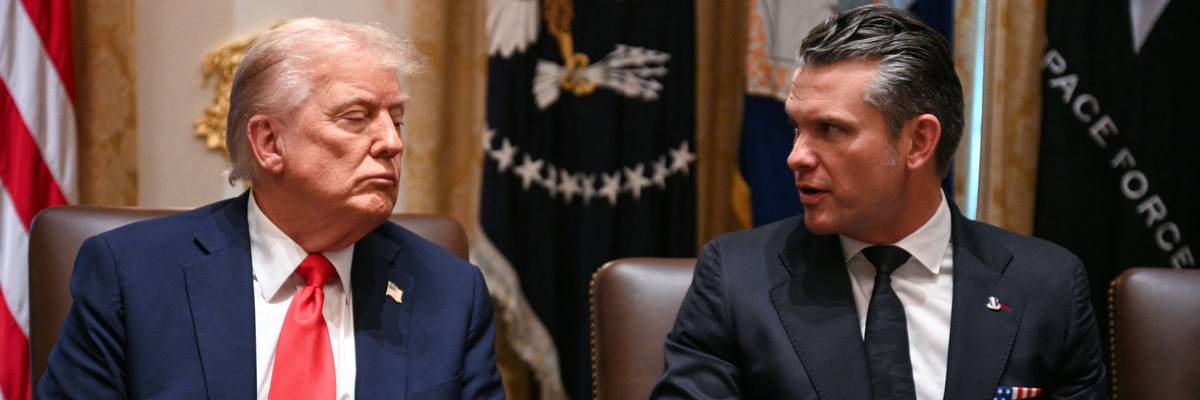
US President Donald Trump looks on as Secretary of Defense Pete Hegseth speaks in Washington, DC, on October 9, 2025.
Jennifer Kavanagh, senior fellow and director of military analysis at Defense Priorities, said US military retrenchment is needed on a global scale.
President Donald Trump's illegal war with Iran has gone so poorly that it portends the end of the American-led global order, foreign policy scholar Jennifer Kavanagh wrote in an analysis published Monday by The American Conservative.
Despite Trump's repeated declarations of a total US victory over Iran, Kavanagh wrote that the continued closure of the Strait of Hormuz has revealed the limits of the American military, which in 2025 had a budget of nearly $1 trillion.
Kavanagh, senior fellow and director of military analysis at Defense Priorities, argued that the Iran war has been particularly damaging to US power because it has drained US munitions supplies and has still achieved none of the major objectives Trump outlined at the start of the conflict.
"Some estimates suggest the United States has burned through 1,000 Tomahawk missiles, nearly 50% of its Patriot and THAAD stockpiles, and significant portions of advanced stand-off weapons like PRSM and JASSM missiles," Kavanagh wrote. "The constraints on US military power created by these shortages will be consequential and enduring."
In practical terms, Kavanagh said, this means the US simply cannot meet key commitments for the foreseeable future, such as supporting the defense of Taiwan in the case of an attack by China.
Kavanagh emphasized that American policymakers should reduce US military commitments around the world and not cling to a global order that is no longer sustainable.
"The period of US military dominance—and of American empire—is over," Kavanagh wrote. "The resulting future will be less comfortable for the United States, but its changes are overdue and its challenges manageable. With the right moves today, American retrenchment can leave the United States, and the world, better off."
This retrenchment, wrote Kavanagh, would refocus American defense strategy solely on defending US territory and "ensuring access to key economic markets." In practice, this would mean closing military bases and ending deployments in Europe and the Middle East, a "narrowing" of security guarantees to NATO allies, and explicitly stating that it would not defend Taiwan in the face of an attack from China, which Kavanagh said would "reduce the risk of a war with China that at this point the United States is unprepared to fight."
"These changes in posture and alliance commitments would amount to a massive transformation of American foreign policy," Kavanagh acknowledged, "but the result would be a sustainable military position, consistent with US capabilities and resources and tailored to protecting US interests."
Dear Common Dreams reader, It’s been nearly 30 years since I co-founded Common Dreams with my late wife, Lina Newhouser. We had the radical notion that journalism should serve the public good, not corporate profits. It was clear to us from the outset what it would take to build such a project. No paid advertisements. No corporate sponsors. No millionaire publisher telling us what to think or do. Many people said we wouldn't last a year, but we proved those doubters wrong. Together with a tremendous team of journalists and dedicated staff, we built an independent media outlet free from the constraints of profits and corporate control. Our mission has always been simple: To inform. To inspire. To ignite change for the common good. Building Common Dreams was not easy. Our survival was never guaranteed. When you take on the most powerful forces—Wall Street greed, fossil fuel industry destruction, Big Tech lobbyists, and uber-rich oligarchs who have spent billions upon billions rigging the economy and democracy in their favor—the only bulwark you have is supporters who believe in your work. But here’s the urgent message from me today. It's never been this bad out there. And it's never been this hard to keep us going. At the very moment Common Dreams is most needed, the threats we face are intensifying. We need your support now more than ever. We don't accept corporate advertising and never will. We don't have a paywall because we don't think people should be blocked from critical news based on their ability to pay. Everything we do is funded by the donations of readers like you. When everyone does the little they can afford, we are strong. But if that support retreats or dries up, so do we. Will you donate now to make sure Common Dreams not only survives but thrives? —Craig Brown, Co-founder |
President Donald Trump's illegal war with Iran has gone so poorly that it portends the end of the American-led global order, foreign policy scholar Jennifer Kavanagh wrote in an analysis published Monday by The American Conservative.
Despite Trump's repeated declarations of a total US victory over Iran, Kavanagh wrote that the continued closure of the Strait of Hormuz has revealed the limits of the American military, which in 2025 had a budget of nearly $1 trillion.
Kavanagh, senior fellow and director of military analysis at Defense Priorities, argued that the Iran war has been particularly damaging to US power because it has drained US munitions supplies and has still achieved none of the major objectives Trump outlined at the start of the conflict.
"Some estimates suggest the United States has burned through 1,000 Tomahawk missiles, nearly 50% of its Patriot and THAAD stockpiles, and significant portions of advanced stand-off weapons like PRSM and JASSM missiles," Kavanagh wrote. "The constraints on US military power created by these shortages will be consequential and enduring."
In practical terms, Kavanagh said, this means the US simply cannot meet key commitments for the foreseeable future, such as supporting the defense of Taiwan in the case of an attack by China.
Kavanagh emphasized that American policymakers should reduce US military commitments around the world and not cling to a global order that is no longer sustainable.
"The period of US military dominance—and of American empire—is over," Kavanagh wrote. "The resulting future will be less comfortable for the United States, but its changes are overdue and its challenges manageable. With the right moves today, American retrenchment can leave the United States, and the world, better off."
This retrenchment, wrote Kavanagh, would refocus American defense strategy solely on defending US territory and "ensuring access to key economic markets." In practice, this would mean closing military bases and ending deployments in Europe and the Middle East, a "narrowing" of security guarantees to NATO allies, and explicitly stating that it would not defend Taiwan in the face of an attack from China, which Kavanagh said would "reduce the risk of a war with China that at this point the United States is unprepared to fight."
"These changes in posture and alliance commitments would amount to a massive transformation of American foreign policy," Kavanagh acknowledged, "but the result would be a sustainable military position, consistent with US capabilities and resources and tailored to protecting US interests."
President Donald Trump's illegal war with Iran has gone so poorly that it portends the end of the American-led global order, foreign policy scholar Jennifer Kavanagh wrote in an analysis published Monday by The American Conservative.
Despite Trump's repeated declarations of a total US victory over Iran, Kavanagh wrote that the continued closure of the Strait of Hormuz has revealed the limits of the American military, which in 2025 had a budget of nearly $1 trillion.
Kavanagh, senior fellow and director of military analysis at Defense Priorities, argued that the Iran war has been particularly damaging to US power because it has drained US munitions supplies and has still achieved none of the major objectives Trump outlined at the start of the conflict.
"Some estimates suggest the United States has burned through 1,000 Tomahawk missiles, nearly 50% of its Patriot and THAAD stockpiles, and significant portions of advanced stand-off weapons like PRSM and JASSM missiles," Kavanagh wrote. "The constraints on US military power created by these shortages will be consequential and enduring."
In practical terms, Kavanagh said, this means the US simply cannot meet key commitments for the foreseeable future, such as supporting the defense of Taiwan in the case of an attack by China.
Kavanagh emphasized that American policymakers should reduce US military commitments around the world and not cling to a global order that is no longer sustainable.
"The period of US military dominance—and of American empire—is over," Kavanagh wrote. "The resulting future will be less comfortable for the United States, but its changes are overdue and its challenges manageable. With the right moves today, American retrenchment can leave the United States, and the world, better off."
This retrenchment, wrote Kavanagh, would refocus American defense strategy solely on defending US territory and "ensuring access to key economic markets." In practice, this would mean closing military bases and ending deployments in Europe and the Middle East, a "narrowing" of security guarantees to NATO allies, and explicitly stating that it would not defend Taiwan in the face of an attack from China, which Kavanagh said would "reduce the risk of a war with China that at this point the United States is unprepared to fight."
"These changes in posture and alliance commitments would amount to a massive transformation of American foreign policy," Kavanagh acknowledged, "but the result would be a sustainable military position, consistent with US capabilities and resources and tailored to protecting US interests."