SUBSCRIBE TO OUR FREE NEWSLETTER
Daily news & progressive opinion—funded by the people, not the corporations—delivered straight to your inbox.
5
#000000
#FFFFFF
To donate by check, phone, or other method, see our More Ways to Give page.


Daily news & progressive opinion—funded by the people, not the corporations—delivered straight to your inbox.

Noah Greenwald, Center for Biological Diversity, (503) 484-7495
Kristen Boyles, Earthjustice, (206) 343-7340 x1033
Bob Sallinger, Portland Audubon, (503) 292-9501 x110
Twenty-one conservation groups sent a letter to the Obama administration today, asking it to withdraw from a recent agreement with the timber industry that, if approved by a federal court, would eliminate protection from 3,887,800 acres of critical habitat for the marbled murrelet until 2018. The federally threatened murrelet -- a shy, robin-sized seabird that nests on the wide branches of old-growth trees -- has severely declined in the face of logging of Pacific Northwest forests, a trend that continues today due to ongoing logging, according to recent studies.
"Murrelets urgently need more, not less, habitat protection," said Noah Greenwald, endangered species director at the Center for Biological Diversity. "A backroom deal with the timber industry that strips protections for an endangered species is a clear throwback to the Bush days -- it's shocking the Obama administration would stoop to this. I'm deeply disappointed."
The agreement must be approved by a federal district court in Washington, D.C. before it is final. The agreement stems from a challenge brought by timber industry groups to listing and protection of critical habitat for murrelets. Conservation group intervenors Audubon Society of Portland, Seattle Audubon, the Center for Biological Diversity, Oregon Wild, Conservation Northwest, the Environmental Protection Information Center, represented by Earthjustice, have opposed the agreement. The court will decide whether to approve the agreement any day, but the groups are calling on the administration to pull out of the agreement before a decision is handed down.
"The administration can and should reverse course," said Kristen Boyles, staff attorney with Earthjustice. "Murrelets need protected habitat to survive, not a private deal to gut protections that have been in place and working for 16 years."
Recent research shows that marbled murrelets have been declining by roughly 4 percent per year since 2002. The main factor in their decline is believed to be continued habitat loss due to logging, particularly on state and private lands. Removal of critical habitat protections could lead to further habitat loss, especially on Bureau of Land Management lands in Oregon, where recent legislative and administrative proposals have sought to increase logging.
"Given the precarious plight of the murrelet, the administration's decision to remove critical habitat is the height of recklessness," said Bob Sallinger, conservation director at the Audubon Society of Portland. "The murrelet cannot withstand increased logging on BLM lands or anywhere else."
Groups on the letter include the Sierra Club, NRDC, Defenders of Wildlife, American Bird Conservancy, Endangered Species Coalition and others.
At the Center for Biological Diversity, we believe that the welfare of human beings is deeply linked to nature — to the existence in our world of a vast diversity of wild animals and plants. Because diversity has intrinsic value, and because its loss impoverishes society, we work to secure a future for all species, great and small, hovering on the brink of extinction. We do so through science, law and creative media, with a focus on protecting the lands, waters and climate that species need to survive.
(520) 623-5252"I don't care about any other part of him: his choices caused mass death. That's it," said one critic.
Hours after Sen. Lindsey Graham unexpectedly died on Saturday, many of his Democratic colleagues in the US Senate posted statements on their social media pages paying tribute to the South Carolina Republican.
Sen. Adam Schiff (D-Calif.) said that he would most remember Graham (R-SC) for his "his sense of humor and how he deployed it to move his policy positions forward."
"Though we did not often agree," Schiff added, "Senator Graham was never disagreeable."
Sen. Elizabeth Warren (D-Mass.) similarly said of Graham that "even though we disagreed on much, he was always willing to negotiate, with humor and wit," adding "my heart goes out to his loved ones."
Sen. Andy Kim (D-NJ) said he was "saddened" to hear of news of Graham's death, which he said came "as a real shock."
"I’m grateful I had the chance to work with Lindsey," said Kim, "including several international trips working on foreign policy."
However, many critics argued that these tributes to Graham overlooked his destructive legacy in public office, including his decades of war mongering and his slavish devotion to the authoritarian President Donald Trump.
"I don't give a fuck that Graham used to be friends with Democratic senators," wrote Thomas Lecaque, associate professor of history at Grand View University. "He was a bloodthirsty bastard who cheered the killing of Muslims and sold his soul to the fascists to be able to push it more effectively. I don't care about any other part of him: his choices caused mass death. That's it."
Princeton historian Kevin Kruse, responding directly to Schiff's post, reminded him of Graham's behavior during the Brett Kavanaugh confirmation hearings when he "threw an angry tantrum in defense of a SCOTUS nominee credibly accused of rape."
"Did you all have a good collegial chuckle over that?" Kruse asked.
Brandon Friedman, co-founder of the Rakkasan Tea Company and a veteran of the Iraq War, also responded directly to Schiff.
"What I'll remember most about Senator Graham," Friedman wrote, "is how he sent my friends to die in an unnecessary war in Iraq."
Jen Rubin, editor-in-chief of The Contrarian and former columnist for The Washington Post, described the Democrats' tributes to Graham as "nauseating" and "everything that is wrong" with the US Senate.
Nicholas Grossman, professor of international relations at the University of Illinois, said the Democrats' statements were just one more signal of weakness from the party.
"The Democratic Party's approval rating is in the toilet," Grossman wrote, "and the main reason is voters see Dem leaders and prominent members acting like things are basically okay instead of fighting like there's an emergency. Slot 'my friend Lindsey Graham, so funny, how great to work with him' comments into that."
Cartoonish Eli Valley was apoplectic about Democrats' fawning hagiography of their late Republican colleague.
"That Democrats see mass-murdering fascists dismantling the country as nothing more than 'colleagues they dislike' is why we've been in a non-stop plummet," Valley wrote. "Incredible this is still debatable, by people who ostensibly oppose fascism, ten years into this?!?"
Political consultant Jamison Foser wrote a parody of the Democrats' statements that imagined them paying tribute to none other than Satan.
"Deeply saddened to learn of the loss of my dear friend Satan, the Prince of Lies," wrote Foser. "Though we often disagreed about matters such as the appropriate role of torture in the afterlife, I will most remember how his quick wit and affable nature made our weekly golf outings a ritual. He will be missed."
Despite the strait's closure, Trump insisted it was "open as far as we're concerned."
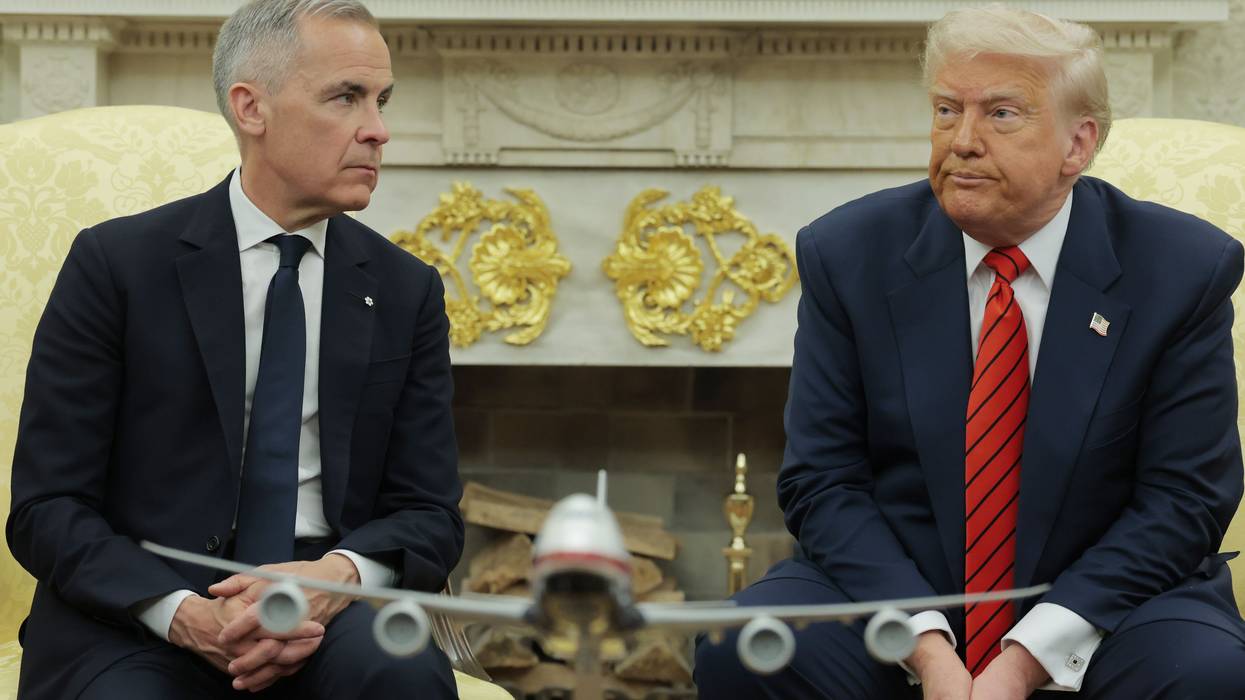
US President Donald Trump on Sunday twice told journalists to stop asking him about the status of the Strait of Hormuz, which Iran once again closed after the president declared an end to the ceasefire deal between the two countries.
The first instance came during an interview with NBC News' Kristen Welker, who pointed to conflicting statements from the Iranian government and US Central Command about the status of the strait, which is an essential shipping lane for global petroleum supplies.
Trump replied that "it's open, and I don't want to talk about it because I want to honor the life" of the late Sen. Lindsey Graham (R-SC), who died on Saturday from what his office described as "a brief and sudden illness."
"So I don't want to talk about it," Trump continued. "I told you that before the call."
WELKER: Iran says the Strait of Hormuz is closed. CENTCOM says it's open. Which is it?
TRUMP: It's open, and I don't want to talk about because I want to honor the life of Lindsey Graham, so I don't want to talk about it. I told you that before the call. pic.twitter.com/3ed7dN1bhK
— Aaron Rupar (@atrupar) July 12, 2026
Shortly after, during an interview with CNN's Jake Tapper, Trump was again asked whether the strait was still open.
"It's open as far as we're concerned," Trump told Tapper. "Don't talk about it. Talk about the reason you asked me to speak."
"Okay," Tapper replied. "We appreciate your time, sir."
TAPPER: Iran has declared the Strait of Hormuz closed. Is that true?
TRUMP: It's open as far as we're concerned. Don't talk about it. Talk about the reason you asked me to speak. pic.twitter.com/TwssTycQdF
— Aaron Rupar (@atrupar) July 12, 2026
Iran shut down shipping traffic in the strait after Trump launched an illegal war against the country in late February. The strait's closure resulted in spiking oil and gasoline prices, which coincided with further erosion in Trump's approval ratings.
Although traffic through the strait initially picked up in the wake of a June memorandum of understanding signed by the US and Iran, it has since slumped as the ceasefire between the two nations has fallen apart.
Ana Marie Cox, contributing editor at The New Republic, bashed both Welker and Tapper for heeding the president's requests and not pushing him to answer questions about the war he unlawfully started.
"Frankly astonished that supposed news sources agreed to terms to interview Trump and appeared to be deferential to them," Cox wrote in a social media post, "enough that they were apologetic in brining up other topics."
Cox's sentiment was echoed by Kai Ryssdal, host of NPR's Marketplace, who remarked that "the guy being interviewed doesn’t get to pick the questions."
Journalist Helen Kennedy challenged Trump's assertion that asking about the status of the Iran war was irrelevant when talking about Lindsey Graham.
"Making war with Iran was Lindsey Graham's favorite thing," Kennedy observed. "It's not like it's unrelated."
"Lindsey Graham will forever be remembered as an enabler of a regime that has murdered people, destroyed democratic norms, and caused irreparable harm to this country. What a horrific legacy," said one critic.
Sen. Lindsey Graham, one of the most relentless proponents for using US military force overseas, died on Saturday night at the age of 71.
In a statement posted on Graham's (R-SC) social media account, the senator's office said that he "passed away from a brief and sudden illness."
"Sen. Graham's family appreciates prayers at this time," the office added, "and asks for privacy during this incredibly difficult period."
During his life, Graham advocated either starting or getting involved in multiple wars across the world, and he was reportedly instrumental in convincing President Donald Trump to launch an illegal attack on Iran without any authorization from the US Congress.
Although Graham was once a Trump critic—he infamously declared in 2016 that the Republican Party would get "destroyed" if it made the former Celebrity Apprentice host its presidential nominee—the South Carolina Republican grew to become one of the president's staunchest allies.
Some critics of Graham reacted to his death by rehashing what they considered to be his least admirable traits.
David Dayen, executive editor of The American Prospect, remarked that Graham "never met a war he didn't want to send your kids to."
Alejandra Caraballo, clinical instructor at the Harvard Law School Cyberlaw Clinic, also reflected on Graham's lifetime of war mongering.
"You can say a lot about Lindsey Graham," Caraballo wrote, "but at least he got to see the thing he most wanted before he died, bombing school children in Iran."
Princeton historian Kevin Kruse predicted that Graham would leave behind a decidedly poor legacy.
"When Lindsey Graham appears in a history book," wrote Kruse, "it'll be his prediction in 2016 that the Republican Party would be destroyed for supporting Donald Trump and then a few lines about how he proved it by becoming Trump's toady. That's pretty much it. That's his legacy. Pathetic lickspittle."
Steve Schmidt, a former Republican strategist who left the party due to its embrace of Trump, wrote that Graham was "a simple, tragic man" who "lacked a moral core."
"The great empty spaces of his life were filled with an insatiable need for 'relevance,'" Schmidt observed. "He found it as a cast member in the most malignant reality show ever made."
Kenneth Roth, former executive director of Human Rights Watch, had a similar analysis of Graham's character.
"Lindsey Graham supported the International Criminal Court when it charged [Russian President Vladimir] Putin but turned on it when it charged [Israeli Prime Minister] Netanyahu," wrote Roth. "Principled, he wasn't."
Nicholas Grossman, professor of international relations at the University of Illinois, wrote that Graham "spent the last decade of his life in public service... trying hard to be remembered as an enemy of the Constitution who worked to destroy American democracy."
Grossman added that Graham "exhibited occasional signs that he knew why that was bad but kept doing it anyway."
Ruth Zakarin, CEO of the Massachusetts Coalition to Prevent Gun Violence, offered a grim assessment of the late senator.
"Lindsey Graham will forever be remembered as an enabler of a regime that has murdered people, destroyed democratic norms, and caused irreparable harm to this country," wrote Zakarin. "What a horrific legacy."