SUBSCRIBE TO OUR FREE NEWSLETTER
Daily news & progressive opinion—funded by the people, not the corporations—delivered straight to your inbox.
5
#000000
#FFFFFF
To donate by check, phone, or other method, see our More Ways to Give page.
Daily news & progressive opinion—funded by the people, not the corporations—delivered straight to your inbox.
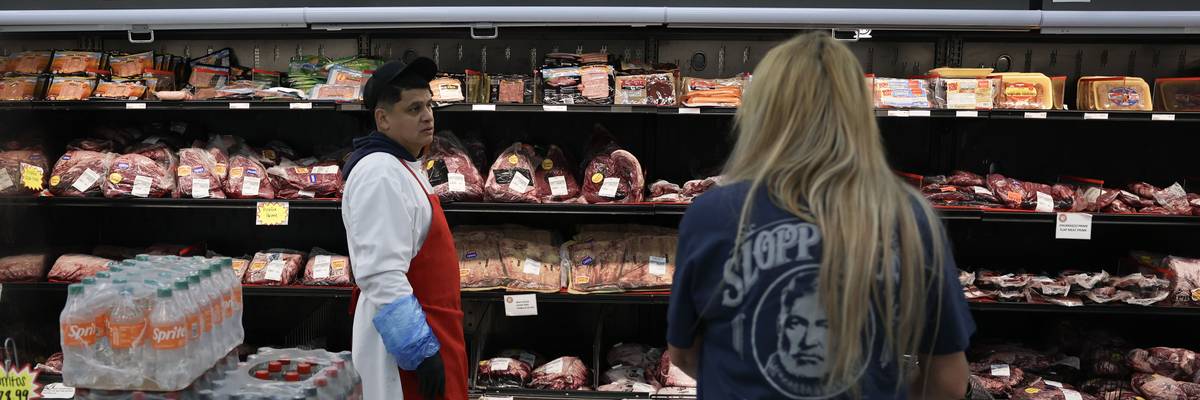
A worker assists a customer in the meat aisle in a grocery store on July 22, 2025 in Miami, Florida.
"The world is in for one hell of a ride," said one climate expert.
Experts are warning that a combination of a super El Niño climate pattern and two separate wars is threatening to put further upward pressure on food prices over the next several months.
A study released by Oxford Economics on Wednesday projects that global food prices will rise by 12% in 2026 and by 5% in 2027 due in large part to the fertilizer shortage caused by the closure in the Strait of Hormuz and increased grain prices caused by Russia's war with Ukraine.
The strait's closure, which began after President Donald Trump launched an illegal war with Iran in February, cut off a major shipping lane for fertilizer, whose price Oxford Economics projects will surge by 22% this year.
The four-year conflict between Russia and Ukraine, meanwhile, is putting a strain on grain supplies, as the two countries combined account for 30% of global wheat exports.
And the two wars might not be the biggest driver of higher food prices.
The Independent on Friday reported that the Met Office, the UK's official weather forecasting service, is projecting this year's El Niño will be "the largest since the 19th century," with sea temperatures projected to reach 3ºC above their long-term average in the coming months.
Professor Adam Scaife, head of long range forecasting at the Met Office, told The Independent that he has "never seen an El Niño signal this intense in our forecasts," describing the projected increase in ocean temperatures as "an unprecedented event."
Bill McGuire, professor emeritus of geophysical hazards at University College London, told The Independent that the Met Office's forecasts "suggest that the world is in for one hell of a ride."
“The astonishing and unprecedented amount of heat building across the eastern Pacific Ocean," McGuire said, "is all but certain to make this the most powerful El Niño in living memory possibly even the biggest in several centuries."
McGuire said that this heat would manifest itself in several destructive ways over the next year, such as "bringing drought and wildfire conditions to the Amazon and parts of Australia, torrential rainfall and floods to California, and a reduced South Asian monsoon."
In an interview with CNBC published Friday, trade and agriculture analyst Noel Fryer noted that North America and Europe have experienced very hot summers that has "decimated" some crops and has hurt grazing prospects by reducing the available supply of grass and hay.
And all this occurred, Fryer added, before the full impact of El Niño has arrived.
“It’s just a huge mix of different issues and we don’t know how they’re going to end," said Fryer. "It’s a perfect storm."
Dear Common Dreams reader, It’s been nearly 30 years since I co-founded Common Dreams with my late wife, Lina Newhouser. We had the radical notion that journalism should serve the public good, not corporate profits. It was clear to us from the outset what it would take to build such a project. No paid advertisements. No corporate sponsors. No millionaire publisher telling us what to think or do. Many people said we wouldn't last a year, but we proved those doubters wrong. Together with a tremendous team of journalists and dedicated staff, we built an independent media outlet free from the constraints of profits and corporate control. Our mission has always been simple: To inform. To inspire. To ignite change for the common good. Building Common Dreams was not easy. Our survival was never guaranteed. When you take on the most powerful forces—Wall Street greed, fossil fuel industry destruction, Big Tech lobbyists, and uber-rich oligarchs who have spent billions upon billions rigging the economy and democracy in their favor—the only bulwark you have is supporters who believe in your work. But here’s the urgent message from me today. It's never been this bad out there. And it's never been this hard to keep us going. At the very moment Common Dreams is most needed, the threats we face are intensifying. We need your support now more than ever. We don't accept corporate advertising and never will. We don't have a paywall because we don't think people should be blocked from critical news based on their ability to pay. Everything we do is funded by the donations of readers like you. When everyone does the little they can afford, we are strong. But if that support retreats or dries up, so do we. Will you donate now to make sure Common Dreams not only survives but thrives? —Craig Brown, Co-founder |
Experts are warning that a combination of a super El Niño climate pattern and two separate wars is threatening to put further upward pressure on food prices over the next several months.
A study released by Oxford Economics on Wednesday projects that global food prices will rise by 12% in 2026 and by 5% in 2027 due in large part to the fertilizer shortage caused by the closure in the Strait of Hormuz and increased grain prices caused by Russia's war with Ukraine.
The strait's closure, which began after President Donald Trump launched an illegal war with Iran in February, cut off a major shipping lane for fertilizer, whose price Oxford Economics projects will surge by 22% this year.
The four-year conflict between Russia and Ukraine, meanwhile, is putting a strain on grain supplies, as the two countries combined account for 30% of global wheat exports.
And the two wars might not be the biggest driver of higher food prices.
The Independent on Friday reported that the Met Office, the UK's official weather forecasting service, is projecting this year's El Niño will be "the largest since the 19th century," with sea temperatures projected to reach 3ºC above their long-term average in the coming months.
Professor Adam Scaife, head of long range forecasting at the Met Office, told The Independent that he has "never seen an El Niño signal this intense in our forecasts," describing the projected increase in ocean temperatures as "an unprecedented event."
Bill McGuire, professor emeritus of geophysical hazards at University College London, told The Independent that the Met Office's forecasts "suggest that the world is in for one hell of a ride."
“The astonishing and unprecedented amount of heat building across the eastern Pacific Ocean," McGuire said, "is all but certain to make this the most powerful El Niño in living memory possibly even the biggest in several centuries."
McGuire said that this heat would manifest itself in several destructive ways over the next year, such as "bringing drought and wildfire conditions to the Amazon and parts of Australia, torrential rainfall and floods to California, and a reduced South Asian monsoon."
In an interview with CNBC published Friday, trade and agriculture analyst Noel Fryer noted that North America and Europe have experienced very hot summers that has "decimated" some crops and has hurt grazing prospects by reducing the available supply of grass and hay.
And all this occurred, Fryer added, before the full impact of El Niño has arrived.
“It’s just a huge mix of different issues and we don’t know how they’re going to end," said Fryer. "It’s a perfect storm."
Experts are warning that a combination of a super El Niño climate pattern and two separate wars is threatening to put further upward pressure on food prices over the next several months.
A study released by Oxford Economics on Wednesday projects that global food prices will rise by 12% in 2026 and by 5% in 2027 due in large part to the fertilizer shortage caused by the closure in the Strait of Hormuz and increased grain prices caused by Russia's war with Ukraine.
The strait's closure, which began after President Donald Trump launched an illegal war with Iran in February, cut off a major shipping lane for fertilizer, whose price Oxford Economics projects will surge by 22% this year.
The four-year conflict between Russia and Ukraine, meanwhile, is putting a strain on grain supplies, as the two countries combined account for 30% of global wheat exports.
And the two wars might not be the biggest driver of higher food prices.
The Independent on Friday reported that the Met Office, the UK's official weather forecasting service, is projecting this year's El Niño will be "the largest since the 19th century," with sea temperatures projected to reach 3ºC above their long-term average in the coming months.
Professor Adam Scaife, head of long range forecasting at the Met Office, told The Independent that he has "never seen an El Niño signal this intense in our forecasts," describing the projected increase in ocean temperatures as "an unprecedented event."
Bill McGuire, professor emeritus of geophysical hazards at University College London, told The Independent that the Met Office's forecasts "suggest that the world is in for one hell of a ride."
“The astonishing and unprecedented amount of heat building across the eastern Pacific Ocean," McGuire said, "is all but certain to make this the most powerful El Niño in living memory possibly even the biggest in several centuries."
McGuire said that this heat would manifest itself in several destructive ways over the next year, such as "bringing drought and wildfire conditions to the Amazon and parts of Australia, torrential rainfall and floods to California, and a reduced South Asian monsoon."
In an interview with CNBC published Friday, trade and agriculture analyst Noel Fryer noted that North America and Europe have experienced very hot summers that has "decimated" some crops and has hurt grazing prospects by reducing the available supply of grass and hay.
And all this occurred, Fryer added, before the full impact of El Niño has arrived.
“It’s just a huge mix of different issues and we don’t know how they’re going to end," said Fryer. "It’s a perfect storm."