SUBSCRIBE TO OUR FREE NEWSLETTER
Daily news & progressive opinion—funded by the people, not the corporations—delivered straight to your inbox.
5
#000000
#FFFFFF
To donate by check, phone, or other method, see our More Ways to Give page.
Daily news & progressive opinion—funded by the people, not the corporations—delivered straight to your inbox.
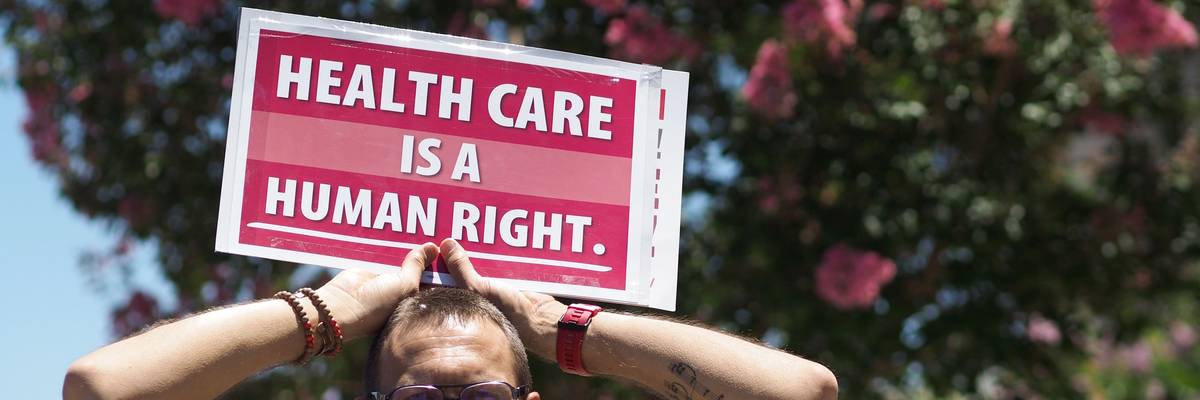
People rally in favor of single-payer healthcare for all Californians as the US Senate prepares to vote on the Senate GOP healthcare bill on June 27, 2017 in South Gate, California.
“No one is safe from making these trade-offs,” said a researcher at Gallup, which found even insured Americans in higher income brackets have avoided daily expenses to pay medical bills.
As the Trump administration spends an estimated $1 billion per day in taxpayer money bombing targets across Iran that have reportedly included an elementary school and healthcare facilities, Gallup released a survey Thursday that found one-third of Americans reported making financial trade-offs in order to pay for medical expenses last year.
The West Health-Gallup Center on Healthcare in America polled nearly 20,000 US adults between June and August 2025 and found that roughly one-third of them—equivalent to about 82 million people in the richest country in the world—were forced cut back on at least one expense in order to afford healthcare.
Eleven percent of respondents—equivalent to 28 million Americans—skipped a meal or intentionally drove less in order to pay a medical bill. Fifteen percent, the equivalent of nearly 40 million people, said they prolonged a current prescription or borrowed money, and 9% cut back on utilities.
Those numbers were strikingly similar among people who have health insurance, with 14% of insured people prolonging prescriptions to avoid paying for a new one and 9% skipping meals. Among insured Americans, 29% made at least one trade-off to afford healthcare.
The crisis is also not exclusively affecting low-income people. A quarter of people in households earning $90,000 to $120,000 per year skipped meals or other expenses to pay medical bills, and 11% of people in households earning $240,000 or more did the same.
“No one is safe from making these trade-offs,” Ellyn Maese, a senior researcher at Gallup and research director for the West Health-Gallup Center, told The New York Times.
Sixty-two percent of people without healthcare coverage were forced to make trade-offs, and 55% of people with household incomes lower than $24,000 per year as well as 47% of people earning $24,000 to $48,000 avoided expenses.
Gallup also released the results of a separate poll taken between October and December 2025, which showed how Americans are delaying major life decisions as well as altering their daily lives to afford healthcare under the for-profit insurance system.
As the Trump administration's policies slashed healthcare for 15 million Americans and raised healthcare premiums for tens of millions of people—and as the White House demanded that families have more children—6% of respondents said they had postponed having or adopting a child due to healthcare costs, equivalent to about 16 million Americans.
Nearly 30% said healthcare costs led them to avoid taking a vacation, 18% said they delayed finding a different job, 15% said they postponed pursuing education or job training, and 14% said they postponed buying a home.
The polls are “telling a consistent story here,” Maese said.
The survey results were released weeks after the Trump administration proposed new regulations for healthcare plans purchased through the Affordable Care Act marketplace that would charge deductibles as high as $15,000 for individuals and $31,000 for families to offset lower monthly premiums—underscoring how the healthcare law passed 16 years ago has left American households vulnerable to rising costs under the for-profit health insurance system.
A survey taken last November by Data for Progress found that 65% of voters support expanding the Medicare system to everyone in the US, a proposal that would save an estimated $650 billion annually.
But as Rep. Pramila Jayapal (D-Wash.)—who has sponsored Medicare for All legislation in the House—noted on Wednesday, Republicans and establishment Democrats continue to claim the proposal is unaffordable.
"When we ask for Medicare for All it’s 'too expensive,' and we 'don’t have the money,'" said Jayapal. "When the president drags us into his own personal war, no expense is spared. Our priorities are backwards."
Dear Common Dreams reader, It’s been nearly 30 years since I co-founded Common Dreams with my late wife, Lina Newhouser. We had the radical notion that journalism should serve the public good, not corporate profits. It was clear to us from the outset what it would take to build such a project. No paid advertisements. No corporate sponsors. No millionaire publisher telling us what to think or do. Many people said we wouldn't last a year, but we proved those doubters wrong. Together with a tremendous team of journalists and dedicated staff, we built an independent media outlet free from the constraints of profits and corporate control. Our mission has always been simple: To inform. To inspire. To ignite change for the common good. Building Common Dreams was not easy. Our survival was never guaranteed. When you take on the most powerful forces—Wall Street greed, fossil fuel industry destruction, Big Tech lobbyists, and uber-rich oligarchs who have spent billions upon billions rigging the economy and democracy in their favor—the only bulwark you have is supporters who believe in your work. But here’s the urgent message from me today. It's never been this bad out there. And it's never been this hard to keep us going. At the very moment Common Dreams is most needed, the threats we face are intensifying. We need your support now more than ever. We don't accept corporate advertising and never will. We don't have a paywall because we don't think people should be blocked from critical news based on their ability to pay. Everything we do is funded by the donations of readers like you. When everyone does the little they can afford, we are strong. But if that support retreats or dries up, so do we. Will you donate now to make sure Common Dreams not only survives but thrives? —Craig Brown, Co-founder |
As the Trump administration spends an estimated $1 billion per day in taxpayer money bombing targets across Iran that have reportedly included an elementary school and healthcare facilities, Gallup released a survey Thursday that found one-third of Americans reported making financial trade-offs in order to pay for medical expenses last year.
The West Health-Gallup Center on Healthcare in America polled nearly 20,000 US adults between June and August 2025 and found that roughly one-third of them—equivalent to about 82 million people in the richest country in the world—were forced cut back on at least one expense in order to afford healthcare.
Eleven percent of respondents—equivalent to 28 million Americans—skipped a meal or intentionally drove less in order to pay a medical bill. Fifteen percent, the equivalent of nearly 40 million people, said they prolonged a current prescription or borrowed money, and 9% cut back on utilities.
Those numbers were strikingly similar among people who have health insurance, with 14% of insured people prolonging prescriptions to avoid paying for a new one and 9% skipping meals. Among insured Americans, 29% made at least one trade-off to afford healthcare.
The crisis is also not exclusively affecting low-income people. A quarter of people in households earning $90,000 to $120,000 per year skipped meals or other expenses to pay medical bills, and 11% of people in households earning $240,000 or more did the same.
“No one is safe from making these trade-offs,” Ellyn Maese, a senior researcher at Gallup and research director for the West Health-Gallup Center, told The New York Times.
Sixty-two percent of people without healthcare coverage were forced to make trade-offs, and 55% of people with household incomes lower than $24,000 per year as well as 47% of people earning $24,000 to $48,000 avoided expenses.
Gallup also released the results of a separate poll taken between October and December 2025, which showed how Americans are delaying major life decisions as well as altering their daily lives to afford healthcare under the for-profit insurance system.
As the Trump administration's policies slashed healthcare for 15 million Americans and raised healthcare premiums for tens of millions of people—and as the White House demanded that families have more children—6% of respondents said they had postponed having or adopting a child due to healthcare costs, equivalent to about 16 million Americans.
Nearly 30% said healthcare costs led them to avoid taking a vacation, 18% said they delayed finding a different job, 15% said they postponed pursuing education or job training, and 14% said they postponed buying a home.
The polls are “telling a consistent story here,” Maese said.
The survey results were released weeks after the Trump administration proposed new regulations for healthcare plans purchased through the Affordable Care Act marketplace that would charge deductibles as high as $15,000 for individuals and $31,000 for families to offset lower monthly premiums—underscoring how the healthcare law passed 16 years ago has left American households vulnerable to rising costs under the for-profit health insurance system.
A survey taken last November by Data for Progress found that 65% of voters support expanding the Medicare system to everyone in the US, a proposal that would save an estimated $650 billion annually.
But as Rep. Pramila Jayapal (D-Wash.)—who has sponsored Medicare for All legislation in the House—noted on Wednesday, Republicans and establishment Democrats continue to claim the proposal is unaffordable.
"When we ask for Medicare for All it’s 'too expensive,' and we 'don’t have the money,'" said Jayapal. "When the president drags us into his own personal war, no expense is spared. Our priorities are backwards."
As the Trump administration spends an estimated $1 billion per day in taxpayer money bombing targets across Iran that have reportedly included an elementary school and healthcare facilities, Gallup released a survey Thursday that found one-third of Americans reported making financial trade-offs in order to pay for medical expenses last year.
The West Health-Gallup Center on Healthcare in America polled nearly 20,000 US adults between June and August 2025 and found that roughly one-third of them—equivalent to about 82 million people in the richest country in the world—were forced cut back on at least one expense in order to afford healthcare.
Eleven percent of respondents—equivalent to 28 million Americans—skipped a meal or intentionally drove less in order to pay a medical bill. Fifteen percent, the equivalent of nearly 40 million people, said they prolonged a current prescription or borrowed money, and 9% cut back on utilities.
Those numbers were strikingly similar among people who have health insurance, with 14% of insured people prolonging prescriptions to avoid paying for a new one and 9% skipping meals. Among insured Americans, 29% made at least one trade-off to afford healthcare.
The crisis is also not exclusively affecting low-income people. A quarter of people in households earning $90,000 to $120,000 per year skipped meals or other expenses to pay medical bills, and 11% of people in households earning $240,000 or more did the same.
“No one is safe from making these trade-offs,” Ellyn Maese, a senior researcher at Gallup and research director for the West Health-Gallup Center, told The New York Times.
Sixty-two percent of people without healthcare coverage were forced to make trade-offs, and 55% of people with household incomes lower than $24,000 per year as well as 47% of people earning $24,000 to $48,000 avoided expenses.
Gallup also released the results of a separate poll taken between October and December 2025, which showed how Americans are delaying major life decisions as well as altering their daily lives to afford healthcare under the for-profit insurance system.
As the Trump administration's policies slashed healthcare for 15 million Americans and raised healthcare premiums for tens of millions of people—and as the White House demanded that families have more children—6% of respondents said they had postponed having or adopting a child due to healthcare costs, equivalent to about 16 million Americans.
Nearly 30% said healthcare costs led them to avoid taking a vacation, 18% said they delayed finding a different job, 15% said they postponed pursuing education or job training, and 14% said they postponed buying a home.
The polls are “telling a consistent story here,” Maese said.
The survey results were released weeks after the Trump administration proposed new regulations for healthcare plans purchased through the Affordable Care Act marketplace that would charge deductibles as high as $15,000 for individuals and $31,000 for families to offset lower monthly premiums—underscoring how the healthcare law passed 16 years ago has left American households vulnerable to rising costs under the for-profit health insurance system.
A survey taken last November by Data for Progress found that 65% of voters support expanding the Medicare system to everyone in the US, a proposal that would save an estimated $650 billion annually.
But as Rep. Pramila Jayapal (D-Wash.)—who has sponsored Medicare for All legislation in the House—noted on Wednesday, Republicans and establishment Democrats continue to claim the proposal is unaffordable.
"When we ask for Medicare for All it’s 'too expensive,' and we 'don’t have the money,'" said Jayapal. "When the president drags us into his own personal war, no expense is spared. Our priorities are backwards."