

SUBSCRIBE TO OUR FREE NEWSLETTER
Daily news & progressive opinion—funded by the people, not the corporations—delivered straight to your inbox.
5
#000000
#FFFFFF
To donate by check, phone, or other method, see our More Ways to Give page.
Daily news & progressive opinion—funded by the people, not the corporations—delivered straight to your inbox.

"Trump's abuse of taxpayer dollars is especially egregious at a time when families are grappling with high costs for rent, groceries, childcare, and other necessities," said US Sen. Maggie Hassan.
Democrats on the congressional Joint Economic Committee on Wednesday released a report calculating that taxpayer funding for President Donald Trump's vanity projects has soared to more than $1.8 billion.
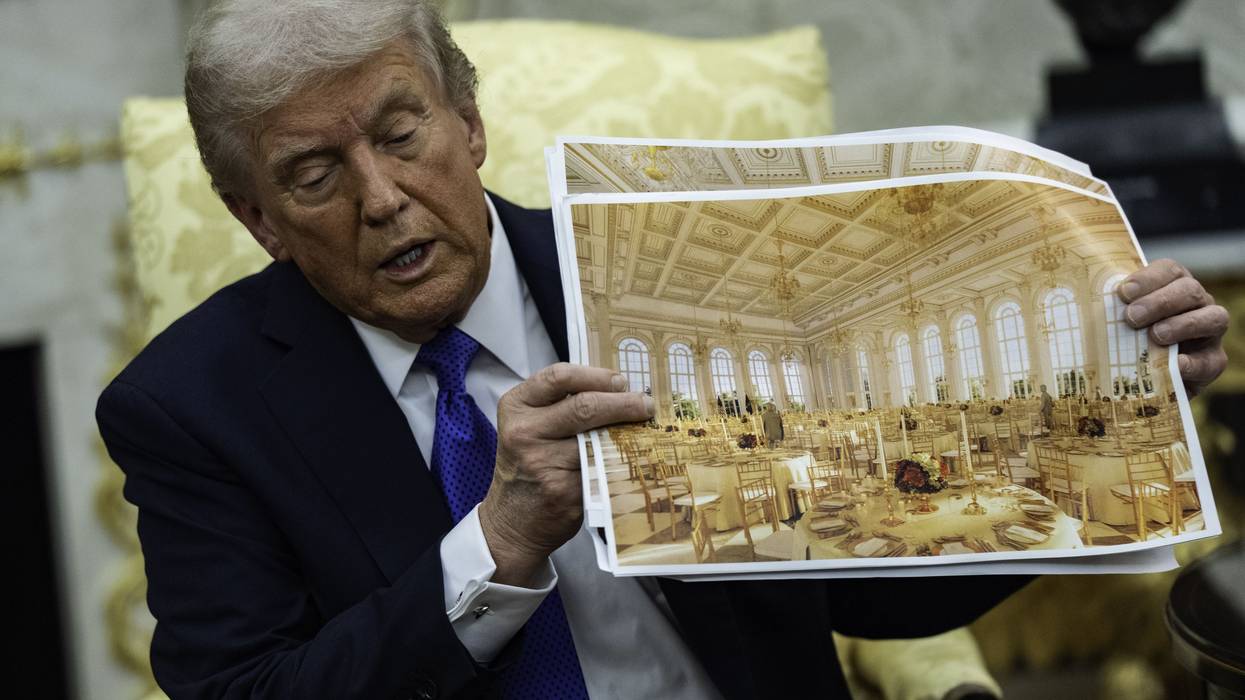
Renovations made to the White House—including the president's luxury ballroom—are the biggest projected expenses, as the analysis cites reporting from The Washington Post last month to estimate that they will cost $927 million.
After the White House renovations, the second-most expensive Trump vanity project highlighted in the report is the estimated $400 million that will be required to provide security upgrades to the luxury jet the president received as a gift from the Qatari government.
The report finds that taxpayers will also be on the hook for $257 in renovations to the the John F. Kennedy Memorial Center for the Performing Arts, which the president has threatened to tear down unless he is allowed to slap his name on the side of the building.
The president's "Triumphal Arch" monument is another big-ticket item, as the report calculates it will cost $100 million to construct. Trump's infamously botched attempt to renovate the Lincoln Memorial Reflecting Pool, meanwhile, is set to cost taxpayers $16 million.
The Democrats on the JEC also released a Trump Vanity Calculator, an online tool that shows the opportunity costs of the president's assorted projects.
Among other things, the calculator shows that the $1.8 billion spent on the projects would be enough to pay for more than 607 million school lunches, or 117,000 additional Head Start slots, or 246,000 Pell Grants.
Redirecting the spending on the Trump projects would also be enough to restore funding for Supplemental Nutrition Assistance Program (SNAP) benefits—which were cut as part of the Republican Party's 2025 budget law—for over 429,000 families.
Sen. Maggie Hassan (D-NH), ranking member of the JEC, said the report shows that Trump "has wasted taxpayer dollars on projects that benefit himself instead of the American people."
“Trump’s abuse of taxpayer dollars is especially egregious at a time when families are grappling with high costs for rent, groceries, childcare, and other necessities," Hassan said. "President Trump admits that he doesn’t think about the financial situation of Americans, and the American people can see that; instead, he thinks about how he can use their money to build gold-plated monuments to himself."
During the 2024 presidential campaign, Trump promised to cut Americans' energy costs in half while keeping the country out of foreign wars.
In February, Trump launched an illegal war against Iran without any congressional authorization that has sent energy prices skyrocketing, including record-high prices for diesel fuel.
Through it all, Trump has continued touting his vanity projects, including the aforementioned ballroom and arch, even as polls show that the high cost of living is American voters' biggest concern.
With the midterm elections just six weeks away, a survey released by CNN on Wednesday shows that just 24% of Americans say that Trump has the right priorities as president, while two-thirds say he has worsened economic conditions in the country.
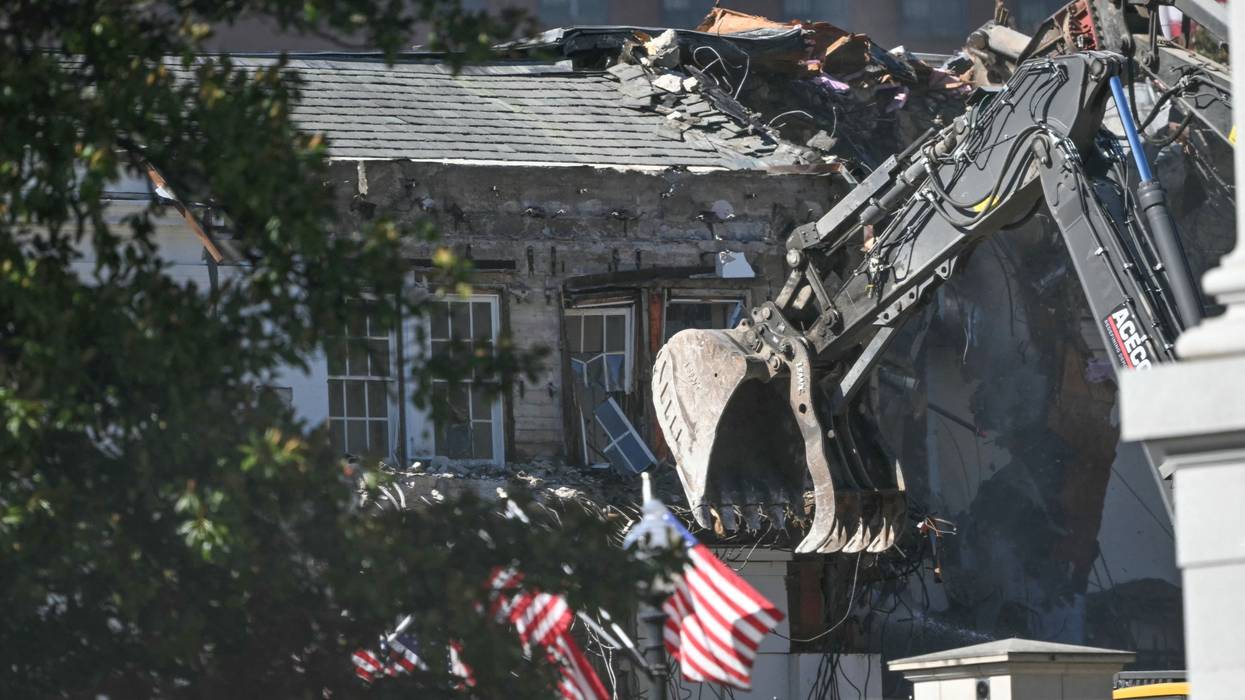
"The White House belongs to the people, but Trump consistently acts like it belongs to him alone," said one watchdog, calling out the court's majority for allowing construction on "this illegal project."
US Supreme Court Chief Justice John Roberts recently let construction on President Donald Trump's White House ballroom continue in a temporary solo decision, but on Monday he sided with the three liberals against the five right-wingers who allowed the project to proceed during a legal battle.
The Trump administration sought intervention from the nation's top court after the US Court of Appeals for the District of Columbia upheld a district judge's ruling that halted above-ground construction but permitted work on an underground bunker and other "national security facilities." Roberts then paused the appellate decision but also sought a review from all justices.
The five justices behind the majority's Monday decision, including Trump's three appointees, concluded the administration "is likely to prevail" in showing that the National Trust for Historic Preservation—which is challenging parts of the widely contested project that's already destroyed the East Wing of the White House—lacks standing.
"This court has not found standing in circumstances like these before. To the contrary, we have repeatedly held that mere offense, disagreement, or distaste does not qualify as a concrete and particularized injury under Article III," the majority wrote, referring to the portion of the US Constitution that addresses the judicial system.
"The government has also established that it will likely suffer irreparable harm from the district court's injunction and that the balance of the equities tips in its favor," the majority added in its unsigned order, which signaled that the merits of the case should continue to be examined by lower courts.
Meanwhile, writing for himself and the liberal justices, Roberts said that the construction "is likely unlawful," given that Congress has not passed legislation authorizing the project, and pointed to the trust's executive committee member Alison K. Hoagland.
"As a Capitol Hill resident, Hoagland regularly visits the White House to take in the historic building's beauty and to appreciate its symbolism. By overshadowing the traditional White House, Hoagland explains, the new ballroom will detract from the building's
message of republican simplicity and thereby worsen her viewing experience," he wrote. "Hoagland's injury suffices for standing."
The high court's majority "misconceives the plaintiff's injury, allowing the executive's likely infringement of the legislature's power of the purse and authority to regulate federal property in the District of Columbia to continue," Roberts added. "Today's decision is no victory for the separation of powers."
The president cheered the majority's decision, writing on his Truth Social platform:
I am pleased to report that the United States Supreme Court has just ruled in favor of the Ballroom/Military Complex being built without any further contingency, doubt, or threat. We are living in the Golden Age of America, and this Building will be one of the Greatest ever constructed in Washington, D.C. When completed in the Summer of 2028, the magnificent Ballroom and Military Complex will be something that the entire Country is very proud of. The Project, despite the baseless lawsuit brought by the so-called National Trust for Historic Preservation of the United States, which is not in any way affiliated with the United States Government, is under budget and ahead of schedule. The Ballroom is totally funded by Great Patriots and Corporations and, therefore, is a Gift — At no cost to the American Taxpayer.
Critics continued to condemn the project after the decision, with US Sen. John Hickenlooper (D-Colo.) stressing on Bluesky that "the president's vanity project does nothing to benefit anyone but Donald J. Trump himself."
"Not a penny to lower your costs," the senator reminded Americans. "This has been a ridiculous waste of taxpayer dollars from the start."
Jon Golinger, democracy advocate at the watchdog group Public Citizen, said in a statement that "in light of this disappointing decision by the court, the next Congress must make investigating Trump's illegal ballroom project and everyone involved with funding and facilitating it a top priority."
Both chambers of Congress are narrowly controlled by Trump's Republican Party, and some GOP lawmakers even tried to boost the project. However, Democrats are aiming to reclaim majorities in the Senate and House of Representatives in the November midterm elections—and if they succeed, they could probe the ballroom and various other concerns from his second presidency.
"Trump suffers from a crippling case of 'palace-envy' and who knows what national treasure he'll demolish next to try to build himself another gold-plated monument," warned Golinger. "For now, we will keep digging into and exposing Trump's ballroom funding schemes, through which he raked in millions from corporations with billions in government contracts and anonymous donors with unknown agendas."
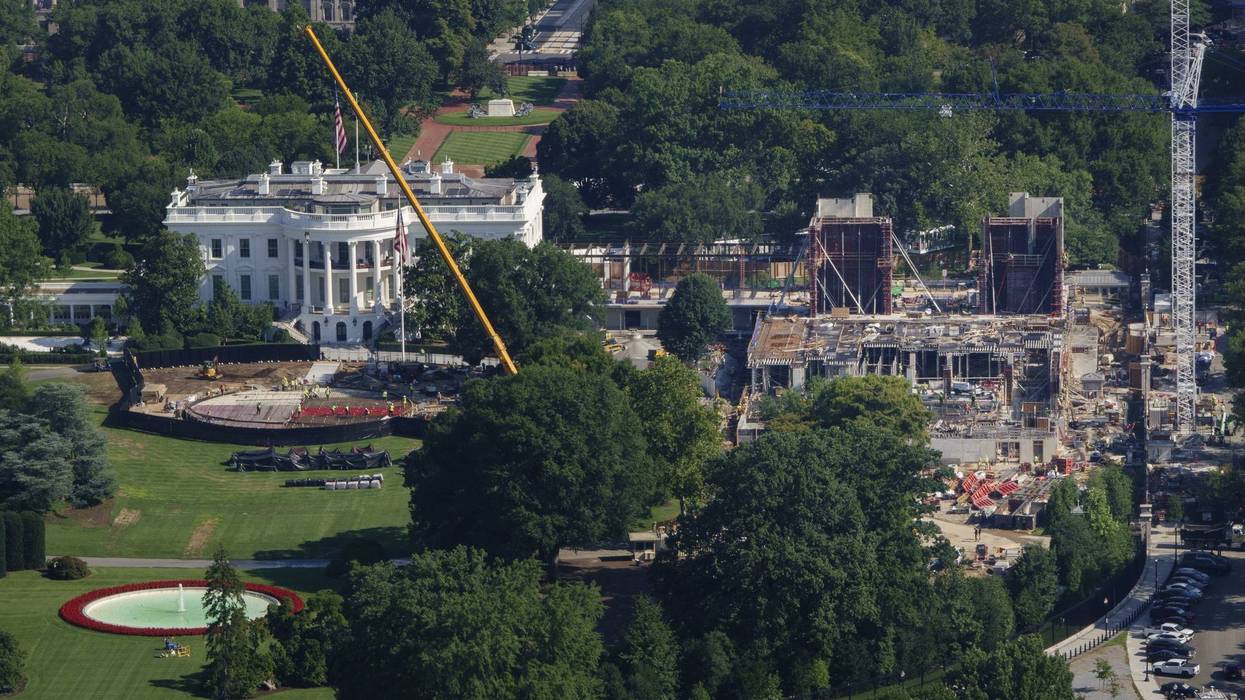
"We call upon the court to hold President Trump accountable and affirm a fundamental principle on which this country was founded: No one, not even a president, is above the law," responded one watchdog leader.
US Supreme Court Chief Justice John Roberts on Friday allowed construction on President Donald Trump's White House ballroom project to continue while a legal battle plays out.
The Trump administration filed an appeal seeking an emergency intervention from the high court last week, after the US Court of Appeals for the District of Columbia upheld a district judge's ruling, halting above-ground construction while allowing work on an underground bunker and other "national security facilities."
Roberts issued a one-page order announcing the administrative stay, which blocks the appellate court's preliminary injunction, pending further consideration by him and the other justices.
The National Trust for Historic Preservation is challenging the contentious project, which is slated to cost hundreds of millions of dollars and has already resulted in workers demolishing the East Wing of the White House.
After Roberts' ruling, a spokesperson for the organization told Courthouse News, "To be clear, this is not a final decision on the merits of the government's stay application, and we await further action."
National Trust's president and CEO, Brent Leggs, said earlier this week that "the executive branch lacks unilateral authority to destroy or transform the White House, and cannot use national security as a justification for ignoring the Constitution."
Various groups and federal lawmakers have echoed the organization's argument that under the US Constitution, "Congress, not the executive, holds the nation's purse strings," and Trump's "plan to fund the ballroom with private donations cannot stand," as the Campaign Legal Center and Citizens for Responsibility and Ethics in Washington (CREW) wrote in a Tuesday amicus brief.
Responding to Roberts' decision, Lisa Gilbert, co-president of the watchdog group Public Citizen, said in a statement that "the ballroom is a microcosm of a hundred different issues with the Trump administration. This president has usurped the powers reserved for Congress by the Constitution and flouted the law at every turn."
"The White House belongs to the people, not to the president himself," she stressed. "We call upon the court to hold President Trump accountable and affirm a fundamental principle on which this country was founded: No one, not even a president, is above the law."
Meanwhile, her colleague Jon Golinger, a democracy advocate at Public Citizen, emphasized that "everything Trump demolishes can be rebuilt. Every place he breaks can be fixed. Every space he pollutes can be fumigated."
Golinger vowed that "we will keep investigating and exposing Trump's shady ballroom funding schemes to rake in millions from corporations with billions in government contracts and anonymous donors with hidden agendas."
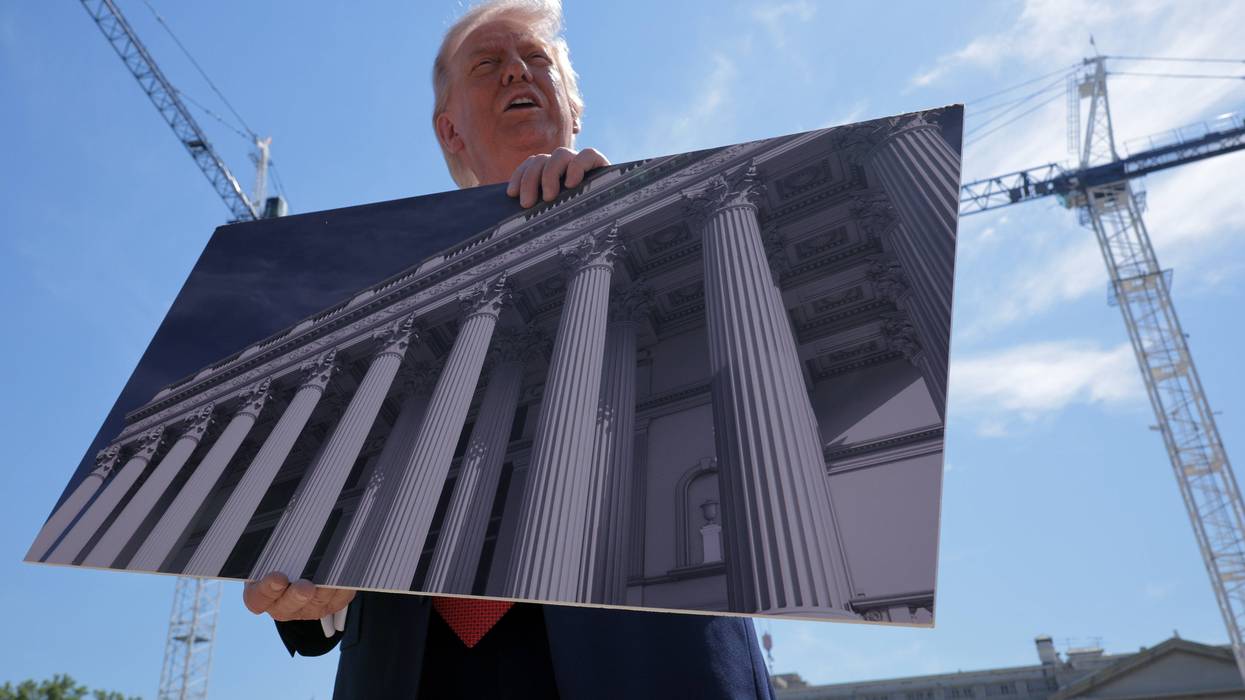
"The Constitution's system of checks and balances ensures that no individual or branch of government holds absolute power," said one legal expert. "The president is ignoring this design."
Just days after President Donald Trump's administration asked the right-wing US Supreme Court to allow construction of a new White House ballroom to continue while a legal challenge plays out, federal lawmakers and advocacy groups on Tuesday urged the justices to block any more work on the project absent congressional approval.
"The Constitution's system of checks and balances ensures that no individual or branch of government holds absolute power," said Trevor Potter, president of the nonpartisan Campaign Legal Center, which filed an amicus brief with Citizens for Responsibility and Ethics in Washington (CREW).
"The president is ignoring this design by unilaterally demolishing the East Wing of the White House and trying to construct a massive ballroom with private funds, raising the risk of corruption that constitutional checks are supposed to prevent," he continued.
Potter stressed that "Congress, not the president, is empowered to raise and spend taxpayer dollars—and it has not authorized the ballroom. The administration's reliance on private donor funding for the ballroom project violates a core principle of separation of powers embedded in our Constitution."
CREW president Donald Sherman highlighted that "President Trump has spent his second term creating pay-to-play opportunities for corporations to curry favor and advance his personal priorities, without regard for the Constitution or the American people's best interests."
Trump kicked off his second term with an inauguration dubbed "a coronation of our country’s descent into oligarchy" because of the billionaires who got prime seating at the event. Since then, according to recent disclosures, he's pocketed at least $2.2 billion, over half of it from his family’s crypto scheming.
Amid alarm over Trump's enrichment of himself and his allies—and his plummeting approval rating—Sherman said that "the Supreme Court should deny the request for a stay and ensure that this administration isn't allowed to run roughshod over the separation of powers and dodge congressional approval for spending taxpayer dollars."
Sherman and Potter's groups were far from alone in filing a brief with that demand; dozens of Democrats who serve as ranking members of various committees across both chambers of Congress as well as the minority leader, whip, and caucus chair in the House of Representatives submitted a similar filing to the nation's top court.
The Democrats "understand that the Constitution empowers Congress—not the President—to control federal property, including
determining whether (and how) parts of the White House should be demolished or constructed," their lawyers wrote, noting that they previously sent a brief to US Court of Appeals for the District of Columbia, which earlier this month upheld a district judge's ruling that halted most construction.
The filing argues that the injunction should remain in place, and "the construction the president seeks should not proceed until Congress authorizes that construction and appropriates the funds for it," an event that is unlikely during this session, even with the GOP's narrow control of both chambers.
Welcoming the lawmakers' brief, Jon Golinger, democracy advocate at the watchdog group Public Citizen, asked, "If President Trump is so proud of his Golden Ballroom, why is he so afraid to ask Congress to approve it?"
"A key reason the Constitution requires Congress to authorize the White House ballroom project is to ensure transparency and oversight of the '$335 million of an expected $400 million' that the White House says it's raised from donors, including corporations who have been awarded billions in government contracts and anonymous donors with secret agendas," Golinger said.
"We agree that by law Congress needs to authorize it and urge the court to reject the White House's desperate 'Hail Mary' pass," he added. "The Supreme Court is expected to decide by this Friday whether to intervene in the ballroom case or to allow the Court of Appeals injunction to take effect, which would block further ballroom construction unless and until Congress authorizes it."
The National Trust for Historic Preservation, which is behind the legal challenge to the project, also sent its arguments against Trump's ballroom on Tuesday. The group's president and CEO, Brent Leggs, noted that "last week, the administration made two audacious claims in asking the US Supreme Court to greenlight continued aboveground construction of the White House ballroom."
"First, that no court in the land has the authority to stop them," he explained. "And second, that because they are using the same indestructible concrete used in nuclear power plants, it would be impossible to remove the ballroom even if ordered to do so. They are working around the clock in an attempt to outrace judicial review."
Leggs said that in its filing, his group "reiterated that the administration has no unilateral legal authority—constitutional, statutory, or otherwise—to build a ballroom on the site of the now-demolished East Wing, unless and until Congress expressly approves. Each court that has reviewed this case has agreed with the National Trust. We hope the Supreme Court will uphold the rule of law by stopping this illegal project."
"Our position was supported by several amicus briefs, including one from the Society for the Rule of Law and former Republican White House lawyers," he added. "These briefs highlight the point the National Trust has made for months: The executive branch lacks unilateral authority to destroy or transform the White House, and cannot use national security as a justification for ignoring the Constitution."
"This is money they're taking out of your healthcare, your jobs, and your education," the California Democrat noted, calling on Republicans in Congress "to do their jobs."
Several Democrats in Congress on Wednesday blasted US President Donald Trump's plans to spend over $900 million—mostly taxpayer dollars—on construction projects on White House grounds, the details of which were first reported by The Washington Post.
"The Post previously reported that the projected cost of the East Wing construction alone was $600 million, with half coming from taxpayers," the newspaper detailed. Journalists reviewed confidential contracts and related planning documents that also "include the costs of upgrades to nearby Lafayette Square, construction of a helipad, a new visitor screening center, and other previously reported projects that would drive the total cost of work on the grounds to at least $927 million."
While the Post highlighted how the administration has "sidestepped Congress and shielded visibility into what would become the most expensive overhaul" of the property in decades, the White House declined to answer the newspaper's questions and claimed that the money is being spent in a "manner consistent with" congressional intent.
"President Trump continues to implement long-overdue and necessary renovations to beautify the People's House as we celebrate our great Nation’s 250th anniversary of independence," said White House spokesperson Davis Ingle. "Thanks to the Builder-in-Chief, the White House will be properly glorified and remain in excellent condition for generations to come."
The report came amid a court battle over Trump's proposed ballroom—for which he's already demolished the East Wing—and just days after journalist Scott MacFarlane revealed that, according to internal documents from the National Park Service, massive sums of money have been diverted to fund assorted projects commissioned by the president.
Responding to the Post's article on Bluesky, US Rep. Ro Khanna (D-Calif.), a potential 2028 presidential candidate, said that "the price of Trump's ballroom keeps going up, and he has lied to Americans about how much taxpayers will pay for it. This is money they're taking out of your healthcare, your jobs, and your education. I am calling on Republicans to do their jobs and block this wasteful spending."
Both chambers of Congress are narrowly controlled by Republicans, but that could change after the November midterm elections. Other lawmakers joined Khanna in calling out Trump's priorities, as Americans struggle with the high cost of necessities, from gasoline and groceries to healthcare and housing.
"The same president who says there's no money for daycare or healthcare wants to hand you a nearly $1 billion tab for his personal playground," stressed Congressman Richard Neal (D-Mass.). "There's a golden age happening alright, but only for residents at the White House."
Rep. Jared Huffman (D-Calif.) said that "when it comes to Trump, everything must be bigger, shinier, and all about him—including the White House. He's turning a place that belongs to the American people into his very own DC Mar-a-Lago on the taxpayers' dime. And the price tag keeps going up. It’s now at least $900 million. This is crazy corruption and a massive grift on Americans."
As inflation continues to spiral out of control and gas prices remain well above $4, this is how Donald Trump is spending your taxpayer dollars. $900 million for a gilded ballroom at the White House. $0 to lower your costs. The Trump White House in a nutshell.
[image or embed]
— Chuck Schumer (@schumer.senate.gov) August 12, 2026 at 10:14 AM
The Post reporting coincided with the US Bureau of Labor Statistics announcing the latest inflation figures, which underscored the financial strain that American consumers are enduring under Trump and the GOP-controlled Congress. Democrats who shared the article on social media emphasized the current affordability crisis.
"Trump secretly transferred $500 million taxpayer dollars into shadowy accounts to fund his White House construction spree. He even redirected funds allocated by Congress to hire more Secret Service agents," said Congressman Gabe Amo (D-RI). "Americans can't afford gas and groceries, but this is Trump's priority."
Similarly, Sen. Tammy Duckworth (D-Ill.) said: "While families are struggling to afford groceries, gas, and rent, Trump is spending at least $900 million on his latest cosmetic project. Trump's priorities? Trump."
Sen. John Hickenlooper (D-Colo.) declared that "Trump isn't helping your household afford the basics. He's too busy spending your tax dollars making the White House a tacky mess."

"The National Park Service is being used as a piggy bank," said one critic.
Internal documents from the US National Park Service reportedly show that massive sums of money have been diverted to fund assorted projects commissioned by President Donald Trump.
According to a Sunday report from journalist Scott MacFarlane, NPS records show that $323 million has been rerouted to fund projects on the White House grounds this year alone, representing an increase of nearly 5,000% from the amount spend on such projects in 2024.
Additionally, the documents show NPS allotted nearly $100 million for projects on the Washington National Mall, a tenfold increase on the amount spent two years ago.
At the same time, the records show "multimillion-dollar reductions" in funding for several famous national parks, including Yellowstone, Yosemite, and Grand Canyon.
In fact, the total spending for projects at the White House and National Mall is larger than the combined spending at nine of the largest US national parks, MacFarlane found.
One anonymous federal employee who spoke with MacFarlane said that the spending shifts documented in internal records are "part of a pattern of the National Park Service being forced to prioritize Trump’s vanity projects over our own needs."
Tim Whitehouse, executive director of Public Employees for Environmental Responsibility, similarly argued that "the National Park Service is being used as a piggy bank for Trump’s vanity projects," which he said was "costing the American people."
Some Democratic critics of Trump pounced on the report, which they said was the latest example of the president corruptly wasting taxpayer dollars.
"Let’s ask the American people," wrote Democrats on the US House Ways and Means Committee in a social media post, "would you rather have your nearest national park preserved and protected or another monument to Trump?"
Sen. Ron Wyden (D-Ore.), whose state has been hit by devastating wildfires this summer, accused the president of "raiding wildfire prevention funding to pay for his vanity projects."
Fred Wellman, a Democratic candidate for the US House of Representatives in Missouri, said that "Trump and his complicit Republican Congress have been robbing us to gild statues and build his private home without any oversight or approval."
"This is theft on a grand scale," Wellman added, "and all of us are paying for it."
"The president has no... constitutionally assigned authority over that property."
A federal court on Friday ruled that President Donald Trump must halt most construction of his $400 million White House ballroom project, siding with a lower court that said it must be authorized by Congress.
“Each president is a temporary tenant, not the owner, of the White House and its executive residence,” wrote judges Patricia Millett and Bradley Garcia in a 2-1 decision for the US Court of Appeals for the District of Columbia. "The president has no—and claims no—constitutionally assigned authority over that property."
Friday’s ruling only affects the above-ground portions of the project. The construction of a fortified underground bunker and other “national security facilities” beneath the site is allowed to continue.
Trump has already demolished the East Wing of the White House to make room for the project, which he has said will be entirely privately funded, mostly by corporate donors, many of whom had business before the executive branch. However, reporting from The Washington Post in June revealed that he had secretly planned to dip into $300 million worth of taxpayer dollars for the project.
At Trump's urging, Republicans have attempted to add $1 billion in taxpayer money to the federal budget to pay for the project's security features, but the proposal to pass it through budget reconciliation without approval from Democrats was rejected by the Senate parliamentarian.
The court's majority said it’s ruling “has nothing at all to do with whether the proposed ballroom is desirable, or not, as a matter of policy… What it does mean is that the defendants may not do so during the district court’s expeditious litigation without securing Congress’s authorization, as the Constitution and laws require.”
Brent Leggs, the CEO of the National Trust for Historic Preservation, which sued to block the ballroom’s construction in December, said Friday was “a great day for our country and for the American people’s right to voice their opinions about the historic places they cherish, including the White House.”
"The White House, a global landmark that symbolizes American identity and the ideals of democracy, belongs to the American people," he said.
Trump reacted with predictable fury on Truth Social.
"We will be immediately appealing to the United States Supreme Court," he wrote. "The Military and Secret Service are viewing this horrendous, politically motivated, and unlawful ruling as a National Security threat to our Nation in that the entire Complex is being built for the protection of our Country and, additionally, all future Presidents."
The ruling is the second blow to one of Trump’s vanity projects this week. A report by the National Park Service recently found that his planned “Arc de Trump” near the National Mall could compromise the historical significance and "integrity" of dozens of other historic landmarks.
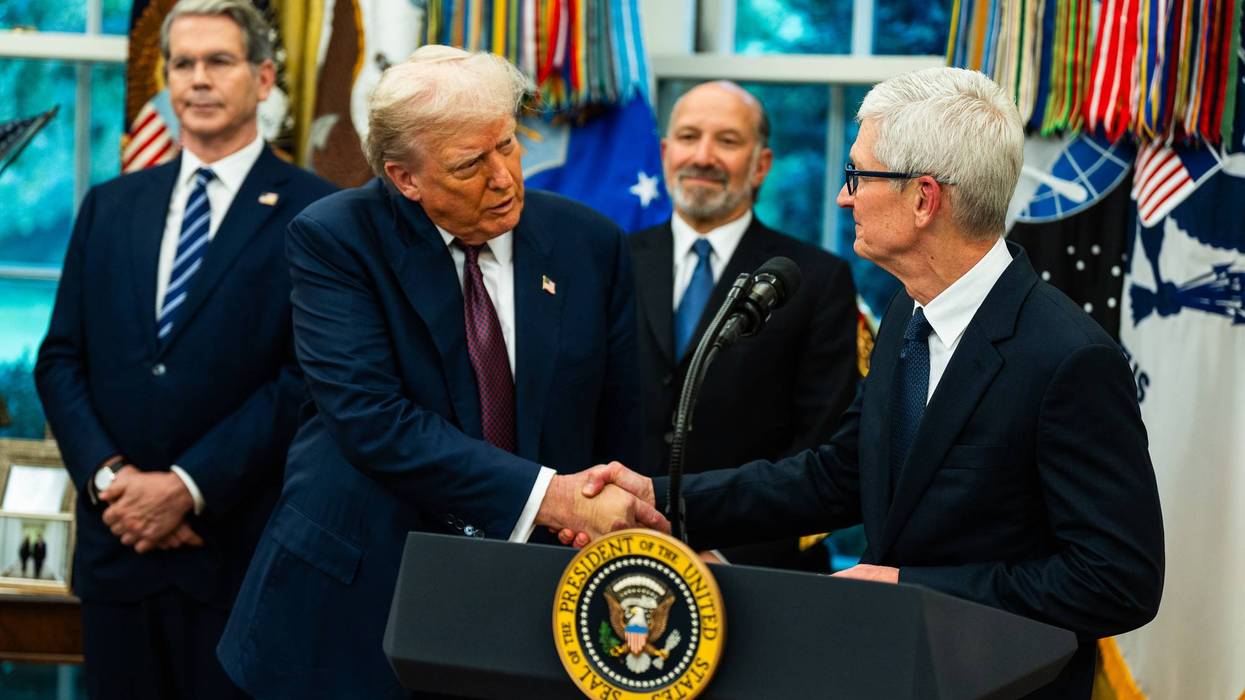
"I am trying to see how this operation differs from a classic organized crime protection racket. I see little distinction."
A Thursday report in The Wall Street Journal revealed new details on President Donald Trump's attempts to shake down major corporate donors to fund his assorted vanity projects, including the construction of his luxury White House ballroom and his presidential library.
According to the Journal, Trump employs a fundraiser named Meredith O’Rourke whose job is to hound corporations into sending money to the president's projects.
O'Rourke's work is so important to the president, the Journal added, that he asks her for updates on her progress in raking in corporate cash almost nightly.
"Trump asks O’Rourke which companies and donors have cut checks and which haven’t, and for how much," the Journal reported. "He often asks her to make much larger financial requests than she was planning—for some donors the ask is $5 million, for others it is $50 million. And the president gives her names to call, often including people who have recently met with him, according to people with knowledge of the calls."
The Journal estimated that Trump has raised more than $800 million from corporate donors throughout his second term, and the newspaper found that it appeared to be entirely legal.
"No laws prohibit presidents from raising unlimited sums of money for nonprofits, like the ones used for the ballroom and his presidential library, his super PAC, or political issue committees," the Journal explained. "For most of these types of transactions, public disclosure of donors isn’t required and reporting on spending is infrequent."
Regardless of technical legality, many critics called the president's actions deeply corrupt, especially since many of the companies being shaken down for cash have business before the federal government.
" Donald Trump is the most corrupt president in our nation’s history," wrote Sen. Elizabeth Warren (D-Mass.) in reaction to the Journal's report.
Adam Serwer, staff writer at The Atlantic, joked that Trump technically "can’t be bought" because "he is subscription based."
"You have to keep bribing him forever," Serwer quipped.
Eric Rauchway, historian at the University of California, Davis, noted the Journal's reporting that O'Rourke will sometimes try to persuade corporate donors by telling them that "the boss wants this money," which he likened to a mafia extortion scheme.
"Guys, 'the boss wants this money' is not 'fundraising,'" wrote Rauchway, "it's a Piranha Brothers operation."
Scott Horton, contributing editor at Harper's, made a similar analogy.
"I am trying to see how this operation differs from a classic organized crime protection racket," Horton wrote. "I see little distinction."
Amanda Carpenter, writer and editor at Protect Democracy, argued that Trump wasn't the only party meriting criticism here, as the corporations who give in to his demands deserve blame as well.
"If a politician is selling access and favors, CEOs aren’t off the hook," she observed. "They don’t get to just pay to play. It’s not a free pass to bribe and extort and corrupt our economy. There are many legal tools to track that on the private side and hold them account for their end of these dirty deals."
“Trump is without question the most corrupt president in American history,” said Senate Minority Leader Chuck Schumer.
A group of Democratic US senators on Monday issued a new report outlining the unprecedented self-enrichment being carried out by President Donald Trump during his second term in office.
The report, called "The Cost of Corruption: How Trump Turns Power into Profit at Americans' Expense," accuses the president and his family of turning "the power of the presidency into eye-popping profits," with Trump himself increasing his net worth by more than $2 billion since his return to the Oval Office last year.
The report highlights how Trump's two eldest sons have invested in numerous technology start-ups that have subsequently received lavish contracts from the US Department of Defense.
According to a report published by The Washington Post last week, the Trump sons' portfolio of tech firms has collectively generated "at least $3.2 billion in direct government business" and an "additional $3.1 billion in future contract options" since their initial investments.
The report also points to the massive windfall the Trump family has scored from World Liberty Financial, its cryptocurrency venture that is nearly half owned by a fund backed by the United Arab Emirates and that helped Trump pocket more than $1 billion in just a year.
While Trump and his family cash in, the report adds, the president and his administration have dismantled the Consumer Financial Protection Bureau, slashed spending on the Supplemental Nutritional Assistance Program, and given lavish tax cuts to the richest Americans.
Trump's acceptance of a $400 million luxury jet from the royal family of Qatar also gets a mention, and the report notes that the president is using at least $1 billion in taxpayer money to renovate the plane with security upgrades.
The report also cites a number of Trump "vanity projects," including his luxury White House ballroom and his French-style arch in Washington, DC, as wastes of money and resources.
“Trump is without question the most corrupt president in American history,” said Senate Minority Leader Chuck Schumer (D-NY) in announcing the report. “Trump has betrayed the American people by using our highest office not for the good of country, but to pad his own bank account, at the expense of working families."
The report is part of a broader initiative by Senate Democrats to hold the Trump White House accountable, which will include an anti-corruption working group composed of Schumer along with Sens. Sheldon Whitehouse (D-RI), Jeff Merkley (D-Ore.), Catherine Cortez Masto (D-Nev.), Alex Padilla (D-Calif,), and Andy Kim (D-NJ).
Merkley, in announcing his support for the initiative, said that "the Trump swamp of corruption is a mile deep and MEGA-wide."
"Trump and his family use his office and official connections to rake in billions for themselves at every turn," Merkley added. "Not only is this making life more expensive for hard-working Americans, it’s a threat to government 'by and for the people.'"
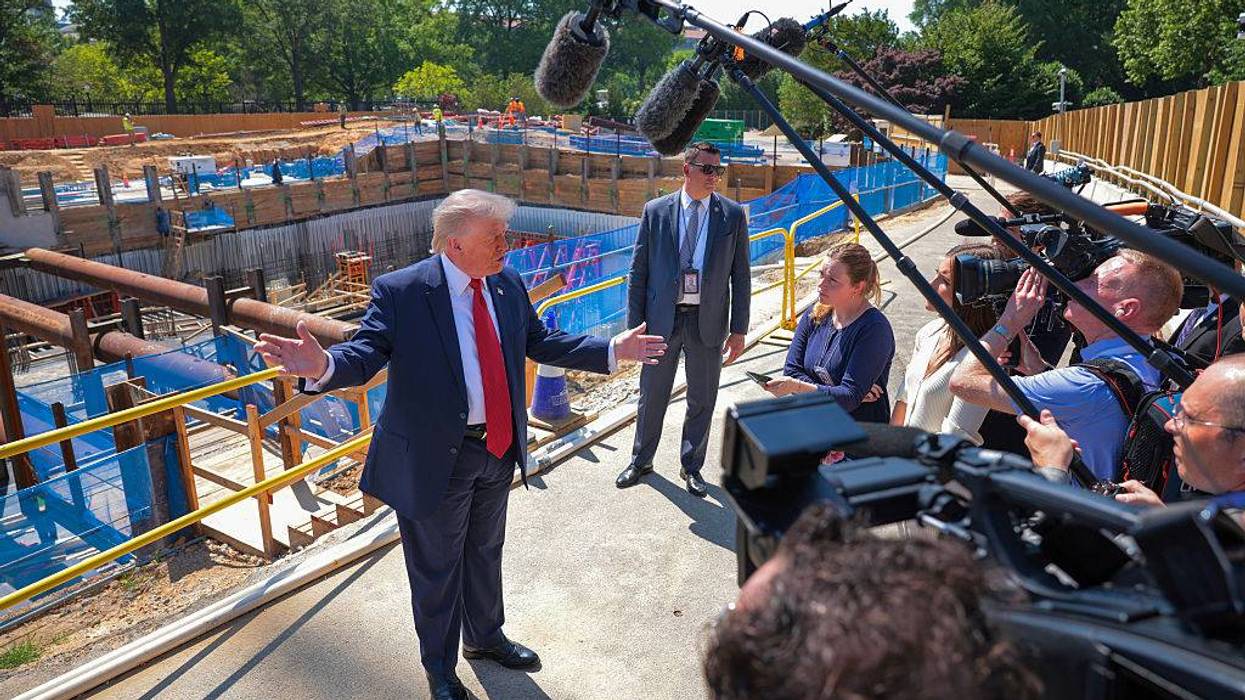
"While Republicans slash healthcare and other programs Americans depend on, President Trump is reportedly using hundreds of millions of taxpayer dollars for a White House ballroom," said US Rep. Raja Krishnamoorthi.
Democratic lawmakers are reacting with disgust amid new reporting on how the White House has been using sneaky budget maneuvering to get US taxpayers to fund President Donald Trump's luxury ballroom that was never approved by Congress.
According to a Thursday report in The Washington Post, the White House Office of Management and Budget (OMB) mysteriously shifted $352 million within the US Secret Service budget that had been earmarked for training and recruitment, but that will now be spent on White House security measures.
An insider familiar with the process told the Post that the redirected funds were related to the construction of the ballroom.
A White House spokesperson did not deny that the money was going toward the ballroom project, while insisting that "the East Wing Modernization Project is inextricably tied to the security of the president, the White House grounds, and the certain security infrastructure assets."
Sen. Jeff Merkley (D-Ore.), ranking member of the Senate Budget Committee, told the Post he was concerned that money "intended to pay Secret Service agents and ensure they have the technology and resources they need to keep individuals under their protection safe" is now being spent on the president's "vanity project."
In a Wednesday interview with NOTUS, Sen. Chris Coons (D-Del.) said it appears Trump "was just flat out lying when he said the taxpayers will not pay a dime for his ballroom," adding that it appears "he is now trying to find ways to funnel public money into it."
In a Thursday social media post, Rep. Raja Krishnamoorthi (D-Ill.) contrasted Trump's willingness to use taxpayer cash for his ballroom with cuts he and the GOP made to vital healthcare and food assistance programs.
"While Republicans slash healthcare and other programs Americans depend on," Krishnamoorthi wrote, "President Trump is reportedly using hundreds of millions of taxpayer dollars for a White House ballroom he claimed would be privately funded."
Rep. Jonathan Jackson (D-Ill.) similarly argued that while the GOP's 2025 budget law "kicked 4.3 million people off SNAP and 5 million people off [Affordable Care Act] health insurance coverage," the administration is now "dishonestly spending millions of dollars of YOUR money to fund a ballroom instead of helping struggling Americans put food on the table and receive essential medical care."
Rep. Jamie Raskin (D-Md.) linked the ballroom money to other Trump schemes to enrich himself through the presidency, including his acceptance of a luxury jet from the government of Qatar and his $1.8 billion slush fund for political allies.
"Now we learn that Trump’s bad architecture obsession is costing us all $600 million," Raskin wrote, in reference to earlier reporting on how the ballroom project has ballooned in costs from the White House's early estimates. "Turn your illegal Qatari jet over to the people and we’ll sell it for $400 million and we’ll take the rest out of other illegal emoluments and slush funds, including the $1.776 billion fund for insurrectionists, and the Board of Peace, another unauthorized Trump fund bankrolled by money misallocated from the State Department."