SUBSCRIBE TO OUR FREE NEWSLETTER
Daily news & progressive opinion—funded by the people, not the corporations—delivered straight to your inbox.
5
#000000
#FFFFFF
To donate by check, phone, or other method, see our More Ways to Give page.
Daily news & progressive opinion—funded by the people, not the corporations—delivered straight to your inbox.
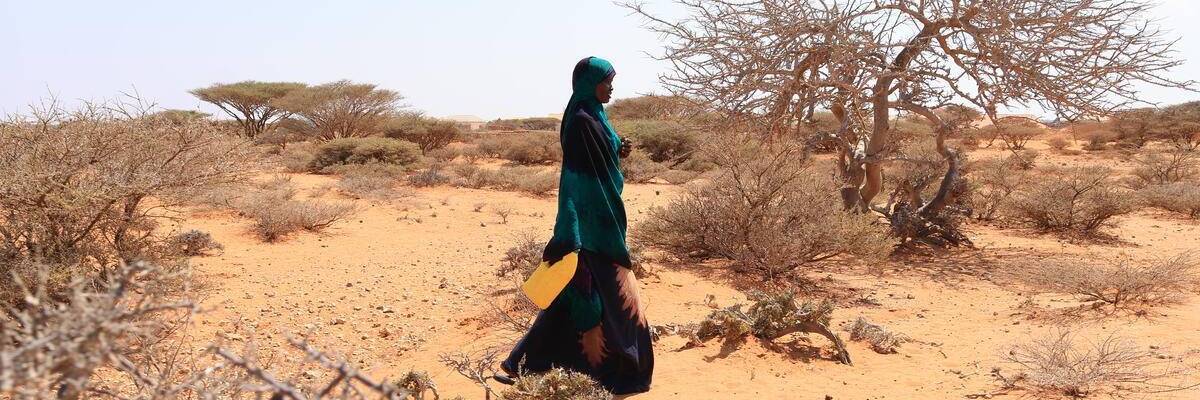
A woman walks in the Nugaal region of Somalia on February 11, 2026.
Countries in Central America and southern Africa are expected to be hardest hit by El Niño this year, according to the United Nations World Food Program.
The United Nations World Food Program on Wednesday warned that close to 50 million more people across the world are facing the prospect of acute hunger due to the El Niño climate pattern that has emerged this summer.
By the end of the year, the WFP projects that 49 million more people could be unable to meet their daily food needs thanks to El Niño, which features warmer than average temperatures in the Pacific Ocean and can cause an increase in extreme weather.
Countries in Central America and southern Africa are expected to be hardest hit by El Niño this year. According to WFP's analysis, southern African nations are "particularly exposed because many households depend on rain-fed subsistence agriculture," while nations in Latin America and the Caribbean "could see one of the sharpest rises in food insecurity, with more than 16 million people affected."
"El Niño is a massive threat to the food security of millions who are already vulnerable," said Carl Skau, acting executive director of the WFP. "The sooner we help families to prepare for these climate shocks, the greater our ability to save lives and protect livelihoods."
WFP said it's boosting its hunger prevention efforts in eight countries that are particularly at risk, noting that it has already "triggered anticipatory action plans in South Sudan, Chad, Mauritania, Uganda, Guatemala, and El Salvador, providing more than $14 million in lifesaving responses to support half a million people."
Celeste Saulo, secretary-general of the World Meteorological Organization (WMO), warned in June that El Niño "will exacerbate drought and heavy rainfall and increase the risk of heatwaves both on land and in the ocean."
While El Niño is a recurring phenomenon, a Wednesday report in The Guardian noted that "its impacts and strength are being strongly affected by the climate crisis," with meteorological experts saying it could lead to the hottest year on record in 2027.
Dear Common Dreams reader, It’s been nearly 30 years since I co-founded Common Dreams with my late wife, Lina Newhouser. We had the radical notion that journalism should serve the public good, not corporate profits. It was clear to us from the outset what it would take to build such a project. No paid advertisements. No corporate sponsors. No millionaire publisher telling us what to think or do. Many people said we wouldn't last a year, but we proved those doubters wrong. Together with a tremendous team of journalists and dedicated staff, we built an independent media outlet free from the constraints of profits and corporate control. Our mission has always been simple: To inform. To inspire. To ignite change for the common good. Building Common Dreams was not easy. Our survival was never guaranteed. When you take on the most powerful forces—Wall Street greed, fossil fuel industry destruction, Big Tech lobbyists, and uber-rich oligarchs who have spent billions upon billions rigging the economy and democracy in their favor—the only bulwark you have is supporters who believe in your work. But here’s the urgent message from me today. It's never been this bad out there. And it's never been this hard to keep us going. At the very moment Common Dreams is most needed, the threats we face are intensifying. We need your support now more than ever. We don't accept corporate advertising and never will. We don't have a paywall because we don't think people should be blocked from critical news based on their ability to pay. Everything we do is funded by the donations of readers like you. When everyone does the little they can afford, we are strong. But if that support retreats or dries up, so do we. Will you donate now to make sure Common Dreams not only survives but thrives? —Craig Brown, Co-founder |
The United Nations World Food Program on Wednesday warned that close to 50 million more people across the world are facing the prospect of acute hunger due to the El Niño climate pattern that has emerged this summer.
By the end of the year, the WFP projects that 49 million more people could be unable to meet their daily food needs thanks to El Niño, which features warmer than average temperatures in the Pacific Ocean and can cause an increase in extreme weather.
Countries in Central America and southern Africa are expected to be hardest hit by El Niño this year. According to WFP's analysis, southern African nations are "particularly exposed because many households depend on rain-fed subsistence agriculture," while nations in Latin America and the Caribbean "could see one of the sharpest rises in food insecurity, with more than 16 million people affected."
"El Niño is a massive threat to the food security of millions who are already vulnerable," said Carl Skau, acting executive director of the WFP. "The sooner we help families to prepare for these climate shocks, the greater our ability to save lives and protect livelihoods."
WFP said it's boosting its hunger prevention efforts in eight countries that are particularly at risk, noting that it has already "triggered anticipatory action plans in South Sudan, Chad, Mauritania, Uganda, Guatemala, and El Salvador, providing more than $14 million in lifesaving responses to support half a million people."
Celeste Saulo, secretary-general of the World Meteorological Organization (WMO), warned in June that El Niño "will exacerbate drought and heavy rainfall and increase the risk of heatwaves both on land and in the ocean."
While El Niño is a recurring phenomenon, a Wednesday report in The Guardian noted that "its impacts and strength are being strongly affected by the climate crisis," with meteorological experts saying it could lead to the hottest year on record in 2027.
The United Nations World Food Program on Wednesday warned that close to 50 million more people across the world are facing the prospect of acute hunger due to the El Niño climate pattern that has emerged this summer.
By the end of the year, the WFP projects that 49 million more people could be unable to meet their daily food needs thanks to El Niño, which features warmer than average temperatures in the Pacific Ocean and can cause an increase in extreme weather.
Countries in Central America and southern Africa are expected to be hardest hit by El Niño this year. According to WFP's analysis, southern African nations are "particularly exposed because many households depend on rain-fed subsistence agriculture," while nations in Latin America and the Caribbean "could see one of the sharpest rises in food insecurity, with more than 16 million people affected."
"El Niño is a massive threat to the food security of millions who are already vulnerable," said Carl Skau, acting executive director of the WFP. "The sooner we help families to prepare for these climate shocks, the greater our ability to save lives and protect livelihoods."
WFP said it's boosting its hunger prevention efforts in eight countries that are particularly at risk, noting that it has already "triggered anticipatory action plans in South Sudan, Chad, Mauritania, Uganda, Guatemala, and El Salvador, providing more than $14 million in lifesaving responses to support half a million people."
Celeste Saulo, secretary-general of the World Meteorological Organization (WMO), warned in June that El Niño "will exacerbate drought and heavy rainfall and increase the risk of heatwaves both on land and in the ocean."
While El Niño is a recurring phenomenon, a Wednesday report in The Guardian noted that "its impacts and strength are being strongly affected by the climate crisis," with meteorological experts saying it could lead to the hottest year on record in 2027.