SUBSCRIBE TO OUR FREE NEWSLETTER
Daily news & progressive opinion—funded by the people, not the corporations—delivered straight to your inbox.
5
#000000
#FFFFFF
To donate by check, phone, or other method, see our More Ways to Give page.
Daily news & progressive opinion—funded by the people, not the corporations—delivered straight to your inbox.
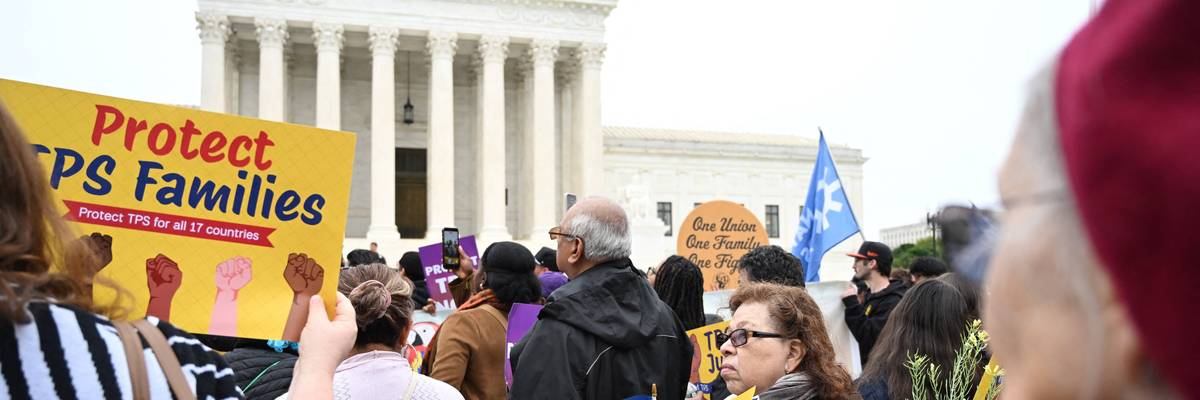
Members of the National TPS Alliance rally at the US Supreme Court in Washington, DC, on April 29, 2026.
"Hundreds of thousands of people who hold legal status... now face losing their ability to work and being torn from their families and homes."
The US Supreme Court on Thursday cleared the way for the Trump administration to deport hundreds of thousands of Haitian and Syrian residents from the US after stripping them of their Temporary Protected Status last year.
In a 6-3 decision, the high court's conservative majority ruled that the Department of Homeland Security was able to strip status from 350,000 Haitians and 6,000 Syrians—including many who'd lived in the US for years—after they'd been given protection because DHS deemed their home countries unsafe to return to.
"Hundreds of thousands of people who hold legal status, who registered with the government, passed background checks, and paid fees to do so, now face losing their ability to work and being torn from their families and homes," explained Todd Schulte, the president of the immigration and criminal justice reform advocacy group Fwd.US.
A federal judge temporarily delayed the administration’s TPS terminations in February, blocking what advocates feared would be a flood of immigration agents to areas with many TPS recipients. The judge said DHS had not followed the legally required steps to determine whether Haiti and Syria were safe enough for people with temporary status to return.
The State Department currently advises Americans not to visit either country for any reason, as Haiti is in the midst of a brutal gang war that has displaced more than 1.4 million people, and Syria has been in an ongoing state of unrest since the civil war began in 2011.
Echoing the lower court, Supreme Court Justice Elena Kagan pointed out in her dissenting opinion that the only consultation within DHS on the conditions in these countries took place in a brief email exchange between a DHS aide and a State Department official, who said that there were no "foreign policy concerns" with terminating their status, but provided no evidence to declare that the two countries were safe.
The justice likewise noted that the stripping of status for Haitians was likely arbitrary and unconstitutional, based in part on "racial animus." She noted that President Donald Trump has made many statements about Haitians "so repellent and racially inflected that the majority declines to put them in print."
Kagan listed several of them, including Trump's nonsensical rant that Haitians were "eating the pets" of residents in Springfield, Ohio; his claim that Haitians living in the US “probably have AIDS"; and his description of Haiti as a "shithole country." She also noted his comments about immigrants more broadly, including that they are "poisoning the blood" of the nation.
"The statements fairly shout, in their racial undertones and overtones alike, that race entered into the president’s resolve to remove Haitians from this country," Kagan wrote.
In the majority opinion, Justice Samuel Alito sidestepped the question of whether DHS has properly considered the conditions in Haiti and Syria, stating that the TPS statute allows "no judicial review of any determination... with respect to the... termination” of a designation. He said that meant the court could not review either the final decision to terminate status or any of the individual decisions leading up to it.
He did acknowledge the question of racial animus and admitted that things Trump has said "would have scandalized the public just a short time ago." But, he said that “none of the cited statements" from Trump were "overtly racial, and in substance all expressed policy views that could rest on race-neutral justifications.”
The Trump administration has declined to renew TPS for all 13 countries for which it has come up for renewal during his second term. Alito said that since the administration has declined to renew TPS for every country, not just Haiti, the evidence was "insufficient to show that the termination of Haiti’s TPS designation was based on the race of the Haitian people.”
Thursday's ruling was yet another validation of Trump's efforts to end TPS by the Supreme Court, which last year ruled that he could similarly strip status from around 350,000 Venezuelan nationals.
But advocates have pointed out that the administration's case this time was substantially weaker.
Aaron Reichlin-Melnick, a senior fellow at the American Immigration Council, said it was "very important for people to understand that the Trump administration did not win a decision today saying that they had lawfully ended TPS."
"Instead," he said, "what the Supreme Court held was that even if the Trump administration had openly ignored the law in making TPS decisions, courts cannot stop them."
Nicolette Glazer, a California-based immigration attorney, said the court had basically determined that "a DHS secretary can end TPS at whim and neither statutory nor constitutional theory applies to curb administrative xenophobia."
"Make no mistake about what this is," said Amina Barhumi, the executive director of the Muslim Civic Coalition. "Temporary Protected Status exists because it is not safe to send people back to war and disaster. This decision does not change those dangers—it simply turns its back on the people fleeing them."
Schulte said it was a "heartbreaking, terrible decision that defies common sense." He added that "the administration simply broke the law in the way it terminated TPS." Now, he said, the lives of "hundreds of thousands of people who have lived here for decades... are in chaos."
While the Trump administration has often portrayed immigrants and refugees as parasites, Schulte argued that the "economic damage" of the decision would be felt far beyond the families facing deportation.
"Haitian TPS holders contribute nearly $6 billion to the US economy each year, and 200,000 of them work in industries already facing labor shortages, including healthcare, agriculture, and manufacturing," he said. "An estimated 25,000 US citizen children of Haitian TPS holders will be pushed into poverty when their parents lose work authorization. Employers will lose trained, dedicated workers they cannot easily replace. The real-life impact of this ruling is profound, cruel, and heartbreaking."
Some members of Congress pledged to take action to defend TPS recipients in light of the decision.
Rep. Sylvia Garcia (D-Texas) called on Congress to pass the American Dream and Promise Act, which would create pathways to permanent legal status for TPS holders, as well as holders of the similar Deferred Enforced Departure (DED), and those who were brought to the US unauthorized as children and received protection under the Deferred Action for Childhood Arrivals (DACA) program.
"TPS holders followed the rules. They registered with the government, passed background checks, renewed their status, worked legally, paid taxes, and raised their families here," Garcia said. "Their reward should not be a deportation notice."
Sen. Ed Markey (D-Mass.), who spoke outside the court on Thursday, said the ruling showed that "the far-right MAGA majority on the court cannot stand." He said, "We need to win back the House and the Senate and expand the court."
"This is not over," Markey added. "It is our responsibility to protect TPS holders and provide this vulnerable group with a pathway to permanent citizenship. I will not stop fighting."
Even Rep. Mike Lawler (R-NY), a strong supporter of Trump, said that while he "never disputed the ability" of Trump to end TPS, he "strongly disagree[d] with ending Haitian TPS at this time," saying that "the situation on the ground in Haiti is a humanitarian and political disaster and continues to warrant an extension."
Lawler noted that "roughly 1/3" of Haitian TPS holders "work in our healthcare system" and said "shutting off TPS will create a crisis" in hospitals, nursing homes, and for people with disabilities.
"I’m asking the administration to allow for an orderly process by which Haitian TPS holders can maintain their work authorization while their immigration cases are adjudicated over the next six months," he said, adding that the Senate should consider his legislation with Rep. Laura Gillen (D-NY) to temporarily extend TPS protections.
He said the administration needed to "allow for a stable government to be established with a free and fair election, creating the conditions for a safe return for Haitians."
Rep. Analilia Mejia (D-NJ), a member of the House Homeland Security Committee and Border Security and Enforcement Subcommittee, said the TPS ruling, and another ruling on Thursday allowing the administration to turn back asylum seekers at legal points of entry, "should alarm every American."
"The 14th Amendment promises due process and equal protection under the law. Those rights do not disappear because a president decides an entire community has become politically convenient to target," she said. "When the government can deny one group a hearing or strip away protections they have relied on for years, it is not just immigrants who lose. It sends a dangerous message that constitutional rights can be discarded whenever those in power find it politically useful."
Dear Common Dreams reader, It’s been nearly 30 years since I co-founded Common Dreams with my late wife, Lina Newhouser. We had the radical notion that journalism should serve the public good, not corporate profits. It was clear to us from the outset what it would take to build such a project. No paid advertisements. No corporate sponsors. No millionaire publisher telling us what to think or do. Many people said we wouldn't last a year, but we proved those doubters wrong. Together with a tremendous team of journalists and dedicated staff, we built an independent media outlet free from the constraints of profits and corporate control. Our mission has always been simple: To inform. To inspire. To ignite change for the common good. Building Common Dreams was not easy. Our survival was never guaranteed. When you take on the most powerful forces—Wall Street greed, fossil fuel industry destruction, Big Tech lobbyists, and uber-rich oligarchs who have spent billions upon billions rigging the economy and democracy in their favor—the only bulwark you have is supporters who believe in your work. But here’s the urgent message from me today. It's never been this bad out there. And it's never been this hard to keep us going. At the very moment Common Dreams is most needed, the threats we face are intensifying. We need your support now more than ever. We don't accept corporate advertising and never will. We don't have a paywall because we don't think people should be blocked from critical news based on their ability to pay. Everything we do is funded by the donations of readers like you. When everyone does the little they can afford, we are strong. But if that support retreats or dries up, so do we. Will you donate now to make sure Common Dreams not only survives but thrives? —Craig Brown, Co-founder |
The US Supreme Court on Thursday cleared the way for the Trump administration to deport hundreds of thousands of Haitian and Syrian residents from the US after stripping them of their Temporary Protected Status last year.
In a 6-3 decision, the high court's conservative majority ruled that the Department of Homeland Security was able to strip status from 350,000 Haitians and 6,000 Syrians—including many who'd lived in the US for years—after they'd been given protection because DHS deemed their home countries unsafe to return to.
"Hundreds of thousands of people who hold legal status, who registered with the government, passed background checks, and paid fees to do so, now face losing their ability to work and being torn from their families and homes," explained Todd Schulte, the president of the immigration and criminal justice reform advocacy group Fwd.US.
A federal judge temporarily delayed the administration’s TPS terminations in February, blocking what advocates feared would be a flood of immigration agents to areas with many TPS recipients. The judge said DHS had not followed the legally required steps to determine whether Haiti and Syria were safe enough for people with temporary status to return.
The State Department currently advises Americans not to visit either country for any reason, as Haiti is in the midst of a brutal gang war that has displaced more than 1.4 million people, and Syria has been in an ongoing state of unrest since the civil war began in 2011.
Echoing the lower court, Supreme Court Justice Elena Kagan pointed out in her dissenting opinion that the only consultation within DHS on the conditions in these countries took place in a brief email exchange between a DHS aide and a State Department official, who said that there were no "foreign policy concerns" with terminating their status, but provided no evidence to declare that the two countries were safe.
The justice likewise noted that the stripping of status for Haitians was likely arbitrary and unconstitutional, based in part on "racial animus." She noted that President Donald Trump has made many statements about Haitians "so repellent and racially inflected that the majority declines to put them in print."
Kagan listed several of them, including Trump's nonsensical rant that Haitians were "eating the pets" of residents in Springfield, Ohio; his claim that Haitians living in the US “probably have AIDS"; and his description of Haiti as a "shithole country." She also noted his comments about immigrants more broadly, including that they are "poisoning the blood" of the nation.
"The statements fairly shout, in their racial undertones and overtones alike, that race entered into the president’s resolve to remove Haitians from this country," Kagan wrote.
In the majority opinion, Justice Samuel Alito sidestepped the question of whether DHS has properly considered the conditions in Haiti and Syria, stating that the TPS statute allows "no judicial review of any determination... with respect to the... termination” of a designation. He said that meant the court could not review either the final decision to terminate status or any of the individual decisions leading up to it.
He did acknowledge the question of racial animus and admitted that things Trump has said "would have scandalized the public just a short time ago." But, he said that “none of the cited statements" from Trump were "overtly racial, and in substance all expressed policy views that could rest on race-neutral justifications.”
The Trump administration has declined to renew TPS for all 13 countries for which it has come up for renewal during his second term. Alito said that since the administration has declined to renew TPS for every country, not just Haiti, the evidence was "insufficient to show that the termination of Haiti’s TPS designation was based on the race of the Haitian people.”
Thursday's ruling was yet another validation of Trump's efforts to end TPS by the Supreme Court, which last year ruled that he could similarly strip status from around 350,000 Venezuelan nationals.
But advocates have pointed out that the administration's case this time was substantially weaker.
Aaron Reichlin-Melnick, a senior fellow at the American Immigration Council, said it was "very important for people to understand that the Trump administration did not win a decision today saying that they had lawfully ended TPS."
"Instead," he said, "what the Supreme Court held was that even if the Trump administration had openly ignored the law in making TPS decisions, courts cannot stop them."
Nicolette Glazer, a California-based immigration attorney, said the court had basically determined that "a DHS secretary can end TPS at whim and neither statutory nor constitutional theory applies to curb administrative xenophobia."
"Make no mistake about what this is," said Amina Barhumi, the executive director of the Muslim Civic Coalition. "Temporary Protected Status exists because it is not safe to send people back to war and disaster. This decision does not change those dangers—it simply turns its back on the people fleeing them."
Schulte said it was a "heartbreaking, terrible decision that defies common sense." He added that "the administration simply broke the law in the way it terminated TPS." Now, he said, the lives of "hundreds of thousands of people who have lived here for decades... are in chaos."
While the Trump administration has often portrayed immigrants and refugees as parasites, Schulte argued that the "economic damage" of the decision would be felt far beyond the families facing deportation.
"Haitian TPS holders contribute nearly $6 billion to the US economy each year, and 200,000 of them work in industries already facing labor shortages, including healthcare, agriculture, and manufacturing," he said. "An estimated 25,000 US citizen children of Haitian TPS holders will be pushed into poverty when their parents lose work authorization. Employers will lose trained, dedicated workers they cannot easily replace. The real-life impact of this ruling is profound, cruel, and heartbreaking."
Some members of Congress pledged to take action to defend TPS recipients in light of the decision.
Rep. Sylvia Garcia (D-Texas) called on Congress to pass the American Dream and Promise Act, which would create pathways to permanent legal status for TPS holders, as well as holders of the similar Deferred Enforced Departure (DED), and those who were brought to the US unauthorized as children and received protection under the Deferred Action for Childhood Arrivals (DACA) program.
"TPS holders followed the rules. They registered with the government, passed background checks, renewed their status, worked legally, paid taxes, and raised their families here," Garcia said. "Their reward should not be a deportation notice."
Sen. Ed Markey (D-Mass.), who spoke outside the court on Thursday, said the ruling showed that "the far-right MAGA majority on the court cannot stand." He said, "We need to win back the House and the Senate and expand the court."
"This is not over," Markey added. "It is our responsibility to protect TPS holders and provide this vulnerable group with a pathway to permanent citizenship. I will not stop fighting."
Even Rep. Mike Lawler (R-NY), a strong supporter of Trump, said that while he "never disputed the ability" of Trump to end TPS, he "strongly disagree[d] with ending Haitian TPS at this time," saying that "the situation on the ground in Haiti is a humanitarian and political disaster and continues to warrant an extension."
Lawler noted that "roughly 1/3" of Haitian TPS holders "work in our healthcare system" and said "shutting off TPS will create a crisis" in hospitals, nursing homes, and for people with disabilities.
"I’m asking the administration to allow for an orderly process by which Haitian TPS holders can maintain their work authorization while their immigration cases are adjudicated over the next six months," he said, adding that the Senate should consider his legislation with Rep. Laura Gillen (D-NY) to temporarily extend TPS protections.
He said the administration needed to "allow for a stable government to be established with a free and fair election, creating the conditions for a safe return for Haitians."
Rep. Analilia Mejia (D-NJ), a member of the House Homeland Security Committee and Border Security and Enforcement Subcommittee, said the TPS ruling, and another ruling on Thursday allowing the administration to turn back asylum seekers at legal points of entry, "should alarm every American."
"The 14th Amendment promises due process and equal protection under the law. Those rights do not disappear because a president decides an entire community has become politically convenient to target," she said. "When the government can deny one group a hearing or strip away protections they have relied on for years, it is not just immigrants who lose. It sends a dangerous message that constitutional rights can be discarded whenever those in power find it politically useful."
The US Supreme Court on Thursday cleared the way for the Trump administration to deport hundreds of thousands of Haitian and Syrian residents from the US after stripping them of their Temporary Protected Status last year.
In a 6-3 decision, the high court's conservative majority ruled that the Department of Homeland Security was able to strip status from 350,000 Haitians and 6,000 Syrians—including many who'd lived in the US for years—after they'd been given protection because DHS deemed their home countries unsafe to return to.
"Hundreds of thousands of people who hold legal status, who registered with the government, passed background checks, and paid fees to do so, now face losing their ability to work and being torn from their families and homes," explained Todd Schulte, the president of the immigration and criminal justice reform advocacy group Fwd.US.
A federal judge temporarily delayed the administration’s TPS terminations in February, blocking what advocates feared would be a flood of immigration agents to areas with many TPS recipients. The judge said DHS had not followed the legally required steps to determine whether Haiti and Syria were safe enough for people with temporary status to return.
The State Department currently advises Americans not to visit either country for any reason, as Haiti is in the midst of a brutal gang war that has displaced more than 1.4 million people, and Syria has been in an ongoing state of unrest since the civil war began in 2011.
Echoing the lower court, Supreme Court Justice Elena Kagan pointed out in her dissenting opinion that the only consultation within DHS on the conditions in these countries took place in a brief email exchange between a DHS aide and a State Department official, who said that there were no "foreign policy concerns" with terminating their status, but provided no evidence to declare that the two countries were safe.
The justice likewise noted that the stripping of status for Haitians was likely arbitrary and unconstitutional, based in part on "racial animus." She noted that President Donald Trump has made many statements about Haitians "so repellent and racially inflected that the majority declines to put them in print."
Kagan listed several of them, including Trump's nonsensical rant that Haitians were "eating the pets" of residents in Springfield, Ohio; his claim that Haitians living in the US “probably have AIDS"; and his description of Haiti as a "shithole country." She also noted his comments about immigrants more broadly, including that they are "poisoning the blood" of the nation.
"The statements fairly shout, in their racial undertones and overtones alike, that race entered into the president’s resolve to remove Haitians from this country," Kagan wrote.
In the majority opinion, Justice Samuel Alito sidestepped the question of whether DHS has properly considered the conditions in Haiti and Syria, stating that the TPS statute allows "no judicial review of any determination... with respect to the... termination” of a designation. He said that meant the court could not review either the final decision to terminate status or any of the individual decisions leading up to it.
He did acknowledge the question of racial animus and admitted that things Trump has said "would have scandalized the public just a short time ago." But, he said that “none of the cited statements" from Trump were "overtly racial, and in substance all expressed policy views that could rest on race-neutral justifications.”
The Trump administration has declined to renew TPS for all 13 countries for which it has come up for renewal during his second term. Alito said that since the administration has declined to renew TPS for every country, not just Haiti, the evidence was "insufficient to show that the termination of Haiti’s TPS designation was based on the race of the Haitian people.”
Thursday's ruling was yet another validation of Trump's efforts to end TPS by the Supreme Court, which last year ruled that he could similarly strip status from around 350,000 Venezuelan nationals.
But advocates have pointed out that the administration's case this time was substantially weaker.
Aaron Reichlin-Melnick, a senior fellow at the American Immigration Council, said it was "very important for people to understand that the Trump administration did not win a decision today saying that they had lawfully ended TPS."
"Instead," he said, "what the Supreme Court held was that even if the Trump administration had openly ignored the law in making TPS decisions, courts cannot stop them."
Nicolette Glazer, a California-based immigration attorney, said the court had basically determined that "a DHS secretary can end TPS at whim and neither statutory nor constitutional theory applies to curb administrative xenophobia."
"Make no mistake about what this is," said Amina Barhumi, the executive director of the Muslim Civic Coalition. "Temporary Protected Status exists because it is not safe to send people back to war and disaster. This decision does not change those dangers—it simply turns its back on the people fleeing them."
Schulte said it was a "heartbreaking, terrible decision that defies common sense." He added that "the administration simply broke the law in the way it terminated TPS." Now, he said, the lives of "hundreds of thousands of people who have lived here for decades... are in chaos."
While the Trump administration has often portrayed immigrants and refugees as parasites, Schulte argued that the "economic damage" of the decision would be felt far beyond the families facing deportation.
"Haitian TPS holders contribute nearly $6 billion to the US economy each year, and 200,000 of them work in industries already facing labor shortages, including healthcare, agriculture, and manufacturing," he said. "An estimated 25,000 US citizen children of Haitian TPS holders will be pushed into poverty when their parents lose work authorization. Employers will lose trained, dedicated workers they cannot easily replace. The real-life impact of this ruling is profound, cruel, and heartbreaking."
Some members of Congress pledged to take action to defend TPS recipients in light of the decision.
Rep. Sylvia Garcia (D-Texas) called on Congress to pass the American Dream and Promise Act, which would create pathways to permanent legal status for TPS holders, as well as holders of the similar Deferred Enforced Departure (DED), and those who were brought to the US unauthorized as children and received protection under the Deferred Action for Childhood Arrivals (DACA) program.
"TPS holders followed the rules. They registered with the government, passed background checks, renewed their status, worked legally, paid taxes, and raised their families here," Garcia said. "Their reward should not be a deportation notice."
Sen. Ed Markey (D-Mass.), who spoke outside the court on Thursday, said the ruling showed that "the far-right MAGA majority on the court cannot stand." He said, "We need to win back the House and the Senate and expand the court."
"This is not over," Markey added. "It is our responsibility to protect TPS holders and provide this vulnerable group with a pathway to permanent citizenship. I will not stop fighting."
Even Rep. Mike Lawler (R-NY), a strong supporter of Trump, said that while he "never disputed the ability" of Trump to end TPS, he "strongly disagree[d] with ending Haitian TPS at this time," saying that "the situation on the ground in Haiti is a humanitarian and political disaster and continues to warrant an extension."
Lawler noted that "roughly 1/3" of Haitian TPS holders "work in our healthcare system" and said "shutting off TPS will create a crisis" in hospitals, nursing homes, and for people with disabilities.
"I’m asking the administration to allow for an orderly process by which Haitian TPS holders can maintain their work authorization while their immigration cases are adjudicated over the next six months," he said, adding that the Senate should consider his legislation with Rep. Laura Gillen (D-NY) to temporarily extend TPS protections.
He said the administration needed to "allow for a stable government to be established with a free and fair election, creating the conditions for a safe return for Haitians."
Rep. Analilia Mejia (D-NJ), a member of the House Homeland Security Committee and Border Security and Enforcement Subcommittee, said the TPS ruling, and another ruling on Thursday allowing the administration to turn back asylum seekers at legal points of entry, "should alarm every American."
"The 14th Amendment promises due process and equal protection under the law. Those rights do not disappear because a president decides an entire community has become politically convenient to target," she said. "When the government can deny one group a hearing or strip away protections they have relied on for years, it is not just immigrants who lose. It sends a dangerous message that constitutional rights can be discarded whenever those in power find it politically useful."