



SUBSCRIBE TO OUR FREE NEWSLETTER

SUBSCRIBE TO OUR FREE NEWSLETTER

Daily news & progressive opinion—funded by the people, not the corporations—delivered straight to your inbox.

* indicates required
5
#000000
#FFFFFF
Opinion
Climate
Economy
Politics
Rights & Justice
War & Peace
Active duty Air Force Major Jason Watson commits civil disobedience at the Capitol
Further

Who Do You Serve

Declaring, "I believe in America, I believe in us," an active duty Air Force major was arrested Wednesday for a non-violent act of civil disobedience after he publicly called for Trump to be impeached, removed and convicted for his scores of impeachable offenses. Citing the "foundational oath" he took to defend the country "against all enemies foreign and domestic" - most vitally a lawless president - Major Jason Watson insisted, finally, "The bill must come due."

Watson's action came after a press conference with advocacy groups including About Face Veterans, Defenders of Our Republic, Removal Coalition, its newly launched Remove the Regime, and Free Speech For People, which has gathered over a million signatures urging Congress to initiate impeachment proceedings against Trump for his hundreds of crimes. Also present was Rep. Al Green, the only member of Congress to have filed impeachment articles. Declaring this "an existential moment for our nation," Free Speech president John Bonifaz praised Major Watson for "the kind of courage our democracy demands (in) stark contrast to those who continue to look away as President Trump commits unprecedented abuses of power."

Watson introduced himself by citing his 17-year career in the military before swiftly adding, "Who I am is immaterial. In the grand scheme of things I'm a nobody. What's more important is what I have to say, and the price I'm willing to pay to say it" - which is substantial. Thanking allies "working to restore responsible governance to our country," he repeated the "foundational" oath he first swore over 20 years ago, and has since repeated "many times since," to "support and defend the Constitution of the United States," which "binds us all together as Americans." We have all "played a part in getting us into this mess," he added, but undeniably "the burden of culpability" falls most heavily on the executive branch, "and the bill must come due."

Matter-of-factly, he offered a hefty list of high crimes and misdemeanors: The "unconstitutional usurpation of Congress’ authority" with military action against foreign countries, absent the requisite emergency scenario, in Venezuela, Cuba, Iran; the granting of power to an unelected person to shut down large swaths of the government; the detaining and sending of residents without due process to a foreign country; the abuse and murder of those exercising their First Amendment rights, etc etc. After each, he added, "For this, the president and vice-president must be impeached convicted, and removed." He was there not as a Democrat - "I am not a Democrat" - but to call on Americans to peacefully "join me in the defense of our republic."

Video of his speech then briefly cuts out; when it returns, he is walking slowly, deliberately, toward the Capitol steps, an area that is open to the public but where protest is prohibited. Several Capitol Police stand to the side, nervously watching. In somber, lonesome silence, he climbs the stairs; mid-way, he stops and holds up a sign that reads, "Impeach. Convict. Remove." The watching crowd cheers. After a brief huddle, a couple of officers arrest him. As he is led away, his hands cuffed behind him, his dignity intact, the crowd breaks into chants of "Shame!" and, "Who do you serve? Who do you protect?" Excellent questions. We, and many weary, grieving, enraged Americans, salute him and his good trouble.

SEE ALL
A tourist uses a hand fan to cool herself
News

Scientists: Fossil Fuel-Driven Climate Crisis 'Directly Responsible' for Deadly European Heatwave

With at least hundreds of people dead and high temperatures persisting, scientists said Friday that the "record-shattering" heatwave devastating Europe was "virtually impossible just 50 years ago"—and climate change driven by fossil fuel emissions "is unequivocally to blame."

World Weather Attribution (WWA), an international scientific collaboration that analyzes extreme weather events, said daytime highs and overnight temperatures that have been scorching several European countries likely could not have occurred in 1976, and a similar heatwave in that historic climate would be 6.3°F cooler.

The findings followed a Monday analysis from ClimaMeter showing that weather patterns similar to those driving the current European heatwave now produce temperatures roughly 3.6-7.2°F warmer, depending on location, than they did during the second half of the 20th century, because of greenhouse gas emissions.

"The sweltering overnight temperatures keeping many people awake this week are about 100x more likely today than they were just 23 years ago during the infamous 2003 European heatwave," WWA said Friday. "The daytime peaks are about 10x more likely."

WWA found that a "staggering" 45% of 854 cities across 30 European countries have broken, or are expected to break, their records for wet-bulb globe temperatures—which incorporate temperature, humidity, wind speed, and sunlight to measure the risk to humans.

"The science of how climate change is worsening heatwaves is settled. Continued fossil fuel emissions are directly responsible for the disruption people are experiencing this week in their homes, schools, and workplaces," said Theodore Keeping, a co-author of the WWA study who researches extreme weather and wildfire at the United Kingdom's Imperial College London (ICL).

"The speed of change is startling," Keeping continued. "Every few years, we are seeing heat records shattered in Europe. This year, it has been in consecutive months. In the UK, we are used to 'snow days' shutting down schools, but this generation is now growing up with 'heat days' as well."

While the "heat dome" responsible for Europe's second heatwave in two months "was moving east on Friday, bringing marginal relief to some areas in the west and threatening parts of Central and Eastern Europe with a scorching weekend," according to The New York Times, the 97.5°F recorded in southwest England was Britain's highest temperature ever for June, breaking a record set the previous day.

A record-breaking heat wave that’s spreading eastward across Europe has revived interest in a hypothetical temperature forecast for August 2050 in France.But it turns out, it didn’t take 36 years for those imagined temperatures to be reached — and even exceeded.

[image or embed]
— The Washington Post (@washingtonpost.com) June 25, 2026 at 12:30 PM

France also faced more intense heat on Friday, with a 103.3°F reading in Paris. The Washington Post pointed out that two days earlier, as parts of the country endured 112.3°F, soaring temperatures exceeded hypothetical forecasts for August 2050 in 19 of 34 locations across the French mainland.

The current conditions have proven deadly. As Reuters reported:

At least 48 people have died in France from drowning since the start of the heatwave while trying to cool off, authorities said, and three young children are known to have been killed by heat in cars in two separate incidents.

Since the end of last week, more than 20 people across Germany have died in swimming-related accidents, the German Life Saving Association said in a statement to Reuters.

Spain's Mortality Monitoring System estimated that the recent heat has resulted in at least 212 deaths, mostly among people ages 65 and older. Diana Gómez, a scientist at the agency, noted that the figures are preliminary and based on statistical projections.

Acknowledging that "many people still live, work, and study in places that are not designed for the temperatures we are now experiencing," Carolina Pereira Marghidan of the Red Cross Red Crescent Climate Center said to "follow local heat advice, seek cooler spaces where possible, drink plenty of water, and check on family, friends, and neighbors who may be most at risk."

Pereira Marghidan also highlighted the "growing gap between the pace of climate change and the pace of adaptation," and called for "greater investment in heat-resilient homes, cities, and infrastructure to keep people safe."

Right now, record-breaking, dangerous heat waves are rolling across Europe. This isn't just "summer weather". This is exactly what the climate crisis looks like 🥵
Greenpeace International 🌍 (@greenpeace.org) June 24, 2026 at 7:57 AM

Speaking at London Climate Action Week on Wednesday, United Nations Secretary-General António Guterres similarly said that "climate adaptation is no longer about preparing for a distant future. It's about managing risks in real time—as the searing heat now gripping London and far beyond makes unmistakably clear."

"Our climate is changing faster than our systems, our infrastructure, and our institutions can handle. The World Meteorological Organization confirms that the past 11 years have been the hottest on record. Scientists now expect the world to exceed 1.5°C in the coming years," he continued, citing the Paris Agreement's goal to limit temperature rise this century. "We're entering a new era of climate risk."

The heat has sparked calls to tackle the root cause of the rising temperatures—fossil fuel emissions—from Guterres and others. UN Climate Change Executive Secretary Simon Stiell said Thursday that "Europe's savage heatwave has the fingerprints of the climate crisis all over it—it's the latest price to pay for fossil fuel pollution baking our planet."

"Schools closing, the vulnerable dying, economies sweating: This is what the climate crisis looks like in practice, and it's just getting started," he emphasized. "Until humanity stops burning colossal amounts of coal, oil, and gas, extreme heat will keep getting worse, and other climate impacts—from megadroughts, floods, wildfires, and storms—will keep hammering every economy and population harder each year."

David Ho, a University of Hawaii at Mānoa professor, said on social media: "The heatwave in western Europe is the most severe and widespread ever, with almost half of Europe's largest cities experiencing their worst ever heat stress, a combination of high temperatures and humidity. Unless we stop burning fossil fuels, future heat conditions will become even more extreme."

I spoke with Geeta GuruMurthy of BBC World News Television about the record European heat wave and it's link to human-caused warming:youtu.be/d8vqO2J8WV0

[image or embed]
— Michael E. Mann (@michaelemann.bsky.social) June 25, 2026 at 2:17 PM

Although some natural phenomena can contribute to high temperatures, and the National Oceanic and Atmospheric Administration announced earlier this month that El Niño, the warm phase of a recurring climate pattern in the Pacific Ocean, had formed, WWA found that it "had no role in driving the heat" in Europe.

"Scientists like me are beginning to sound like a broken record. We put out similar quotes year after year, reacting to heat extremes that climb ever higher. Yes this is climate change, yes it's us, no it's not El Niño, yes we have the solutions, no we're not implementing them fast enough," said study co-author and ICL climate science professor Friederike Otto. "It's really now a question of what kind of future we want for ourselves, and whether we're willing to do what it takes to secure it."

On the heels of a French court's ruling against TotalEnergies, Lisa Rose, a campaigner at the global climate group 350.org, argued Friday that "it's time to turn the heat on the fossil fuel giants that caused this heatwave but are doing nothing to cover the costs."

"Both science and the law are clear: Polluters must answer for climate damage. Now it's up to our leaders to make them pay," Rose said. "Forcing fossil fuel companies to cut emissions and pay their fair share is the only effective lasting response. Half-measures won't cool this crisis, only a faster shift to renewables can."

SEE ALL
Rescue workers search for survivors of a massive earthquake in Venezuela
News

Advocates Renew Call for End to US Sanctions After Devastating Venezuela Earthquakes

Human rights groups on Thursday implored the United States and allied countries to lift all sanctions against Venezuela—which experts say have already killed tens of thousands of people—as the beleaguered South American country reels from Wednesday's devastating earthquakes.

At least 188 people are dead and over 1,500 others injured, with those figures almost certain to rise, following a 7.2-magnitude temblor centered in San Felipe, Yaracuy—about 100 miles west of Caracas—and a 7.5-magnitude quake that struck less than a minute later, also in centered in Yaracuy.

US President Donald Trump, who authorized the illegal invasion of Venezuela and abduction of President Nicolás Maduro earlier this year, wrote on social media after the earthquakes that his administration “stands ready, willing, and able to help."

“We will be there for our new and great friends," Trump claimed.

Delcy Rodríguez, Maduro's vice president and acting president since his ouster, thanked the Trump administration for "offering support and solidarity to the people of Venezuela in the face of this tragedy that has plunged us into mourning."

However, US sanctions—first imposed during then-President George W. Bush's second term while Hugo Chávez was leading Venezuela and ramped up under the Obama, Trump, and Biden administrations—remain in place, complicating relief efforts after one of the country's worst-ever natural disasters.

While the Trump administration has issued narrow exemptions from sanctions to companies looking to profit from Venezuela's crisis and copious natural resources, primarily oil, these waivers have not delivered broad relief to the people who need it most.

"Today’s catastrophe makes clear what we have long argued: When a country is deliberately weakened through economic warfare, its ability to prepare for, respond to, and recover from disasters is also weakened," the US-based peace group CodePink said in a statement. "The United States has a responsibility to help address the humanitarian consequences of the policies it has imposed."

🇻🇪 CODEPINK extends our deepest condolences to the people of Venezuela following the devastating earthquakes that have taken hundreds of lives, injured thousands, and left entire communities in urgent need of assistance.Our full statement: buff.ly/QzYcQ3p

[image or embed]
— CODEPINK (@codepink.bsky.social) June 25, 2026 at 2:22 PM

CodePink continued:

Too often, we’ve seen the US and other Western countries exploit natural disasters like this in order to deepen foreign control. In Haiti, the US and its allies have repeatedly pushed militarization and politically conditioned aid instead of genuine recovery led by the country itself. In this moment, the world must refuse to allow Venezuela to be forced down the same path.

We also call on the administration to immediately lift all US sanctions on Venezuela and release Venezuelan funds under US jurisdiction so they can be used for emergency relief, reconstruction, and recovery.

"This is the time for cooperation, compassion, and respect for Venezuela’s sovereignty," CodePink added. "We urge the international community to support relief efforts and stand with the Venezuelan people as they rebuild their homes, their communities, and their future."

The Center for Economic and Policy Research (CEPR), a Washington, DC-based think tank, said Thursday that "while the Trump administration has issued a series of general licenses to allow foreign businesses and banks to operate in Venezuela in spite of US sanctions, the continued existence of these sanctions significantly discourages international economic and financial actors from expanding operations there."

CEPR co-director Mark Weisbrot said that “we must remember that Venezuela suffered the worst depression in the history of the world, without a war, due to illegal US economic sanctions."

"This deadly destruction was not a mistake, but an expected result that would happen to any country that was cut off by sanctions from the international financial system, and also from the vast majority of its foreign exchange earnings from exports," he continued.

According to a 2019 CEPR report, as many as 40,000 Venezuelans died due to sanctions during the previous two years. The sanctions ostensibly targeted Maduro's government, but made it much more difficult for millions of people to obtain food, medicine, and other necessities.

“Tens of thousands, and more likely hundreds of thousands, of Venezuelans died as a result of those sanctions," Weisbrot said Thursday. "The United States is therefore obligated to help prevent further loss of life in Venezuela."

SEE ALL
Shoppers browse the produce section of a Fresh Market grocery store
News

Inspired by Seattle Program, Jayapal Bill Would Help US Families Buy Fruits and Veggies

As Americans face rising grocery prices under President Donald Trump and rally behind progressive policies and primary candidates, US Rep. Pramila Jayapal on Thursday introduced a bill that shows what kind of proposals could become reality with more Democrats like her in Congress.

Inspired by a program in her own district in Washington state, the chair emerita of the Congressional Progressive Caucus introduced the Fresh Bucks for Fresh Produce Act, which would create a pilot program at the US Department of Agriculture (USDA) that gives households earning 80% or less of their area's median income $60 per month to buy fruits and vegetables.

The USDA pilot would be modeled on Seattle's Fresh Bucks initiative, in which enrolled households "experience a 31% higher rate of food security and consume at least three daily servings of fruits and vegetables 37% more often than those assigned to a program waitlist," according to University of Washington (UW) research published last August.

"I would classify both of those numbers as pretty large," study co-author Jessica Jones-Smith a professor at UW and University of California, Irvine, said at the time. "We don't routinely see interventions that work that well. It's a pretty big impact on diet in terms of what we can do from a policy perspective and expect to make a difference in food insecurity."

In Seattle—generally ranked as an expensive but livable metropolis—a single person living within city limits on a monthly income of $7,070, or $84,850 a year, can apply for the program. For a family of four, it's $10,095 per month, or $121,150 annually. In January, the city the welcomed over 4,500 more local households off its waitlist and increased monthly benefits from $40 to $60.

Those enrolled in Seattle's program can buy "fresh fruits and vegetables at supermarkets, and fresh, frozen, canned, and dried fruits and vegetables (with no added fats, sugars, or salt) at farmers markets and independent grocers" that accept Fresh Bucks cards.

Adam Porter, who directs the Meals on Wheels program at the Seattle-based Sound Generations, said Thursday that "older adults across King County are facing impossible choices as grocery prices continue to rise. Seattle's Fresh Bucks program has had a substantial impact on our clients' health and quality of life: We have seen firsthand how a targeted produce benefit can increase health equity, improve food security, and keep food dollars circulating locally.

"A USDA pilot modeled on that success would be a meaningful step toward healthier households and stronger community food systems nationwide," Porter continued. In addition to his organization, groups endorsing Jayapal's bill include the Center for Biological Diversity, Coalition for Organic and Regenerative Agriculture, Farm Action Fund, Food & Water Watch, National Education Association, Southern Poverty Law Center, White Center Community Development Association (WCCDA), and over a dozen more.

"In White Center and historically underinvested communities across King County, we see every day how rising grocery costs continue to strain working families, seniors, immigrants, and households already navigating increasing housing and living expenses," said WCCDA executive director Aaron Garcia. "Access to healthy, culturally relevant food should not be determined by income—it should not be considered a luxury."

"At WCCDA, we believe thriving communities require systems that make healthy food accessible, affordable, and attainable—and that investments in food access are investments in community health, economic stability, and opportunity," Garcia said. "We strongly support Congresswoman Jayapal's leadership in advancing innovative solutions that respond to the realities families face today while strengthening local food systems and neighborhood businesses that give us our vibrancy."

"Expanding the proven Seattle Fresh Bucks model through a federal pilot offers an opportunity to increase food security, support local producers and retailers, and help communities across the country build healthier, more resilient futures," he added.

Jayapal has celebrated recent primary wins by leftists in New York, and on Thursday, with the November midterms just four months away, she called out her Republican colleagues—who are trying to hang on to their narrow majorities in both chambers of Congress after using them to pass cuts to federal food and healthcare programs while giving more tax breaks to the rich.

"As families struggle to keep food on the table, Congress must prioritize work on efforts to lower costs and help Americans stay afloat," said Jayapal, who is joined in sponsoring the bill by Democratic Reps. Alma Adams (NC), Nanette Barragán (Calif.), Chris Deluzio (Pa.), Shomari Figures (Ala.), Jahana Hayes (Conn.), Eleanor Holmes Norton (DC), Andrea Salinas (Ore.), Adam Smith (Wash.), and Shri Thanedar (Mich).

"While Republicans in Congress enacted legislation to raise food prices and are hell-bent on cutting food assistance, Seattle is once again leading the way with the Fresh Bucks program, which is successfully keeping people fed with nutritious food and reducing hunger," she said. "We must pass this legislation to expand the program nationwide and get families in every corner of the country healthy produce they can afford."

SEE ALL
President Trump Signs His "Big, Beautiful Bill" Into Law And Celebrates Independence Day At The White House
News

One Year In, Trump's 'Big, Ugly Bill' Is the Kick In the Face Worker Advocates Warned About

As Republicans rammed their so-called One Big Beautiful Bill through Congress last year on the way to President Donald Trump's desk, opponents of the legislation sounded the alarm over the pain it would inflict upon working families for the benefit of the wealthiest Americans. One year in, those warnings have borne out—and experts say the worst is yet to come.

The GOP budget reconciliation package that Trump signed into law last July 4 ushered in the biggest cuts to Medicaid and the Supplemental Nutritional Assistance Program (SNAP) in the programs’ histories in order to fund trillions of dollars in tax reductions that disproportionately benefit the wealthiest Americans.

Senate Democrats said Wednesday that "Republicans stole from the working class to give to the rich," highlighting how "millions of families are going hungry and how the law's cuts "are endangering lives."

“When Republicans passed their ‘Big, Ugly Bill,’ they chose the wealthy elite over working Americans,” US Senate Minority Leader Chuck Schumer (D-NY) said Wednesday in a statement marking the law's looming anniversary. “It wasn’t beautiful; it was a betrayal."

"Republicans gutted healthcare, SNAP, and low-cost clean energy to benefit billionaires and big corporations," he added. "Now, Americans are dealing with a cost-of-living crisis, and they have Donald Trump and Republicans to thank for it. While Trump says, ‘I love the inflation’ and affordable housing is ‘a big yawn’ between rounds of golf, Democrats are fighting tooth and nail to lower costs, expand housing, and make life more affordable.”

The law's Medicaid eligibility restrictions and paperwork requirements are expected to dramatically increase the number of uninsured Americans. The advocacy group Protect Our Care estimates that, since the passage of the GOP legislation, 3.8 million people have lost coverage they previously had under Medicaid and the Children’s Health Insurance Program. Combined with the loss of Affordable Care Act (ACA) subsidies that Trump and congressional Republicans let expire late last year, approximately 8 million more people are now uninsured.

Health insurance premiums have more than doubled for nearly 22 million families, with further increases expected in 2027.

Since enactment of the Republican law, more than 1,000 hospitals, clinics, and nursing homes have been forced to either close or face the prospect of closure, with rural healthcare services hit particularly hard.

“A mind-boggling number of Americans have found themselves joining the ranks of the uninsured. And this is just the beginning," Protect Our Care president Brad Woodhouse said on Tuesday. "As working families continue to get squeezed left and right by GOP-driven healthcare cost hikes and bureaucratic red tape, millions more Americans will lose the care they rely on to stay alive and healthy."

Meanwhile, more than 3.5 million people have lost food assistance, including 770,000 children, due at least in part to the law's SNAP cuts. According to a Center on Budget and Policy Priorities analysis of SNAP caseload data, enrollment in the crucial food aid program plummeted by 4 million between the OBBBA's enactment and March 2026. The result has been what the New York Federal Reserve Bank in late May called a “remarkable increase in food insecurity, particularly among lower-educated and lower-income households and households with young children."

Lindsay Owens, executive director of the progressive economic advocacy group Groundwork Collaborative, said Wednesday that “President Trump promised to lower costs. Instead, his signature legislative achievement has left Americans to foot the bill for tax cuts for his wealthy friends and donors."

"Millions have lost healthcare coverage and food assistance, hundreds of nursing homes and clinics have shuttered, and the prices for basics like groceries continue to climb," Owens added. "One year later, the Republican tax law has proven to be a callous bill that punishes working families to reward billionaires.”

There is much more pain to come. The research organization RAND estimates that impending Medicaid cuts under the OBBBA will result in 7.6 million fewer program enrollees by 2034. Overall, roughly 15 million people are projected to lose health coverage and become uninsured by 2034 due to Medicaid and ACA marketplace cuts in the OBBBA, according to estimates from the nonpartisan Congressional Budget Office.

"We weren’t being hysterical. We knew this would happen," Congresswoman Sara Jacobs (D-Calif.) said this week. "When Republicans passed the Big Ugly Bill and cut funding for healthcare, they literally signed away millions of Americans’ ability to afford health insurance. And now it’s happening."

On Tuesday, the Washington Center for Equitable Growth published an analysis examining the OBBBA's impacts on the overall economy. The research nonprofit noted that the legislation "makes enormous cuts to critical income supports on which Americans depend to survive," while at the same time "is a windfall for corporations and wealthy households, making it the most regressive tax and budget law in at least 40 years."

As Common Dreams reported, the OBBBA is expected to give the wealthiest 1% of Americans $1 trillion in tax cuts while adding $4.6 trillion to the federal deficit over the next decade.

"Even so, its tax cuts were not paid for," the Washington Center said of the law. "By increasing the federal budget deficit, the law not only limits the nation’s ability to invest in future needs but also drives up interest rates on mortgages, car loans, and business loans."

"Thus far, implementation guidance from the Trump administration has been faster and harsher than anticipated, with looming consequences for state budgets—which will necessitate further cuts to state initiatives that support families and that lead to longer-term state economic growth," the center added.

The American Federation of State, County, and Municipal Employees (AFSCME)—a union representing 1.3 million public sector workers and retirees—said Monday that the year of harm wrought by the OBBBA "is only the beginning."

"Some of the law’s cuts hit immediately, while extreme changes and cuts to Medicaid, for example, won’t happen until after November this year. But working families are already feeling its impact," the union said.

"You feel it when you ask yourself whether the energy bill gets paid or the rent does—because you can’t always do both," AFSCME continued. "You feel it when you watch your health insurance premiums climb while your neighborhood clinic cuts its hours."

"For AFSCME members, you feel it at work too—when you talk to families and have to break it to them that new policies mean they will lose food assistance, Medicaid, and other life-sustaining support," the union said. "You feel it when low pay drives high turnover, so you’re forced to work mandatory overtime. And you feel it when states, cities, and towns say they don’t have the resources to compensate you fairly for your work or invest in our schools, hospitals, and roads."

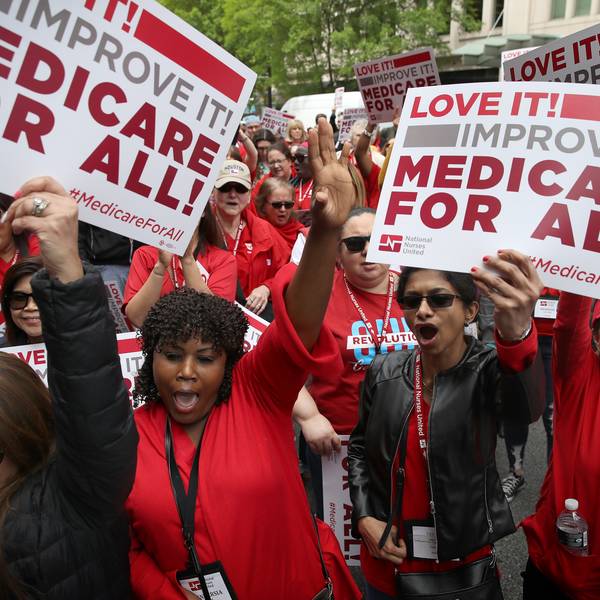
AFSCME asserted that the Republican law and its harms should sound "a nationwide call to action for working families to get organized and demand more."

"The labor movement is how working people have always asserted that we are not spectators in our own lives," the union added. "That we have a voice, a vote, and the power to drive change."

SEE ALL
rubio, trump, hegseth
News

In 'Most Serious Test Yet' of Ceasefire Deal, Trump Bombs Iran After Strike on Cargo Ship in Strait

US President Donald Trump resumed bombing Iran on Friday, a day after an Iranian attack on a cargo ship in the Strait of Hormuz, elevating concerns about the future of a ceasefire agreement just as Israel and Lebanon signed a related deal.

The Trump administration—which partnered with Israel to launch an illegal war on Iran in late February—and the Iranian government agreed on a memorandum of understanding (MOU) earlier this month. On Thursday, Iran attacked the Singapore-flagged commercial vessel, the Ever Lovely, in the strait, a key trade waterway.

"The Islamic Republic of Iran shot at least four One Way Attack Drones at Ships transversing the Strait of Hormuz," Trump wrote on his Truth Social platform Friday morning. "One of the Drones solidly hit the upper deck of a large and very expensive Cargo Carrying Ship. Damage was done, but the Ship was able to proceed on its way. We knocked down three other Drones. Obviously, this is a foolish violation of our Ceasefire Agreement."

Responding on the social media network X, Ebrahim Azizi, who heads the Iranian Parliament's Commission on National Security and Foreign Policy, said: "The reality in the Persian Gulf has changed. The Strait of Hormuz is governed by Iran, so: Respect the rules. Use secure routes. Do not mistake control for escalation. If you do not learn the rules, the Iranian armed forces will teach them to you. This is not a violation of the ceasefire; it is ceasefire management."

Later Friday, US Central Command (CENTCOM) announced that "as a powerful response to yesterday's attack on a commercial ship that was transiting the Strait of Hormuz," American aircraft "struck Iranian missile and drone storage locations and coastal radar sites."

"The unwarranted aggression against commercial shipping by Iranian forces clearly violated the ceasefire," CENTCOM said. "Furthermore, Iran's dangerous behavior undermined freedom of navigation as commerce increasingly flows through the vital international trade corridor."

"CENTCOM forces continue to provide safe passage coordination and support to commercial vessels transiting the strait," Central Command added. "The US military remains present and vigilant to ensure all aspects of the agreement with Iran are adhered to, obeyed, and in full force and effect."

Flagging CENTCOM's announcement, the National Iranian American Council (NIAC) pointed out that "this marks the first publicly acknowledged US military action against Iran since the recent ceasefire agreement, potentially representing the most serious test yet of the fragile understanding between Tehran and Washington."

"Notably, the alleged violation of the MOU resulted in military retaliation," NIAC added, "contra coordination via the executive mechanism that was supposed to be established to monitor implementation of the deal."

Al Jazeera reported late Friday that Iran's Islamic Revolutionary Guard Corps (IRGC) released a statement saying it has responded with fire:

The IRGC said its Navy targeted locations in the region where US forces are deployed, without specifying where or providing additional details.

It condemned the US strikes on Iran, saying Washington, "as always, violated its commitments and launched an airstrike” on the Iranian coast.

"According to Article 5 of the memorandum of understanding, Islamabad has arrangements for controlling traffic in the Strait of Hormuz with the Islamic Republic of Iran," the IRGC said.

"However, the US, by inciting various parties, sought to violate this commitment, which was met with the necessary response," the statement continued. "If the aggression is repeated, our response will be more extensive."

As for the administration's supposedly diplomatic efforts, US Secretary of State Marco Rubio announced that the United States, Israel, and Lebanon—which Israeli forces have been bombing throughout the Iran War—had signed a trilateral framework that he claimed "builds a realistic path out of endless conflict."

"This agreement establishes a clear and structured process to restore Lebanon’s sovereignty, disarm Hezbollah, and dismantle its terrorist infrastructure, and enable Israel to return to its borders once that threat to its citizens is removed," Rubio said. "It also creates a trilateral Military Coordination Group for Lebanon (MCG4L), facilitated by the United States, allowing the two sides to implement this framework. For Lebanon, this framework provides a genuine pathway out of a long crisis. For Israel, it creates a verifiable path to removing the persistent threat on its northern border."

The framework was met with protests in the Lebanese capital. Lebanon's National News Agency reported that Hezbollah supporters gathered on motorcycles in Beirut to oppose the deal.

SEE ALL