SUBSCRIBE TO OUR FREE NEWSLETTER
Daily news & progressive opinion—funded by the people, not the corporations—delivered straight to your inbox.
5
#000000
#FFFFFF
To donate by check, phone, or other method, see our More Ways to Give page.
Daily news & progressive opinion—funded by the people, not the corporations—delivered straight to your inbox.
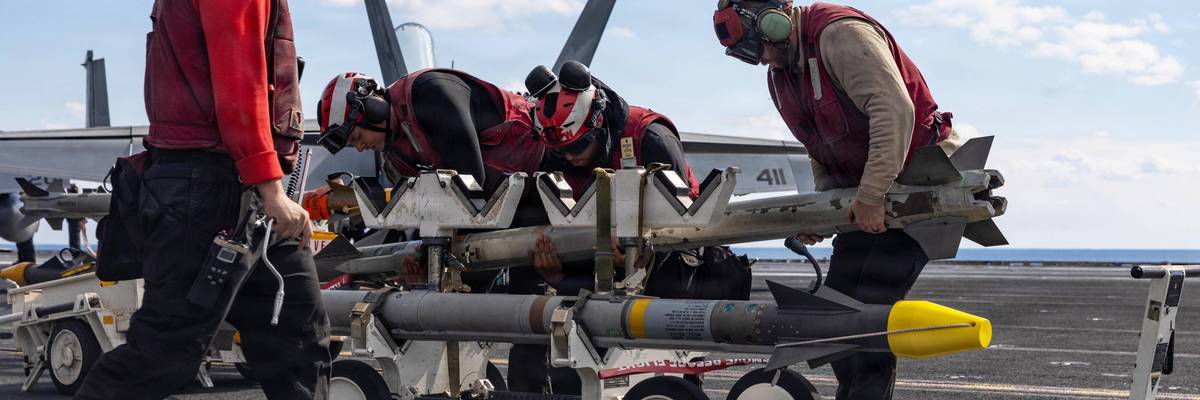
Sailors in the eastern Mediterranean Sea handle ordnance on the flight deck of the USS Gerald R. Ford in support of the assault on Iran on March 2, 2026.
"We are seeing the Iran war become a quagmire in real time," said one analyst.
The Pentagon reportedly wants Congress to approve more than $200 billion in supplemental funding for US President Donald Trump's unauthorized and deeply unpopular war on Iran as the administration weighs deploying thousands of additional troops to the Middle East, signaling a drawn-out conflict and a possible ground invasion.
The Washington Post reported late Wednesday that the Pentagon has asked the White House to sign off on the supplemental funding request as the financial and human costs of the Iran war balloon. The $200 billion figure, which drew immediate backlash and vows of opposition from several Democratic lawmakers, is quadruple the number widely floated in recent days as the department's likely supplemental request.
"This should be an absolute nonstarter," said Sen. Chris Van Hollen (D-Md.) in response to the Post's reporting. "The best way to end this war, protect our troops, save civilian lives, and rein in a lawless administration is to cut off funding. I’m a hell no."
Sen. Ruben Gallego (D-Ariz.) wrote on social media that "at the height of combat the Iraq War cost around $140 billion per year."
"If the Pentagon is asking for $200 billion they are asking for a long war," Gallego added. "The answer is a simple no."
Any funding package would need 60 votes to get through the US Senate, requiring some Democratic support. As of this writing, neither Senate Minority Leader Chuck Schumer (D-NY) nor House Minority Leader Hakeem Jeffries (D-NY) has responded to reports of the Pentagon's request.
The Post reported Wednesday that "it remains unclear how much the White House will ultimately ask congressional lawmakers to approve," and that "some White House officials do not think the Pentagon’s request has a realistic shot of being approved in Congress."
Prior to the start of the Iran assault, Trump called for a $1.5 trillion US military budget for the coming fiscal year even after the Pentagon failed its eighth consecutive audit.
The Pentagon's push for $200 billion in Iran war funding comes after US investigators reportedly determined that American forces were responsible for the bombing—on the first day of the war—of an Iranian elementary school that killed around 175 people, mostly young children.
News of the Pentagon's funding request came as Reuters reported that the Trump administration is "considering deploying thousands of US troops to reinforce its operation in the Middle East, as the US military prepares for possible next steps in its campaign against Iran."
"The deployments could help provide Trump with additional options as he weighs expanding US operations, with the Iran war well into its third week," Reuters reported. "Those options include securing safe passage for oil tankers through the Strait of Hormuz, a mission that would be accomplished primarily through air and naval forces, the sources said. But securing the Strait could also mean deploying U.S. troops to Iran's shoreline, said four sources, including two U.S. officials."
"The Trump administration has also discussed options to send ground forces to Iran's Kharg Island, the hub for 90% of Iran's oil exports," Reuters added. "One of the officials said such an operation would be very risky. Iran has the ability to reach the island with missiles and drones."
Dylan Williams, vice president for government affairs at the Center for International Policy, said Wednesday that "we are seeing the Iran war become a quagmire in real time."
"Asking US taxpayers to spend $50 billion on a war Trump claims we have already won was outrageous enough," said Williams. "Quadrupling that within a week shows a total lack of understanding or control over what he has gotten us into."
Foreign policy journalist Laura Rozen, author of the Diplomatic newsletter, wrote Wednesday that "Trump blundered into what he thought would be a few day 'excursion' as he calls it, maybe Venezuela 2.0."
"That is not what Israel had in mind, the military has hit all of its targets," Rozen added. "He has no idea what he is doing, his intelligence and other aides were appointed not to tell him anything he does not want to hear; not a single one of them can explain what the goal is. Congressional Republicans have their heads deep in the sand, and now talk of a $200 billion Pentagon supplemental and sending more potential ground troops."
Iran's foreign minister, Abbas Araghchi, highlighted the Post's reporting on social media and called $200 billion "the tip of the iceberg."
"Ordinary Americans can thank Benjamin Netanyahu and his lackeys in Congress for the trillion-dollar 'Israel First tax' that's about to hit the US economy," he wrote.
Dear Common Dreams reader, It’s been nearly 30 years since I co-founded Common Dreams with my late wife, Lina Newhouser. We had the radical notion that journalism should serve the public good, not corporate profits. It was clear to us from the outset what it would take to build such a project. No paid advertisements. No corporate sponsors. No millionaire publisher telling us what to think or do. Many people said we wouldn't last a year, but we proved those doubters wrong. Together with a tremendous team of journalists and dedicated staff, we built an independent media outlet free from the constraints of profits and corporate control. Our mission has always been simple: To inform. To inspire. To ignite change for the common good. Building Common Dreams was not easy. Our survival was never guaranteed. When you take on the most powerful forces—Wall Street greed, fossil fuel industry destruction, Big Tech lobbyists, and uber-rich oligarchs who have spent billions upon billions rigging the economy and democracy in their favor—the only bulwark you have is supporters who believe in your work. But here’s the urgent message from me today. It's never been this bad out there. And it's never been this hard to keep us going. At the very moment Common Dreams is most needed, the threats we face are intensifying. We need your support now more than ever. We don't accept corporate advertising and never will. We don't have a paywall because we don't think people should be blocked from critical news based on their ability to pay. Everything we do is funded by the donations of readers like you. When everyone does the little they can afford, we are strong. But if that support retreats or dries up, so do we. Will you donate now to make sure Common Dreams not only survives but thrives? —Craig Brown, Co-founder |
The Pentagon reportedly wants Congress to approve more than $200 billion in supplemental funding for US President Donald Trump's unauthorized and deeply unpopular war on Iran as the administration weighs deploying thousands of additional troops to the Middle East, signaling a drawn-out conflict and a possible ground invasion.
The Washington Post reported late Wednesday that the Pentagon has asked the White House to sign off on the supplemental funding request as the financial and human costs of the Iran war balloon. The $200 billion figure, which drew immediate backlash and vows of opposition from several Democratic lawmakers, is quadruple the number widely floated in recent days as the department's likely supplemental request.
"This should be an absolute nonstarter," said Sen. Chris Van Hollen (D-Md.) in response to the Post's reporting. "The best way to end this war, protect our troops, save civilian lives, and rein in a lawless administration is to cut off funding. I’m a hell no."
Sen. Ruben Gallego (D-Ariz.) wrote on social media that "at the height of combat the Iraq War cost around $140 billion per year."
"If the Pentagon is asking for $200 billion they are asking for a long war," Gallego added. "The answer is a simple no."
Any funding package would need 60 votes to get through the US Senate, requiring some Democratic support. As of this writing, neither Senate Minority Leader Chuck Schumer (D-NY) nor House Minority Leader Hakeem Jeffries (D-NY) has responded to reports of the Pentagon's request.
The Post reported Wednesday that "it remains unclear how much the White House will ultimately ask congressional lawmakers to approve," and that "some White House officials do not think the Pentagon’s request has a realistic shot of being approved in Congress."
Prior to the start of the Iran assault, Trump called for a $1.5 trillion US military budget for the coming fiscal year even after the Pentagon failed its eighth consecutive audit.
The Pentagon's push for $200 billion in Iran war funding comes after US investigators reportedly determined that American forces were responsible for the bombing—on the first day of the war—of an Iranian elementary school that killed around 175 people, mostly young children.
News of the Pentagon's funding request came as Reuters reported that the Trump administration is "considering deploying thousands of US troops to reinforce its operation in the Middle East, as the US military prepares for possible next steps in its campaign against Iran."
"The deployments could help provide Trump with additional options as he weighs expanding US operations, with the Iran war well into its third week," Reuters reported. "Those options include securing safe passage for oil tankers through the Strait of Hormuz, a mission that would be accomplished primarily through air and naval forces, the sources said. But securing the Strait could also mean deploying U.S. troops to Iran's shoreline, said four sources, including two U.S. officials."
"The Trump administration has also discussed options to send ground forces to Iran's Kharg Island, the hub for 90% of Iran's oil exports," Reuters added. "One of the officials said such an operation would be very risky. Iran has the ability to reach the island with missiles and drones."
Dylan Williams, vice president for government affairs at the Center for International Policy, said Wednesday that "we are seeing the Iran war become a quagmire in real time."
"Asking US taxpayers to spend $50 billion on a war Trump claims we have already won was outrageous enough," said Williams. "Quadrupling that within a week shows a total lack of understanding or control over what he has gotten us into."
Foreign policy journalist Laura Rozen, author of the Diplomatic newsletter, wrote Wednesday that "Trump blundered into what he thought would be a few day 'excursion' as he calls it, maybe Venezuela 2.0."
"That is not what Israel had in mind, the military has hit all of its targets," Rozen added. "He has no idea what he is doing, his intelligence and other aides were appointed not to tell him anything he does not want to hear; not a single one of them can explain what the goal is. Congressional Republicans have their heads deep in the sand, and now talk of a $200 billion Pentagon supplemental and sending more potential ground troops."
Iran's foreign minister, Abbas Araghchi, highlighted the Post's reporting on social media and called $200 billion "the tip of the iceberg."
"Ordinary Americans can thank Benjamin Netanyahu and his lackeys in Congress for the trillion-dollar 'Israel First tax' that's about to hit the US economy," he wrote.
The Pentagon reportedly wants Congress to approve more than $200 billion in supplemental funding for US President Donald Trump's unauthorized and deeply unpopular war on Iran as the administration weighs deploying thousands of additional troops to the Middle East, signaling a drawn-out conflict and a possible ground invasion.
The Washington Post reported late Wednesday that the Pentagon has asked the White House to sign off on the supplemental funding request as the financial and human costs of the Iran war balloon. The $200 billion figure, which drew immediate backlash and vows of opposition from several Democratic lawmakers, is quadruple the number widely floated in recent days as the department's likely supplemental request.
"This should be an absolute nonstarter," said Sen. Chris Van Hollen (D-Md.) in response to the Post's reporting. "The best way to end this war, protect our troops, save civilian lives, and rein in a lawless administration is to cut off funding. I’m a hell no."
Sen. Ruben Gallego (D-Ariz.) wrote on social media that "at the height of combat the Iraq War cost around $140 billion per year."
"If the Pentagon is asking for $200 billion they are asking for a long war," Gallego added. "The answer is a simple no."
Any funding package would need 60 votes to get through the US Senate, requiring some Democratic support. As of this writing, neither Senate Minority Leader Chuck Schumer (D-NY) nor House Minority Leader Hakeem Jeffries (D-NY) has responded to reports of the Pentagon's request.
The Post reported Wednesday that "it remains unclear how much the White House will ultimately ask congressional lawmakers to approve," and that "some White House officials do not think the Pentagon’s request has a realistic shot of being approved in Congress."
Prior to the start of the Iran assault, Trump called for a $1.5 trillion US military budget for the coming fiscal year even after the Pentagon failed its eighth consecutive audit.
The Pentagon's push for $200 billion in Iran war funding comes after US investigators reportedly determined that American forces were responsible for the bombing—on the first day of the war—of an Iranian elementary school that killed around 175 people, mostly young children.
News of the Pentagon's funding request came as Reuters reported that the Trump administration is "considering deploying thousands of US troops to reinforce its operation in the Middle East, as the US military prepares for possible next steps in its campaign against Iran."
"The deployments could help provide Trump with additional options as he weighs expanding US operations, with the Iran war well into its third week," Reuters reported. "Those options include securing safe passage for oil tankers through the Strait of Hormuz, a mission that would be accomplished primarily through air and naval forces, the sources said. But securing the Strait could also mean deploying U.S. troops to Iran's shoreline, said four sources, including two U.S. officials."
"The Trump administration has also discussed options to send ground forces to Iran's Kharg Island, the hub for 90% of Iran's oil exports," Reuters added. "One of the officials said such an operation would be very risky. Iran has the ability to reach the island with missiles and drones."
Dylan Williams, vice president for government affairs at the Center for International Policy, said Wednesday that "we are seeing the Iran war become a quagmire in real time."
"Asking US taxpayers to spend $50 billion on a war Trump claims we have already won was outrageous enough," said Williams. "Quadrupling that within a week shows a total lack of understanding or control over what he has gotten us into."
Foreign policy journalist Laura Rozen, author of the Diplomatic newsletter, wrote Wednesday that "Trump blundered into what he thought would be a few day 'excursion' as he calls it, maybe Venezuela 2.0."
"That is not what Israel had in mind, the military has hit all of its targets," Rozen added. "He has no idea what he is doing, his intelligence and other aides were appointed not to tell him anything he does not want to hear; not a single one of them can explain what the goal is. Congressional Republicans have their heads deep in the sand, and now talk of a $200 billion Pentagon supplemental and sending more potential ground troops."
Iran's foreign minister, Abbas Araghchi, highlighted the Post's reporting on social media and called $200 billion "the tip of the iceberg."
"Ordinary Americans can thank Benjamin Netanyahu and his lackeys in Congress for the trillion-dollar 'Israel First tax' that's about to hit the US economy," he wrote.