SUBSCRIBE TO OUR FREE NEWSLETTER
Daily news & progressive opinion—funded by the people, not the corporations—delivered straight to your inbox.
5
#000000
#FFFFFF
To donate by check, phone, or other method, see our More Ways to Give page.
Daily news & progressive opinion—funded by the people, not the corporations—delivered straight to your inbox.
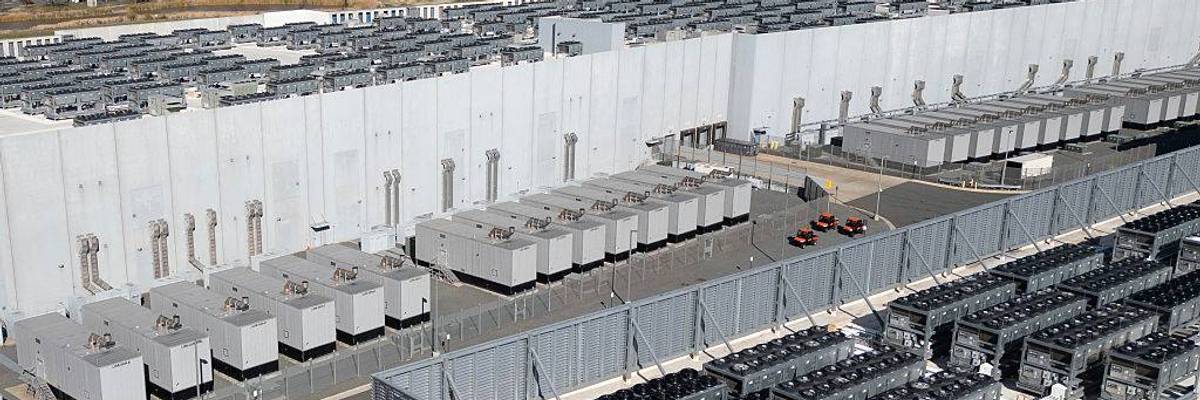
An aerial view shows cooling vent fans on the roof next to generators on the lower level of a Digital Realty data center in Ashburn, Virginia on November 12, 2025.
"Nothing short of a halt to the data center rollout will suffice... to ensure that people and the environment are fully protected."
Several Big Tech CEOs met with President Donald Trump on Wednesday and pledged to fund their own energy infrastructure needed to power their artificial intelligence data centers that have caused US utility bills to spike over the last year.
That same day, Food and Water Watch slammed the pledge as "wholly inadequate" and released what it described as a "first-of-its-kind report" outlining the massive environmental and human costs imposed by the AI data center explosion.
Among other things, the report states that data centers' vast energy needs are throwing a "lifeline to the fossil fuel industry," while undermining the many gains made from the revolution in clean power technology.
"AI expansion is largely fueled by dirty energy sources," the report notes. "In the US, over 40% of energy for data centers comes from natural gas, 24% from solar and wind combined, 20% from nuclear, and 15% from coal."
The report also pours cold water on Trump's plan to have Big Tech build its own energy infrastructure to power its data centers.
"Power plants can’t come online fast enough to fuel this growth," the report explains. "Data centers in New York state are seeking more than 9,000 megawatts (MW) of new demand—about 1.5 times the power consumption of every household in the state in 2024. Georgia Power predicts that energy sales will almost double by the early 2030s, largely driven by data centers. This steep demand increase can raise residential electricity costs—regardless of whether the new data centers pull from the grid or not."
Electricity isn't the only resource consumed in vast quantities by AI data centers, and the report also shines a light on the enormous amounts of water required to keep the facilities from overheating.
"The amount of water consumed by data centers more than tripled from 2014 to 2023," the report explains. "By 2028, US data centers could use as many as 720 billion gallons of water each year just to cool AI servers. This is equal to over 1 million Olympic-size swimming pools—or enough water to meet the indoor needs of 18.5 million American households."
Food and Water Watch says that the report's findings point to only one solution: A moratorium on AI data center construction along the lines of what US Sen. Bernie Sanders (I-Vt.) proposed last year.
"The well-documented harms of AI data centers cannot be resolved with piecemeal regulations or vague promises from AI enthusiasts of a utopian future," the report concludes. "Nothing short of a halt to the data center rollout will suffice until a comprehensive regulatory framework is developed to ensure that people and the environment are fully protected."
Meghan Pazik, senior policy advocate with Public Citizen’s Climate Program, also criticized Trump's AI data center pledge on Thursday and argued that the president's plan "isn’t doing anything binding to cut energy bills."
"Data centers increase residential energy bills by upwards of 250% and many communities are left in the dark on these projects from the start," said Pazik. "Asking corporations to sign meaningless ‘agreements’ fits Trump’s tired pattern of seeking fake concessions from corporations that translate to zero action or relief."
Trump's AI data center pledge comes at a time when US voters are facing increasing economic pressure across multiple fronts. In addition to data centers' impacts on utility bills, Americans are also facing increased costs from Trump's global tariffs on imported products and a spike in gas prices caused by the president's war against Iran.
While Trump has claimed to be prioritizing cutting costs with the data center pledge, he was dismissive of Americans’ concerns about paying more for gas this week, telling Reuters in an interview that “if [gas prices] rise, they rise.”
Dear Common Dreams reader, It’s been nearly 30 years since I co-founded Common Dreams with my late wife, Lina Newhouser. We had the radical notion that journalism should serve the public good, not corporate profits. It was clear to us from the outset what it would take to build such a project. No paid advertisements. No corporate sponsors. No millionaire publisher telling us what to think or do. Many people said we wouldn't last a year, but we proved those doubters wrong. Together with a tremendous team of journalists and dedicated staff, we built an independent media outlet free from the constraints of profits and corporate control. Our mission has always been simple: To inform. To inspire. To ignite change for the common good. Building Common Dreams was not easy. Our survival was never guaranteed. When you take on the most powerful forces—Wall Street greed, fossil fuel industry destruction, Big Tech lobbyists, and uber-rich oligarchs who have spent billions upon billions rigging the economy and democracy in their favor—the only bulwark you have is supporters who believe in your work. But here’s the urgent message from me today. It's never been this bad out there. And it's never been this hard to keep us going. At the very moment Common Dreams is most needed, the threats we face are intensifying. We need your support now more than ever. We don't accept corporate advertising and never will. We don't have a paywall because we don't think people should be blocked from critical news based on their ability to pay. Everything we do is funded by the donations of readers like you. When everyone does the little they can afford, we are strong. But if that support retreats or dries up, so do we. Will you donate now to make sure Common Dreams not only survives but thrives? —Craig Brown, Co-founder |
Several Big Tech CEOs met with President Donald Trump on Wednesday and pledged to fund their own energy infrastructure needed to power their artificial intelligence data centers that have caused US utility bills to spike over the last year.
That same day, Food and Water Watch slammed the pledge as "wholly inadequate" and released what it described as a "first-of-its-kind report" outlining the massive environmental and human costs imposed by the AI data center explosion.
Among other things, the report states that data centers' vast energy needs are throwing a "lifeline to the fossil fuel industry," while undermining the many gains made from the revolution in clean power technology.
"AI expansion is largely fueled by dirty energy sources," the report notes. "In the US, over 40% of energy for data centers comes from natural gas, 24% from solar and wind combined, 20% from nuclear, and 15% from coal."
The report also pours cold water on Trump's plan to have Big Tech build its own energy infrastructure to power its data centers.
"Power plants can’t come online fast enough to fuel this growth," the report explains. "Data centers in New York state are seeking more than 9,000 megawatts (MW) of new demand—about 1.5 times the power consumption of every household in the state in 2024. Georgia Power predicts that energy sales will almost double by the early 2030s, largely driven by data centers. This steep demand increase can raise residential electricity costs—regardless of whether the new data centers pull from the grid or not."
Electricity isn't the only resource consumed in vast quantities by AI data centers, and the report also shines a light on the enormous amounts of water required to keep the facilities from overheating.
"The amount of water consumed by data centers more than tripled from 2014 to 2023," the report explains. "By 2028, US data centers could use as many as 720 billion gallons of water each year just to cool AI servers. This is equal to over 1 million Olympic-size swimming pools—or enough water to meet the indoor needs of 18.5 million American households."
Food and Water Watch says that the report's findings point to only one solution: A moratorium on AI data center construction along the lines of what US Sen. Bernie Sanders (I-Vt.) proposed last year.
"The well-documented harms of AI data centers cannot be resolved with piecemeal regulations or vague promises from AI enthusiasts of a utopian future," the report concludes. "Nothing short of a halt to the data center rollout will suffice until a comprehensive regulatory framework is developed to ensure that people and the environment are fully protected."
Meghan Pazik, senior policy advocate with Public Citizen’s Climate Program, also criticized Trump's AI data center pledge on Thursday and argued that the president's plan "isn’t doing anything binding to cut energy bills."
"Data centers increase residential energy bills by upwards of 250% and many communities are left in the dark on these projects from the start," said Pazik. "Asking corporations to sign meaningless ‘agreements’ fits Trump’s tired pattern of seeking fake concessions from corporations that translate to zero action or relief."
Trump's AI data center pledge comes at a time when US voters are facing increasing economic pressure across multiple fronts. In addition to data centers' impacts on utility bills, Americans are also facing increased costs from Trump's global tariffs on imported products and a spike in gas prices caused by the president's war against Iran.
While Trump has claimed to be prioritizing cutting costs with the data center pledge, he was dismissive of Americans’ concerns about paying more for gas this week, telling Reuters in an interview that “if [gas prices] rise, they rise.”
Several Big Tech CEOs met with President Donald Trump on Wednesday and pledged to fund their own energy infrastructure needed to power their artificial intelligence data centers that have caused US utility bills to spike over the last year.
That same day, Food and Water Watch slammed the pledge as "wholly inadequate" and released what it described as a "first-of-its-kind report" outlining the massive environmental and human costs imposed by the AI data center explosion.
Among other things, the report states that data centers' vast energy needs are throwing a "lifeline to the fossil fuel industry," while undermining the many gains made from the revolution in clean power technology.
"AI expansion is largely fueled by dirty energy sources," the report notes. "In the US, over 40% of energy for data centers comes from natural gas, 24% from solar and wind combined, 20% from nuclear, and 15% from coal."
The report also pours cold water on Trump's plan to have Big Tech build its own energy infrastructure to power its data centers.
"Power plants can’t come online fast enough to fuel this growth," the report explains. "Data centers in New York state are seeking more than 9,000 megawatts (MW) of new demand—about 1.5 times the power consumption of every household in the state in 2024. Georgia Power predicts that energy sales will almost double by the early 2030s, largely driven by data centers. This steep demand increase can raise residential electricity costs—regardless of whether the new data centers pull from the grid or not."
Electricity isn't the only resource consumed in vast quantities by AI data centers, and the report also shines a light on the enormous amounts of water required to keep the facilities from overheating.
"The amount of water consumed by data centers more than tripled from 2014 to 2023," the report explains. "By 2028, US data centers could use as many as 720 billion gallons of water each year just to cool AI servers. This is equal to over 1 million Olympic-size swimming pools—or enough water to meet the indoor needs of 18.5 million American households."
Food and Water Watch says that the report's findings point to only one solution: A moratorium on AI data center construction along the lines of what US Sen. Bernie Sanders (I-Vt.) proposed last year.
"The well-documented harms of AI data centers cannot be resolved with piecemeal regulations or vague promises from AI enthusiasts of a utopian future," the report concludes. "Nothing short of a halt to the data center rollout will suffice until a comprehensive regulatory framework is developed to ensure that people and the environment are fully protected."
Meghan Pazik, senior policy advocate with Public Citizen’s Climate Program, also criticized Trump's AI data center pledge on Thursday and argued that the president's plan "isn’t doing anything binding to cut energy bills."
"Data centers increase residential energy bills by upwards of 250% and many communities are left in the dark on these projects from the start," said Pazik. "Asking corporations to sign meaningless ‘agreements’ fits Trump’s tired pattern of seeking fake concessions from corporations that translate to zero action or relief."
Trump's AI data center pledge comes at a time when US voters are facing increasing economic pressure across multiple fronts. In addition to data centers' impacts on utility bills, Americans are also facing increased costs from Trump's global tariffs on imported products and a spike in gas prices caused by the president's war against Iran.
While Trump has claimed to be prioritizing cutting costs with the data center pledge, he was dismissive of Americans’ concerns about paying more for gas this week, telling Reuters in an interview that “if [gas prices] rise, they rise.”