SUBSCRIBE TO OUR FREE NEWSLETTER
Daily news & progressive opinion—funded by the people, not the corporations—delivered straight to your inbox.
5
#000000
#FFFFFF
To donate by check, phone, or other method, see our More Ways to Give page.
Daily news & progressive opinion—funded by the people, not the corporations—delivered straight to your inbox.
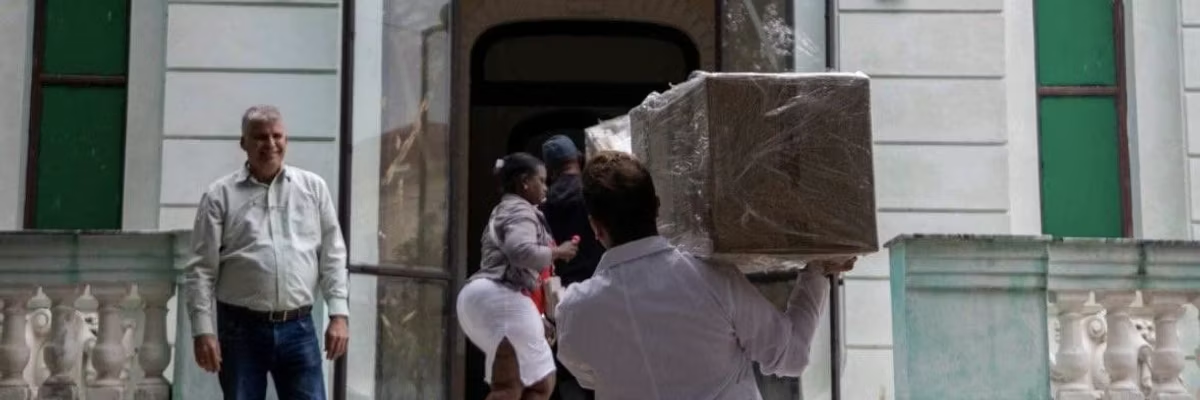
A medical worker carries a box of aid supplies delivered by the Nuestra America Convoy on March 18, 2026 in Havana, Cuba.
"People are looking at Trump's siege of this island with horror," said convoy organizer David Adler. "They understand... if it's successfully applied on a small, peaceful island nation like Cuba, they could be next."
As the United States strangles Cuba with an economic blockade, a convoy of activists from around the world is seeking to break it by traveling to the island with more than five tons of humanitarian aid.
The “Nuestra America Convoy” began arriving on the island on Wednesday with more than five tons of desperately needed supplies valued at more than $570,000.
Progressive International, the transnational left-wing organization that organized the campaign, said on Thursday that it had already delivered several tons of medical supplies to hospitals around Havana. They included cancer drugs, antibiotics, pain medication, surgical materials, and treatments for chronic conditions.
Attempts are also underway to directly defy the US oil blockade. On Wednesday, The Guardian reported that a sanctioned Russian tanker had set sail for Cuba with more than 730,000 barrels of crude oil and was expected to make landfall on March 23. Cuba has not imported any oil since January 9.
The activists arrived in Cuba days after the island was roiled by a total blackout amid the American blockade, which has effectively cut off 90% of its fuel imports—disrupting everything from medical care to food harvesting to garbage collection.
President Donald Trump enacted the blockade in January via an executive order, threatening to place tariffs on any nation selling oil to Cuba in a bid to cripple the island's economy and force regime change, after more than 60 years of a crushing US embargo.
As the crisis on the island escalated this week, the president threatened to take the island outright, saying he could "do anything I want with it."
"The consequences of the US blockade are lethal, for newborns and parents, for the elderly and the sick," the organizers of the convoy said. "That is why we are mobilizing by air, land, and sea in solidarity with the Cuban people."
The project began as a small flotilla, but has morphed into a much broader effort and attracted support from well-known public figures, including former UK Labour Party Leader Jeremy Corbyn and US Rep. Rashida Tlaib (D-Mich.).
Other famous faces, including the Swedish humanitarian and climate activist Greta Thunberg, the journalists Ryan Grim and Owen Jones, the left-wing streamer Hasan Piker, and the Irish rap group Kneecap, are also expected to travel to Cuba as part of the convoy.
More than 120 activists from at least 19 countries touched down with the convoy's first delegation at Havana's airport on Wednesday. But they are just the first of several groups expected to arrive in the coming days.
Several more vessels from Mexico are expected to arrive on the island on Saturday, carrying "food, medicine, and essential supplies." In total, activists with the effort hope to transport 20 tons of aid.
"When we first put out this call to respond to the aggravated humanitarian crisis on the island, thousands of people heard that call," said David Adler, the co-coordinator of Progressive International.
"People are looking at Trump's siege of this island with horror," he said, "not only because it has disastrous consequences... but also because they understand that this really barbaric tactic of a siege, if it's successfully applied on a small, peaceful island nation like Cuba, they could be next."
The activists involved in the effort have said they took inspiration from the Global Sumud Flotilla that attempted to break Israel's siege of Gaza with humanitarian aid last fall. However, the effort to provide aid to Cuba is very different.
Whereas the ships attempting to enter Gaza were intercepted by the Israeli military, activists entering Cuba are unlikely to face physical danger, as the blockade is not being enforced militarily and the Cuban government has welcomed their arrival.
(Video by The National)
Nathan J. Robinson and Alex Skopic, editors of the American left-wing magazine Current Affairs, who are traveling to Cuba as part of the convoy on Friday, said in an article published earlier this week they were outraged by the lack of action taken by the US government and other governments around the world, especially since it's "perfectly legal to bring humanitarian supplies to the island."
"The fact that it’s fallen to a handful of activists to carry out this work should bring shame to every elected official, everywhere in the world, who hasn’t launched a ship full of supplies to Havana," they said. "If this mission becomes a big enough international news story, perhaps more governments can be pressured to do exactly that."
"Beyond food, medicine, and energy infrastructure, this mission sends a message. As Americans, we want to make it crystal clear that the Trump administration does not speak for us, and we’re sickened by what Trump and [Secretary of State Marco] Rubio are doing to the Cuban people in the name of US foreign policy," they continued. "We’re determined to do what we can, and we’re going to make sure the people of Cuba do not stand alone."
Dear Common Dreams reader, It’s been nearly 30 years since I co-founded Common Dreams with my late wife, Lina Newhouser. We had the radical notion that journalism should serve the public good, not corporate profits. It was clear to us from the outset what it would take to build such a project. No paid advertisements. No corporate sponsors. No millionaire publisher telling us what to think or do. Many people said we wouldn't last a year, but we proved those doubters wrong. Together with a tremendous team of journalists and dedicated staff, we built an independent media outlet free from the constraints of profits and corporate control. Our mission has always been simple: To inform. To inspire. To ignite change for the common good. Building Common Dreams was not easy. Our survival was never guaranteed. When you take on the most powerful forces—Wall Street greed, fossil fuel industry destruction, Big Tech lobbyists, and uber-rich oligarchs who have spent billions upon billions rigging the economy and democracy in their favor—the only bulwark you have is supporters who believe in your work. But here’s the urgent message from me today. It's never been this bad out there. And it's never been this hard to keep us going. At the very moment Common Dreams is most needed, the threats we face are intensifying. We need your support now more than ever. We don't accept corporate advertising and never will. We don't have a paywall because we don't think people should be blocked from critical news based on their ability to pay. Everything we do is funded by the donations of readers like you. When everyone does the little they can afford, we are strong. But if that support retreats or dries up, so do we. Will you donate now to make sure Common Dreams not only survives but thrives? —Craig Brown, Co-founder |
As the United States strangles Cuba with an economic blockade, a convoy of activists from around the world is seeking to break it by traveling to the island with more than five tons of humanitarian aid.
The “Nuestra America Convoy” began arriving on the island on Wednesday with more than five tons of desperately needed supplies valued at more than $570,000.
Progressive International, the transnational left-wing organization that organized the campaign, said on Thursday that it had already delivered several tons of medical supplies to hospitals around Havana. They included cancer drugs, antibiotics, pain medication, surgical materials, and treatments for chronic conditions.
Attempts are also underway to directly defy the US oil blockade. On Wednesday, The Guardian reported that a sanctioned Russian tanker had set sail for Cuba with more than 730,000 barrels of crude oil and was expected to make landfall on March 23. Cuba has not imported any oil since January 9.
The activists arrived in Cuba days after the island was roiled by a total blackout amid the American blockade, which has effectively cut off 90% of its fuel imports—disrupting everything from medical care to food harvesting to garbage collection.
President Donald Trump enacted the blockade in January via an executive order, threatening to place tariffs on any nation selling oil to Cuba in a bid to cripple the island's economy and force regime change, after more than 60 years of a crushing US embargo.
As the crisis on the island escalated this week, the president threatened to take the island outright, saying he could "do anything I want with it."
"The consequences of the US blockade are lethal, for newborns and parents, for the elderly and the sick," the organizers of the convoy said. "That is why we are mobilizing by air, land, and sea in solidarity with the Cuban people."
The project began as a small flotilla, but has morphed into a much broader effort and attracted support from well-known public figures, including former UK Labour Party Leader Jeremy Corbyn and US Rep. Rashida Tlaib (D-Mich.).
Other famous faces, including the Swedish humanitarian and climate activist Greta Thunberg, the journalists Ryan Grim and Owen Jones, the left-wing streamer Hasan Piker, and the Irish rap group Kneecap, are also expected to travel to Cuba as part of the convoy.
More than 120 activists from at least 19 countries touched down with the convoy's first delegation at Havana's airport on Wednesday. But they are just the first of several groups expected to arrive in the coming days.
Several more vessels from Mexico are expected to arrive on the island on Saturday, carrying "food, medicine, and essential supplies." In total, activists with the effort hope to transport 20 tons of aid.
"When we first put out this call to respond to the aggravated humanitarian crisis on the island, thousands of people heard that call," said David Adler, the co-coordinator of Progressive International.
"People are looking at Trump's siege of this island with horror," he said, "not only because it has disastrous consequences... but also because they understand that this really barbaric tactic of a siege, if it's successfully applied on a small, peaceful island nation like Cuba, they could be next."
The activists involved in the effort have said they took inspiration from the Global Sumud Flotilla that attempted to break Israel's siege of Gaza with humanitarian aid last fall. However, the effort to provide aid to Cuba is very different.
Whereas the ships attempting to enter Gaza were intercepted by the Israeli military, activists entering Cuba are unlikely to face physical danger, as the blockade is not being enforced militarily and the Cuban government has welcomed their arrival.
(Video by The National)
Nathan J. Robinson and Alex Skopic, editors of the American left-wing magazine Current Affairs, who are traveling to Cuba as part of the convoy on Friday, said in an article published earlier this week they were outraged by the lack of action taken by the US government and other governments around the world, especially since it's "perfectly legal to bring humanitarian supplies to the island."
"The fact that it’s fallen to a handful of activists to carry out this work should bring shame to every elected official, everywhere in the world, who hasn’t launched a ship full of supplies to Havana," they said. "If this mission becomes a big enough international news story, perhaps more governments can be pressured to do exactly that."
"Beyond food, medicine, and energy infrastructure, this mission sends a message. As Americans, we want to make it crystal clear that the Trump administration does not speak for us, and we’re sickened by what Trump and [Secretary of State Marco] Rubio are doing to the Cuban people in the name of US foreign policy," they continued. "We’re determined to do what we can, and we’re going to make sure the people of Cuba do not stand alone."
As the United States strangles Cuba with an economic blockade, a convoy of activists from around the world is seeking to break it by traveling to the island with more than five tons of humanitarian aid.
The “Nuestra America Convoy” began arriving on the island on Wednesday with more than five tons of desperately needed supplies valued at more than $570,000.
Progressive International, the transnational left-wing organization that organized the campaign, said on Thursday that it had already delivered several tons of medical supplies to hospitals around Havana. They included cancer drugs, antibiotics, pain medication, surgical materials, and treatments for chronic conditions.
Attempts are also underway to directly defy the US oil blockade. On Wednesday, The Guardian reported that a sanctioned Russian tanker had set sail for Cuba with more than 730,000 barrels of crude oil and was expected to make landfall on March 23. Cuba has not imported any oil since January 9.
The activists arrived in Cuba days after the island was roiled by a total blackout amid the American blockade, which has effectively cut off 90% of its fuel imports—disrupting everything from medical care to food harvesting to garbage collection.
President Donald Trump enacted the blockade in January via an executive order, threatening to place tariffs on any nation selling oil to Cuba in a bid to cripple the island's economy and force regime change, after more than 60 years of a crushing US embargo.
As the crisis on the island escalated this week, the president threatened to take the island outright, saying he could "do anything I want with it."
"The consequences of the US blockade are lethal, for newborns and parents, for the elderly and the sick," the organizers of the convoy said. "That is why we are mobilizing by air, land, and sea in solidarity with the Cuban people."
The project began as a small flotilla, but has morphed into a much broader effort and attracted support from well-known public figures, including former UK Labour Party Leader Jeremy Corbyn and US Rep. Rashida Tlaib (D-Mich.).
Other famous faces, including the Swedish humanitarian and climate activist Greta Thunberg, the journalists Ryan Grim and Owen Jones, the left-wing streamer Hasan Piker, and the Irish rap group Kneecap, are also expected to travel to Cuba as part of the convoy.
More than 120 activists from at least 19 countries touched down with the convoy's first delegation at Havana's airport on Wednesday. But they are just the first of several groups expected to arrive in the coming days.
Several more vessels from Mexico are expected to arrive on the island on Saturday, carrying "food, medicine, and essential supplies." In total, activists with the effort hope to transport 20 tons of aid.
"When we first put out this call to respond to the aggravated humanitarian crisis on the island, thousands of people heard that call," said David Adler, the co-coordinator of Progressive International.
"People are looking at Trump's siege of this island with horror," he said, "not only because it has disastrous consequences... but also because they understand that this really barbaric tactic of a siege, if it's successfully applied on a small, peaceful island nation like Cuba, they could be next."
The activists involved in the effort have said they took inspiration from the Global Sumud Flotilla that attempted to break Israel's siege of Gaza with humanitarian aid last fall. However, the effort to provide aid to Cuba is very different.
Whereas the ships attempting to enter Gaza were intercepted by the Israeli military, activists entering Cuba are unlikely to face physical danger, as the blockade is not being enforced militarily and the Cuban government has welcomed their arrival.
(Video by The National)
Nathan J. Robinson and Alex Skopic, editors of the American left-wing magazine Current Affairs, who are traveling to Cuba as part of the convoy on Friday, said in an article published earlier this week they were outraged by the lack of action taken by the US government and other governments around the world, especially since it's "perfectly legal to bring humanitarian supplies to the island."
"The fact that it’s fallen to a handful of activists to carry out this work should bring shame to every elected official, everywhere in the world, who hasn’t launched a ship full of supplies to Havana," they said. "If this mission becomes a big enough international news story, perhaps more governments can be pressured to do exactly that."
"Beyond food, medicine, and energy infrastructure, this mission sends a message. As Americans, we want to make it crystal clear that the Trump administration does not speak for us, and we’re sickened by what Trump and [Secretary of State Marco] Rubio are doing to the Cuban people in the name of US foreign policy," they continued. "We’re determined to do what we can, and we’re going to make sure the people of Cuba do not stand alone."