SUBSCRIBE TO OUR FREE NEWSLETTER
Daily news & progressive opinion—funded by the people, not the corporations—delivered straight to your inbox.
5
#000000
#FFFFFF
To donate by check, phone, or other method, see our More Ways to Give page.
Daily news & progressive opinion—funded by the people, not the corporations—delivered straight to your inbox.
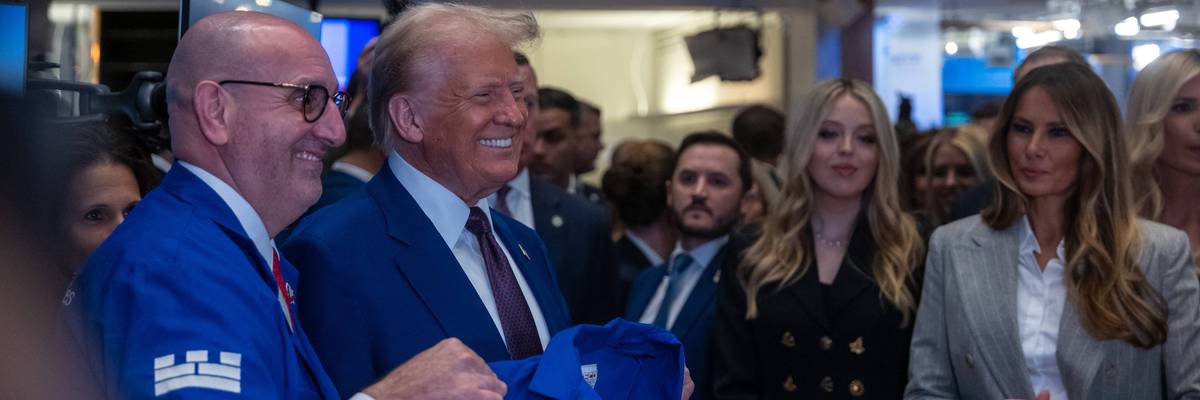
Donald Trump walks onto the floor of the New York Stock Exchange on December 12, 2024 in New York City.
A new analysis shows that over 40% of all US adults are unable to fully pay off their credit cards each month, leaving them trapped in "cycles of persistent debt."
US President Donald Trump promised repeatedly during his 2024 campaign to temporarily cap credit card interest rates at 10%, but—in the face of Wall Street opposition—he has done nothing concrete to fulfill that pledge since returning to the White House.
That failure, according to an analysis released Tuesday, has so far cost Americans $134.5 billion in interest payments. Every day, The Century Foundation (TCF) and Protect Borrowers estimate, US credit card holders are accruing $368 million more in interest than they would have if rates were capped at 10%. The average interest rate for credit cards in the US is currently around 25%, according to a Forbes measure.
In January, Trump called on Congress to approve a 10% cap on credit card interest rates for one year, and bipartisan legislation has been introduced in both the House and the Senate. But the president has not pressured bank-friendly Republicans to back the measure, and he vowed earlier this month to refuse to sign any legislation that reaches his desk unless lawmakers approve a massive voter suppression bill that is likely dead in the Senate.
“Trump could work with Congress to deliver on his promise to cap credit card interest rates at 10%—saving the average American with credit card debt about $900 a year," Sen. Elizabeth Warren (D-Mass.) said Tuesday. "But he is too busy siding with Wall Street.”
The new analysis by TCF and Protect Borrowers shows that over 40% of adults in the US are "unable to pay off their credit card bills each month, trapping them in cycles of persistent debt that balloons ever-higher due to record-high, industry-inflated interest rates and predatory fees."
Collectively, around 111 million Americans carry more than $1 trillion in credit card debt month to month, according to the analysis, and more than 27 million Americans can't afford more than the minimum monthly payment on their cards.
"Americans’ monthly credit card payments have grown by nearly 40% since 2018, a trend that is continuing unabated under President Trump," TCF and Protect Borrowers found. "From 2018 to 2025, the average monthly credit card payment rose by $553, or 38% (from $1,441 to $1,994). This growth far outstrips inflation."
"Since Trump’s inauguration alone, the average annual amount that Americans pay in credit card bills grew by an additional $1,177 (from $22,756 to $23,933)," the groups added. "The pace of this growth suggests that, in large part due to soaring interest rates, families today devote more income to credit card payments than at any point in history."
The nation's worsening credit card debt crisis comes amid a broader affordability crisis in an economy that Trump has hailed as the "greatest" in history, despite all the glaring evidence to the contrary.
A West Health-Gallup Center on Healthcare in America survey published last week found that roughly a third of respondents—equivalent to more than 80 million Americans—said they have had to skip a meal, borrow money, cut back on utilities, or make other painful trade-offs to afford healthcare expenses over the last 12 months as prices continue to rise across the economy.
“Grocery, utility, and healthcare bills are piling up, and Americans are increasingly turning to credit cards—some carrying interest rates exceeding 22%—just to make ends meet,” Jennifer Zhang, policy, research, and data Analyst at Protect Borrowers and co-author of the new analysis, said Tuesday.
“President Trump promised to tackle crushing credit card interest rates by January 20 of this year," Zhang added, "but that deadline has come and gone."
Dear Common Dreams reader, It’s been nearly 30 years since I co-founded Common Dreams with my late wife, Lina Newhouser. We had the radical notion that journalism should serve the public good, not corporate profits. It was clear to us from the outset what it would take to build such a project. No paid advertisements. No corporate sponsors. No millionaire publisher telling us what to think or do. Many people said we wouldn't last a year, but we proved those doubters wrong. Together with a tremendous team of journalists and dedicated staff, we built an independent media outlet free from the constraints of profits and corporate control. Our mission has always been simple: To inform. To inspire. To ignite change for the common good. Building Common Dreams was not easy. Our survival was never guaranteed. When you take on the most powerful forces—Wall Street greed, fossil fuel industry destruction, Big Tech lobbyists, and uber-rich oligarchs who have spent billions upon billions rigging the economy and democracy in their favor—the only bulwark you have is supporters who believe in your work. But here’s the urgent message from me today. It's never been this bad out there. And it's never been this hard to keep us going. At the very moment Common Dreams is most needed, the threats we face are intensifying. We need your support now more than ever. We don't accept corporate advertising and never will. We don't have a paywall because we don't think people should be blocked from critical news based on their ability to pay. Everything we do is funded by the donations of readers like you. When everyone does the little they can afford, we are strong. But if that support retreats or dries up, so do we. Will you donate now to make sure Common Dreams not only survives but thrives? —Craig Brown, Co-founder |
US President Donald Trump promised repeatedly during his 2024 campaign to temporarily cap credit card interest rates at 10%, but—in the face of Wall Street opposition—he has done nothing concrete to fulfill that pledge since returning to the White House.
That failure, according to an analysis released Tuesday, has so far cost Americans $134.5 billion in interest payments. Every day, The Century Foundation (TCF) and Protect Borrowers estimate, US credit card holders are accruing $368 million more in interest than they would have if rates were capped at 10%. The average interest rate for credit cards in the US is currently around 25%, according to a Forbes measure.
In January, Trump called on Congress to approve a 10% cap on credit card interest rates for one year, and bipartisan legislation has been introduced in both the House and the Senate. But the president has not pressured bank-friendly Republicans to back the measure, and he vowed earlier this month to refuse to sign any legislation that reaches his desk unless lawmakers approve a massive voter suppression bill that is likely dead in the Senate.
“Trump could work with Congress to deliver on his promise to cap credit card interest rates at 10%—saving the average American with credit card debt about $900 a year," Sen. Elizabeth Warren (D-Mass.) said Tuesday. "But he is too busy siding with Wall Street.”
The new analysis by TCF and Protect Borrowers shows that over 40% of adults in the US are "unable to pay off their credit card bills each month, trapping them in cycles of persistent debt that balloons ever-higher due to record-high, industry-inflated interest rates and predatory fees."
Collectively, around 111 million Americans carry more than $1 trillion in credit card debt month to month, according to the analysis, and more than 27 million Americans can't afford more than the minimum monthly payment on their cards.
"Americans’ monthly credit card payments have grown by nearly 40% since 2018, a trend that is continuing unabated under President Trump," TCF and Protect Borrowers found. "From 2018 to 2025, the average monthly credit card payment rose by $553, or 38% (from $1,441 to $1,994). This growth far outstrips inflation."
"Since Trump’s inauguration alone, the average annual amount that Americans pay in credit card bills grew by an additional $1,177 (from $22,756 to $23,933)," the groups added. "The pace of this growth suggests that, in large part due to soaring interest rates, families today devote more income to credit card payments than at any point in history."
The nation's worsening credit card debt crisis comes amid a broader affordability crisis in an economy that Trump has hailed as the "greatest" in history, despite all the glaring evidence to the contrary.
A West Health-Gallup Center on Healthcare in America survey published last week found that roughly a third of respondents—equivalent to more than 80 million Americans—said they have had to skip a meal, borrow money, cut back on utilities, or make other painful trade-offs to afford healthcare expenses over the last 12 months as prices continue to rise across the economy.
“Grocery, utility, and healthcare bills are piling up, and Americans are increasingly turning to credit cards—some carrying interest rates exceeding 22%—just to make ends meet,” Jennifer Zhang, policy, research, and data Analyst at Protect Borrowers and co-author of the new analysis, said Tuesday.
“President Trump promised to tackle crushing credit card interest rates by January 20 of this year," Zhang added, "but that deadline has come and gone."
US President Donald Trump promised repeatedly during his 2024 campaign to temporarily cap credit card interest rates at 10%, but—in the face of Wall Street opposition—he has done nothing concrete to fulfill that pledge since returning to the White House.
That failure, according to an analysis released Tuesday, has so far cost Americans $134.5 billion in interest payments. Every day, The Century Foundation (TCF) and Protect Borrowers estimate, US credit card holders are accruing $368 million more in interest than they would have if rates were capped at 10%. The average interest rate for credit cards in the US is currently around 25%, according to a Forbes measure.
In January, Trump called on Congress to approve a 10% cap on credit card interest rates for one year, and bipartisan legislation has been introduced in both the House and the Senate. But the president has not pressured bank-friendly Republicans to back the measure, and he vowed earlier this month to refuse to sign any legislation that reaches his desk unless lawmakers approve a massive voter suppression bill that is likely dead in the Senate.
“Trump could work with Congress to deliver on his promise to cap credit card interest rates at 10%—saving the average American with credit card debt about $900 a year," Sen. Elizabeth Warren (D-Mass.) said Tuesday. "But he is too busy siding with Wall Street.”
The new analysis by TCF and Protect Borrowers shows that over 40% of adults in the US are "unable to pay off their credit card bills each month, trapping them in cycles of persistent debt that balloons ever-higher due to record-high, industry-inflated interest rates and predatory fees."
Collectively, around 111 million Americans carry more than $1 trillion in credit card debt month to month, according to the analysis, and more than 27 million Americans can't afford more than the minimum monthly payment on their cards.
"Americans’ monthly credit card payments have grown by nearly 40% since 2018, a trend that is continuing unabated under President Trump," TCF and Protect Borrowers found. "From 2018 to 2025, the average monthly credit card payment rose by $553, or 38% (from $1,441 to $1,994). This growth far outstrips inflation."
"Since Trump’s inauguration alone, the average annual amount that Americans pay in credit card bills grew by an additional $1,177 (from $22,756 to $23,933)," the groups added. "The pace of this growth suggests that, in large part due to soaring interest rates, families today devote more income to credit card payments than at any point in history."
The nation's worsening credit card debt crisis comes amid a broader affordability crisis in an economy that Trump has hailed as the "greatest" in history, despite all the glaring evidence to the contrary.
A West Health-Gallup Center on Healthcare in America survey published last week found that roughly a third of respondents—equivalent to more than 80 million Americans—said they have had to skip a meal, borrow money, cut back on utilities, or make other painful trade-offs to afford healthcare expenses over the last 12 months as prices continue to rise across the economy.
“Grocery, utility, and healthcare bills are piling up, and Americans are increasingly turning to credit cards—some carrying interest rates exceeding 22%—just to make ends meet,” Jennifer Zhang, policy, research, and data Analyst at Protect Borrowers and co-author of the new analysis, said Tuesday.
“President Trump promised to tackle crushing credit card interest rates by January 20 of this year," Zhang added, "but that deadline has come and gone."