SUBSCRIBE TO OUR FREE NEWSLETTER
Daily news & progressive opinion—funded by the people, not the corporations—delivered straight to your inbox.
5
#000000
#FFFFFF
To donate by check, phone, or other method, see our More Ways to Give page.
Daily news & progressive opinion—funded by the people, not the corporations—delivered straight to your inbox.
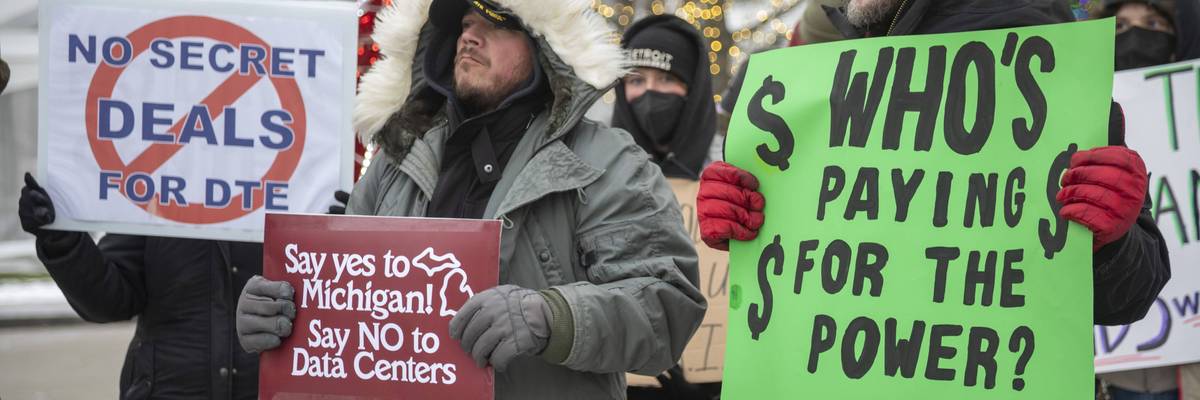
Detroit, Michigan, residents picket DTE Energy, opposing the electric utility's plan to provide power for a proposed $7 billion data center in rural Michigan, on December 3, 3025.
Sixty percent of respondents blamed the energy demand of large users like AI data centers for higher household electricity costs.
It's been two weeks since Big Tech companies gathered at the White House to sign a nonbinding pledge saying they will not pass on higher utility costs to consumers as the rapid build-out of energy-intensive artificial intelligence data centers sends electricity bills skyrocketing—but polling out Wednesday showed a majority of Americans reject President Donald Trump's plan to leave corporations responsible for tackling the affordability crisis.
Those same companies, said most respondents to a survey by Data for Progress and Groundwork Collaborative, are responsible for higher costs that have hit households across the country, and can't be trusted to ensure life is more affordable for families.
Instead, said 61% of respondents, "cracking down on price gouging" from both utility and energy companies would be the most effective way to lower the cost of electricity. In comparison, just 35% said building more energy infrastructure to meet demands was the answer to high costs.
While Trump has been forced in recent weeks to acknowledge that "energy demands from AI data centers could unfairly drive up" people's energy costs, as he admitted in his State of the Union address while announcing AI companies would sign his "ratepayer protection pledge," the president has largely deflected blame regarding the affordability crisis—or denied its existence altogether.
Trump claimed at a rally in Kentucky last week that "the economy is roaring back," even as his $1 billion-per-day, unprovoked war on Iran inflamed tensions across the Middle East and drove up oil prices.
Groundwork said in its analysis of the poll that following Trump's announcement of the ratepayer protection pledge, "Americans reject this reliance on corporations to do the right thing."
Elizabeth Pancotti, managing director of policy and advocacy for Groundwork Collaborative, said that "utility prices are up and consumers know the truth: These price increases are being driven by corporate greed and unchecked AI data center growth."
Trump has pushed to accelerate the construction of new data centers by fast-tracking the permitting process.
Two-thirds of those surveyed said their monthly electricity payments have gone up in the past year, with nearly a quarter of respondents saying they had increased by "a lot." More than 40% of people said they are now paying between $101-$200 per month for electricity.
As Common Dreams reported last November, Trump's demand for AI companies to build massive, energy-sucking data centers in communities across the US has been linked to rising costs of consumers, with the average overdue balance on utility bills surging by 32% in the last three years and states with high concentrations of AI data centers seeing electricity prices skyrocket by as much as 16% from 2024-25.
Sixty percent of respondents told Data for Progress and Groundwork Collaborative that the energy demand of large commercial users like AI data centers is to blame for higher consumer prices, and the same percentage of people also blamed high compensation for utility company executives. Sixty-three percent of those polled said high profits for utility companies and their investors were to blame.
Joint Economic Committee Democrats revealed Tuesday that the average annual US electric bill increased by $110 last year.
A 2022 analysis by Accountable.US found that the nine largest US energy utility companies raked in nearly $14 billion in combined profits in the first three quarters of that year and handed out $11 billion to shareholders while tens of millions of households struggled with rising utility bills.
Nearly 60% of the 1,149 people polled by the two progressive think tanks also said the public sector must take a leadership role on providing energy, "because the public sector doesn't collect profits and can pass on savings to customers," and 60% said the public sector should be responsible for upgrading and modernizing the electric grid because it is a "public resource that should serve all Americans equally, not generate profits for shareholders."
Alex Jacquez, chief of policy and advocacy for Groundwork and a former Biden administration official, said the poll revealed that "the people believe in public power."
The groups also polled respondents on their opinions of "energy superusers," including cryptocurrency companies, AI data centers, and AI firms.
Crypto companies were the least popular, with 54% disapproving compared to 26% who approved. Voters disapproved of AI data centers by a 16-point margin and AI companies in general by an 8-point margin.
Nearly two-thirds said they believe new AI data centers would raise their energy costs, and voters across the political spectrum opposed new data centers in their communities.
Grassroots efforts have taken off in states including Michigan, Wisconsin, and New Jersey as community members have rejected the construction of data centers on the grounds that they would consume massive amounts of water as well as electricity, threaten jobs, and take up space that could otherwise be used for affordable housing and small businesses.
"Voters feel ripped off by the corporations who hold their utilities hostage and are calling on lawmakers to put an end to the profiteering racket," said Pancotti. "It’s time for regulators and policymakers to answer the call to protect working families from predatory utility corporations and Big Tech.”
Dear Common Dreams reader, It’s been nearly 30 years since I co-founded Common Dreams with my late wife, Lina Newhouser. We had the radical notion that journalism should serve the public good, not corporate profits. It was clear to us from the outset what it would take to build such a project. No paid advertisements. No corporate sponsors. No millionaire publisher telling us what to think or do. Many people said we wouldn't last a year, but we proved those doubters wrong. Together with a tremendous team of journalists and dedicated staff, we built an independent media outlet free from the constraints of profits and corporate control. Our mission has always been simple: To inform. To inspire. To ignite change for the common good. Building Common Dreams was not easy. Our survival was never guaranteed. When you take on the most powerful forces—Wall Street greed, fossil fuel industry destruction, Big Tech lobbyists, and uber-rich oligarchs who have spent billions upon billions rigging the economy and democracy in their favor—the only bulwark you have is supporters who believe in your work. But here’s the urgent message from me today. It's never been this bad out there. And it's never been this hard to keep us going. At the very moment Common Dreams is most needed, the threats we face are intensifying. We need your support now more than ever. We don't accept corporate advertising and never will. We don't have a paywall because we don't think people should be blocked from critical news based on their ability to pay. Everything we do is funded by the donations of readers like you. When everyone does the little they can afford, we are strong. But if that support retreats or dries up, so do we. Will you donate now to make sure Common Dreams not only survives but thrives? —Craig Brown, Co-founder |
It's been two weeks since Big Tech companies gathered at the White House to sign a nonbinding pledge saying they will not pass on higher utility costs to consumers as the rapid build-out of energy-intensive artificial intelligence data centers sends electricity bills skyrocketing—but polling out Wednesday showed a majority of Americans reject President Donald Trump's plan to leave corporations responsible for tackling the affordability crisis.
Those same companies, said most respondents to a survey by Data for Progress and Groundwork Collaborative, are responsible for higher costs that have hit households across the country, and can't be trusted to ensure life is more affordable for families.
Instead, said 61% of respondents, "cracking down on price gouging" from both utility and energy companies would be the most effective way to lower the cost of electricity. In comparison, just 35% said building more energy infrastructure to meet demands was the answer to high costs.
While Trump has been forced in recent weeks to acknowledge that "energy demands from AI data centers could unfairly drive up" people's energy costs, as he admitted in his State of the Union address while announcing AI companies would sign his "ratepayer protection pledge," the president has largely deflected blame regarding the affordability crisis—or denied its existence altogether.
Trump claimed at a rally in Kentucky last week that "the economy is roaring back," even as his $1 billion-per-day, unprovoked war on Iran inflamed tensions across the Middle East and drove up oil prices.
Groundwork said in its analysis of the poll that following Trump's announcement of the ratepayer protection pledge, "Americans reject this reliance on corporations to do the right thing."
Elizabeth Pancotti, managing director of policy and advocacy for Groundwork Collaborative, said that "utility prices are up and consumers know the truth: These price increases are being driven by corporate greed and unchecked AI data center growth."
Trump has pushed to accelerate the construction of new data centers by fast-tracking the permitting process.
Two-thirds of those surveyed said their monthly electricity payments have gone up in the past year, with nearly a quarter of respondents saying they had increased by "a lot." More than 40% of people said they are now paying between $101-$200 per month for electricity.
As Common Dreams reported last November, Trump's demand for AI companies to build massive, energy-sucking data centers in communities across the US has been linked to rising costs of consumers, with the average overdue balance on utility bills surging by 32% in the last three years and states with high concentrations of AI data centers seeing electricity prices skyrocket by as much as 16% from 2024-25.
Sixty percent of respondents told Data for Progress and Groundwork Collaborative that the energy demand of large commercial users like AI data centers is to blame for higher consumer prices, and the same percentage of people also blamed high compensation for utility company executives. Sixty-three percent of those polled said high profits for utility companies and their investors were to blame.
Joint Economic Committee Democrats revealed Tuesday that the average annual US electric bill increased by $110 last year.
A 2022 analysis by Accountable.US found that the nine largest US energy utility companies raked in nearly $14 billion in combined profits in the first three quarters of that year and handed out $11 billion to shareholders while tens of millions of households struggled with rising utility bills.
Nearly 60% of the 1,149 people polled by the two progressive think tanks also said the public sector must take a leadership role on providing energy, "because the public sector doesn't collect profits and can pass on savings to customers," and 60% said the public sector should be responsible for upgrading and modernizing the electric grid because it is a "public resource that should serve all Americans equally, not generate profits for shareholders."
Alex Jacquez, chief of policy and advocacy for Groundwork and a former Biden administration official, said the poll revealed that "the people believe in public power."
The groups also polled respondents on their opinions of "energy superusers," including cryptocurrency companies, AI data centers, and AI firms.
Crypto companies were the least popular, with 54% disapproving compared to 26% who approved. Voters disapproved of AI data centers by a 16-point margin and AI companies in general by an 8-point margin.
Nearly two-thirds said they believe new AI data centers would raise their energy costs, and voters across the political spectrum opposed new data centers in their communities.
Grassroots efforts have taken off in states including Michigan, Wisconsin, and New Jersey as community members have rejected the construction of data centers on the grounds that they would consume massive amounts of water as well as electricity, threaten jobs, and take up space that could otherwise be used for affordable housing and small businesses.
"Voters feel ripped off by the corporations who hold their utilities hostage and are calling on lawmakers to put an end to the profiteering racket," said Pancotti. "It’s time for regulators and policymakers to answer the call to protect working families from predatory utility corporations and Big Tech.”
It's been two weeks since Big Tech companies gathered at the White House to sign a nonbinding pledge saying they will not pass on higher utility costs to consumers as the rapid build-out of energy-intensive artificial intelligence data centers sends electricity bills skyrocketing—but polling out Wednesday showed a majority of Americans reject President Donald Trump's plan to leave corporations responsible for tackling the affordability crisis.
Those same companies, said most respondents to a survey by Data for Progress and Groundwork Collaborative, are responsible for higher costs that have hit households across the country, and can't be trusted to ensure life is more affordable for families.
Instead, said 61% of respondents, "cracking down on price gouging" from both utility and energy companies would be the most effective way to lower the cost of electricity. In comparison, just 35% said building more energy infrastructure to meet demands was the answer to high costs.
While Trump has been forced in recent weeks to acknowledge that "energy demands from AI data centers could unfairly drive up" people's energy costs, as he admitted in his State of the Union address while announcing AI companies would sign his "ratepayer protection pledge," the president has largely deflected blame regarding the affordability crisis—or denied its existence altogether.
Trump claimed at a rally in Kentucky last week that "the economy is roaring back," even as his $1 billion-per-day, unprovoked war on Iran inflamed tensions across the Middle East and drove up oil prices.
Groundwork said in its analysis of the poll that following Trump's announcement of the ratepayer protection pledge, "Americans reject this reliance on corporations to do the right thing."
Elizabeth Pancotti, managing director of policy and advocacy for Groundwork Collaborative, said that "utility prices are up and consumers know the truth: These price increases are being driven by corporate greed and unchecked AI data center growth."
Trump has pushed to accelerate the construction of new data centers by fast-tracking the permitting process.
Two-thirds of those surveyed said their monthly electricity payments have gone up in the past year, with nearly a quarter of respondents saying they had increased by "a lot." More than 40% of people said they are now paying between $101-$200 per month for electricity.
As Common Dreams reported last November, Trump's demand for AI companies to build massive, energy-sucking data centers in communities across the US has been linked to rising costs of consumers, with the average overdue balance on utility bills surging by 32% in the last three years and states with high concentrations of AI data centers seeing electricity prices skyrocket by as much as 16% from 2024-25.
Sixty percent of respondents told Data for Progress and Groundwork Collaborative that the energy demand of large commercial users like AI data centers is to blame for higher consumer prices, and the same percentage of people also blamed high compensation for utility company executives. Sixty-three percent of those polled said high profits for utility companies and their investors were to blame.
Joint Economic Committee Democrats revealed Tuesday that the average annual US electric bill increased by $110 last year.
A 2022 analysis by Accountable.US found that the nine largest US energy utility companies raked in nearly $14 billion in combined profits in the first three quarters of that year and handed out $11 billion to shareholders while tens of millions of households struggled with rising utility bills.
Nearly 60% of the 1,149 people polled by the two progressive think tanks also said the public sector must take a leadership role on providing energy, "because the public sector doesn't collect profits and can pass on savings to customers," and 60% said the public sector should be responsible for upgrading and modernizing the electric grid because it is a "public resource that should serve all Americans equally, not generate profits for shareholders."
Alex Jacquez, chief of policy and advocacy for Groundwork and a former Biden administration official, said the poll revealed that "the people believe in public power."
The groups also polled respondents on their opinions of "energy superusers," including cryptocurrency companies, AI data centers, and AI firms.
Crypto companies were the least popular, with 54% disapproving compared to 26% who approved. Voters disapproved of AI data centers by a 16-point margin and AI companies in general by an 8-point margin.
Nearly two-thirds said they believe new AI data centers would raise their energy costs, and voters across the political spectrum opposed new data centers in their communities.
Grassroots efforts have taken off in states including Michigan, Wisconsin, and New Jersey as community members have rejected the construction of data centers on the grounds that they would consume massive amounts of water as well as electricity, threaten jobs, and take up space that could otherwise be used for affordable housing and small businesses.
"Voters feel ripped off by the corporations who hold their utilities hostage and are calling on lawmakers to put an end to the profiteering racket," said Pancotti. "It’s time for regulators and policymakers to answer the call to protect working families from predatory utility corporations and Big Tech.”