
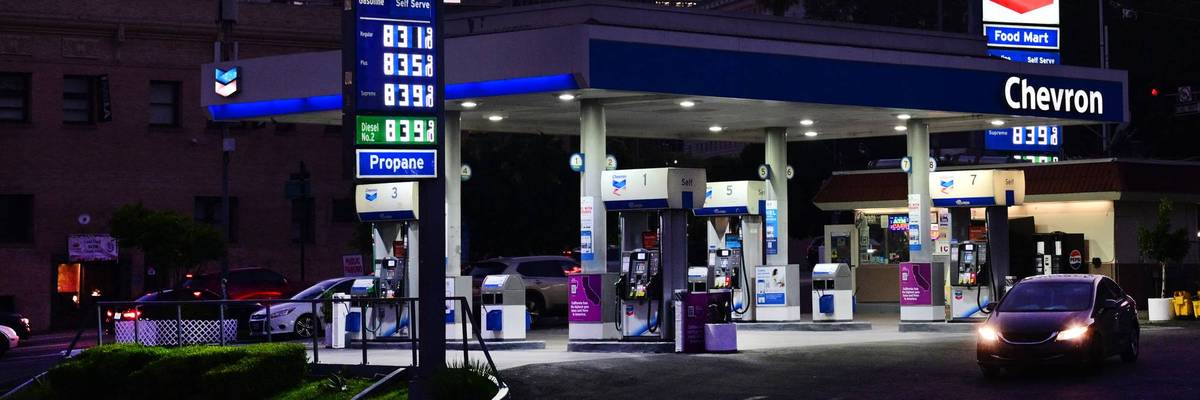
High gas prices are displayed at a Chevron gas station in Los Angeles, California on March 9, 2026.
Climate Group Says Rich Nations 'Must Tax Fossil Fuel Windfall Profits' Tied to Iran War
"If G7 countries are serious about stabilizing the market, they need to stop protecting profits and start taxing companies which fuel the climate crisis."
Campaigners with the global climate movement 350.org argued Tuesday that Group of Seven countries "must tax fossil fuel windfall profits" from price hikes related to the US-Israeli war on Iran.
"Wars expose a deep flaw in our energy system: When prices spike, fossil fuel companies stand ready to cash in while households and businesses struggle," said the group's global campaigns manager, Clémence Dubois, in a statement. "That's not just market volatility, it's the result of governments allowing fossil fuel companies to keep the power to shape the energy system and pass the costs onto everyone else."
In addition to the US, the G7 includes Canada, France, Germany, Italy, Japan, and the United Kingdom. Dubois declared that they all "must stop reinforcing this model with fossil fuel tax cuts that only inflate corporate earnings. Cutting fossil fuel taxes during a crisis is not a relief for families, it's a subsidy for companies that are already enjoying windfall profits."
"The right response is a strong windfall tax, which should be redirected to support households and accelerate the transition to clean energy that reduces our dependence on the very fuels driving both climate disruption and global instability," she stressed, just days after new research revealed that the pace of global heating from fossil fuels has accelerated over the past decade.
While advocates have long called for taxing oil and gas companies to pay for a swift transition to clean power and the impacts of the climate emergency on communities around the world, the Trump administration and Israel's assault on Iran has generated fresh demands for an urgent transition away from dirty energy.
The US and Israel have bombarded civilian infrastructure, including Iranian oil facilities, sending clouds of smoke and black droplets falling over Tehran. Iran has threatened to fire upon ships crossing through the Strait of Hormuz, a crucial pathway for both oil and liquefied natural gas (LNG) between the Persian Gulf and the Gulf of Oman.
The shutdown of both the key waterway and Qatari liquefied natural gas facilities damaged by Iranian attacks has sent oil prices soaring and led to estimates that US LNG companies could soon see $20 billion in monthly windfall profits, as they direct exports to the highest bidders.
As Politico reported: "News early Monday that the United States and other G7 countries were discussing a possible coordinated release of oil from their strategic petroleum reserves halted a panic-driven market spike that briefly pushed US oil to nearly $120 a barrel overnight. The French government later in the morning walked that back, saying the G7 was 'not there yet' as far as tapping oil stockpiles."
Speaking in Cyprus on Monday, French President Emmanuel Macron said that "we are in the process of setting up a purely defensive, purely escort mission, which must be prepared together with both European and non-European states, and whose purpose is to enable, as soon as possible after the most intense phase of the conflict has ended, the escort of container ships and tankers to gradually reopen the Strait of Hormuz."
Meanwhile, Fanny Petitbon, 350's France country manager, said Tuesday that "releasing emergency oil reserves is just a Band-Aid on a gaping wound. If G7 countries are serious about stabilizing the market, they need to stop protecting profits and start taxing companies which fuel the climate crisis."
"Working people shouldn't be paying the price while oil majors treat the war in the Middle East like a winning lottery ticket. We need the G7 to step up and establish a windfall tax now to put those profits back into the pockets of the people," Petitbon asserted. "The French government, as president of the G7, must also confront the elephant in the room—the urgent phaseout of fossil fuels. It can no longer look away from the reality, which is that we cannot stay addicted to oil and gas."
Among the countries significantly impacted by the Strait of Hormuz closure is Japan, which relies on the route for around 70% of its oil and 6% of its LNG imports, according to Reuters. Masayoshi Iyoda, a 350 campaigner for the country, said that "Prime Minister Sanae Takaichi has moved to calm fears over rising energy and food prices, but reassurances and stopgap measures like releasing oil reserves are not enough."
"Fossil fuel companies are cashing in on this crisis. A windfall tax on polluting industries would make them pay by taking responsibility, not ordinary families already stretched by years of stagnant wages and price surges due to climate impacts," Iyoda continued, before looking toward Takaichi's planned meeting with US President Donald Trump next week.
"We urge her to reconsider Japan's alignment with the Trump administration's fossil fuel agenda," the campaigner said. "The attack on Iran has shown, once again, how that agenda means prosperity for oil and gas corporations, and higher bills for everyone else. Accelerating a just transition to renewable energy and phasing out fossil fuels is Japan's best option to secure affordable and sustainable energy based on democracy and peace."
We are at a crossroads
This country and this world are at a monumental crossroads. In a few short weeks, US voters will have an opportunity to beat back the forces of fascism and confront the billionaires who are rigging the economy, our media system, and our democracy, making it increasingly impossible for ordinary people to get by. We’re not just talking about the election. We’re talking about what must be done once these fascist elements are vanquished from power. We need a bolder set of solutions than what either major party has so far been willing to offer and a working-class movement ready to fight like hell for it. Trump didn't emerge from nowhere. The conditions that fueled MAGA authoritarianism were created by decades of radical neoliberal economic policies and a corrupt political system dominated by corporate interests. They slashed taxes on the super-rich, promising that the benefits would trickle down. They said giveaways to the corporate titans would make life more affordable for the rest of us. It was all bullshit. And when a bitter, betrayed populace searches for someone to blame, right-wing demagogues have little trouble finding scapegoats. People know when they're being lied to, but you won't hear any of this from the corporate media. Only independent journalism—powered and funded by people who believe in building a better world—can deliver truly trustworthy daily news. Our Fall Campaign is underway, and we need your help. To power our newsroom through the rest of the year, we need to raise $125,000 by midnight on October 31. So if you share our vision, please contribute whatever you can to sustain our work. |
Campaigners with the global climate movement 350.org argued Tuesday that Group of Seven countries "must tax fossil fuel windfall profits" from price hikes related to the US-Israeli war on Iran.
"Wars expose a deep flaw in our energy system: When prices spike, fossil fuel companies stand ready to cash in while households and businesses struggle," said the group's global campaigns manager, Clémence Dubois, in a statement. "That's not just market volatility, it's the result of governments allowing fossil fuel companies to keep the power to shape the energy system and pass the costs onto everyone else."
In addition to the US, the G7 includes Canada, France, Germany, Italy, Japan, and the United Kingdom. Dubois declared that they all "must stop reinforcing this model with fossil fuel tax cuts that only inflate corporate earnings. Cutting fossil fuel taxes during a crisis is not a relief for families, it's a subsidy for companies that are already enjoying windfall profits."
"The right response is a strong windfall tax, which should be redirected to support households and accelerate the transition to clean energy that reduces our dependence on the very fuels driving both climate disruption and global instability," she stressed, just days after new research revealed that the pace of global heating from fossil fuels has accelerated over the past decade.
While advocates have long called for taxing oil and gas companies to pay for a swift transition to clean power and the impacts of the climate emergency on communities around the world, the Trump administration and Israel's assault on Iran has generated fresh demands for an urgent transition away from dirty energy.
The US and Israel have bombarded civilian infrastructure, including Iranian oil facilities, sending clouds of smoke and black droplets falling over Tehran. Iran has threatened to fire upon ships crossing through the Strait of Hormuz, a crucial pathway for both oil and liquefied natural gas (LNG) between the Persian Gulf and the Gulf of Oman.
The shutdown of both the key waterway and Qatari liquefied natural gas facilities damaged by Iranian attacks has sent oil prices soaring and led to estimates that US LNG companies could soon see $20 billion in monthly windfall profits, as they direct exports to the highest bidders.
As Politico reported: "News early Monday that the United States and other G7 countries were discussing a possible coordinated release of oil from their strategic petroleum reserves halted a panic-driven market spike that briefly pushed US oil to nearly $120 a barrel overnight. The French government later in the morning walked that back, saying the G7 was 'not there yet' as far as tapping oil stockpiles."
Speaking in Cyprus on Monday, French President Emmanuel Macron said that "we are in the process of setting up a purely defensive, purely escort mission, which must be prepared together with both European and non-European states, and whose purpose is to enable, as soon as possible after the most intense phase of the conflict has ended, the escort of container ships and tankers to gradually reopen the Strait of Hormuz."
Meanwhile, Fanny Petitbon, 350's France country manager, said Tuesday that "releasing emergency oil reserves is just a Band-Aid on a gaping wound. If G7 countries are serious about stabilizing the market, they need to stop protecting profits and start taxing companies which fuel the climate crisis."
"Working people shouldn't be paying the price while oil majors treat the war in the Middle East like a winning lottery ticket. We need the G7 to step up and establish a windfall tax now to put those profits back into the pockets of the people," Petitbon asserted. "The French government, as president of the G7, must also confront the elephant in the room—the urgent phaseout of fossil fuels. It can no longer look away from the reality, which is that we cannot stay addicted to oil and gas."
Among the countries significantly impacted by the Strait of Hormuz closure is Japan, which relies on the route for around 70% of its oil and 6% of its LNG imports, according to Reuters. Masayoshi Iyoda, a 350 campaigner for the country, said that "Prime Minister Sanae Takaichi has moved to calm fears over rising energy and food prices, but reassurances and stopgap measures like releasing oil reserves are not enough."
"Fossil fuel companies are cashing in on this crisis. A windfall tax on polluting industries would make them pay by taking responsibility, not ordinary families already stretched by years of stagnant wages and price surges due to climate impacts," Iyoda continued, before looking toward Takaichi's planned meeting with US President Donald Trump next week.
"We urge her to reconsider Japan's alignment with the Trump administration's fossil fuel agenda," the campaigner said. "The attack on Iran has shown, once again, how that agenda means prosperity for oil and gas corporations, and higher bills for everyone else. Accelerating a just transition to renewable energy and phasing out fossil fuels is Japan's best option to secure affordable and sustainable energy based on democracy and peace."
- 'Your Tax Dollars Being Used to Raise Your Gas Prices': US-Israel Bomb Major Iranian Oil Depots ›
- 'Absolutely Massive' Price Shocks Coming as Trump's Iran War Drives Up Gas, Diesel Prices ›
- Thanks to Trump's Iran War, US LNG Giants Could See $20 Billion in Monthly Windfall Profits ›
- 'The Situation Is Scary': Global Economic Chaos as Trump’s Iran War Sends Markets Diving ›
- Dems Introduce Windfall Tax on Big Oil So Companies 'Pay a Price When They Price Gouge' ›
- Opinion | Trump and Israel’s War on Iran Once Again Exposes the Folly of Fossil Fuel Dependence | Common Dreams ›
- Opinion | Corporations and the Rich Should Pay for Trump's Hideous War—Here's How | Common Dreams ›
- Windfall Tax on Big Oil Demanded as Trump's Iran War Pads Profits of Fossil Fuel Giants | Common Dreams ›
- Opinion | Congress, Pass a Windfall Tax on the Oil Companies Profiting From Trump's Iran War | Common Dreams ›
- 'They Profit, We Pay': Coalition Says End Mideast Wars, Tax Fossil Fuel Giants | Common Dreams ›
- Opinion | The 2026 Energy Crisis and Our Wile E. Coyote Moment | Common Dreams ›
- World ‘Burning Through Oil Safety Net’ as Trump Weighs Plans to Restart Iran Assault | Common Dreams ›
- $1.1 Trillion Big Oil Subsidies Spark Fresh Calls for Windfall Tax on Profits From Trump's Iran War | Common Dreams ›
- Opinion | Why We Need a Carbon War Tax | Common Dreams ›
Campaigners with the global climate movement 350.org argued Tuesday that Group of Seven countries "must tax fossil fuel windfall profits" from price hikes related to the US-Israeli war on Iran.
"Wars expose a deep flaw in our energy system: When prices spike, fossil fuel companies stand ready to cash in while households and businesses struggle," said the group's global campaigns manager, Clémence Dubois, in a statement. "That's not just market volatility, it's the result of governments allowing fossil fuel companies to keep the power to shape the energy system and pass the costs onto everyone else."
In addition to the US, the G7 includes Canada, France, Germany, Italy, Japan, and the United Kingdom. Dubois declared that they all "must stop reinforcing this model with fossil fuel tax cuts that only inflate corporate earnings. Cutting fossil fuel taxes during a crisis is not a relief for families, it's a subsidy for companies that are already enjoying windfall profits."
"The right response is a strong windfall tax, which should be redirected to support households and accelerate the transition to clean energy that reduces our dependence on the very fuels driving both climate disruption and global instability," she stressed, just days after new research revealed that the pace of global heating from fossil fuels has accelerated over the past decade.
While advocates have long called for taxing oil and gas companies to pay for a swift transition to clean power and the impacts of the climate emergency on communities around the world, the Trump administration and Israel's assault on Iran has generated fresh demands for an urgent transition away from dirty energy.
The US and Israel have bombarded civilian infrastructure, including Iranian oil facilities, sending clouds of smoke and black droplets falling over Tehran. Iran has threatened to fire upon ships crossing through the Strait of Hormuz, a crucial pathway for both oil and liquefied natural gas (LNG) between the Persian Gulf and the Gulf of Oman.
The shutdown of both the key waterway and Qatari liquefied natural gas facilities damaged by Iranian attacks has sent oil prices soaring and led to estimates that US LNG companies could soon see $20 billion in monthly windfall profits, as they direct exports to the highest bidders.
As Politico reported: "News early Monday that the United States and other G7 countries were discussing a possible coordinated release of oil from their strategic petroleum reserves halted a panic-driven market spike that briefly pushed US oil to nearly $120 a barrel overnight. The French government later in the morning walked that back, saying the G7 was 'not there yet' as far as tapping oil stockpiles."
Speaking in Cyprus on Monday, French President Emmanuel Macron said that "we are in the process of setting up a purely defensive, purely escort mission, which must be prepared together with both European and non-European states, and whose purpose is to enable, as soon as possible after the most intense phase of the conflict has ended, the escort of container ships and tankers to gradually reopen the Strait of Hormuz."
Meanwhile, Fanny Petitbon, 350's France country manager, said Tuesday that "releasing emergency oil reserves is just a Band-Aid on a gaping wound. If G7 countries are serious about stabilizing the market, they need to stop protecting profits and start taxing companies which fuel the climate crisis."
"Working people shouldn't be paying the price while oil majors treat the war in the Middle East like a winning lottery ticket. We need the G7 to step up and establish a windfall tax now to put those profits back into the pockets of the people," Petitbon asserted. "The French government, as president of the G7, must also confront the elephant in the room—the urgent phaseout of fossil fuels. It can no longer look away from the reality, which is that we cannot stay addicted to oil and gas."
Among the countries significantly impacted by the Strait of Hormuz closure is Japan, which relies on the route for around 70% of its oil and 6% of its LNG imports, according to Reuters. Masayoshi Iyoda, a 350 campaigner for the country, said that "Prime Minister Sanae Takaichi has moved to calm fears over rising energy and food prices, but reassurances and stopgap measures like releasing oil reserves are not enough."
"Fossil fuel companies are cashing in on this crisis. A windfall tax on polluting industries would make them pay by taking responsibility, not ordinary families already stretched by years of stagnant wages and price surges due to climate impacts," Iyoda continued, before looking toward Takaichi's planned meeting with US President Donald Trump next week.
"We urge her to reconsider Japan's alignment with the Trump administration's fossil fuel agenda," the campaigner said. "The attack on Iran has shown, once again, how that agenda means prosperity for oil and gas corporations, and higher bills for everyone else. Accelerating a just transition to renewable energy and phasing out fossil fuels is Japan's best option to secure affordable and sustainable energy based on democracy and peace."
- 'Your Tax Dollars Being Used to Raise Your Gas Prices': US-Israel Bomb Major Iranian Oil Depots ›
- 'Absolutely Massive' Price Shocks Coming as Trump's Iran War Drives Up Gas, Diesel Prices ›
- Thanks to Trump's Iran War, US LNG Giants Could See $20 Billion in Monthly Windfall Profits ›
- 'The Situation Is Scary': Global Economic Chaos as Trump’s Iran War Sends Markets Diving ›
- Dems Introduce Windfall Tax on Big Oil So Companies 'Pay a Price When They Price Gouge' ›
- Opinion | Trump and Israel’s War on Iran Once Again Exposes the Folly of Fossil Fuel Dependence | Common Dreams ›
- Opinion | Corporations and the Rich Should Pay for Trump's Hideous War—Here's How | Common Dreams ›
- Windfall Tax on Big Oil Demanded as Trump's Iran War Pads Profits of Fossil Fuel Giants | Common Dreams ›
- Opinion | Congress, Pass a Windfall Tax on the Oil Companies Profiting From Trump's Iran War | Common Dreams ›
- 'They Profit, We Pay': Coalition Says End Mideast Wars, Tax Fossil Fuel Giants | Common Dreams ›
- Opinion | The 2026 Energy Crisis and Our Wile E. Coyote Moment | Common Dreams ›
- World ‘Burning Through Oil Safety Net’ as Trump Weighs Plans to Restart Iran Assault | Common Dreams ›
- $1.1 Trillion Big Oil Subsidies Spark Fresh Calls for Windfall Tax on Profits From Trump's Iran War | Common Dreams ›
- Opinion | Why We Need a Carbon War Tax | Common Dreams ›