SUBSCRIBE TO OUR FREE NEWSLETTER
Daily news & progressive opinion—funded by the people, not the corporations—delivered straight to your inbox.
5
#000000
#FFFFFF
To donate by check, phone, or other method, see our More Ways to Give page.
Daily news & progressive opinion—funded by the people, not the corporations—delivered straight to your inbox.
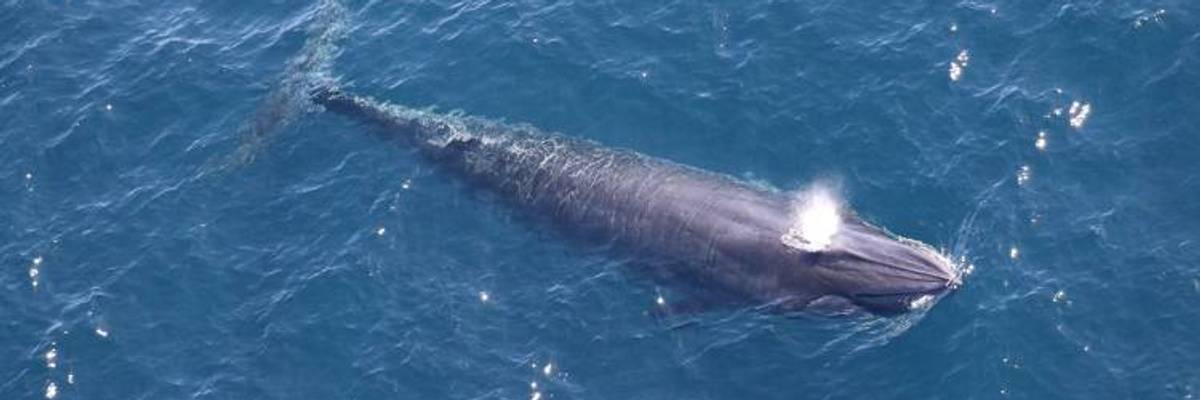
A Rice’s whale is photographed from the air during a survey onboard the NOAA Twin Otter aircraft off the coast of Texas in 2024.
“Burgum’s Extinction Committee is immoral, illegal, and unnecessary,” said the head of the Center for Biological Diversity, which warns it could put the final nail in the coffin of the extremely endangered Rice's whale.
An environmental organization is suing to stop the Trump administration from illegally convening a meeting that could allow oil and gas companies to drive an extremely endangered whale species to extinction.
On Wednesday, the Center for Biological Diversity filed an emergency lawsuit against Secretary of the Interior Doug Burgum in a federal district court in Washington, DC, seeking to block him from convening the Endangered Species Committee, more commonly known as the “Extinction Committee,” on March 31.
This committee is sometimes referred to as the "God Squad" because its members have the power to grant exemptions to the Endangered Species Act that can result in the extinction of imperiled species.
Led by the interior secretary, it has seven total members who can vote to override regulations. Five of them are senior executive officials: the secretaries of agriculture and the Army, the head of the Council of Economic Advisers, and the administrators of the Environmental Protection Agency (EPA) and the National Oceanic and Atmospheric Administration (NOAA). Each affected state also receives a delegate to the committee, but they collectively receive just one vote. Five votes of seven are needed to grant an exemption.
In the federal register, Burgum announced earlier this week that the committee would meet at the end of the month “regarding an Endangered Species Act exemption for Gulf of America oil and gas activities," referring to the Gulf of Mexico by the name preferred by President Donald Trump.
The Center for Biological Diversity said Burgum was seeking to override a requirement for oil and gas companies in the Gulf of Mexico to drive boats at safe speeds in order to protect the nearly extinct Rice’s whale from strikes.
These whales, named after the cetologist Dale Rice, who first recognized them as distinct from other whales in 1965, were not formally recognized as a new species until 2021.
According to the Center for Biological Diversity, only about 51 Rice's whales remain after BP's catastrophic Deepwater Horizon oil spill in 2010, which devastated their population.
Last May, NOAA's National Marine Fisheries Service issued a biological opinion concluding that their continued existence—as well as that of other whale and sea turtle species—was under threat from boat strikes, since Rice's whales spend most of their time in the top 15 meters of water, which often puts them on a collision course with oil vessels.
The agency issued guidance requiring oil industry ships to travel at slower speeds in the eastern Gulf, saying that if they were followed, lethal collisions would be “extremely unlikely to occur” and that the species would be protected.
The Extinction Committee could override this rule, but it has only been convened three times in its history, and not since 1991, when then-President George H.W. Bush used it to open up timber harvests in the Pacific Northwest that endangered the habitats of spotted owls, which were considered threatened under the Endangered Species Act.
The Extinction Committee is invoked so rarely because the circumstances for its use, as outlined in law, are extremely narrow: It can only be convened within 90 days of a biological opinion by the US Fish and Wildlife Service or the National Marine Fisheries Service concluding that a federal action is likely to jeopardize a species. They must also determine that there is no “reasonable and prudent alternative” to the action the government plans to take.
In its lawsuit, the Center for Biological Diversity says that neither of these criteria has been reached, since the Fisheries Service issued its opinion 10 months ago and already established a reasonable alternative: slowing down the boats.
"Slowing boat speeds is not just reasonable, it’s easy, and it’s the absolute minimum the oil and gas industry can do to save Rice’s whales from extinction,” said Kierán Suckling, executive director of the Center for Biological Diversity.
The group said Burgum is also flouting other requirements of the law, including that the meeting be presided over by an administrative judge and have a formal hearing with public comment. No judge has been appointed by Burgum, and the meeting is only scheduled to be livestreamed on YouTube, with no forum for public input.
“Burgum’s Extinction Committee is immoral, illegal, and unnecessary,” Suckling said. “There’s no emergency, no legal basis to convene the committee, and no legal way to approve the extinction of Rice’s whales. This sham is nothing more than Burgum posturing for Trump and saving the fossil fuel industry a few dollars by allowing its boats to drive faster and more recklessly.”
If Rice's whales were to go extinct, they could be the first ever large whale species to be driven out of existence by human activity in recorded history. Earthjustice says that the rollback of boat speed restrictions and other activities by the Trump administration—including the approval of the first BP oil field in the Gulf since the 2010 spill—are putting other species at risk too.
The scheduled March 31 meeting, said the group, "could kick off a months-long process to decide whether to give special treatment to the oil industry by allowing offshore drilling to go forward even if it would lead to the extinction of Gulf species."
“The marine species in the Gulf are our natural heritage. There’s no imaginable justification to sacrifice them,” said Steve Mashuda, Earthjustice's managing attorney for oceans. "It’s beyond reckless even to consider greenlighting the extinction of sea turtles, fish, whales, rays, and corals to further pad the oil industry’s pockets at the public’s expense. Giving carte blanche to industry also takes us further away from renewable energy that is cleaner, cheaper, more reliable, and more efficient than ever before.”
Dear Common Dreams reader, It’s been nearly 30 years since I co-founded Common Dreams with my late wife, Lina Newhouser. We had the radical notion that journalism should serve the public good, not corporate profits. It was clear to us from the outset what it would take to build such a project. No paid advertisements. No corporate sponsors. No millionaire publisher telling us what to think or do. Many people said we wouldn't last a year, but we proved those doubters wrong. Together with a tremendous team of journalists and dedicated staff, we built an independent media outlet free from the constraints of profits and corporate control. Our mission has always been simple: To inform. To inspire. To ignite change for the common good. Building Common Dreams was not easy. Our survival was never guaranteed. When you take on the most powerful forces—Wall Street greed, fossil fuel industry destruction, Big Tech lobbyists, and uber-rich oligarchs who have spent billions upon billions rigging the economy and democracy in their favor—the only bulwark you have is supporters who believe in your work. But here’s the urgent message from me today. It's never been this bad out there. And it's never been this hard to keep us going. At the very moment Common Dreams is most needed, the threats we face are intensifying. We need your support now more than ever. We don't accept corporate advertising and never will. We don't have a paywall because we don't think people should be blocked from critical news based on their ability to pay. Everything we do is funded by the donations of readers like you. When everyone does the little they can afford, we are strong. But if that support retreats or dries up, so do we. Will you donate now to make sure Common Dreams not only survives but thrives? —Craig Brown, Co-founder |
An environmental organization is suing to stop the Trump administration from illegally convening a meeting that could allow oil and gas companies to drive an extremely endangered whale species to extinction.
On Wednesday, the Center for Biological Diversity filed an emergency lawsuit against Secretary of the Interior Doug Burgum in a federal district court in Washington, DC, seeking to block him from convening the Endangered Species Committee, more commonly known as the “Extinction Committee,” on March 31.
This committee is sometimes referred to as the "God Squad" because its members have the power to grant exemptions to the Endangered Species Act that can result in the extinction of imperiled species.
Led by the interior secretary, it has seven total members who can vote to override regulations. Five of them are senior executive officials: the secretaries of agriculture and the Army, the head of the Council of Economic Advisers, and the administrators of the Environmental Protection Agency (EPA) and the National Oceanic and Atmospheric Administration (NOAA). Each affected state also receives a delegate to the committee, but they collectively receive just one vote. Five votes of seven are needed to grant an exemption.
In the federal register, Burgum announced earlier this week that the committee would meet at the end of the month “regarding an Endangered Species Act exemption for Gulf of America oil and gas activities," referring to the Gulf of Mexico by the name preferred by President Donald Trump.
The Center for Biological Diversity said Burgum was seeking to override a requirement for oil and gas companies in the Gulf of Mexico to drive boats at safe speeds in order to protect the nearly extinct Rice’s whale from strikes.
These whales, named after the cetologist Dale Rice, who first recognized them as distinct from other whales in 1965, were not formally recognized as a new species until 2021.
According to the Center for Biological Diversity, only about 51 Rice's whales remain after BP's catastrophic Deepwater Horizon oil spill in 2010, which devastated their population.
Last May, NOAA's National Marine Fisheries Service issued a biological opinion concluding that their continued existence—as well as that of other whale and sea turtle species—was under threat from boat strikes, since Rice's whales spend most of their time in the top 15 meters of water, which often puts them on a collision course with oil vessels.
The agency issued guidance requiring oil industry ships to travel at slower speeds in the eastern Gulf, saying that if they were followed, lethal collisions would be “extremely unlikely to occur” and that the species would be protected.
The Extinction Committee could override this rule, but it has only been convened three times in its history, and not since 1991, when then-President George H.W. Bush used it to open up timber harvests in the Pacific Northwest that endangered the habitats of spotted owls, which were considered threatened under the Endangered Species Act.
The Extinction Committee is invoked so rarely because the circumstances for its use, as outlined in law, are extremely narrow: It can only be convened within 90 days of a biological opinion by the US Fish and Wildlife Service or the National Marine Fisheries Service concluding that a federal action is likely to jeopardize a species. They must also determine that there is no “reasonable and prudent alternative” to the action the government plans to take.
In its lawsuit, the Center for Biological Diversity says that neither of these criteria has been reached, since the Fisheries Service issued its opinion 10 months ago and already established a reasonable alternative: slowing down the boats.
"Slowing boat speeds is not just reasonable, it’s easy, and it’s the absolute minimum the oil and gas industry can do to save Rice’s whales from extinction,” said Kierán Suckling, executive director of the Center for Biological Diversity.
The group said Burgum is also flouting other requirements of the law, including that the meeting be presided over by an administrative judge and have a formal hearing with public comment. No judge has been appointed by Burgum, and the meeting is only scheduled to be livestreamed on YouTube, with no forum for public input.
“Burgum’s Extinction Committee is immoral, illegal, and unnecessary,” Suckling said. “There’s no emergency, no legal basis to convene the committee, and no legal way to approve the extinction of Rice’s whales. This sham is nothing more than Burgum posturing for Trump and saving the fossil fuel industry a few dollars by allowing its boats to drive faster and more recklessly.”
If Rice's whales were to go extinct, they could be the first ever large whale species to be driven out of existence by human activity in recorded history. Earthjustice says that the rollback of boat speed restrictions and other activities by the Trump administration—including the approval of the first BP oil field in the Gulf since the 2010 spill—are putting other species at risk too.
The scheduled March 31 meeting, said the group, "could kick off a months-long process to decide whether to give special treatment to the oil industry by allowing offshore drilling to go forward even if it would lead to the extinction of Gulf species."
“The marine species in the Gulf are our natural heritage. There’s no imaginable justification to sacrifice them,” said Steve Mashuda, Earthjustice's managing attorney for oceans. "It’s beyond reckless even to consider greenlighting the extinction of sea turtles, fish, whales, rays, and corals to further pad the oil industry’s pockets at the public’s expense. Giving carte blanche to industry also takes us further away from renewable energy that is cleaner, cheaper, more reliable, and more efficient than ever before.”
An environmental organization is suing to stop the Trump administration from illegally convening a meeting that could allow oil and gas companies to drive an extremely endangered whale species to extinction.
On Wednesday, the Center for Biological Diversity filed an emergency lawsuit against Secretary of the Interior Doug Burgum in a federal district court in Washington, DC, seeking to block him from convening the Endangered Species Committee, more commonly known as the “Extinction Committee,” on March 31.
This committee is sometimes referred to as the "God Squad" because its members have the power to grant exemptions to the Endangered Species Act that can result in the extinction of imperiled species.
Led by the interior secretary, it has seven total members who can vote to override regulations. Five of them are senior executive officials: the secretaries of agriculture and the Army, the head of the Council of Economic Advisers, and the administrators of the Environmental Protection Agency (EPA) and the National Oceanic and Atmospheric Administration (NOAA). Each affected state also receives a delegate to the committee, but they collectively receive just one vote. Five votes of seven are needed to grant an exemption.
In the federal register, Burgum announced earlier this week that the committee would meet at the end of the month “regarding an Endangered Species Act exemption for Gulf of America oil and gas activities," referring to the Gulf of Mexico by the name preferred by President Donald Trump.
The Center for Biological Diversity said Burgum was seeking to override a requirement for oil and gas companies in the Gulf of Mexico to drive boats at safe speeds in order to protect the nearly extinct Rice’s whale from strikes.
These whales, named after the cetologist Dale Rice, who first recognized them as distinct from other whales in 1965, were not formally recognized as a new species until 2021.
According to the Center for Biological Diversity, only about 51 Rice's whales remain after BP's catastrophic Deepwater Horizon oil spill in 2010, which devastated their population.
Last May, NOAA's National Marine Fisheries Service issued a biological opinion concluding that their continued existence—as well as that of other whale and sea turtle species—was under threat from boat strikes, since Rice's whales spend most of their time in the top 15 meters of water, which often puts them on a collision course with oil vessels.
The agency issued guidance requiring oil industry ships to travel at slower speeds in the eastern Gulf, saying that if they were followed, lethal collisions would be “extremely unlikely to occur” and that the species would be protected.
The Extinction Committee could override this rule, but it has only been convened three times in its history, and not since 1991, when then-President George H.W. Bush used it to open up timber harvests in the Pacific Northwest that endangered the habitats of spotted owls, which were considered threatened under the Endangered Species Act.
The Extinction Committee is invoked so rarely because the circumstances for its use, as outlined in law, are extremely narrow: It can only be convened within 90 days of a biological opinion by the US Fish and Wildlife Service or the National Marine Fisheries Service concluding that a federal action is likely to jeopardize a species. They must also determine that there is no “reasonable and prudent alternative” to the action the government plans to take.
In its lawsuit, the Center for Biological Diversity says that neither of these criteria has been reached, since the Fisheries Service issued its opinion 10 months ago and already established a reasonable alternative: slowing down the boats.
"Slowing boat speeds is not just reasonable, it’s easy, and it’s the absolute minimum the oil and gas industry can do to save Rice’s whales from extinction,” said Kierán Suckling, executive director of the Center for Biological Diversity.
The group said Burgum is also flouting other requirements of the law, including that the meeting be presided over by an administrative judge and have a formal hearing with public comment. No judge has been appointed by Burgum, and the meeting is only scheduled to be livestreamed on YouTube, with no forum for public input.
“Burgum’s Extinction Committee is immoral, illegal, and unnecessary,” Suckling said. “There’s no emergency, no legal basis to convene the committee, and no legal way to approve the extinction of Rice’s whales. This sham is nothing more than Burgum posturing for Trump and saving the fossil fuel industry a few dollars by allowing its boats to drive faster and more recklessly.”
If Rice's whales were to go extinct, they could be the first ever large whale species to be driven out of existence by human activity in recorded history. Earthjustice says that the rollback of boat speed restrictions and other activities by the Trump administration—including the approval of the first BP oil field in the Gulf since the 2010 spill—are putting other species at risk too.
The scheduled March 31 meeting, said the group, "could kick off a months-long process to decide whether to give special treatment to the oil industry by allowing offshore drilling to go forward even if it would lead to the extinction of Gulf species."
“The marine species in the Gulf are our natural heritage. There’s no imaginable justification to sacrifice them,” said Steve Mashuda, Earthjustice's managing attorney for oceans. "It’s beyond reckless even to consider greenlighting the extinction of sea turtles, fish, whales, rays, and corals to further pad the oil industry’s pockets at the public’s expense. Giving carte blanche to industry also takes us further away from renewable energy that is cleaner, cheaper, more reliable, and more efficient than ever before.”