SUBSCRIBE TO OUR FREE NEWSLETTER
Daily news & progressive opinion—funded by the people, not the corporations—delivered straight to your inbox.
5
#000000
#FFFFFF
To donate by check, phone, or other method, see our More Ways to Give page.
Daily news & progressive opinion—funded by the people, not the corporations—delivered straight to your inbox.
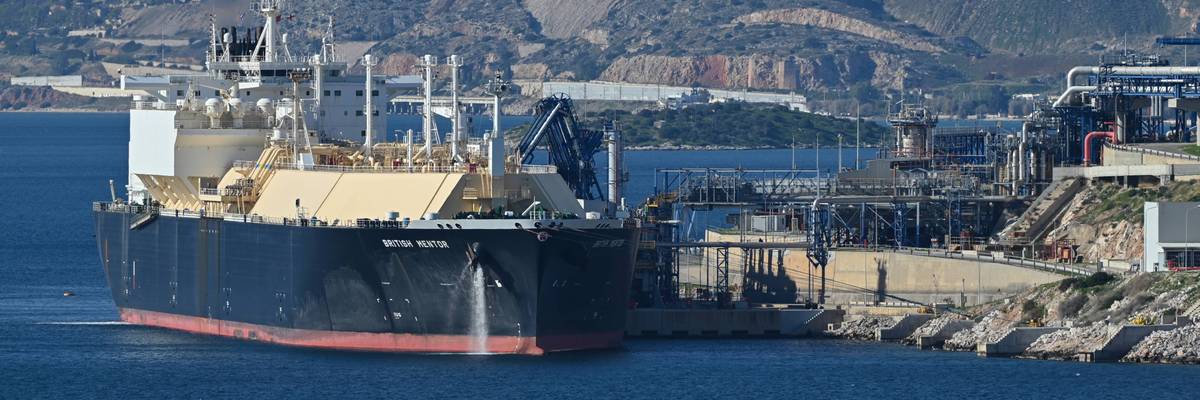
The liquefied natural gas tanker British Mentor unloads US LNG at the Revithoussa terminal near Athens, in Megara, Greece, on December 27, 2025.
"Oil and gas companies may achieve huge windfall profits in a year that previously looked far less lucrative for them, and billions of people could see their energy bills soar," warned one campaigner.
From declaring an energy emergency and ditching global climate initiatives to abducting the Venezuelan leader to seize control of the country's nationalized oil industry, President Donald Trump has taken various actions to serve his fossil fuel donors since returning to power last year. Now, his and Israel's war on Iran could soon lead to US liquefied natural gas giants pocketing tens of billions in windfall profits.
"The Persian Gulf has some of the world's largest oil and gas producers," Oil Change International research co-director Lorne Stockman explained in a Tuesday blog post, "and a large proportion of that production, around 20% of global petroleum, must pass through a relatively narrow corridor controlled by Iran to reach global markets: the Strait of Hormuz," between the Persian Gulf and the Gulf of Oman.
Stockman—whose advocacy group works to expose the costs of fossil fuels and facilitate a just transition to clean energy—noted that "crude oil, refined petroleum products, and liquefied natural gas (LNG) traverse the strait in vast quantities every day. But not since Saturday. With missiles, fighter jets, and drones circling, shipping has ground to a halt, and Iran reportedly threatened to close the strait by force on Monday."
As the conflict in the Persian Gulf continues, fossil fuel companies are preparing for record-breaking profits while billions of people face soaring energy bills and "energy poverty."We’re tired of a world where our energy system fuels war and destroys our climate. oilchange.org/blogs/trumps...
[image or embed]
— 350.org (@350.org) March 4, 2026 at 4:43 AM
Based on ship-tracking data from MarineTraffic, Reuters estimated Wednesday that "at least 200 ships, including oil and liquefied natural gas tankers as well as cargo ships, remained at anchor in open waters off the coast of major Gulf producers including Iraq, Saudi Arabia, and Qatar," and "hundreds of other vessels remained outside Hormuz unable to reach ports."
Stockman warned that "depending on how long the violence and its atrocious human toll continues—Trump said it may take weeks until his undefined objectives are achieved—this will have huge implications for energy markets. Oil and gas companies may achieve huge windfall profits in a year that previously looked far less lucrative for them, and billions of people could see their energy bills soar."
Since Trump and Israeli Benjamin Netanyahu launched "Operation Epic Fury" on Saturday, over 1,000 people had been killed as of Wednesday, according to the Iranian government, and oil prices have surged—highlighting how, as Greenpeace International executive director Mads Christensen put it earlier this week, "as long as our world runs on oil and gas, our peace, security and our pockets will always be at the mercy of geopolitics."
Qatar exports about 20% of the global LNG supply, second only to the United States. All of that LNG goes through the Strait of Hormuz. An Iranian drone attack on Monday targeted Qatari LNG facilities, leading state-owned QatarEnergy to declare force majeure on exports. Two unnamed sources told Reuters that QE "will fully shut down gas liquefaction on Wednesday," and "it may take at least a month to return to normal production volumes."
The Qatari shutdown is expected to boost the US LNG industry, which exported about 108 million metric tons last year. Already, shares of the two largest LNG producers in the United States, Cheniere and Venture Global, have surged.
"We've got an acute contraction of global LNG supply," Alex Munton, an expert on natural gas markets at consulting firm Rapidan Energy, told CNBC. "The world is now down 20% from where it was, and that leaves the world short."
As CNBC reported Tuesday:
US producers can't ramp LNG production beyond current levels, Munton said. "They're basically running at capacity," he said.
But since their customer contracts don't have fixed destinations, they can reroute LNG to meet demand, he said. The flexible capacity at US LNG producers like Venture and Cheniere plays a crucial role in moments of crisis, the analyst said. It's a unique feature of the US LNG industry, he added.
"The volumes are able to reroute to where the demand is greatest," Munton said. "We saw this in 2022 after Russia's invasion of Ukraine. Suddenly, Europe was left short, and it was able to call on US LNG and utilize the inherent flexibility of US LNG.
US LNG cannot replace lost supply from Qatar, but buyers who really need the gas and are willing to pay a high enough price will get it, Munton said.
Seb Kennedy, the energy journalist and market analyst behind the newsletter Energy Flux, estimated Wednesday that "American LNG exports could generate up to $4 billion in windfall profits if the force majeure remains in effect for one month. This figure could rise as high as $20 billion per month if the market is deprived of Qatari supply until the summer."
"Over the first four months, US LNG profits could reach more than $33 billion above the pre-Iran average. Over eight months, that figure rises to $108 billion," he continued. "And if, in an extreme scenario, Qatari LNG is shut-in for a full year, the excess profits raining down on US LNG exports could stack up to almost $170 billion—a figure that would represent one of the most concentrated commodity windfalls of the post-2000 era."
"To put that in context, the 12-month Ukraine war windfall accruing to US LNG exporters, from August 2021 through August 2022, is estimated at $84 billion," Kennedy noted. "Iran could, in certain circumstances, eclipse that total in just over six months."
My latest for Energy Flux:💥 War profits, quantified 💥As Middle East regional war upends global gas markets, US LNG exporters stand to pocket a multi-billion-dollar windfallCheck it out 👉 www.energyflux.news/war-profits...
[image or embed]
— Seb Kennedy (@sebkennedy.bsky.social) March 4, 2026 at 11:58 AM
As the US Senate prepared for a vote on a war powers resolution that is not expected to pass but would swiftly halt Trump's assault on Iran, Defense Secretary Pete Hegseth said Wednesday that the war could last at least eight weeks. He also announced that an American submarine fired a torpedo that sank an Iranian naval ship off the coast of Sri Lanka.
On Tuesday, Trump had responded to Iran's attempt to shut down the Strait of Hormuz with a post on his Truth Social platform: "Effective IMMEDIATELY, I have ordered the United States Development Finance Corporation (DFC) to provide, at a very reasonable price, political risk insurance and guarantees for the Financial Security of ALL Maritime Trade, especially Energy, traveling through the Gulf. This will be available to all Shipping Lines. If necessary, the United States Navy will begin escorting tankers through the Strait of Hormuz, as soon as possible. No matter what, the United States will ensure the FREE FLOW of ENERGY to the WORLD. The United States’ ECONOMIC and MILITARY MIGHT is the GREATEST ON EARTH—More actions to come."
However, as the New York Times highlighted Wednesday, "shipping company officials and analysts are skeptical" of Trump's promised fixes, and "some industry executives also worried how quickly these could get up and running."
For example, Helima Croft, the global head of commodity strategy at RBC Capital Markets, wrote to clients on Tuesday that "we think the insurance proposal is likely in a concepts-of-a-plan stage," and she questioned whether there are enough US naval assets in the region to actually provide escorts.
Dear Common Dreams reader, It’s been nearly 30 years since I co-founded Common Dreams with my late wife, Lina Newhouser. We had the radical notion that journalism should serve the public good, not corporate profits. It was clear to us from the outset what it would take to build such a project. No paid advertisements. No corporate sponsors. No millionaire publisher telling us what to think or do. Many people said we wouldn't last a year, but we proved those doubters wrong. Together with a tremendous team of journalists and dedicated staff, we built an independent media outlet free from the constraints of profits and corporate control. Our mission has always been simple: To inform. To inspire. To ignite change for the common good. Building Common Dreams was not easy. Our survival was never guaranteed. When you take on the most powerful forces—Wall Street greed, fossil fuel industry destruction, Big Tech lobbyists, and uber-rich oligarchs who have spent billions upon billions rigging the economy and democracy in their favor—the only bulwark you have is supporters who believe in your work. But here’s the urgent message from me today. It's never been this bad out there. And it's never been this hard to keep us going. At the very moment Common Dreams is most needed, the threats we face are intensifying. We need your support now more than ever. We don't accept corporate advertising and never will. We don't have a paywall because we don't think people should be blocked from critical news based on their ability to pay. Everything we do is funded by the donations of readers like you. When everyone does the little they can afford, we are strong. But if that support retreats or dries up, so do we. Will you donate now to make sure Common Dreams not only survives but thrives? —Craig Brown, Co-founder |
From declaring an energy emergency and ditching global climate initiatives to abducting the Venezuelan leader to seize control of the country's nationalized oil industry, President Donald Trump has taken various actions to serve his fossil fuel donors since returning to power last year. Now, his and Israel's war on Iran could soon lead to US liquefied natural gas giants pocketing tens of billions in windfall profits.
"The Persian Gulf has some of the world's largest oil and gas producers," Oil Change International research co-director Lorne Stockman explained in a Tuesday blog post, "and a large proportion of that production, around 20% of global petroleum, must pass through a relatively narrow corridor controlled by Iran to reach global markets: the Strait of Hormuz," between the Persian Gulf and the Gulf of Oman.
Stockman—whose advocacy group works to expose the costs of fossil fuels and facilitate a just transition to clean energy—noted that "crude oil, refined petroleum products, and liquefied natural gas (LNG) traverse the strait in vast quantities every day. But not since Saturday. With missiles, fighter jets, and drones circling, shipping has ground to a halt, and Iran reportedly threatened to close the strait by force on Monday."
As the conflict in the Persian Gulf continues, fossil fuel companies are preparing for record-breaking profits while billions of people face soaring energy bills and "energy poverty."We’re tired of a world where our energy system fuels war and destroys our climate. oilchange.org/blogs/trumps...
[image or embed]
— 350.org (@350.org) March 4, 2026 at 4:43 AM
Based on ship-tracking data from MarineTraffic, Reuters estimated Wednesday that "at least 200 ships, including oil and liquefied natural gas tankers as well as cargo ships, remained at anchor in open waters off the coast of major Gulf producers including Iraq, Saudi Arabia, and Qatar," and "hundreds of other vessels remained outside Hormuz unable to reach ports."
Stockman warned that "depending on how long the violence and its atrocious human toll continues—Trump said it may take weeks until his undefined objectives are achieved—this will have huge implications for energy markets. Oil and gas companies may achieve huge windfall profits in a year that previously looked far less lucrative for them, and billions of people could see their energy bills soar."
Since Trump and Israeli Benjamin Netanyahu launched "Operation Epic Fury" on Saturday, over 1,000 people had been killed as of Wednesday, according to the Iranian government, and oil prices have surged—highlighting how, as Greenpeace International executive director Mads Christensen put it earlier this week, "as long as our world runs on oil and gas, our peace, security and our pockets will always be at the mercy of geopolitics."
Qatar exports about 20% of the global LNG supply, second only to the United States. All of that LNG goes through the Strait of Hormuz. An Iranian drone attack on Monday targeted Qatari LNG facilities, leading state-owned QatarEnergy to declare force majeure on exports. Two unnamed sources told Reuters that QE "will fully shut down gas liquefaction on Wednesday," and "it may take at least a month to return to normal production volumes."
The Qatari shutdown is expected to boost the US LNG industry, which exported about 108 million metric tons last year. Already, shares of the two largest LNG producers in the United States, Cheniere and Venture Global, have surged.
"We've got an acute contraction of global LNG supply," Alex Munton, an expert on natural gas markets at consulting firm Rapidan Energy, told CNBC. "The world is now down 20% from where it was, and that leaves the world short."
As CNBC reported Tuesday:
US producers can't ramp LNG production beyond current levels, Munton said. "They're basically running at capacity," he said.
But since their customer contracts don't have fixed destinations, they can reroute LNG to meet demand, he said. The flexible capacity at US LNG producers like Venture and Cheniere plays a crucial role in moments of crisis, the analyst said. It's a unique feature of the US LNG industry, he added.
"The volumes are able to reroute to where the demand is greatest," Munton said. "We saw this in 2022 after Russia's invasion of Ukraine. Suddenly, Europe was left short, and it was able to call on US LNG and utilize the inherent flexibility of US LNG.
US LNG cannot replace lost supply from Qatar, but buyers who really need the gas and are willing to pay a high enough price will get it, Munton said.
Seb Kennedy, the energy journalist and market analyst behind the newsletter Energy Flux, estimated Wednesday that "American LNG exports could generate up to $4 billion in windfall profits if the force majeure remains in effect for one month. This figure could rise as high as $20 billion per month if the market is deprived of Qatari supply until the summer."
"Over the first four months, US LNG profits could reach more than $33 billion above the pre-Iran average. Over eight months, that figure rises to $108 billion," he continued. "And if, in an extreme scenario, Qatari LNG is shut-in for a full year, the excess profits raining down on US LNG exports could stack up to almost $170 billion—a figure that would represent one of the most concentrated commodity windfalls of the post-2000 era."
"To put that in context, the 12-month Ukraine war windfall accruing to US LNG exporters, from August 2021 through August 2022, is estimated at $84 billion," Kennedy noted. "Iran could, in certain circumstances, eclipse that total in just over six months."
My latest for Energy Flux:💥 War profits, quantified 💥As Middle East regional war upends global gas markets, US LNG exporters stand to pocket a multi-billion-dollar windfallCheck it out 👉 www.energyflux.news/war-profits...
[image or embed]
— Seb Kennedy (@sebkennedy.bsky.social) March 4, 2026 at 11:58 AM
As the US Senate prepared for a vote on a war powers resolution that is not expected to pass but would swiftly halt Trump's assault on Iran, Defense Secretary Pete Hegseth said Wednesday that the war could last at least eight weeks. He also announced that an American submarine fired a torpedo that sank an Iranian naval ship off the coast of Sri Lanka.
On Tuesday, Trump had responded to Iran's attempt to shut down the Strait of Hormuz with a post on his Truth Social platform: "Effective IMMEDIATELY, I have ordered the United States Development Finance Corporation (DFC) to provide, at a very reasonable price, political risk insurance and guarantees for the Financial Security of ALL Maritime Trade, especially Energy, traveling through the Gulf. This will be available to all Shipping Lines. If necessary, the United States Navy will begin escorting tankers through the Strait of Hormuz, as soon as possible. No matter what, the United States will ensure the FREE FLOW of ENERGY to the WORLD. The United States’ ECONOMIC and MILITARY MIGHT is the GREATEST ON EARTH—More actions to come."
However, as the New York Times highlighted Wednesday, "shipping company officials and analysts are skeptical" of Trump's promised fixes, and "some industry executives also worried how quickly these could get up and running."
For example, Helima Croft, the global head of commodity strategy at RBC Capital Markets, wrote to clients on Tuesday that "we think the insurance proposal is likely in a concepts-of-a-plan stage," and she questioned whether there are enough US naval assets in the region to actually provide escorts.
From declaring an energy emergency and ditching global climate initiatives to abducting the Venezuelan leader to seize control of the country's nationalized oil industry, President Donald Trump has taken various actions to serve his fossil fuel donors since returning to power last year. Now, his and Israel's war on Iran could soon lead to US liquefied natural gas giants pocketing tens of billions in windfall profits.
"The Persian Gulf has some of the world's largest oil and gas producers," Oil Change International research co-director Lorne Stockman explained in a Tuesday blog post, "and a large proportion of that production, around 20% of global petroleum, must pass through a relatively narrow corridor controlled by Iran to reach global markets: the Strait of Hormuz," between the Persian Gulf and the Gulf of Oman.
Stockman—whose advocacy group works to expose the costs of fossil fuels and facilitate a just transition to clean energy—noted that "crude oil, refined petroleum products, and liquefied natural gas (LNG) traverse the strait in vast quantities every day. But not since Saturday. With missiles, fighter jets, and drones circling, shipping has ground to a halt, and Iran reportedly threatened to close the strait by force on Monday."
As the conflict in the Persian Gulf continues, fossil fuel companies are preparing for record-breaking profits while billions of people face soaring energy bills and "energy poverty."We’re tired of a world where our energy system fuels war and destroys our climate. oilchange.org/blogs/trumps...
[image or embed]
— 350.org (@350.org) March 4, 2026 at 4:43 AM
Based on ship-tracking data from MarineTraffic, Reuters estimated Wednesday that "at least 200 ships, including oil and liquefied natural gas tankers as well as cargo ships, remained at anchor in open waters off the coast of major Gulf producers including Iraq, Saudi Arabia, and Qatar," and "hundreds of other vessels remained outside Hormuz unable to reach ports."
Stockman warned that "depending on how long the violence and its atrocious human toll continues—Trump said it may take weeks until his undefined objectives are achieved—this will have huge implications for energy markets. Oil and gas companies may achieve huge windfall profits in a year that previously looked far less lucrative for them, and billions of people could see their energy bills soar."
Since Trump and Israeli Benjamin Netanyahu launched "Operation Epic Fury" on Saturday, over 1,000 people had been killed as of Wednesday, according to the Iranian government, and oil prices have surged—highlighting how, as Greenpeace International executive director Mads Christensen put it earlier this week, "as long as our world runs on oil and gas, our peace, security and our pockets will always be at the mercy of geopolitics."
Qatar exports about 20% of the global LNG supply, second only to the United States. All of that LNG goes through the Strait of Hormuz. An Iranian drone attack on Monday targeted Qatari LNG facilities, leading state-owned QatarEnergy to declare force majeure on exports. Two unnamed sources told Reuters that QE "will fully shut down gas liquefaction on Wednesday," and "it may take at least a month to return to normal production volumes."
The Qatari shutdown is expected to boost the US LNG industry, which exported about 108 million metric tons last year. Already, shares of the two largest LNG producers in the United States, Cheniere and Venture Global, have surged.
"We've got an acute contraction of global LNG supply," Alex Munton, an expert on natural gas markets at consulting firm Rapidan Energy, told CNBC. "The world is now down 20% from where it was, and that leaves the world short."
As CNBC reported Tuesday:
US producers can't ramp LNG production beyond current levels, Munton said. "They're basically running at capacity," he said.
But since their customer contracts don't have fixed destinations, they can reroute LNG to meet demand, he said. The flexible capacity at US LNG producers like Venture and Cheniere plays a crucial role in moments of crisis, the analyst said. It's a unique feature of the US LNG industry, he added.
"The volumes are able to reroute to where the demand is greatest," Munton said. "We saw this in 2022 after Russia's invasion of Ukraine. Suddenly, Europe was left short, and it was able to call on US LNG and utilize the inherent flexibility of US LNG.
US LNG cannot replace lost supply from Qatar, but buyers who really need the gas and are willing to pay a high enough price will get it, Munton said.
Seb Kennedy, the energy journalist and market analyst behind the newsletter Energy Flux, estimated Wednesday that "American LNG exports could generate up to $4 billion in windfall profits if the force majeure remains in effect for one month. This figure could rise as high as $20 billion per month if the market is deprived of Qatari supply until the summer."
"Over the first four months, US LNG profits could reach more than $33 billion above the pre-Iran average. Over eight months, that figure rises to $108 billion," he continued. "And if, in an extreme scenario, Qatari LNG is shut-in for a full year, the excess profits raining down on US LNG exports could stack up to almost $170 billion—a figure that would represent one of the most concentrated commodity windfalls of the post-2000 era."
"To put that in context, the 12-month Ukraine war windfall accruing to US LNG exporters, from August 2021 through August 2022, is estimated at $84 billion," Kennedy noted. "Iran could, in certain circumstances, eclipse that total in just over six months."
My latest for Energy Flux:💥 War profits, quantified 💥As Middle East regional war upends global gas markets, US LNG exporters stand to pocket a multi-billion-dollar windfallCheck it out 👉 www.energyflux.news/war-profits...
[image or embed]
— Seb Kennedy (@sebkennedy.bsky.social) March 4, 2026 at 11:58 AM
As the US Senate prepared for a vote on a war powers resolution that is not expected to pass but would swiftly halt Trump's assault on Iran, Defense Secretary Pete Hegseth said Wednesday that the war could last at least eight weeks. He also announced that an American submarine fired a torpedo that sank an Iranian naval ship off the coast of Sri Lanka.
On Tuesday, Trump had responded to Iran's attempt to shut down the Strait of Hormuz with a post on his Truth Social platform: "Effective IMMEDIATELY, I have ordered the United States Development Finance Corporation (DFC) to provide, at a very reasonable price, political risk insurance and guarantees for the Financial Security of ALL Maritime Trade, especially Energy, traveling through the Gulf. This will be available to all Shipping Lines. If necessary, the United States Navy will begin escorting tankers through the Strait of Hormuz, as soon as possible. No matter what, the United States will ensure the FREE FLOW of ENERGY to the WORLD. The United States’ ECONOMIC and MILITARY MIGHT is the GREATEST ON EARTH—More actions to come."
However, as the New York Times highlighted Wednesday, "shipping company officials and analysts are skeptical" of Trump's promised fixes, and "some industry executives also worried how quickly these could get up and running."
For example, Helima Croft, the global head of commodity strategy at RBC Capital Markets, wrote to clients on Tuesday that "we think the insurance proposal is likely in a concepts-of-a-plan stage," and she questioned whether there are enough US naval assets in the region to actually provide escorts.