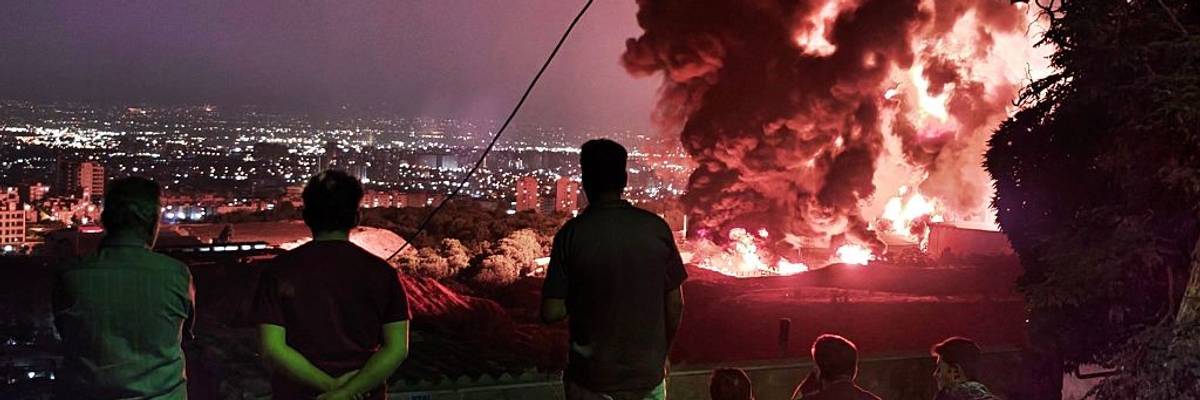
People observe fire and smoke from an Israeli attack on the Shahran oil depot on June 15, 2025 in Tehran, Iran.
As Another Oil-Fueled War Erupts, Study Reveals Planet Heating at Unprecedented Rate
The findings mean global temperatures are on track to surpass 1.5°C above preindustrial levels before 2030.
Nearly a week into President Donald Trump's illegal war on Iran that is likely to increase climate-warming emissions, new research has found that the pace of human-caused global heating has accelerated over the past 10 years.
The study, published in Geophysical Research Letters on Friday, concluded that global heating had nearly doubled from a rate of less than 0.2°C a decade from 1970-2015 to 0.35°C between 2015-25. This would put global temperatures on track to surpass 1.5°C above preindustrial levels before 2030.
"Warming proceeding faster is not unexpected by climate models, but it is a cause of concern and shows how insufficient the efforts to slow and eventually stop global warming under the Paris Climate Accord have so far been," study authors Stefan Rahmstorf and G. Foster wrote.
Scientists had long suspected that global warming was speeding up, given that the past three years were the three hottest on record. Yet previous studies had not been able to find statistically significant evidence of acceleration. The new study removed the natural variability from solar variations, volcanic eruptions, and El Niño from the data, which revealed a statistically significant speedup.
“How quickly the Earth continues to warm ultimately depends on how rapidly we reduce global CO2 emissions from fossil fuels to zero."
It follows a study from 2025 that found a smaller increase of 0.27°C per decade from 2015-24.
“Either way, this represents a significant increase in the rate of warming,” Zeke Hausfather, a climate scientist at Berkeley Earth and a co-author on the earlier study, told The Guardian. “[This] should be worrying as the world hurtles toward crossing 1.5°C later this decade.”
Whatever the rate of increase, the solution, from a scientific perspective, is clear.
“How quickly the Earth continues to warm ultimately depends on how rapidly we reduce global CO2 emissions from fossil fuels to zero,” Rahmstorf, a Potsdam Institute for Climate Impact Research scientist, told The Guardian.
Yet the findings come at a time when emissions look set only to increase, as the US launches an oil-fueled war on Iran that risks drawing other major military powers into a greater conflict.
"The outbreak of any war is bad news for the climate, just as the election of politicians hostile to climate action is," Mark Hertsgaard, Covering Climate Now executive director and co-founder, and Giles Trendle, former managing director of Al Jazeera English, wrote in a newsletter on Thursday. "The climate implications of this new war are not the center of attention at the moment, but they are essential context for understanding what’s at stake. At a time when civilization is hurtling toward irreversible climate breakdown, to overlook the climate consequences of three of the deadliest militaries on Earth going to war would be journalistic malpractice."
War itself increases greenhouse gas emissions. Studies have found that Russia's invasion of Ukraine emitted as much in its first two years as the annual emissions of the Netherlands, while Israel's genocide in Gaza emitted as much in its first four months as each of the 135 lowest-emitting nations in a year.
The Conflict and Environment Observatory observed 120 incidents of environmental harm during the first three days of the Iran conflict, and noted that attacks on oil and gas infrastructure had global implications:
There are also consequences for the global environment through changes in greenhouse gas emissions. Attacks on oil and gas sites will release methane, carbon dioxide, and other greenhouse gasses, but the curtailment of production—as has occurred with Qatari LNG [liquefied natural gas], oil production in Iraqi Kurdistan, and Israeli offshore gas—does not necessarily reduce emissions. Instead energy price signals can lead to short term substitution, as well as more complex downstream energy supply changes over longer timeframes.
Fossil fuels are also required to power the machinery that makes war possible.
"What’s beyond dispute is that this war could not be fought without oil," Hertsgaard and Trendle wrote. "The aircraft carriers, jet planes, and the myriad support systems they require gobble immense quantities of fossil fuels. Which helps explain why the US Department of Defense is the largest institutional emitter of greenhouse gases globally."
There is also the speculation that control of fossil fuels is one motivation for the war itself, given that Iran has the world's third-largest reserve of oil. While Trump has not included oil in his incoherent word salad of war aims, as he did when he kidnapped Venezuelan President Nicolás Maduro in January, climate advocate Bill McKibben pointed out that members of US oil industry have said that they would rather develop Iran's oil than Venezuela's, as its industry is more "structurally sound."
"Europe, Asia, and other regions whose energy costs skyrocket because of this reckless escalation by the Trump administration are reminded, yet again, that fossil fuels are volatile, insecure, and expensive."
"The military attacks on Iran are not about peace and democracy, but rather about sowing fear, bloodshed, and despair as the US attempts to further destabilize the region and secure access to profitable natural resources that it wants to control," the Climate Justice Alliance said in a statement. "This is not surprising given recent foreign policy actions taken by the Trump administration in Venezuela and Cuba, and our ongoing history of engaging in coups, occupations, and endless wars to control resource-rich countries, especially for oil and gas."
Yet, at the same time, the war is already offering an object lesson in the dangers of relying on fossil fuels—for everyone except fossil fuel CEOs. The war could disrupt markets such that profits soar for Big Oil and liquefied natural gas companies while ordinary people suddenly find themselves struggling to pay gas or heating bills.
"Iran is in the middle of one of the world’s most important energy corridors," Lorne Stockman, Oil Change International research director, told Common Dreams. "Roughly 20% of global petroleum flows through the Strait of Hormuz, so when military escalation disrupts that route, global energy markets are immediately impacted."
Stockman continued: "That instability means higher energy bills for people around the world while communities in the region suffer the devastation of war. Europe, Asia, and other regions whose energy costs skyrocket because of this reckless escalation by the Trump administration are reminded, yet again, that fossil fuels are volatile, insecure, and expensive. The only question is whether governments will heed that signal and make a fair fossil fuel phase out a priority.”
Chair of the Fossil Fuel Non-Proliferation Treaty Tzeporah Berman made a similar point on social media: "Drones hitting Saudi oil fields, Qatar halting LNG production, Iran putting a squeeze on the Strait of Hormuz, and US attack on Iran’s Kharg Island oil terminals—all of it should be a wake-up call that fossil fuel phaseout is a national and energy security priority."
Yet Berman noted that the energy landscape is different today than it has been during previous periods of war.
"Unlike previous oil wars renewable energy is now available at scale," Berman continued. "It's distributed, diversified, and resilient. Most importantly, solar panels don’t blow up and once they are in place you don’t need ships to constantly feed them to make energy. The sun is looking like a pretty stable energy source right about now."
We are at a crossroads
This country and this world are at a monumental crossroads. In a few short weeks, US voters will have an opportunity to beat back the forces of fascism and confront the billionaires who are rigging the economy, our media system, and our democracy, making it increasingly impossible for ordinary people to get by. We’re not just talking about the election. We’re talking about what must be done once these fascist elements are vanquished from power. We need a bolder set of solutions than what either major party has so far been willing to offer and a working-class movement ready to fight like hell for it. Trump didn't emerge from nowhere. The conditions that fueled MAGA authoritarianism were created by decades of radical neoliberal economic policies and a corrupt political system dominated by corporate interests. They slashed taxes on the super-rich, promising that the benefits would trickle down. They said giveaways to the corporate titans would make life more affordable for the rest of us. It was all bullshit. And when a bitter, betrayed populace searches for someone to blame, right-wing demagogues have little trouble finding scapegoats. People know when they're being lied to, but you won't hear any of this from the corporate media. Only independent journalism—powered and funded by people who believe in building a better world—can deliver truly trustworthy daily news. Our Fall Campaign is underway, and we need your help. To power our newsroom through the rest of the year, we need to raise $125,000 by midnight on October 31. So if you share our vision, please contribute whatever you can to sustain our work. |
Nearly a week into President Donald Trump's illegal war on Iran that is likely to increase climate-warming emissions, new research has found that the pace of human-caused global heating has accelerated over the past 10 years.
The study, published in Geophysical Research Letters on Friday, concluded that global heating had nearly doubled from a rate of less than 0.2°C a decade from 1970-2015 to 0.35°C between 2015-25. This would put global temperatures on track to surpass 1.5°C above preindustrial levels before 2030.
"Warming proceeding faster is not unexpected by climate models, but it is a cause of concern and shows how insufficient the efforts to slow and eventually stop global warming under the Paris Climate Accord have so far been," study authors Stefan Rahmstorf and G. Foster wrote.
Scientists had long suspected that global warming was speeding up, given that the past three years were the three hottest on record. Yet previous studies had not been able to find statistically significant evidence of acceleration. The new study removed the natural variability from solar variations, volcanic eruptions, and El Niño from the data, which revealed a statistically significant speedup.
“How quickly the Earth continues to warm ultimately depends on how rapidly we reduce global CO2 emissions from fossil fuels to zero."
It follows a study from 2025 that found a smaller increase of 0.27°C per decade from 2015-24.
“Either way, this represents a significant increase in the rate of warming,” Zeke Hausfather, a climate scientist at Berkeley Earth and a co-author on the earlier study, told The Guardian. “[This] should be worrying as the world hurtles toward crossing 1.5°C later this decade.”
Whatever the rate of increase, the solution, from a scientific perspective, is clear.
“How quickly the Earth continues to warm ultimately depends on how rapidly we reduce global CO2 emissions from fossil fuels to zero,” Rahmstorf, a Potsdam Institute for Climate Impact Research scientist, told The Guardian.
Yet the findings come at a time when emissions look set only to increase, as the US launches an oil-fueled war on Iran that risks drawing other major military powers into a greater conflict.
"The outbreak of any war is bad news for the climate, just as the election of politicians hostile to climate action is," Mark Hertsgaard, Covering Climate Now executive director and co-founder, and Giles Trendle, former managing director of Al Jazeera English, wrote in a newsletter on Thursday. "The climate implications of this new war are not the center of attention at the moment, but they are essential context for understanding what’s at stake. At a time when civilization is hurtling toward irreversible climate breakdown, to overlook the climate consequences of three of the deadliest militaries on Earth going to war would be journalistic malpractice."
War itself increases greenhouse gas emissions. Studies have found that Russia's invasion of Ukraine emitted as much in its first two years as the annual emissions of the Netherlands, while Israel's genocide in Gaza emitted as much in its first four months as each of the 135 lowest-emitting nations in a year.
The Conflict and Environment Observatory observed 120 incidents of environmental harm during the first three days of the Iran conflict, and noted that attacks on oil and gas infrastructure had global implications:
There are also consequences for the global environment through changes in greenhouse gas emissions. Attacks on oil and gas sites will release methane, carbon dioxide, and other greenhouse gasses, but the curtailment of production—as has occurred with Qatari LNG [liquefied natural gas], oil production in Iraqi Kurdistan, and Israeli offshore gas—does not necessarily reduce emissions. Instead energy price signals can lead to short term substitution, as well as more complex downstream energy supply changes over longer timeframes.
Fossil fuels are also required to power the machinery that makes war possible.
"What’s beyond dispute is that this war could not be fought without oil," Hertsgaard and Trendle wrote. "The aircraft carriers, jet planes, and the myriad support systems they require gobble immense quantities of fossil fuels. Which helps explain why the US Department of Defense is the largest institutional emitter of greenhouse gases globally."
There is also the speculation that control of fossil fuels is one motivation for the war itself, given that Iran has the world's third-largest reserve of oil. While Trump has not included oil in his incoherent word salad of war aims, as he did when he kidnapped Venezuelan President Nicolás Maduro in January, climate advocate Bill McKibben pointed out that members of US oil industry have said that they would rather develop Iran's oil than Venezuela's, as its industry is more "structurally sound."
"Europe, Asia, and other regions whose energy costs skyrocket because of this reckless escalation by the Trump administration are reminded, yet again, that fossil fuels are volatile, insecure, and expensive."
"The military attacks on Iran are not about peace and democracy, but rather about sowing fear, bloodshed, and despair as the US attempts to further destabilize the region and secure access to profitable natural resources that it wants to control," the Climate Justice Alliance said in a statement. "This is not surprising given recent foreign policy actions taken by the Trump administration in Venezuela and Cuba, and our ongoing history of engaging in coups, occupations, and endless wars to control resource-rich countries, especially for oil and gas."
Yet, at the same time, the war is already offering an object lesson in the dangers of relying on fossil fuels—for everyone except fossil fuel CEOs. The war could disrupt markets such that profits soar for Big Oil and liquefied natural gas companies while ordinary people suddenly find themselves struggling to pay gas or heating bills.
"Iran is in the middle of one of the world’s most important energy corridors," Lorne Stockman, Oil Change International research director, told Common Dreams. "Roughly 20% of global petroleum flows through the Strait of Hormuz, so when military escalation disrupts that route, global energy markets are immediately impacted."
Stockman continued: "That instability means higher energy bills for people around the world while communities in the region suffer the devastation of war. Europe, Asia, and other regions whose energy costs skyrocket because of this reckless escalation by the Trump administration are reminded, yet again, that fossil fuels are volatile, insecure, and expensive. The only question is whether governments will heed that signal and make a fair fossil fuel phase out a priority.”
Chair of the Fossil Fuel Non-Proliferation Treaty Tzeporah Berman made a similar point on social media: "Drones hitting Saudi oil fields, Qatar halting LNG production, Iran putting a squeeze on the Strait of Hormuz, and US attack on Iran’s Kharg Island oil terminals—all of it should be a wake-up call that fossil fuel phaseout is a national and energy security priority."
Yet Berman noted that the energy landscape is different today than it has been during previous periods of war.
"Unlike previous oil wars renewable energy is now available at scale," Berman continued. "It's distributed, diversified, and resilient. Most importantly, solar panels don’t blow up and once they are in place you don’t need ships to constantly feed them to make energy. The sun is looking like a pretty stable energy source right about now."
- 'Very Fabric of Life' at Risk Without Urgent Action to End Fossil Fuel Era ›
- With a Planet on Fire, This Is What It Means to Enter Emergency Mode ›
- After 'Mind-Blowing' September, 2023 Set to Be Hottest Year on Record: EU Climate Agency ›
- Earth Hurtling Toward 'Hothouse Trajectory,' Scientists Warn in Tipping Points Analysis ›
- 'A Sobering Moment': UN Warns Planet Could See Cataclysmic 2.9degC of Heating by 2100 ›
- Satellite Images Ignite Alarm Over 'Unprecedented' Scale and Planet-Heating Emissions of Raging Arctic Wildfires ›
- Opinion | Who Wants to Be Tied to the Energy of War? | Common Dreams ›
Nearly a week into President Donald Trump's illegal war on Iran that is likely to increase climate-warming emissions, new research has found that the pace of human-caused global heating has accelerated over the past 10 years.
The study, published in Geophysical Research Letters on Friday, concluded that global heating had nearly doubled from a rate of less than 0.2°C a decade from 1970-2015 to 0.35°C between 2015-25. This would put global temperatures on track to surpass 1.5°C above preindustrial levels before 2030.
"Warming proceeding faster is not unexpected by climate models, but it is a cause of concern and shows how insufficient the efforts to slow and eventually stop global warming under the Paris Climate Accord have so far been," study authors Stefan Rahmstorf and G. Foster wrote.
Scientists had long suspected that global warming was speeding up, given that the past three years were the three hottest on record. Yet previous studies had not been able to find statistically significant evidence of acceleration. The new study removed the natural variability from solar variations, volcanic eruptions, and El Niño from the data, which revealed a statistically significant speedup.
“How quickly the Earth continues to warm ultimately depends on how rapidly we reduce global CO2 emissions from fossil fuels to zero."
It follows a study from 2025 that found a smaller increase of 0.27°C per decade from 2015-24.
“Either way, this represents a significant increase in the rate of warming,” Zeke Hausfather, a climate scientist at Berkeley Earth and a co-author on the earlier study, told The Guardian. “[This] should be worrying as the world hurtles toward crossing 1.5°C later this decade.”
Whatever the rate of increase, the solution, from a scientific perspective, is clear.
“How quickly the Earth continues to warm ultimately depends on how rapidly we reduce global CO2 emissions from fossil fuels to zero,” Rahmstorf, a Potsdam Institute for Climate Impact Research scientist, told The Guardian.
Yet the findings come at a time when emissions look set only to increase, as the US launches an oil-fueled war on Iran that risks drawing other major military powers into a greater conflict.
"The outbreak of any war is bad news for the climate, just as the election of politicians hostile to climate action is," Mark Hertsgaard, Covering Climate Now executive director and co-founder, and Giles Trendle, former managing director of Al Jazeera English, wrote in a newsletter on Thursday. "The climate implications of this new war are not the center of attention at the moment, but they are essential context for understanding what’s at stake. At a time when civilization is hurtling toward irreversible climate breakdown, to overlook the climate consequences of three of the deadliest militaries on Earth going to war would be journalistic malpractice."
War itself increases greenhouse gas emissions. Studies have found that Russia's invasion of Ukraine emitted as much in its first two years as the annual emissions of the Netherlands, while Israel's genocide in Gaza emitted as much in its first four months as each of the 135 lowest-emitting nations in a year.
The Conflict and Environment Observatory observed 120 incidents of environmental harm during the first three days of the Iran conflict, and noted that attacks on oil and gas infrastructure had global implications:
There are also consequences for the global environment through changes in greenhouse gas emissions. Attacks on oil and gas sites will release methane, carbon dioxide, and other greenhouse gasses, but the curtailment of production—as has occurred with Qatari LNG [liquefied natural gas], oil production in Iraqi Kurdistan, and Israeli offshore gas—does not necessarily reduce emissions. Instead energy price signals can lead to short term substitution, as well as more complex downstream energy supply changes over longer timeframes.
Fossil fuels are also required to power the machinery that makes war possible.
"What’s beyond dispute is that this war could not be fought without oil," Hertsgaard and Trendle wrote. "The aircraft carriers, jet planes, and the myriad support systems they require gobble immense quantities of fossil fuels. Which helps explain why the US Department of Defense is the largest institutional emitter of greenhouse gases globally."
There is also the speculation that control of fossil fuels is one motivation for the war itself, given that Iran has the world's third-largest reserve of oil. While Trump has not included oil in his incoherent word salad of war aims, as he did when he kidnapped Venezuelan President Nicolás Maduro in January, climate advocate Bill McKibben pointed out that members of US oil industry have said that they would rather develop Iran's oil than Venezuela's, as its industry is more "structurally sound."
"Europe, Asia, and other regions whose energy costs skyrocket because of this reckless escalation by the Trump administration are reminded, yet again, that fossil fuels are volatile, insecure, and expensive."
"The military attacks on Iran are not about peace and democracy, but rather about sowing fear, bloodshed, and despair as the US attempts to further destabilize the region and secure access to profitable natural resources that it wants to control," the Climate Justice Alliance said in a statement. "This is not surprising given recent foreign policy actions taken by the Trump administration in Venezuela and Cuba, and our ongoing history of engaging in coups, occupations, and endless wars to control resource-rich countries, especially for oil and gas."
Yet, at the same time, the war is already offering an object lesson in the dangers of relying on fossil fuels—for everyone except fossil fuel CEOs. The war could disrupt markets such that profits soar for Big Oil and liquefied natural gas companies while ordinary people suddenly find themselves struggling to pay gas or heating bills.
"Iran is in the middle of one of the world’s most important energy corridors," Lorne Stockman, Oil Change International research director, told Common Dreams. "Roughly 20% of global petroleum flows through the Strait of Hormuz, so when military escalation disrupts that route, global energy markets are immediately impacted."
Stockman continued: "That instability means higher energy bills for people around the world while communities in the region suffer the devastation of war. Europe, Asia, and other regions whose energy costs skyrocket because of this reckless escalation by the Trump administration are reminded, yet again, that fossil fuels are volatile, insecure, and expensive. The only question is whether governments will heed that signal and make a fair fossil fuel phase out a priority.”
Chair of the Fossil Fuel Non-Proliferation Treaty Tzeporah Berman made a similar point on social media: "Drones hitting Saudi oil fields, Qatar halting LNG production, Iran putting a squeeze on the Strait of Hormuz, and US attack on Iran’s Kharg Island oil terminals—all of it should be a wake-up call that fossil fuel phaseout is a national and energy security priority."
Yet Berman noted that the energy landscape is different today than it has been during previous periods of war.
"Unlike previous oil wars renewable energy is now available at scale," Berman continued. "It's distributed, diversified, and resilient. Most importantly, solar panels don’t blow up and once they are in place you don’t need ships to constantly feed them to make energy. The sun is looking like a pretty stable energy source right about now."
- 'Very Fabric of Life' at Risk Without Urgent Action to End Fossil Fuel Era ›
- With a Planet on Fire, This Is What It Means to Enter Emergency Mode ›
- After 'Mind-Blowing' September, 2023 Set to Be Hottest Year on Record: EU Climate Agency ›
- Earth Hurtling Toward 'Hothouse Trajectory,' Scientists Warn in Tipping Points Analysis ›
- 'A Sobering Moment': UN Warns Planet Could See Cataclysmic 2.9degC of Heating by 2100 ›
- Satellite Images Ignite Alarm Over 'Unprecedented' Scale and Planet-Heating Emissions of Raging Arctic Wildfires ›
- Opinion | Who Wants to Be Tied to the Energy of War? | Common Dreams ›