SUBSCRIBE TO OUR FREE NEWSLETTER
Daily news & progressive opinion—funded by the people, not the corporations—delivered straight to your inbox.
5
#000000
#FFFFFF
To donate by check, phone, or other method, see our More Ways to Give page.
Daily news & progressive opinion—funded by the people, not the corporations—delivered straight to your inbox.
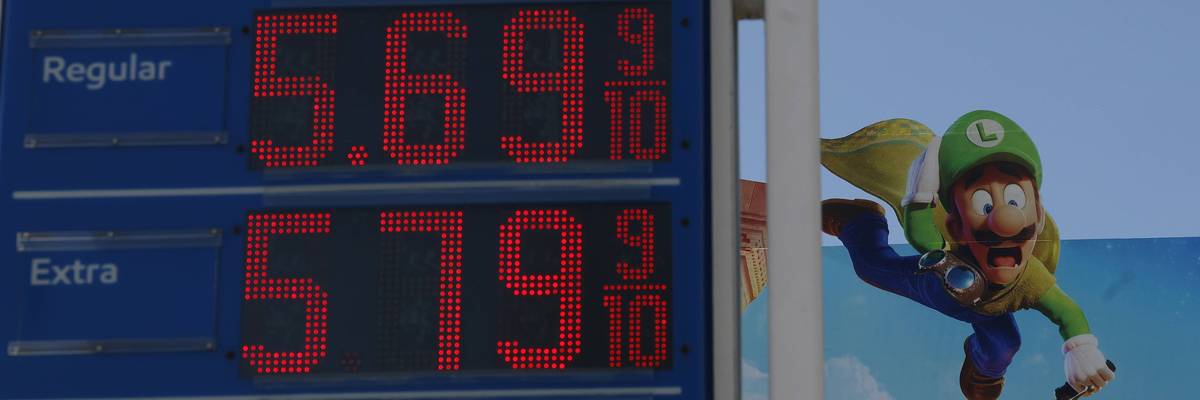
Gas prices over $5 a gallon are displayed at a Mobil station on March 11, 2026 in Los Angeles, California.
"If high costs weren’t already bad enough, Donald Trump’s unnecessary war in Iran has sent gas prices through the roof," said one House Democrat.
Data released Friday showed that US consumer sentiment hit a new low for 2026 and the American economy expanded by just 0.7% in the fourth quarter of last year, indicators that experts said are only going to get worse due to the cascading impacts of President Donald Trump's deadly, illegal, and expensive war on Iran.
“President Trump is flooring the gas pedal as he drives our economy over a cliff," Alex Jacquez, chief of policy and advocacy at the Groundwork Collaborative, said in response to the new data, some of which was collected before the US and Israel launched their assault on Iran, sparking a regional conflict, sending oil prices surging, and destabilizing the global economy.
"As bad as this week’s data is," Jacquez added, "it understates reality for exhausted consumers who have been hit with even more price hikes caused by the president’s intentional turmoil in the weeks since this data was collected. Instead of working to bring down ever-increasing prices at the pump, the grocery store, and the doctor’s office, the president is betraying working families as his illegal war with Iran stokes inflation."
Figures released Friday by the US Commerce Department's Bureau of Economic Analysis (BEA) showed that real gross domestic product increased at half the rate predicted by previous government estimates.
"Real GDP was revised down 0.7 percentage points from the advance estimate [of 1.4%], reflecting downward revisions to exports, consumer spending, government spending, and investment," the BEA said in a news release.
NBC News noted that "economists had expected the revision to go the other way—and show stronger growth."
The BEA also published data showing that the personal consumption expenditures price index, a key inflation reading, rose at an annualized rate of 2.8% in January.
“Families across the United States are struggling to make ends meet in Donald Trump’s economy," Rep. Brendan Boyle (D-Pa.), the top Democrat on the House Budget Committee, said in a statement. "If high costs weren’t already bad enough, Donald Trump’s unnecessary war in Iran has sent gas prices through the roof."
A Harris Poll opinion survey conducted for The Guardian and released Friday found that more than 70% of US voters believe Trump's tariff regime has driven up their costs.
"In the short run, the economic impact of a sustained loss of Gulf oil could be very ugly."
Consumer sentiment, meanwhile, continued its steady decline in March, falling about 2% compared to last month, according to the University of Michigan's Surveys of Consumers. Roughly half of the interviews conducted for the consumer sentiment report were completed before the US and Israel began attacking Iran on February 28.
Joanne Hsu, director of the Surveys of Consumers, noted that "interviews completed prior to the military action in Iran showed an improvement in sentiment from last month, but lower readings seen during the nine days thereafter completely erased those initial gains."
"Gasoline prices have exerted the most immediate impact felt by consumers, though the magnitude of passthrough to other prices remains highly uncertain," Hsu noted. "A broad swath of consumers across incomes, age, and political affiliation all reported declines in expectations for their personal finances, down 7.5% nationally."
"Interviews completed after February 28 exhibited higher inflation expectations than those completed before that date," Hsu added.
The first six days of Trump's war on Iran cost US taxpayers over $11 billion, and the price tag is set to rise exponentially as the administration deploys thousands of additional troops to the Middle East and continues aggressively bombing Iran, which has retaliated in part by closing the Strait of Hormuz—choking off the flow of oil through the critical trade route and sending prices surging.
The Trump administration has sought to downplay skyrocketing oil prices even as it takes emergency action in an attempt to bring them down. The International Energy Agency said Thursday that the US-Israeli assault on Iran sparked "the largest supply disruption in the history of the global oil market."
Economist Paul Krugman warned Friday that "oil prices could easily go much higher," noting, "The US and other major economies are a lot less oil-dependent than they were in the 1970s, and even at $100 a barrel oil prices are not high enough to provoke a major crisis."
"In the short run, the economic impact of a sustained loss of Gulf oil could be very ugly," Krugman wrote. "I’ve seen some alarmists warn that a long war in the Gulf could lead to oil at $150 a barrel. That looks low to me."
Dear Common Dreams reader, It’s been nearly 30 years since I co-founded Common Dreams with my late wife, Lina Newhouser. We had the radical notion that journalism should serve the public good, not corporate profits. It was clear to us from the outset what it would take to build such a project. No paid advertisements. No corporate sponsors. No millionaire publisher telling us what to think or do. Many people said we wouldn't last a year, but we proved those doubters wrong. Together with a tremendous team of journalists and dedicated staff, we built an independent media outlet free from the constraints of profits and corporate control. Our mission has always been simple: To inform. To inspire. To ignite change for the common good. Building Common Dreams was not easy. Our survival was never guaranteed. When you take on the most powerful forces—Wall Street greed, fossil fuel industry destruction, Big Tech lobbyists, and uber-rich oligarchs who have spent billions upon billions rigging the economy and democracy in their favor—the only bulwark you have is supporters who believe in your work. But here’s the urgent message from me today. It's never been this bad out there. And it's never been this hard to keep us going. At the very moment Common Dreams is most needed, the threats we face are intensifying. We need your support now more than ever. We don't accept corporate advertising and never will. We don't have a paywall because we don't think people should be blocked from critical news based on their ability to pay. Everything we do is funded by the donations of readers like you. When everyone does the little they can afford, we are strong. But if that support retreats or dries up, so do we. Will you donate now to make sure Common Dreams not only survives but thrives? —Craig Brown, Co-founder |
Data released Friday showed that US consumer sentiment hit a new low for 2026 and the American economy expanded by just 0.7% in the fourth quarter of last year, indicators that experts said are only going to get worse due to the cascading impacts of President Donald Trump's deadly, illegal, and expensive war on Iran.
“President Trump is flooring the gas pedal as he drives our economy over a cliff," Alex Jacquez, chief of policy and advocacy at the Groundwork Collaborative, said in response to the new data, some of which was collected before the US and Israel launched their assault on Iran, sparking a regional conflict, sending oil prices surging, and destabilizing the global economy.
"As bad as this week’s data is," Jacquez added, "it understates reality for exhausted consumers who have been hit with even more price hikes caused by the president’s intentional turmoil in the weeks since this data was collected. Instead of working to bring down ever-increasing prices at the pump, the grocery store, and the doctor’s office, the president is betraying working families as his illegal war with Iran stokes inflation."
Figures released Friday by the US Commerce Department's Bureau of Economic Analysis (BEA) showed that real gross domestic product increased at half the rate predicted by previous government estimates.
"Real GDP was revised down 0.7 percentage points from the advance estimate [of 1.4%], reflecting downward revisions to exports, consumer spending, government spending, and investment," the BEA said in a news release.
NBC News noted that "economists had expected the revision to go the other way—and show stronger growth."
The BEA also published data showing that the personal consumption expenditures price index, a key inflation reading, rose at an annualized rate of 2.8% in January.
“Families across the United States are struggling to make ends meet in Donald Trump’s economy," Rep. Brendan Boyle (D-Pa.), the top Democrat on the House Budget Committee, said in a statement. "If high costs weren’t already bad enough, Donald Trump’s unnecessary war in Iran has sent gas prices through the roof."
A Harris Poll opinion survey conducted for The Guardian and released Friday found that more than 70% of US voters believe Trump's tariff regime has driven up their costs.
"In the short run, the economic impact of a sustained loss of Gulf oil could be very ugly."
Consumer sentiment, meanwhile, continued its steady decline in March, falling about 2% compared to last month, according to the University of Michigan's Surveys of Consumers. Roughly half of the interviews conducted for the consumer sentiment report were completed before the US and Israel began attacking Iran on February 28.
Joanne Hsu, director of the Surveys of Consumers, noted that "interviews completed prior to the military action in Iran showed an improvement in sentiment from last month, but lower readings seen during the nine days thereafter completely erased those initial gains."
"Gasoline prices have exerted the most immediate impact felt by consumers, though the magnitude of passthrough to other prices remains highly uncertain," Hsu noted. "A broad swath of consumers across incomes, age, and political affiliation all reported declines in expectations for their personal finances, down 7.5% nationally."
"Interviews completed after February 28 exhibited higher inflation expectations than those completed before that date," Hsu added.
The first six days of Trump's war on Iran cost US taxpayers over $11 billion, and the price tag is set to rise exponentially as the administration deploys thousands of additional troops to the Middle East and continues aggressively bombing Iran, which has retaliated in part by closing the Strait of Hormuz—choking off the flow of oil through the critical trade route and sending prices surging.
The Trump administration has sought to downplay skyrocketing oil prices even as it takes emergency action in an attempt to bring them down. The International Energy Agency said Thursday that the US-Israeli assault on Iran sparked "the largest supply disruption in the history of the global oil market."
Economist Paul Krugman warned Friday that "oil prices could easily go much higher," noting, "The US and other major economies are a lot less oil-dependent than they were in the 1970s, and even at $100 a barrel oil prices are not high enough to provoke a major crisis."
"In the short run, the economic impact of a sustained loss of Gulf oil could be very ugly," Krugman wrote. "I’ve seen some alarmists warn that a long war in the Gulf could lead to oil at $150 a barrel. That looks low to me."
Data released Friday showed that US consumer sentiment hit a new low for 2026 and the American economy expanded by just 0.7% in the fourth quarter of last year, indicators that experts said are only going to get worse due to the cascading impacts of President Donald Trump's deadly, illegal, and expensive war on Iran.
“President Trump is flooring the gas pedal as he drives our economy over a cliff," Alex Jacquez, chief of policy and advocacy at the Groundwork Collaborative, said in response to the new data, some of which was collected before the US and Israel launched their assault on Iran, sparking a regional conflict, sending oil prices surging, and destabilizing the global economy.
"As bad as this week’s data is," Jacquez added, "it understates reality for exhausted consumers who have been hit with even more price hikes caused by the president’s intentional turmoil in the weeks since this data was collected. Instead of working to bring down ever-increasing prices at the pump, the grocery store, and the doctor’s office, the president is betraying working families as his illegal war with Iran stokes inflation."
Figures released Friday by the US Commerce Department's Bureau of Economic Analysis (BEA) showed that real gross domestic product increased at half the rate predicted by previous government estimates.
"Real GDP was revised down 0.7 percentage points from the advance estimate [of 1.4%], reflecting downward revisions to exports, consumer spending, government spending, and investment," the BEA said in a news release.
NBC News noted that "economists had expected the revision to go the other way—and show stronger growth."
The BEA also published data showing that the personal consumption expenditures price index, a key inflation reading, rose at an annualized rate of 2.8% in January.
“Families across the United States are struggling to make ends meet in Donald Trump’s economy," Rep. Brendan Boyle (D-Pa.), the top Democrat on the House Budget Committee, said in a statement. "If high costs weren’t already bad enough, Donald Trump’s unnecessary war in Iran has sent gas prices through the roof."
A Harris Poll opinion survey conducted for The Guardian and released Friday found that more than 70% of US voters believe Trump's tariff regime has driven up their costs.
"In the short run, the economic impact of a sustained loss of Gulf oil could be very ugly."
Consumer sentiment, meanwhile, continued its steady decline in March, falling about 2% compared to last month, according to the University of Michigan's Surveys of Consumers. Roughly half of the interviews conducted for the consumer sentiment report were completed before the US and Israel began attacking Iran on February 28.
Joanne Hsu, director of the Surveys of Consumers, noted that "interviews completed prior to the military action in Iran showed an improvement in sentiment from last month, but lower readings seen during the nine days thereafter completely erased those initial gains."
"Gasoline prices have exerted the most immediate impact felt by consumers, though the magnitude of passthrough to other prices remains highly uncertain," Hsu noted. "A broad swath of consumers across incomes, age, and political affiliation all reported declines in expectations for their personal finances, down 7.5% nationally."
"Interviews completed after February 28 exhibited higher inflation expectations than those completed before that date," Hsu added.
The first six days of Trump's war on Iran cost US taxpayers over $11 billion, and the price tag is set to rise exponentially as the administration deploys thousands of additional troops to the Middle East and continues aggressively bombing Iran, which has retaliated in part by closing the Strait of Hormuz—choking off the flow of oil through the critical trade route and sending prices surging.
The Trump administration has sought to downplay skyrocketing oil prices even as it takes emergency action in an attempt to bring them down. The International Energy Agency said Thursday that the US-Israeli assault on Iran sparked "the largest supply disruption in the history of the global oil market."
Economist Paul Krugman warned Friday that "oil prices could easily go much higher," noting, "The US and other major economies are a lot less oil-dependent than they were in the 1970s, and even at $100 a barrel oil prices are not high enough to provoke a major crisis."
"In the short run, the economic impact of a sustained loss of Gulf oil could be very ugly," Krugman wrote. "I’ve seen some alarmists warn that a long war in the Gulf could lead to oil at $150 a barrel. That looks low to me."