SUBSCRIBE TO OUR FREE NEWSLETTER
Daily news & progressive opinion—funded by the people, not the corporations—delivered straight to your inbox.
5
#000000
#FFFFFF
To donate by check, phone, or other method, see our More Ways to Give page.
Daily news & progressive opinion—funded by the people, not the corporations—delivered straight to your inbox.

An aerial view shows the Chawkbazar iftar market bustling with crowds and traditional foods as thousands gather during Ramadan.
One expert warned of a "direct hit on consumer prices" if the Iran war persists.
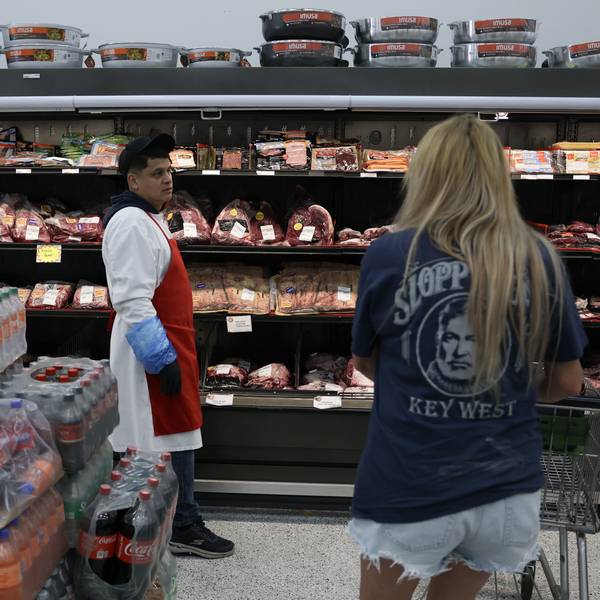
President Donald Trump's unprovoked and unconstitutional war against Iran has already been raising gas prices for US drivers, and could soon raise the cost of food both in the US and all over the world.
NBC News reported on Tuesday that the price of diesel fuel has now soared above $5 per gallon for the first time since December 2022. If the price of diesel remains high, the report explained, it will raise the price of all goods delivered by trucks throughout the US, including food.
Paul Dietrich, chief investment strategist at Wedbush Securities, told NBC News that diesel prices will become a "direct hit on consumer prices" if they remain elevated, as "groceries get more expensive, delivery costs rise, and household budgets are tightened."
"Diesel is what moves the real economy," explained Dietrich. "It hauls the food, the packages, the building supplies, and the inventory sitting on store shelves."
The cost of diesel isn't the only factor that could spike food prices, as the Iran war has also put a strain on fertilizer that farmers need to grow crops.
Al Jazeera reported on Wednesday that there is growing concern that the rising price of fertilizer caused by the closure of the Strait of Hormuz could lead to a global food crisis.
As Al Jazeera explained, almost half of the global supply of urea, the most commonly used fertilizer, is shipped from Middle Eastern nations through the Strait of Hormuz.
With the strait closed by Iran in response to US and Israeli attacks, Al Jazeera wrote, "urea export prices from the Middle East have surged by about 40%, rising from just less than $500 to a little more than $700 per metric ton as of last Friday."
Al Jazeera also cited an estimate from data and analytics firm Kpler projecting that up to one-third of the global fertilizer trade could be disrupted if the strait remains closed for a prolonged period.
Carl Skau, deputy executive director and chief operating officer of the World Food Program, warned on Tuesday that the Iran war could push millions of people into extreme hunger should it persist.
"If this conflict continues, it will send shockwaves across the globe, and families who already cannot afford their next meal will be hit the hardest," said Skau. "Without an adequately funded humanitarian response, it could spell catastrophe for millions already on the edge."
WFP said the disruption in fertilizer markets offers "the most recent proof that conflict is the number one driver of hunger."
"Conflict forces people from their homes, destroys infrastructure, fuels inflation, and wipes out jobs," said the agency. "All of this makes it nearly impossible for people to find or afford enough food to survive. And children are always hit hardest: A child living in a country ravaged by conflict is more than twice as likely to be malnourished and out of school than their peers in peaceful settings."
Warnings about the war's impact on the price of food come as the US economy is showing signs of accelerating inflation.
As reported by CNBC on Wednesday, wholesale prices in February surged by 0.7%, more than double economists' consensus estimate of 0.3%.
On a year-over-year basis, wholesale prices rose by 3.4% in February—the highest increase in a year.
Spikes in wholesale prices, which reflect the amount that firms pay for inputs for their products, typically also lead to increased consumer prices, as companies pass on their cost increases to customers.
"The report suggests that pipeline inflation pressures remain persistent, particularly on the services side, complicating the Fed’s path as it weighs how long to keep interest rates elevated," CNBC noted.
Dear Common Dreams reader, It’s been nearly 30 years since I co-founded Common Dreams with my late wife, Lina Newhouser. We had the radical notion that journalism should serve the public good, not corporate profits. It was clear to us from the outset what it would take to build such a project. No paid advertisements. No corporate sponsors. No millionaire publisher telling us what to think or do. Many people said we wouldn't last a year, but we proved those doubters wrong. Together with a tremendous team of journalists and dedicated staff, we built an independent media outlet free from the constraints of profits and corporate control. Our mission has always been simple: To inform. To inspire. To ignite change for the common good. Building Common Dreams was not easy. Our survival was never guaranteed. When you take on the most powerful forces—Wall Street greed, fossil fuel industry destruction, Big Tech lobbyists, and uber-rich oligarchs who have spent billions upon billions rigging the economy and democracy in their favor—the only bulwark you have is supporters who believe in your work. But here’s the urgent message from me today. It's never been this bad out there. And it's never been this hard to keep us going. At the very moment Common Dreams is most needed, the threats we face are intensifying. We need your support now more than ever. We don't accept corporate advertising and never will. We don't have a paywall because we don't think people should be blocked from critical news based on their ability to pay. Everything we do is funded by the donations of readers like you. When everyone does the little they can afford, we are strong. But if that support retreats or dries up, so do we. Will you donate now to make sure Common Dreams not only survives but thrives? —Craig Brown, Co-founder |
President Donald Trump's unprovoked and unconstitutional war against Iran has already been raising gas prices for US drivers, and could soon raise the cost of food both in the US and all over the world.
NBC News reported on Tuesday that the price of diesel fuel has now soared above $5 per gallon for the first time since December 2022. If the price of diesel remains high, the report explained, it will raise the price of all goods delivered by trucks throughout the US, including food.
Paul Dietrich, chief investment strategist at Wedbush Securities, told NBC News that diesel prices will become a "direct hit on consumer prices" if they remain elevated, as "groceries get more expensive, delivery costs rise, and household budgets are tightened."
"Diesel is what moves the real economy," explained Dietrich. "It hauls the food, the packages, the building supplies, and the inventory sitting on store shelves."
The cost of diesel isn't the only factor that could spike food prices, as the Iran war has also put a strain on fertilizer that farmers need to grow crops.
Al Jazeera reported on Wednesday that there is growing concern that the rising price of fertilizer caused by the closure of the Strait of Hormuz could lead to a global food crisis.
As Al Jazeera explained, almost half of the global supply of urea, the most commonly used fertilizer, is shipped from Middle Eastern nations through the Strait of Hormuz.
With the strait closed by Iran in response to US and Israeli attacks, Al Jazeera wrote, "urea export prices from the Middle East have surged by about 40%, rising from just less than $500 to a little more than $700 per metric ton as of last Friday."
Al Jazeera also cited an estimate from data and analytics firm Kpler projecting that up to one-third of the global fertilizer trade could be disrupted if the strait remains closed for a prolonged period.
Carl Skau, deputy executive director and chief operating officer of the World Food Program, warned on Tuesday that the Iran war could push millions of people into extreme hunger should it persist.
"If this conflict continues, it will send shockwaves across the globe, and families who already cannot afford their next meal will be hit the hardest," said Skau. "Without an adequately funded humanitarian response, it could spell catastrophe for millions already on the edge."
WFP said the disruption in fertilizer markets offers "the most recent proof that conflict is the number one driver of hunger."
"Conflict forces people from their homes, destroys infrastructure, fuels inflation, and wipes out jobs," said the agency. "All of this makes it nearly impossible for people to find or afford enough food to survive. And children are always hit hardest: A child living in a country ravaged by conflict is more than twice as likely to be malnourished and out of school than their peers in peaceful settings."
Warnings about the war's impact on the price of food come as the US economy is showing signs of accelerating inflation.
As reported by CNBC on Wednesday, wholesale prices in February surged by 0.7%, more than double economists' consensus estimate of 0.3%.
On a year-over-year basis, wholesale prices rose by 3.4% in February—the highest increase in a year.
Spikes in wholesale prices, which reflect the amount that firms pay for inputs for their products, typically also lead to increased consumer prices, as companies pass on their cost increases to customers.
"The report suggests that pipeline inflation pressures remain persistent, particularly on the services side, complicating the Fed’s path as it weighs how long to keep interest rates elevated," CNBC noted.
President Donald Trump's unprovoked and unconstitutional war against Iran has already been raising gas prices for US drivers, and could soon raise the cost of food both in the US and all over the world.
NBC News reported on Tuesday that the price of diesel fuel has now soared above $5 per gallon for the first time since December 2022. If the price of diesel remains high, the report explained, it will raise the price of all goods delivered by trucks throughout the US, including food.
Paul Dietrich, chief investment strategist at Wedbush Securities, told NBC News that diesel prices will become a "direct hit on consumer prices" if they remain elevated, as "groceries get more expensive, delivery costs rise, and household budgets are tightened."
"Diesel is what moves the real economy," explained Dietrich. "It hauls the food, the packages, the building supplies, and the inventory sitting on store shelves."
The cost of diesel isn't the only factor that could spike food prices, as the Iran war has also put a strain on fertilizer that farmers need to grow crops.
Al Jazeera reported on Wednesday that there is growing concern that the rising price of fertilizer caused by the closure of the Strait of Hormuz could lead to a global food crisis.
As Al Jazeera explained, almost half of the global supply of urea, the most commonly used fertilizer, is shipped from Middle Eastern nations through the Strait of Hormuz.
With the strait closed by Iran in response to US and Israeli attacks, Al Jazeera wrote, "urea export prices from the Middle East have surged by about 40%, rising from just less than $500 to a little more than $700 per metric ton as of last Friday."
Al Jazeera also cited an estimate from data and analytics firm Kpler projecting that up to one-third of the global fertilizer trade could be disrupted if the strait remains closed for a prolonged period.
Carl Skau, deputy executive director and chief operating officer of the World Food Program, warned on Tuesday that the Iran war could push millions of people into extreme hunger should it persist.
"If this conflict continues, it will send shockwaves across the globe, and families who already cannot afford their next meal will be hit the hardest," said Skau. "Without an adequately funded humanitarian response, it could spell catastrophe for millions already on the edge."
WFP said the disruption in fertilizer markets offers "the most recent proof that conflict is the number one driver of hunger."
"Conflict forces people from their homes, destroys infrastructure, fuels inflation, and wipes out jobs," said the agency. "All of this makes it nearly impossible for people to find or afford enough food to survive. And children are always hit hardest: A child living in a country ravaged by conflict is more than twice as likely to be malnourished and out of school than their peers in peaceful settings."
Warnings about the war's impact on the price of food come as the US economy is showing signs of accelerating inflation.
As reported by CNBC on Wednesday, wholesale prices in February surged by 0.7%, more than double economists' consensus estimate of 0.3%.
On a year-over-year basis, wholesale prices rose by 3.4% in February—the highest increase in a year.
Spikes in wholesale prices, which reflect the amount that firms pay for inputs for their products, typically also lead to increased consumer prices, as companies pass on their cost increases to customers.
"The report suggests that pipeline inflation pressures remain persistent, particularly on the services side, complicating the Fed’s path as it weighs how long to keep interest rates elevated," CNBC noted.