SUBSCRIBE TO OUR FREE NEWSLETTER
Daily news & progressive opinion—funded by the people, not the corporations—delivered straight to your inbox.
5
#000000
#FFFFFF
To donate by check, phone, or other method, see our More Ways to Give page.
Daily news & progressive opinion—funded by the people, not the corporations—delivered straight to your inbox.
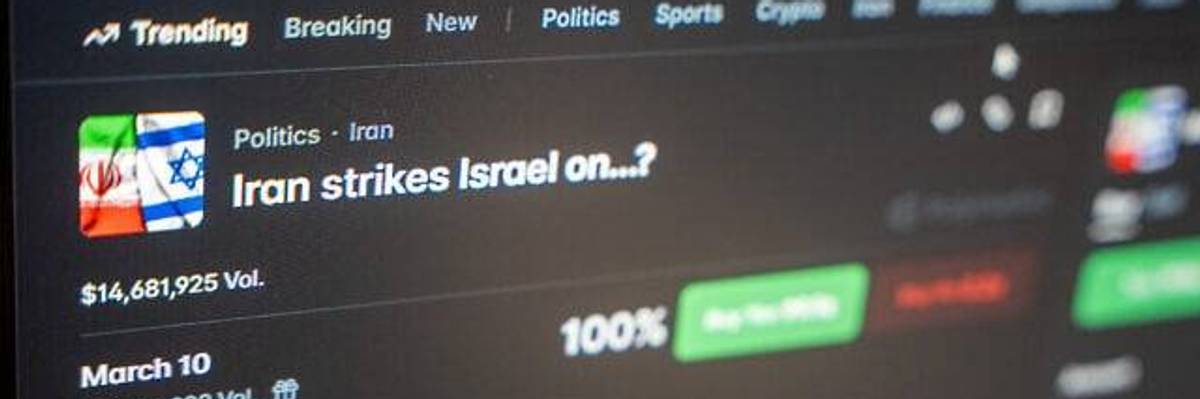
A photo taken on March 16, 2026, shows a bet on the prediction market Polymarket titled ‘Iran strikes Israel on…?’ for the date of March 10.
“After you make us lose $900,000, we will invest no less than that to finish you.”
An Israeli journalist said he's received death threats from gamblers demanding he change an accurate report about an Iranian missile strike in order to help them win a bet on the prediction app Polymarket.
On Monday, Emanuel Fabian, a military correspondent for The Times of Israel, wrote that he was confused when he suddenly received several requests to correct a report on March 10 that an Iranian missile had struck Israeli territory.
Fabian said he'd based his report on information from "rescue services" as well as "footage that emerged showing the massive explosion caused by the missile’s warhead." No injuries were reported from the impact, as the missile struck an empty area outside the city of Beit Shemesh, near Jerusalem.
"What I thought was a seemingly minor incident during the war has turned into days of harassment and death threats against me," Fabian said.
Hours after posting the report to the paper's live blog, Fabian said he received an email, from a user identifying as Aviv, claiming that what had hit the ground was not a missile, but an interceptor fragment.
Fabian contended military sources had confirmed it was a missile and that the impact was far too large to have been from only an interceptor.
He then received another email from a user named Daniel with the exact same gripe. Daniel described having an "urgent request" for the report to be changed and told Fabian that by changing it, "you would be helping me, many others, and, of course, the state of Israel."
Daniel sent Fabian several more emails over the next couple of days demanding a correction, and the tone continued to grow more urgent.
"I ask again, if you could handle this as soon as possible, it would help us a lot," Daniel said on Thursday. "It’s really important, if possible, still this morning."
Other users messaged him with the same complaint over email and the messaging app Discord. It was only when Fabian received more angry replies from two more users on X that he realized what was going on.
"Checking those X accounts, both appeared to be involved in gambling on the Polymarket betting site," he explained. "As far as I now understand, the emails I received were intended to confirm whether or not a missile had hit Israel on March 10 in order to resolve a prediction on Polymarket."
Polymarket is a cryptocurrency-based prediction market where users buy and sell shares tied to real‑world events, enabling them to bet on the likelihood of future events, including those in wartime.
Fabian found that the people clamoring for his attention had put money on whether Iran would strike Israel on March 10. "This market will resolve to ‘Yes’ if Iran initiates a drone, missile, or air strike on Israel’s soil on the listed date in Israel Time (GMT+2). Otherwise, this market will resolve to ‘No’,” the website explained. However, it stipulates that intercepted missiles would not receive a "yes" verdict.
As of March 16, gamblers had wagered more than $14 million on the event.
Over the next several days, requests continued to roll in from people demanding a correction to the story.
One user presented a fabricated email, purportedly from Fabian to Daniel, stating that the Israel Defense Forces had confirmed the missiles were intercepted and that he planned to correct the story.
Fabian was later approached by a colleague at another publication, who said his friend had asked him to reach out for the story to be changed. After being confronted, the friend admitted that he had money on the wager too, and offered some of his winnings to Fabian's colleague if he could persuade the journalist to change the story.
By the weekend, the messages had become violent. Fabian said a user identified as Haim accosted him with several threatening messages in Hebrew over WhatsApp:
"You have exactly half an hour to correct your attempt at influence,” Haim wrote. "Despite the fact that you received countless inquiries—you insist on leaving it that way.”
“If you do not correct this by 01:00 Israel time today, March 15, you are bringing upon yourself damage you have never imagined you would suffer,” he threatened, in a very lengthy message.
Haim also attempted to call me via WhatsApp multiple times during the night, before sending me more messages.
“You have no idea how much you’ve put yourself at risk. Today is the most significant day of your career. You have two choices: either believe that we have the capabilities, and after you make us lose $900,000 we will invest no less than that to finish you."
Haim also threatened Fabian by referring "with specific details" to his home address, his parents, and family.
After receiving several more threats and being contacted by someone purporting to be a "lawyer," Fabian went to the police, who he said are now investigating the situation.
The threats continued into Monday, after Fabian ran into a bomb shelter amid another Iranian missile attack.
"The attempt by these gamblers to pressure me to change my reporting so that they would win their bet did not and will not succeed," Fabian said. "But I do worry that other journalists may not be as ethical if they are promised some of the winnings."
He said that journalists are in a unique position to "exploit their knowledge for insider trading on the platform."
Polymarket and other similar "prediction market" apps like Kalshi have come under similar scrutiny in the United States for allowing users to place suspiciously timed bets on military actions taken by the Trump administration.
Earlier this month, the watchdog group Public Citizen sent a letter to the chair of the Commodity Futures Trading Commission (CFTC), which regulates prediction markets, outlining a series of "highly suspicious" bets made just before President Donald Trump launched strikes against Iran on February 28. Among the big winners were what the Wall Street Journal described as "six suspected insiders,” whose immaculately timed wagers netted them a $1.2 million profit.
In January, another trader made more than $436,000 after betting that Veneuzelan President Nicolás Maduro would be removed from power just hours before Trump launched an operation to remove him.
In the face of state regulations, the Trump administration has sought to ease restrictions on betting apps. The Trump family's media company offers access to prediction markets on its Truth Social platform via Crypto.com. Meanwhile, Donald Trump Jr. is an adviser to both Polymarket and Kalshi.
US Sen. Chris Murphy (D-Conn.), who has emerged as a leading critic of prediction markets, described Fabian's account as a "bone-chilling story."
The senator said: "We need to end prediction markets for government action. NOW."
Dear Common Dreams reader, It’s been nearly 30 years since I co-founded Common Dreams with my late wife, Lina Newhouser. We had the radical notion that journalism should serve the public good, not corporate profits. It was clear to us from the outset what it would take to build such a project. No paid advertisements. No corporate sponsors. No millionaire publisher telling us what to think or do. Many people said we wouldn't last a year, but we proved those doubters wrong. Together with a tremendous team of journalists and dedicated staff, we built an independent media outlet free from the constraints of profits and corporate control. Our mission has always been simple: To inform. To inspire. To ignite change for the common good. Building Common Dreams was not easy. Our survival was never guaranteed. When you take on the most powerful forces—Wall Street greed, fossil fuel industry destruction, Big Tech lobbyists, and uber-rich oligarchs who have spent billions upon billions rigging the economy and democracy in their favor—the only bulwark you have is supporters who believe in your work. But here’s the urgent message from me today. It's never been this bad out there. And it's never been this hard to keep us going. At the very moment Common Dreams is most needed, the threats we face are intensifying. We need your support now more than ever. We don't accept corporate advertising and never will. We don't have a paywall because we don't think people should be blocked from critical news based on their ability to pay. Everything we do is funded by the donations of readers like you. When everyone does the little they can afford, we are strong. But if that support retreats or dries up, so do we. Will you donate now to make sure Common Dreams not only survives but thrives? —Craig Brown, Co-founder |
An Israeli journalist said he's received death threats from gamblers demanding he change an accurate report about an Iranian missile strike in order to help them win a bet on the prediction app Polymarket.
On Monday, Emanuel Fabian, a military correspondent for The Times of Israel, wrote that he was confused when he suddenly received several requests to correct a report on March 10 that an Iranian missile had struck Israeli territory.
Fabian said he'd based his report on information from "rescue services" as well as "footage that emerged showing the massive explosion caused by the missile’s warhead." No injuries were reported from the impact, as the missile struck an empty area outside the city of Beit Shemesh, near Jerusalem.
"What I thought was a seemingly minor incident during the war has turned into days of harassment and death threats against me," Fabian said.
Hours after posting the report to the paper's live blog, Fabian said he received an email, from a user identifying as Aviv, claiming that what had hit the ground was not a missile, but an interceptor fragment.
Fabian contended military sources had confirmed it was a missile and that the impact was far too large to have been from only an interceptor.
He then received another email from a user named Daniel with the exact same gripe. Daniel described having an "urgent request" for the report to be changed and told Fabian that by changing it, "you would be helping me, many others, and, of course, the state of Israel."
Daniel sent Fabian several more emails over the next couple of days demanding a correction, and the tone continued to grow more urgent.
"I ask again, if you could handle this as soon as possible, it would help us a lot," Daniel said on Thursday. "It’s really important, if possible, still this morning."
Other users messaged him with the same complaint over email and the messaging app Discord. It was only when Fabian received more angry replies from two more users on X that he realized what was going on.
"Checking those X accounts, both appeared to be involved in gambling on the Polymarket betting site," he explained. "As far as I now understand, the emails I received were intended to confirm whether or not a missile had hit Israel on March 10 in order to resolve a prediction on Polymarket."
Polymarket is a cryptocurrency-based prediction market where users buy and sell shares tied to real‑world events, enabling them to bet on the likelihood of future events, including those in wartime.
Fabian found that the people clamoring for his attention had put money on whether Iran would strike Israel on March 10. "This market will resolve to ‘Yes’ if Iran initiates a drone, missile, or air strike on Israel’s soil on the listed date in Israel Time (GMT+2). Otherwise, this market will resolve to ‘No’,” the website explained. However, it stipulates that intercepted missiles would not receive a "yes" verdict.
As of March 16, gamblers had wagered more than $14 million on the event.
Over the next several days, requests continued to roll in from people demanding a correction to the story.
One user presented a fabricated email, purportedly from Fabian to Daniel, stating that the Israel Defense Forces had confirmed the missiles were intercepted and that he planned to correct the story.
Fabian was later approached by a colleague at another publication, who said his friend had asked him to reach out for the story to be changed. After being confronted, the friend admitted that he had money on the wager too, and offered some of his winnings to Fabian's colleague if he could persuade the journalist to change the story.
By the weekend, the messages had become violent. Fabian said a user identified as Haim accosted him with several threatening messages in Hebrew over WhatsApp:
"You have exactly half an hour to correct your attempt at influence,” Haim wrote. "Despite the fact that you received countless inquiries—you insist on leaving it that way.”
“If you do not correct this by 01:00 Israel time today, March 15, you are bringing upon yourself damage you have never imagined you would suffer,” he threatened, in a very lengthy message.
Haim also attempted to call me via WhatsApp multiple times during the night, before sending me more messages.
“You have no idea how much you’ve put yourself at risk. Today is the most significant day of your career. You have two choices: either believe that we have the capabilities, and after you make us lose $900,000 we will invest no less than that to finish you."
Haim also threatened Fabian by referring "with specific details" to his home address, his parents, and family.
After receiving several more threats and being contacted by someone purporting to be a "lawyer," Fabian went to the police, who he said are now investigating the situation.
The threats continued into Monday, after Fabian ran into a bomb shelter amid another Iranian missile attack.
"The attempt by these gamblers to pressure me to change my reporting so that they would win their bet did not and will not succeed," Fabian said. "But I do worry that other journalists may not be as ethical if they are promised some of the winnings."
He said that journalists are in a unique position to "exploit their knowledge for insider trading on the platform."
Polymarket and other similar "prediction market" apps like Kalshi have come under similar scrutiny in the United States for allowing users to place suspiciously timed bets on military actions taken by the Trump administration.
Earlier this month, the watchdog group Public Citizen sent a letter to the chair of the Commodity Futures Trading Commission (CFTC), which regulates prediction markets, outlining a series of "highly suspicious" bets made just before President Donald Trump launched strikes against Iran on February 28. Among the big winners were what the Wall Street Journal described as "six suspected insiders,” whose immaculately timed wagers netted them a $1.2 million profit.
In January, another trader made more than $436,000 after betting that Veneuzelan President Nicolás Maduro would be removed from power just hours before Trump launched an operation to remove him.
In the face of state regulations, the Trump administration has sought to ease restrictions on betting apps. The Trump family's media company offers access to prediction markets on its Truth Social platform via Crypto.com. Meanwhile, Donald Trump Jr. is an adviser to both Polymarket and Kalshi.
US Sen. Chris Murphy (D-Conn.), who has emerged as a leading critic of prediction markets, described Fabian's account as a "bone-chilling story."
The senator said: "We need to end prediction markets for government action. NOW."
An Israeli journalist said he's received death threats from gamblers demanding he change an accurate report about an Iranian missile strike in order to help them win a bet on the prediction app Polymarket.
On Monday, Emanuel Fabian, a military correspondent for The Times of Israel, wrote that he was confused when he suddenly received several requests to correct a report on March 10 that an Iranian missile had struck Israeli territory.
Fabian said he'd based his report on information from "rescue services" as well as "footage that emerged showing the massive explosion caused by the missile’s warhead." No injuries were reported from the impact, as the missile struck an empty area outside the city of Beit Shemesh, near Jerusalem.
"What I thought was a seemingly minor incident during the war has turned into days of harassment and death threats against me," Fabian said.
Hours after posting the report to the paper's live blog, Fabian said he received an email, from a user identifying as Aviv, claiming that what had hit the ground was not a missile, but an interceptor fragment.
Fabian contended military sources had confirmed it was a missile and that the impact was far too large to have been from only an interceptor.
He then received another email from a user named Daniel with the exact same gripe. Daniel described having an "urgent request" for the report to be changed and told Fabian that by changing it, "you would be helping me, many others, and, of course, the state of Israel."
Daniel sent Fabian several more emails over the next couple of days demanding a correction, and the tone continued to grow more urgent.
"I ask again, if you could handle this as soon as possible, it would help us a lot," Daniel said on Thursday. "It’s really important, if possible, still this morning."
Other users messaged him with the same complaint over email and the messaging app Discord. It was only when Fabian received more angry replies from two more users on X that he realized what was going on.
"Checking those X accounts, both appeared to be involved in gambling on the Polymarket betting site," he explained. "As far as I now understand, the emails I received were intended to confirm whether or not a missile had hit Israel on March 10 in order to resolve a prediction on Polymarket."
Polymarket is a cryptocurrency-based prediction market where users buy and sell shares tied to real‑world events, enabling them to bet on the likelihood of future events, including those in wartime.
Fabian found that the people clamoring for his attention had put money on whether Iran would strike Israel on March 10. "This market will resolve to ‘Yes’ if Iran initiates a drone, missile, or air strike on Israel’s soil on the listed date in Israel Time (GMT+2). Otherwise, this market will resolve to ‘No’,” the website explained. However, it stipulates that intercepted missiles would not receive a "yes" verdict.
As of March 16, gamblers had wagered more than $14 million on the event.
Over the next several days, requests continued to roll in from people demanding a correction to the story.
One user presented a fabricated email, purportedly from Fabian to Daniel, stating that the Israel Defense Forces had confirmed the missiles were intercepted and that he planned to correct the story.
Fabian was later approached by a colleague at another publication, who said his friend had asked him to reach out for the story to be changed. After being confronted, the friend admitted that he had money on the wager too, and offered some of his winnings to Fabian's colleague if he could persuade the journalist to change the story.
By the weekend, the messages had become violent. Fabian said a user identified as Haim accosted him with several threatening messages in Hebrew over WhatsApp:
"You have exactly half an hour to correct your attempt at influence,” Haim wrote. "Despite the fact that you received countless inquiries—you insist on leaving it that way.”
“If you do not correct this by 01:00 Israel time today, March 15, you are bringing upon yourself damage you have never imagined you would suffer,” he threatened, in a very lengthy message.
Haim also attempted to call me via WhatsApp multiple times during the night, before sending me more messages.
“You have no idea how much you’ve put yourself at risk. Today is the most significant day of your career. You have two choices: either believe that we have the capabilities, and after you make us lose $900,000 we will invest no less than that to finish you."
Haim also threatened Fabian by referring "with specific details" to his home address, his parents, and family.
After receiving several more threats and being contacted by someone purporting to be a "lawyer," Fabian went to the police, who he said are now investigating the situation.
The threats continued into Monday, after Fabian ran into a bomb shelter amid another Iranian missile attack.
"The attempt by these gamblers to pressure me to change my reporting so that they would win their bet did not and will not succeed," Fabian said. "But I do worry that other journalists may not be as ethical if they are promised some of the winnings."
He said that journalists are in a unique position to "exploit their knowledge for insider trading on the platform."
Polymarket and other similar "prediction market" apps like Kalshi have come under similar scrutiny in the United States for allowing users to place suspiciously timed bets on military actions taken by the Trump administration.
Earlier this month, the watchdog group Public Citizen sent a letter to the chair of the Commodity Futures Trading Commission (CFTC), which regulates prediction markets, outlining a series of "highly suspicious" bets made just before President Donald Trump launched strikes against Iran on February 28. Among the big winners were what the Wall Street Journal described as "six suspected insiders,” whose immaculately timed wagers netted them a $1.2 million profit.
In January, another trader made more than $436,000 after betting that Veneuzelan President Nicolás Maduro would be removed from power just hours before Trump launched an operation to remove him.
In the face of state regulations, the Trump administration has sought to ease restrictions on betting apps. The Trump family's media company offers access to prediction markets on its Truth Social platform via Crypto.com. Meanwhile, Donald Trump Jr. is an adviser to both Polymarket and Kalshi.
US Sen. Chris Murphy (D-Conn.), who has emerged as a leading critic of prediction markets, described Fabian's account as a "bone-chilling story."
The senator said: "We need to end prediction markets for government action. NOW."