SUBSCRIBE TO OUR FREE NEWSLETTER
Daily news & progressive opinion—funded by the people, not the corporations—delivered straight to your inbox.
5
#000000
#FFFFFF
To donate by check, phone, or other method, see our More Ways to Give page.
Daily news & progressive opinion—funded by the people, not the corporations—delivered straight to your inbox.
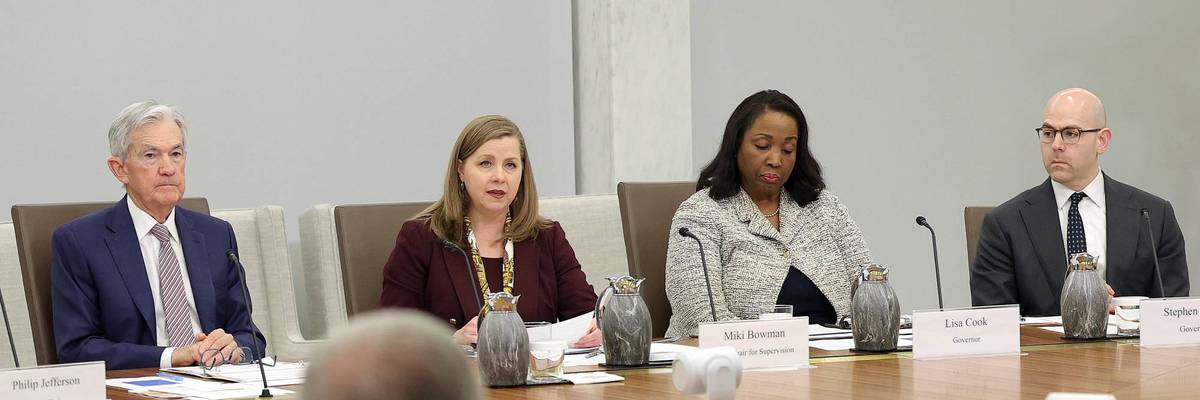
Federal Reserve Chair Jerome Powell presides over a meeting with fellow central bank board members on March 19, 2026 in Washington, DC.
“At a time of extreme and growing inequality," said one critic, "today’s proposals will drain lending away from Main Street families’ needs and priorities and further enrich the already wealthy on Wall Street."
The Trump administration and Federal Reserve unveiled proposals Thursday that would significantly reduce capital requirements for the largest banks in the United States, potentially setting the stage for another financial industry collapse as the US-Israeli war on Iran destabilizes the global economy and jacks up prices for consumers.
Under the new rules proposed by the Fed, Federal Deposit Insurance Corporation, and Office of the Comptroller of the Currency, large banks would have to hold nearly 5% less capital on average. The advocacy organization Better Markets noted that the proposals—combined with other deregulatory actions taken by the Trump administration and the Fed over the past year—would return Wall Street banks' capital requirements "to the irresponsibly low 2007 levels they had just before the 2008 crash."
“At a time of extreme and growing inequality, when tens of millions of Americans are struggling to pay their bills, today’s proposals will drain lending away from Main Street families’ needs and priorities and further enrich the already wealthy on Wall Street and the top 10% of Americans they focus on serving," Dennis Kelleher, the president of Better Markets, said in a statement. "The banking agencies’ proposals to loosen capital rules are a victory for Wall Street lobbying, and claims to the contrary are nothing more than an attempt to mislead the American people."
Fed Gov. Michael Barr, who was nominated by former President Joe Biden, was the central bank board's lone dissenting voice against the new rules, a product of years of aggressive Wall Street lobbying for less stringent regulations in the wake of the Great Recession.
"Today's proposals, if adopted, would harm the resilience of banks and the US financial system," Barr warned in a statement. "There are suggestions that liquidity requirements could also be reduced. Additionally, Federal Reserve supervisory staff have been cut by over 30%, and supervisory practices have been weakened. Banking is built on trust. I worry greatly that these actions are rapidly eroding that trust."
The new deregulatory package, which will be subject to a 90-day public comment period before it's finalized, comes as President Donald Trump is waging an expensive and deadly war on Iran with no end in sight and attacking social programs at home, from Medicaid to nutrition assistance.
“With private credit markets cratering, AI transforming the workforce, and Trump’s Iran war threatening the world economy, we need healthy, resilient, well-capitalized banks," said Bartlett Naylor, an economist for the consumer advocacy group Public Citizen. "Lessons learned after millions lost their jobs, homes, and savings following the 2008 megabank crash must not be ignored."
"Trump’s bank regulators propose to tear at the already tissue-thin layer of solvency levels at the nation’s banks," said Naylor. "Lowering solvency standards won’t generate more loans; it will only send banks closer to failure."
Matt Stoller, an anti-monopoly researcher and author of the BIG newsletter, wrote that the juxtaposition of a quagmire in Iran, Wall Street deregulation, and millions of Americans losing health insurance "tells the story" of the Trump administration.
Today's WSJ front page tells the story of the Trump admin.
#1: Hegseth Says ‘No Time Set’ on Ending Operations in Iran
#2: U.S. Regulators Propose More Lenient Capital Rules for Big Banks
#3: Millions of Americans Are Going Uninsured Following Expiration of ACA Subsidies pic.twitter.com/26jKsQuNc4
— Matt Stoller (@matthewstoller) March 19, 2026
The effort to curb banks' capital requirements was spearheaded by Fed Vice Chair for Supervision Michelle Bowman, a Trump appointee whose nomination last year was criticized by watchdogs as a "gift to the banking industry."
Kelleher of Better Markets said Thursday that "such counterproductive, shortsighted, and wrongheaded rulemaking isn’t a surprise given that the interests of Wall Street’s biggest banks are driving the priorities at the banking agencies, rather than facts, merit, and the public interest."
"The worst is at the Federal Reserve, where the senior regulatory staff comes from Wall Street’s top DC lobbyist (the Bank Policy Institute), Goldman Sachs, and one of Wall Street’s top law firms (a former partner is now the director responsible for supervising and regulating his recent Wall Street clients)," Kelleher observed. "That’s why mindless deregulation, especially for the biggest Wall Street banks, is at the top of the agenda, just as it was in the years before the 2008 crash."
Dear Common Dreams reader, It’s been nearly 30 years since I co-founded Common Dreams with my late wife, Lina Newhouser. We had the radical notion that journalism should serve the public good, not corporate profits. It was clear to us from the outset what it would take to build such a project. No paid advertisements. No corporate sponsors. No millionaire publisher telling us what to think or do. Many people said we wouldn't last a year, but we proved those doubters wrong. Together with a tremendous team of journalists and dedicated staff, we built an independent media outlet free from the constraints of profits and corporate control. Our mission has always been simple: To inform. To inspire. To ignite change for the common good. Building Common Dreams was not easy. Our survival was never guaranteed. When you take on the most powerful forces—Wall Street greed, fossil fuel industry destruction, Big Tech lobbyists, and uber-rich oligarchs who have spent billions upon billions rigging the economy and democracy in their favor—the only bulwark you have is supporters who believe in your work. But here’s the urgent message from me today. It's never been this bad out there. And it's never been this hard to keep us going. At the very moment Common Dreams is most needed, the threats we face are intensifying. We need your support now more than ever. We don't accept corporate advertising and never will. We don't have a paywall because we don't think people should be blocked from critical news based on their ability to pay. Everything we do is funded by the donations of readers like you. When everyone does the little they can afford, we are strong. But if that support retreats or dries up, so do we. Will you donate now to make sure Common Dreams not only survives but thrives? —Craig Brown, Co-founder |
The Trump administration and Federal Reserve unveiled proposals Thursday that would significantly reduce capital requirements for the largest banks in the United States, potentially setting the stage for another financial industry collapse as the US-Israeli war on Iran destabilizes the global economy and jacks up prices for consumers.
Under the new rules proposed by the Fed, Federal Deposit Insurance Corporation, and Office of the Comptroller of the Currency, large banks would have to hold nearly 5% less capital on average. The advocacy organization Better Markets noted that the proposals—combined with other deregulatory actions taken by the Trump administration and the Fed over the past year—would return Wall Street banks' capital requirements "to the irresponsibly low 2007 levels they had just before the 2008 crash."
“At a time of extreme and growing inequality, when tens of millions of Americans are struggling to pay their bills, today’s proposals will drain lending away from Main Street families’ needs and priorities and further enrich the already wealthy on Wall Street and the top 10% of Americans they focus on serving," Dennis Kelleher, the president of Better Markets, said in a statement. "The banking agencies’ proposals to loosen capital rules are a victory for Wall Street lobbying, and claims to the contrary are nothing more than an attempt to mislead the American people."
Fed Gov. Michael Barr, who was nominated by former President Joe Biden, was the central bank board's lone dissenting voice against the new rules, a product of years of aggressive Wall Street lobbying for less stringent regulations in the wake of the Great Recession.
"Today's proposals, if adopted, would harm the resilience of banks and the US financial system," Barr warned in a statement. "There are suggestions that liquidity requirements could also be reduced. Additionally, Federal Reserve supervisory staff have been cut by over 30%, and supervisory practices have been weakened. Banking is built on trust. I worry greatly that these actions are rapidly eroding that trust."
The new deregulatory package, which will be subject to a 90-day public comment period before it's finalized, comes as President Donald Trump is waging an expensive and deadly war on Iran with no end in sight and attacking social programs at home, from Medicaid to nutrition assistance.
“With private credit markets cratering, AI transforming the workforce, and Trump’s Iran war threatening the world economy, we need healthy, resilient, well-capitalized banks," said Bartlett Naylor, an economist for the consumer advocacy group Public Citizen. "Lessons learned after millions lost their jobs, homes, and savings following the 2008 megabank crash must not be ignored."
"Trump’s bank regulators propose to tear at the already tissue-thin layer of solvency levels at the nation’s banks," said Naylor. "Lowering solvency standards won’t generate more loans; it will only send banks closer to failure."
Matt Stoller, an anti-monopoly researcher and author of the BIG newsletter, wrote that the juxtaposition of a quagmire in Iran, Wall Street deregulation, and millions of Americans losing health insurance "tells the story" of the Trump administration.
Today's WSJ front page tells the story of the Trump admin.
#1: Hegseth Says ‘No Time Set’ on Ending Operations in Iran
#2: U.S. Regulators Propose More Lenient Capital Rules for Big Banks
#3: Millions of Americans Are Going Uninsured Following Expiration of ACA Subsidies pic.twitter.com/26jKsQuNc4
— Matt Stoller (@matthewstoller) March 19, 2026
The effort to curb banks' capital requirements was spearheaded by Fed Vice Chair for Supervision Michelle Bowman, a Trump appointee whose nomination last year was criticized by watchdogs as a "gift to the banking industry."
Kelleher of Better Markets said Thursday that "such counterproductive, shortsighted, and wrongheaded rulemaking isn’t a surprise given that the interests of Wall Street’s biggest banks are driving the priorities at the banking agencies, rather than facts, merit, and the public interest."
"The worst is at the Federal Reserve, where the senior regulatory staff comes from Wall Street’s top DC lobbyist (the Bank Policy Institute), Goldman Sachs, and one of Wall Street’s top law firms (a former partner is now the director responsible for supervising and regulating his recent Wall Street clients)," Kelleher observed. "That’s why mindless deregulation, especially for the biggest Wall Street banks, is at the top of the agenda, just as it was in the years before the 2008 crash."
The Trump administration and Federal Reserve unveiled proposals Thursday that would significantly reduce capital requirements for the largest banks in the United States, potentially setting the stage for another financial industry collapse as the US-Israeli war on Iran destabilizes the global economy and jacks up prices for consumers.
Under the new rules proposed by the Fed, Federal Deposit Insurance Corporation, and Office of the Comptroller of the Currency, large banks would have to hold nearly 5% less capital on average. The advocacy organization Better Markets noted that the proposals—combined with other deregulatory actions taken by the Trump administration and the Fed over the past year—would return Wall Street banks' capital requirements "to the irresponsibly low 2007 levels they had just before the 2008 crash."
“At a time of extreme and growing inequality, when tens of millions of Americans are struggling to pay their bills, today’s proposals will drain lending away from Main Street families’ needs and priorities and further enrich the already wealthy on Wall Street and the top 10% of Americans they focus on serving," Dennis Kelleher, the president of Better Markets, said in a statement. "The banking agencies’ proposals to loosen capital rules are a victory for Wall Street lobbying, and claims to the contrary are nothing more than an attempt to mislead the American people."
Fed Gov. Michael Barr, who was nominated by former President Joe Biden, was the central bank board's lone dissenting voice against the new rules, a product of years of aggressive Wall Street lobbying for less stringent regulations in the wake of the Great Recession.
"Today's proposals, if adopted, would harm the resilience of banks and the US financial system," Barr warned in a statement. "There are suggestions that liquidity requirements could also be reduced. Additionally, Federal Reserve supervisory staff have been cut by over 30%, and supervisory practices have been weakened. Banking is built on trust. I worry greatly that these actions are rapidly eroding that trust."
The new deregulatory package, which will be subject to a 90-day public comment period before it's finalized, comes as President Donald Trump is waging an expensive and deadly war on Iran with no end in sight and attacking social programs at home, from Medicaid to nutrition assistance.
“With private credit markets cratering, AI transforming the workforce, and Trump’s Iran war threatening the world economy, we need healthy, resilient, well-capitalized banks," said Bartlett Naylor, an economist for the consumer advocacy group Public Citizen. "Lessons learned after millions lost their jobs, homes, and savings following the 2008 megabank crash must not be ignored."
"Trump’s bank regulators propose to tear at the already tissue-thin layer of solvency levels at the nation’s banks," said Naylor. "Lowering solvency standards won’t generate more loans; it will only send banks closer to failure."
Matt Stoller, an anti-monopoly researcher and author of the BIG newsletter, wrote that the juxtaposition of a quagmire in Iran, Wall Street deregulation, and millions of Americans losing health insurance "tells the story" of the Trump administration.
Today's WSJ front page tells the story of the Trump admin.
#1: Hegseth Says ‘No Time Set’ on Ending Operations in Iran
#2: U.S. Regulators Propose More Lenient Capital Rules for Big Banks
#3: Millions of Americans Are Going Uninsured Following Expiration of ACA Subsidies pic.twitter.com/26jKsQuNc4
— Matt Stoller (@matthewstoller) March 19, 2026
The effort to curb banks' capital requirements was spearheaded by Fed Vice Chair for Supervision Michelle Bowman, a Trump appointee whose nomination last year was criticized by watchdogs as a "gift to the banking industry."
Kelleher of Better Markets said Thursday that "such counterproductive, shortsighted, and wrongheaded rulemaking isn’t a surprise given that the interests of Wall Street’s biggest banks are driving the priorities at the banking agencies, rather than facts, merit, and the public interest."
"The worst is at the Federal Reserve, where the senior regulatory staff comes from Wall Street’s top DC lobbyist (the Bank Policy Institute), Goldman Sachs, and one of Wall Street’s top law firms (a former partner is now the director responsible for supervising and regulating his recent Wall Street clients)," Kelleher observed. "That’s why mindless deregulation, especially for the biggest Wall Street banks, is at the top of the agenda, just as it was in the years before the 2008 crash."