SUBSCRIBE TO OUR FREE NEWSLETTER
Daily news & progressive opinion—funded by the people, not the corporations—delivered straight to your inbox.
5
#000000
#FFFFFF
To donate by check, phone, or other method, see our More Ways to Give page.
Daily news & progressive opinion—funded by the people, not the corporations—delivered straight to your inbox.
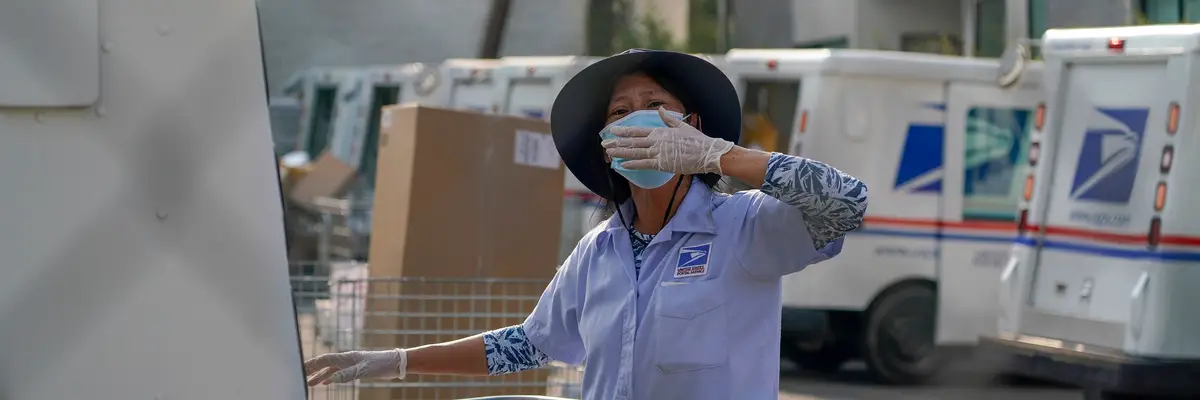
A postal worker blows a kiss towards protesters holding a "Save the Post Office" demonstration outside a United States Postal Service location in Los Angeles, California, on August 22, 2020.
The decision to downgrade postal service standards and eliminate evening collections increases the risk of disenfranchising voters and raising costs for families already struggling to pay their bills.
For over 250 years, Americans have relied on the United States Postal Service for timely processing of their mail, no matter the conditions. After we dropped it in a box or gave it to a letter carrier, we could count on our mail being postmarked on that date so that our bills and tax returns aren’t late and our election ballots are counted.
Unfortunately, this trust is now increasingly risky—since we can no longer rely on USPS to postmark mail on the day it’s collected.
As part of former Postmaster General Louis DeJoy’s broader cost-cutting and restructuring plan, the Postal Service has stopped its practice of picking up mail at the end of every day from all post offices. This means your ballot or bill payment could sit there until the following morning or even longer before being postmarked at a huge processing center.
This gap between mail collection and postmarking is particularly concerning for rural residents, for two main reasons.
To maintain public trust, USPS should restore same-day postmarking and do whatever it takes to protect voting rights for all Americans.
First, the decision to eliminate evening collections applies only to post offices located more than 50 miles from a regional processing center. This raises strong concerns about whether a federal agency with an obligation to provide universal service to all Americans is actively discriminating against rural communities.
Second, rural residents rely especially heavily on our public Postal Service for voting and paying bills. During the 2024 general election, USPS delivered more than 99 million ballots to and from voters. The mail-in option makes voting much easier for rural residents who live long distances from their polling place.
Half of rural county polling sites serve an area larger than 62 square miles, while half of urban polling sites serve an area of less than 2 square miles. Vote by mail is particularly important for seniors, who are more likely to have mobility issues that make it difficult to cast their ballots in person. Americans age 65 or older make up about 20% of all rural residents, compared to just 16% of urban residents.
Older Americans are also more likely to drop a check in the mail rather than paying bills online. According to a USPS survey, 18% of households headed by someone 55 or older paid their bills by mail, compared to just 7% of those aged 18 to 34.
A key reason many rural residents use USPS for bill paying: the digital divide. An Institute for Policy Studies analysis of the 15 most rural states found that only one (North Dakota) had a broadband access rate higher than the national average in 2024. More than 20% of the population lacked broadband access in seven of these states (Alaska, West Virginia, Montana, Alabama, Mississippi, Wyoming, and Iowa).
The decision to downgrade postal service standards and eliminate evening collections increases the risk of disenfranchising voters and raising costs for families already struggling to pay their bills.
These problems are particularly serious as the nation heads into a tense election season. To maintain public trust, USPS should restore same-day postmarking and do whatever it takes to protect voting rights for all Americans, whether they live in the most remote mountain village or the largest city.
Our democracy depends on a strong public Postal Service.
Dear Common Dreams reader, It’s been nearly 30 years since I co-founded Common Dreams with my late wife, Lina Newhouser. We had the radical notion that journalism should serve the public good, not corporate profits. It was clear to us from the outset what it would take to build such a project. No paid advertisements. No corporate sponsors. No millionaire publisher telling us what to think or do. Many people said we wouldn't last a year, but we proved those doubters wrong. Together with a tremendous team of journalists and dedicated staff, we built an independent media outlet free from the constraints of profits and corporate control. Our mission has always been simple: To inform. To inspire. To ignite change for the common good. Building Common Dreams was not easy. Our survival was never guaranteed. When you take on the most powerful forces—Wall Street greed, fossil fuel industry destruction, Big Tech lobbyists, and uber-rich oligarchs who have spent billions upon billions rigging the economy and democracy in their favor—the only bulwark you have is supporters who believe in your work. But here’s the urgent message from me today. It's never been this bad out there. And it's never been this hard to keep us going. At the very moment Common Dreams is most needed, the threats we face are intensifying. We need your support now more than ever. We don't accept corporate advertising and never will. We don't have a paywall because we don't think people should be blocked from critical news based on their ability to pay. Everything we do is funded by the donations of readers like you. When everyone does the little they can afford, we are strong. But if that support retreats or dries up, so do we. Will you donate now to make sure Common Dreams not only survives but thrives? —Craig Brown, Co-founder |
For over 250 years, Americans have relied on the United States Postal Service for timely processing of their mail, no matter the conditions. After we dropped it in a box or gave it to a letter carrier, we could count on our mail being postmarked on that date so that our bills and tax returns aren’t late and our election ballots are counted.
Unfortunately, this trust is now increasingly risky—since we can no longer rely on USPS to postmark mail on the day it’s collected.
As part of former Postmaster General Louis DeJoy’s broader cost-cutting and restructuring plan, the Postal Service has stopped its practice of picking up mail at the end of every day from all post offices. This means your ballot or bill payment could sit there until the following morning or even longer before being postmarked at a huge processing center.
This gap between mail collection and postmarking is particularly concerning for rural residents, for two main reasons.
To maintain public trust, USPS should restore same-day postmarking and do whatever it takes to protect voting rights for all Americans.
First, the decision to eliminate evening collections applies only to post offices located more than 50 miles from a regional processing center. This raises strong concerns about whether a federal agency with an obligation to provide universal service to all Americans is actively discriminating against rural communities.
Second, rural residents rely especially heavily on our public Postal Service for voting and paying bills. During the 2024 general election, USPS delivered more than 99 million ballots to and from voters. The mail-in option makes voting much easier for rural residents who live long distances from their polling place.
Half of rural county polling sites serve an area larger than 62 square miles, while half of urban polling sites serve an area of less than 2 square miles. Vote by mail is particularly important for seniors, who are more likely to have mobility issues that make it difficult to cast their ballots in person. Americans age 65 or older make up about 20% of all rural residents, compared to just 16% of urban residents.
Older Americans are also more likely to drop a check in the mail rather than paying bills online. According to a USPS survey, 18% of households headed by someone 55 or older paid their bills by mail, compared to just 7% of those aged 18 to 34.
A key reason many rural residents use USPS for bill paying: the digital divide. An Institute for Policy Studies analysis of the 15 most rural states found that only one (North Dakota) had a broadband access rate higher than the national average in 2024. More than 20% of the population lacked broadband access in seven of these states (Alaska, West Virginia, Montana, Alabama, Mississippi, Wyoming, and Iowa).
The decision to downgrade postal service standards and eliminate evening collections increases the risk of disenfranchising voters and raising costs for families already struggling to pay their bills.
These problems are particularly serious as the nation heads into a tense election season. To maintain public trust, USPS should restore same-day postmarking and do whatever it takes to protect voting rights for all Americans, whether they live in the most remote mountain village or the largest city.
Our democracy depends on a strong public Postal Service.
For over 250 years, Americans have relied on the United States Postal Service for timely processing of their mail, no matter the conditions. After we dropped it in a box or gave it to a letter carrier, we could count on our mail being postmarked on that date so that our bills and tax returns aren’t late and our election ballots are counted.
Unfortunately, this trust is now increasingly risky—since we can no longer rely on USPS to postmark mail on the day it’s collected.
As part of former Postmaster General Louis DeJoy’s broader cost-cutting and restructuring plan, the Postal Service has stopped its practice of picking up mail at the end of every day from all post offices. This means your ballot or bill payment could sit there until the following morning or even longer before being postmarked at a huge processing center.
This gap between mail collection and postmarking is particularly concerning for rural residents, for two main reasons.
To maintain public trust, USPS should restore same-day postmarking and do whatever it takes to protect voting rights for all Americans.
First, the decision to eliminate evening collections applies only to post offices located more than 50 miles from a regional processing center. This raises strong concerns about whether a federal agency with an obligation to provide universal service to all Americans is actively discriminating against rural communities.
Second, rural residents rely especially heavily on our public Postal Service for voting and paying bills. During the 2024 general election, USPS delivered more than 99 million ballots to and from voters. The mail-in option makes voting much easier for rural residents who live long distances from their polling place.
Half of rural county polling sites serve an area larger than 62 square miles, while half of urban polling sites serve an area of less than 2 square miles. Vote by mail is particularly important for seniors, who are more likely to have mobility issues that make it difficult to cast their ballots in person. Americans age 65 or older make up about 20% of all rural residents, compared to just 16% of urban residents.
Older Americans are also more likely to drop a check in the mail rather than paying bills online. According to a USPS survey, 18% of households headed by someone 55 or older paid their bills by mail, compared to just 7% of those aged 18 to 34.
A key reason many rural residents use USPS for bill paying: the digital divide. An Institute for Policy Studies analysis of the 15 most rural states found that only one (North Dakota) had a broadband access rate higher than the national average in 2024. More than 20% of the population lacked broadband access in seven of these states (Alaska, West Virginia, Montana, Alabama, Mississippi, Wyoming, and Iowa).
The decision to downgrade postal service standards and eliminate evening collections increases the risk of disenfranchising voters and raising costs for families already struggling to pay their bills.
These problems are particularly serious as the nation heads into a tense election season. To maintain public trust, USPS should restore same-day postmarking and do whatever it takes to protect voting rights for all Americans, whether they live in the most remote mountain village or the largest city.
Our democracy depends on a strong public Postal Service.