SUBSCRIBE TO OUR FREE NEWSLETTER
Daily news & progressive opinion—funded by the people, not the corporations—delivered straight to your inbox.
5
#000000
#FFFFFF
To donate by check, phone, or other method, see our More Ways to Give page.
Daily news & progressive opinion—funded by the people, not the corporations—delivered straight to your inbox.
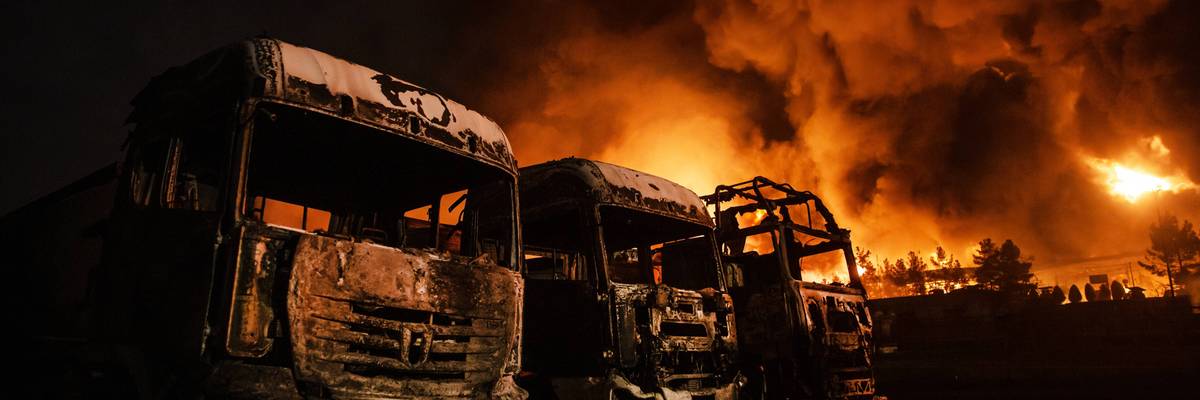
Fire breaks out at the Shahran oil depot after US and Israeli attacks, leaving numerous fuel tankers and vehicles in the area unusable in Tehran, Iran on March 8, 2026.
The world’s leaders should not only condemn US and Israeli aggression that has thrown the global economy into a tailspin but also take action to insulate their economies from this relentless cycle of fossil-fueled violence, volatility, and instability
As the US and Israeli war on Iran continues into its third week, the human, economic, and ecological impacts are devastating. Some 3,000 Iranians have been killed, including 165 children in one school strike, 10,000 injured, and 3.2 million displaced.
The war has caused a crisis. The World Health Organization has warned that with many oil storage tanks hit, resulting in “black rain” falling on Tehran, there is "danger for the population." The debris contains toxins that can cause respiratory and neurological damage, as well as certain kinds of cancer. For US consumers, who were promised that President Donald Trump would stop foreign conflict, the war is costing more than $890 million a day in direct costs, before we factor in the rising costs of energy. This is money that could be spent on education and healthcare.
The war has also brought chaos to global oil markets. Middle East producers have cut oil production by at least 10 million barrels per day, sending oil prices soaring. With no end to the conflict in sight, oil markets remain jittery and volatile.
Spikes in the price of oil affect billions of working people worldwide. They are forced to pay more to fill up their tanks, heat their homes, and even purchase food, since fertilizer is often made from fossil fuels. Rising energy prices can also cause knock-on inflation in the price of other consumer goods.
It is nonsensical that the global economy is so dependent on a 21-mile strait of water staying open to tanker traffic.
On Tuesday, the price of a barrel of Brent crude, the global benchmark for oil, was close to $104, up almost 50% from before the conflict started. By Thursday, after strikes on Gulf oil and gas infrastructure, oil was $119 a barrel and gas jumped 30%, with industry insiders calling it an “Armageddon scenario.” “The world does not need $120 oil,” said Steven Pruett, chief executive of one Texas-based oil producer, Elevation Resources. “It’s going to cause economic destruction.”
Last week, the global energy watchdog, the International Energy Agency, said that oil markets are suffering “the largest supply disruption in history.” The boss of Saudi Aramco, Amin Nasser, has warned of “catastrophic consequences” for the world economy if the US-Iran war drags on.
The problem lies with the Strait of Hormuz, the narrow waterway between Iran, the United Arab Emirates, and Oman. A quarter of the world’s oil—some 20 million barrels a day—passes through the Strait, which is only 21 miles wide at one point. And now, in retaliation for the US and Israeli aggression, Iran has effectively stopped traffic through the Strait by bombing tankers.
For decades, academics and the oil industry have warned that war in Iran could cut off the Strait in times of conflict. The industry has long feared what would happen if the Strait were to close. Chevron boss Mike Wirth recently said: “We do crisis management exercises… the big one has always been something in the Middle East that shuts the Strait of Hormuz… Markets are very uncomfortable, uncertain, volatile, and unpredictable.”
It has become increasingly apparent that Trump had no plan for dealing with the Strait’s closure after pleading earlier this week with European allies to help keep it open. In a scathing editorial, the New York Times wrote: “President Trump went to war against Iran without explaining his strategy to the American people or the world. It now appears that he may not have had much of a strategy at all.”
It added that he also “failed to plan for a predictable side effect of a war in the Middle East: a disruption of oil supplies that causes a price spike and impairs the global economy.”
The evidence bears this out. The threat of closing the Strait remained unseen by the Trump administration, bloodthirsty for regime change and blinkered by the ease of removing President Nicolás Maduro from power in Venezuela.
Before the strikes on Iran, Trump’s Energy Secretary Chris Wright had told an interviewer he was not concerned that the looming war might disrupt oil supplies in the Middle East and wreak havoc in the markets. Since the crisis began, Wright and Interior Secretary Doug Burgum have appeared “flummoxed” by the surge in prices, according to Politico. One industry official has called Burgum the “Where’s Waldo” of the crisis. Both men have been scrambling, but failing, “to head off a bout of energy-driven inflation.”
After a closed-door briefing to lawmakers last week, one Democratic Senator, Chris Murphy, said on social media that the administration had no plan for the Strait of Hormuz and did “not know how to get it safely back open.”
It's not all bad news for the oil industry, though.
Oil companies are set to make obscene profits. Oil Change researchers recently calculated that if oil prices rise just $20 a barrel, US producers will rake in $280 million in extra revenue every day. That’s over $100 billion a year. Shares in the six oil majors, BP, Chevron, Eni, ExxonMobil, Shell, and TotalEnergies, have soared by more than $130 billion in the first two weeks of the war.
This isn’t the first time global oil markets have been thrown into upheaval by war, and by looking to the past, we can see the dangers and possibilities created by oil shocks. In 2022, oil companies were able to use the invasion of Ukraine to increase their already massive profits.
For long-term economic security and stability, as well as a future safe from climate disasters, there needs to be a radical shift to renewables.
The five Big Oil companies—BP, Chevron, ExxonMobil, Shell, and TotalEnergies—reported combined profits of $196.3 billion the following year, more than the economic output of most countries. Working people around the world, as well as our climate, paid the price for Big Oil’s greed. For example, the war cost Canadians $200 billion over the next three years due to inflation spikes.
After the Ukraine war, Pakistan prioritized renewables. Energy analysts in the country believe that solar expansion has helped insulate the power sector from the spiraling energy costs.
“While we’re certainly seeing some impacts, the expansion of distributed solar in the country has provided a cushioning effect against the impacts [of the energy crisis]” Nabiya Imran, an associate at Renewables First, a Pakistani think tank, told The Guardian.
The world’s reaction to the 1973 oil crisis shows that a different path is possible. After oil prices quadrupled, there was significant investment in renewables and energy efficiency. Back then, the US government worked on a program to promote wind turbines and energy efficiency, which would be antithetical to the Trump administration.
Indeed, the madness of Trump’s current war on renewables is such that the administration is reportedly planning to pay nearly $1 billion to French energy company TotalEnergies to stop further offshore wind development.
Despite this, the chaos in the energy markets has led to renewed calls to get off oil and decarbonize. In the UK, The Guardian editorial board argued: “After Russia’s invasion of Ukraine, Europe swapped Russian pipeline gas for American LNG [liquefied natural gas]. Dependency didn’t disappear. Britain just changed suppliers. That is one reason among many why this crisis must see the government focus like a laser on faster decarbonisation, not more drilling.”
US tech corporation Microsoft, which donated $1 million to Trump’s inauguration fund, has also said the war strengthens the case for investment in clean energy sources and battery storage. “Wind and solar as, as part of that mix, is a huge benefit from the standpoint of price stability, because once you install it, you have more certainty around what that actual cost profile looks like,” the company told the Financial Times.
It is nonsensical that the global economy is so dependent on a 21-mile strait of water staying open to tanker traffic. It is nonsensical that oil prices are so volatile that they whipsaw on a tweet from Trump or even a misleading one from US Energy Secretary Chris Wright claiming the US military had successfully shepherded a tanker through the Strait. And it is deeply unjust that this volatility affects the household bills for billions of people.
As some pundits have pointed out, even if Trump declares victory, it is now up to Iran when they will allow the Strait to reopen. It can close it at any time in the future. Iran has the means to hold much of the global economy to ransom.
So, for long-term economic security and stability, as well as a future safe from climate disasters, there needs to be a radical shift to renewables. Leading pundits agree:
There is evidence that the war in Iran is beginning to cause the same shift in thinking that the 1973 oil crisis did. South Korean President Lee Jae Myung said this week that it was time to prepare major measures to conserve energy as the situation deteriorates. These include promoting energy conservation and “rapidly transitioning away from fossil fuels to renewable energy.”
It's also worth remembering that the US military is the largest emitter of greenhouse gases of any institution on Earth and the US is the largest producer of oil and gas globally. The military uses much of that might to defend US interests in fossil fuels.
The world’s leaders should not only condemn US and Israeli aggression that has once again thrown the global economy into a tailspin but also take action to insulate their economies from this relentless cycle of fossil-fueled violence, volatility, and instability. Moving away from fossil fuels does not guarantee world peace. We are already seeing conflicts over the rare earth minerals needed for solar and other green technologies in places like the Congo.
But it can insulate working people from the shocks triggered by the reckless aggression of powerful nations that consider themselves adequately protected from the consequences of their actions.
Dear Common Dreams reader, It’s been nearly 30 years since I co-founded Common Dreams with my late wife, Lina Newhouser. We had the radical notion that journalism should serve the public good, not corporate profits. It was clear to us from the outset what it would take to build such a project. No paid advertisements. No corporate sponsors. No millionaire publisher telling us what to think or do. Many people said we wouldn't last a year, but we proved those doubters wrong. Together with a tremendous team of journalists and dedicated staff, we built an independent media outlet free from the constraints of profits and corporate control. Our mission has always been simple: To inform. To inspire. To ignite change for the common good. Building Common Dreams was not easy. Our survival was never guaranteed. When you take on the most powerful forces—Wall Street greed, fossil fuel industry destruction, Big Tech lobbyists, and uber-rich oligarchs who have spent billions upon billions rigging the economy and democracy in their favor—the only bulwark you have is supporters who believe in your work. But here’s the urgent message from me today. It's never been this bad out there. And it's never been this hard to keep us going. At the very moment Common Dreams is most needed, the threats we face are intensifying. We need your support now more than ever. We don't accept corporate advertising and never will. We don't have a paywall because we don't think people should be blocked from critical news based on their ability to pay. Everything we do is funded by the donations of readers like you. When everyone does the little they can afford, we are strong. But if that support retreats or dries up, so do we. Will you donate now to make sure Common Dreams not only survives but thrives? —Craig Brown, Co-founder |
As the US and Israeli war on Iran continues into its third week, the human, economic, and ecological impacts are devastating. Some 3,000 Iranians have been killed, including 165 children in one school strike, 10,000 injured, and 3.2 million displaced.
The war has caused a crisis. The World Health Organization has warned that with many oil storage tanks hit, resulting in “black rain” falling on Tehran, there is "danger for the population." The debris contains toxins that can cause respiratory and neurological damage, as well as certain kinds of cancer. For US consumers, who were promised that President Donald Trump would stop foreign conflict, the war is costing more than $890 million a day in direct costs, before we factor in the rising costs of energy. This is money that could be spent on education and healthcare.
The war has also brought chaos to global oil markets. Middle East producers have cut oil production by at least 10 million barrels per day, sending oil prices soaring. With no end to the conflict in sight, oil markets remain jittery and volatile.
Spikes in the price of oil affect billions of working people worldwide. They are forced to pay more to fill up their tanks, heat their homes, and even purchase food, since fertilizer is often made from fossil fuels. Rising energy prices can also cause knock-on inflation in the price of other consumer goods.
It is nonsensical that the global economy is so dependent on a 21-mile strait of water staying open to tanker traffic.
On Tuesday, the price of a barrel of Brent crude, the global benchmark for oil, was close to $104, up almost 50% from before the conflict started. By Thursday, after strikes on Gulf oil and gas infrastructure, oil was $119 a barrel and gas jumped 30%, with industry insiders calling it an “Armageddon scenario.” “The world does not need $120 oil,” said Steven Pruett, chief executive of one Texas-based oil producer, Elevation Resources. “It’s going to cause economic destruction.”
Last week, the global energy watchdog, the International Energy Agency, said that oil markets are suffering “the largest supply disruption in history.” The boss of Saudi Aramco, Amin Nasser, has warned of “catastrophic consequences” for the world economy if the US-Iran war drags on.
The problem lies with the Strait of Hormuz, the narrow waterway between Iran, the United Arab Emirates, and Oman. A quarter of the world’s oil—some 20 million barrels a day—passes through the Strait, which is only 21 miles wide at one point. And now, in retaliation for the US and Israeli aggression, Iran has effectively stopped traffic through the Strait by bombing tankers.
For decades, academics and the oil industry have warned that war in Iran could cut off the Strait in times of conflict. The industry has long feared what would happen if the Strait were to close. Chevron boss Mike Wirth recently said: “We do crisis management exercises… the big one has always been something in the Middle East that shuts the Strait of Hormuz… Markets are very uncomfortable, uncertain, volatile, and unpredictable.”
It has become increasingly apparent that Trump had no plan for dealing with the Strait’s closure after pleading earlier this week with European allies to help keep it open. In a scathing editorial, the New York Times wrote: “President Trump went to war against Iran without explaining his strategy to the American people or the world. It now appears that he may not have had much of a strategy at all.”
It added that he also “failed to plan for a predictable side effect of a war in the Middle East: a disruption of oil supplies that causes a price spike and impairs the global economy.”
The evidence bears this out. The threat of closing the Strait remained unseen by the Trump administration, bloodthirsty for regime change and blinkered by the ease of removing President Nicolás Maduro from power in Venezuela.
Before the strikes on Iran, Trump’s Energy Secretary Chris Wright had told an interviewer he was not concerned that the looming war might disrupt oil supplies in the Middle East and wreak havoc in the markets. Since the crisis began, Wright and Interior Secretary Doug Burgum have appeared “flummoxed” by the surge in prices, according to Politico. One industry official has called Burgum the “Where’s Waldo” of the crisis. Both men have been scrambling, but failing, “to head off a bout of energy-driven inflation.”
After a closed-door briefing to lawmakers last week, one Democratic Senator, Chris Murphy, said on social media that the administration had no plan for the Strait of Hormuz and did “not know how to get it safely back open.”
It's not all bad news for the oil industry, though.
Oil companies are set to make obscene profits. Oil Change researchers recently calculated that if oil prices rise just $20 a barrel, US producers will rake in $280 million in extra revenue every day. That’s over $100 billion a year. Shares in the six oil majors, BP, Chevron, Eni, ExxonMobil, Shell, and TotalEnergies, have soared by more than $130 billion in the first two weeks of the war.
This isn’t the first time global oil markets have been thrown into upheaval by war, and by looking to the past, we can see the dangers and possibilities created by oil shocks. In 2022, oil companies were able to use the invasion of Ukraine to increase their already massive profits.
For long-term economic security and stability, as well as a future safe from climate disasters, there needs to be a radical shift to renewables.
The five Big Oil companies—BP, Chevron, ExxonMobil, Shell, and TotalEnergies—reported combined profits of $196.3 billion the following year, more than the economic output of most countries. Working people around the world, as well as our climate, paid the price for Big Oil’s greed. For example, the war cost Canadians $200 billion over the next three years due to inflation spikes.
After the Ukraine war, Pakistan prioritized renewables. Energy analysts in the country believe that solar expansion has helped insulate the power sector from the spiraling energy costs.
“While we’re certainly seeing some impacts, the expansion of distributed solar in the country has provided a cushioning effect against the impacts [of the energy crisis]” Nabiya Imran, an associate at Renewables First, a Pakistani think tank, told The Guardian.
The world’s reaction to the 1973 oil crisis shows that a different path is possible. After oil prices quadrupled, there was significant investment in renewables and energy efficiency. Back then, the US government worked on a program to promote wind turbines and energy efficiency, which would be antithetical to the Trump administration.
Indeed, the madness of Trump’s current war on renewables is such that the administration is reportedly planning to pay nearly $1 billion to French energy company TotalEnergies to stop further offshore wind development.
Despite this, the chaos in the energy markets has led to renewed calls to get off oil and decarbonize. In the UK, The Guardian editorial board argued: “After Russia’s invasion of Ukraine, Europe swapped Russian pipeline gas for American LNG [liquefied natural gas]. Dependency didn’t disappear. Britain just changed suppliers. That is one reason among many why this crisis must see the government focus like a laser on faster decarbonisation, not more drilling.”
US tech corporation Microsoft, which donated $1 million to Trump’s inauguration fund, has also said the war strengthens the case for investment in clean energy sources and battery storage. “Wind and solar as, as part of that mix, is a huge benefit from the standpoint of price stability, because once you install it, you have more certainty around what that actual cost profile looks like,” the company told the Financial Times.
It is nonsensical that the global economy is so dependent on a 21-mile strait of water staying open to tanker traffic. It is nonsensical that oil prices are so volatile that they whipsaw on a tweet from Trump or even a misleading one from US Energy Secretary Chris Wright claiming the US military had successfully shepherded a tanker through the Strait. And it is deeply unjust that this volatility affects the household bills for billions of people.
As some pundits have pointed out, even if Trump declares victory, it is now up to Iran when they will allow the Strait to reopen. It can close it at any time in the future. Iran has the means to hold much of the global economy to ransom.
So, for long-term economic security and stability, as well as a future safe from climate disasters, there needs to be a radical shift to renewables. Leading pundits agree:
There is evidence that the war in Iran is beginning to cause the same shift in thinking that the 1973 oil crisis did. South Korean President Lee Jae Myung said this week that it was time to prepare major measures to conserve energy as the situation deteriorates. These include promoting energy conservation and “rapidly transitioning away from fossil fuels to renewable energy.”
It's also worth remembering that the US military is the largest emitter of greenhouse gases of any institution on Earth and the US is the largest producer of oil and gas globally. The military uses much of that might to defend US interests in fossil fuels.
The world’s leaders should not only condemn US and Israeli aggression that has once again thrown the global economy into a tailspin but also take action to insulate their economies from this relentless cycle of fossil-fueled violence, volatility, and instability. Moving away from fossil fuels does not guarantee world peace. We are already seeing conflicts over the rare earth minerals needed for solar and other green technologies in places like the Congo.
But it can insulate working people from the shocks triggered by the reckless aggression of powerful nations that consider themselves adequately protected from the consequences of their actions.
As the US and Israeli war on Iran continues into its third week, the human, economic, and ecological impacts are devastating. Some 3,000 Iranians have been killed, including 165 children in one school strike, 10,000 injured, and 3.2 million displaced.
The war has caused a crisis. The World Health Organization has warned that with many oil storage tanks hit, resulting in “black rain” falling on Tehran, there is "danger for the population." The debris contains toxins that can cause respiratory and neurological damage, as well as certain kinds of cancer. For US consumers, who were promised that President Donald Trump would stop foreign conflict, the war is costing more than $890 million a day in direct costs, before we factor in the rising costs of energy. This is money that could be spent on education and healthcare.
The war has also brought chaos to global oil markets. Middle East producers have cut oil production by at least 10 million barrels per day, sending oil prices soaring. With no end to the conflict in sight, oil markets remain jittery and volatile.
Spikes in the price of oil affect billions of working people worldwide. They are forced to pay more to fill up their tanks, heat their homes, and even purchase food, since fertilizer is often made from fossil fuels. Rising energy prices can also cause knock-on inflation in the price of other consumer goods.
It is nonsensical that the global economy is so dependent on a 21-mile strait of water staying open to tanker traffic.
On Tuesday, the price of a barrel of Brent crude, the global benchmark for oil, was close to $104, up almost 50% from before the conflict started. By Thursday, after strikes on Gulf oil and gas infrastructure, oil was $119 a barrel and gas jumped 30%, with industry insiders calling it an “Armageddon scenario.” “The world does not need $120 oil,” said Steven Pruett, chief executive of one Texas-based oil producer, Elevation Resources. “It’s going to cause economic destruction.”
Last week, the global energy watchdog, the International Energy Agency, said that oil markets are suffering “the largest supply disruption in history.” The boss of Saudi Aramco, Amin Nasser, has warned of “catastrophic consequences” for the world economy if the US-Iran war drags on.
The problem lies with the Strait of Hormuz, the narrow waterway between Iran, the United Arab Emirates, and Oman. A quarter of the world’s oil—some 20 million barrels a day—passes through the Strait, which is only 21 miles wide at one point. And now, in retaliation for the US and Israeli aggression, Iran has effectively stopped traffic through the Strait by bombing tankers.
For decades, academics and the oil industry have warned that war in Iran could cut off the Strait in times of conflict. The industry has long feared what would happen if the Strait were to close. Chevron boss Mike Wirth recently said: “We do crisis management exercises… the big one has always been something in the Middle East that shuts the Strait of Hormuz… Markets are very uncomfortable, uncertain, volatile, and unpredictable.”
It has become increasingly apparent that Trump had no plan for dealing with the Strait’s closure after pleading earlier this week with European allies to help keep it open. In a scathing editorial, the New York Times wrote: “President Trump went to war against Iran without explaining his strategy to the American people or the world. It now appears that he may not have had much of a strategy at all.”
It added that he also “failed to plan for a predictable side effect of a war in the Middle East: a disruption of oil supplies that causes a price spike and impairs the global economy.”
The evidence bears this out. The threat of closing the Strait remained unseen by the Trump administration, bloodthirsty for regime change and blinkered by the ease of removing President Nicolás Maduro from power in Venezuela.
Before the strikes on Iran, Trump’s Energy Secretary Chris Wright had told an interviewer he was not concerned that the looming war might disrupt oil supplies in the Middle East and wreak havoc in the markets. Since the crisis began, Wright and Interior Secretary Doug Burgum have appeared “flummoxed” by the surge in prices, according to Politico. One industry official has called Burgum the “Where’s Waldo” of the crisis. Both men have been scrambling, but failing, “to head off a bout of energy-driven inflation.”
After a closed-door briefing to lawmakers last week, one Democratic Senator, Chris Murphy, said on social media that the administration had no plan for the Strait of Hormuz and did “not know how to get it safely back open.”
It's not all bad news for the oil industry, though.
Oil companies are set to make obscene profits. Oil Change researchers recently calculated that if oil prices rise just $20 a barrel, US producers will rake in $280 million in extra revenue every day. That’s over $100 billion a year. Shares in the six oil majors, BP, Chevron, Eni, ExxonMobil, Shell, and TotalEnergies, have soared by more than $130 billion in the first two weeks of the war.
This isn’t the first time global oil markets have been thrown into upheaval by war, and by looking to the past, we can see the dangers and possibilities created by oil shocks. In 2022, oil companies were able to use the invasion of Ukraine to increase their already massive profits.
For long-term economic security and stability, as well as a future safe from climate disasters, there needs to be a radical shift to renewables.
The five Big Oil companies—BP, Chevron, ExxonMobil, Shell, and TotalEnergies—reported combined profits of $196.3 billion the following year, more than the economic output of most countries. Working people around the world, as well as our climate, paid the price for Big Oil’s greed. For example, the war cost Canadians $200 billion over the next three years due to inflation spikes.
After the Ukraine war, Pakistan prioritized renewables. Energy analysts in the country believe that solar expansion has helped insulate the power sector from the spiraling energy costs.
“While we’re certainly seeing some impacts, the expansion of distributed solar in the country has provided a cushioning effect against the impacts [of the energy crisis]” Nabiya Imran, an associate at Renewables First, a Pakistani think tank, told The Guardian.
The world’s reaction to the 1973 oil crisis shows that a different path is possible. After oil prices quadrupled, there was significant investment in renewables and energy efficiency. Back then, the US government worked on a program to promote wind turbines and energy efficiency, which would be antithetical to the Trump administration.
Indeed, the madness of Trump’s current war on renewables is such that the administration is reportedly planning to pay nearly $1 billion to French energy company TotalEnergies to stop further offshore wind development.
Despite this, the chaos in the energy markets has led to renewed calls to get off oil and decarbonize. In the UK, The Guardian editorial board argued: “After Russia’s invasion of Ukraine, Europe swapped Russian pipeline gas for American LNG [liquefied natural gas]. Dependency didn’t disappear. Britain just changed suppliers. That is one reason among many why this crisis must see the government focus like a laser on faster decarbonisation, not more drilling.”
US tech corporation Microsoft, which donated $1 million to Trump’s inauguration fund, has also said the war strengthens the case for investment in clean energy sources and battery storage. “Wind and solar as, as part of that mix, is a huge benefit from the standpoint of price stability, because once you install it, you have more certainty around what that actual cost profile looks like,” the company told the Financial Times.
It is nonsensical that the global economy is so dependent on a 21-mile strait of water staying open to tanker traffic. It is nonsensical that oil prices are so volatile that they whipsaw on a tweet from Trump or even a misleading one from US Energy Secretary Chris Wright claiming the US military had successfully shepherded a tanker through the Strait. And it is deeply unjust that this volatility affects the household bills for billions of people.
As some pundits have pointed out, even if Trump declares victory, it is now up to Iran when they will allow the Strait to reopen. It can close it at any time in the future. Iran has the means to hold much of the global economy to ransom.
So, for long-term economic security and stability, as well as a future safe from climate disasters, there needs to be a radical shift to renewables. Leading pundits agree:
There is evidence that the war in Iran is beginning to cause the same shift in thinking that the 1973 oil crisis did. South Korean President Lee Jae Myung said this week that it was time to prepare major measures to conserve energy as the situation deteriorates. These include promoting energy conservation and “rapidly transitioning away from fossil fuels to renewable energy.”
It's also worth remembering that the US military is the largest emitter of greenhouse gases of any institution on Earth and the US is the largest producer of oil and gas globally. The military uses much of that might to defend US interests in fossil fuels.
The world’s leaders should not only condemn US and Israeli aggression that has once again thrown the global economy into a tailspin but also take action to insulate their economies from this relentless cycle of fossil-fueled violence, volatility, and instability. Moving away from fossil fuels does not guarantee world peace. We are already seeing conflicts over the rare earth minerals needed for solar and other green technologies in places like the Congo.
But it can insulate working people from the shocks triggered by the reckless aggression of powerful nations that consider themselves adequately protected from the consequences of their actions.