

SUBSCRIBE TO OUR FREE NEWSLETTER
Daily news & progressive opinion—funded by the people, not the corporations—delivered straight to your inbox.
5
#000000
#FFFFFF
To donate by check, phone, or other method, see our More Ways to Give page.


Daily news & progressive opinion—funded by the people, not the corporations—delivered straight to your inbox.
“She doesn’t have one.”
As Democratic US Senate candidate Scott Colom's lead over Republican Sen. Cindy Hyde-Smith surpassed 2,000 votes in the too-close-to-call race in Mississippi—a state that hasn't elected a Democrat to the upper chamber since 1982, the year Colom was born—the candidate expressed frustration that Hyde-Smith has been nowhere to be seen during the ballot-counting process.
Colom told CNN that he has faith in the tallying of votes, in which provisional and affidavit ballots are now being counted, but urged Hyde-Smith to speak publicly and suggested she should be ready to concede.
"Ultimately, at some point, the senator needs to speak out. Where is Cindy Hyde-Smith?... Why can't she speak for herself? Why's she got to have Chairman Hurst speaking for her?" said Colom, referring to state Republican Party Chairman Mike Hurst.
Hurst said Thursday that "there is no election denying going on here" and affirmed that Republicans will accept a victory by Colom, who would be the state's first Black senator elected since 1870, during Reconstruction, "if the laws are followed."
"We want to hear from her," added Colom. "What is her path to victory? She doesn't have one. Chairman Hurst knows that, I know that, the people of Mississippi have spoken, we all know where this is going."
Colom: "I have faith that the process will be followed correctly. Everybody just needs to calm down, follow the law. It's very clear the direction of this. Ultimately, at some point the senator needs to speak out. Where is Cindy Hyde-Smith? Why can't she speak for herself? What is her path for victory? She doesn't have one."
— Aaron Rupar (@atrupar) November 6, 2026
The Associated Press reported late Friday morning that Colom's lead had grown to 2,010 votes.
Hyde-Smith and her allies had believed that as affidavit and provisional ballots were counted, she would surpass the district attorney, but the Mississippi Free Press reported that Colom's lead has only gotten larger as each new batch of votes has been tallied.
More mail-in absentee ballots could still arrive before their deadline of November 10, which is also the last day of counting for affidavit ballots, which were cast by voters who did not bring their ID to the polls and had to identify themselves to their circuit clerk’s office before their vote would be counted.
Many of the absentee ballots that have yet to be counted are from Hinds County, which includes the heavily Democratic and majority-Black capital city of Jackson.
The Mississippi Free Press reported Friday that Colom's lead among the affidavit ballots cast in Chickasaw County was 55.2 points, and he has overperformed on affidavit ballots that were cast in counties that Hyde-Smith won overall.
In Itawamba County, the Republican senator leads by 65.8 points, but "her lead among affidavit ballots is substantially lower, at 46 points, meaning Colom is significantly overperforming in the county’s affidavit ballots."
More than 95% of all votes have been counted, according to The New York Times. Political observers saw Colom's victory in Forrest County, named for Ku Klux Klan founder Nathan Bedford Forrest and carried by President Donald Trump by 18 points in 2024, as one sign that the Democrat could win the election.
On Thursday, lawyers for Colom's campaign cautioned county election commissioners and circuit clerks in Mississippi against following a demand by the National Republican Senatorial Committee (NRSC) that they segregate affidavit ballots in preparation for a potential legal challenge.
"Those demands have no basis in Mississippi law, and if you depart from ordinary election procedures as you have been asked to do, you will violate Mississippi voters’ rights and Mississippi election law," wrote Jacquelyn Lopez with the Elias Law Group.
The state Supreme Court has barred election officials from changing election procedures during vote-counting, and the separation of affidavit ballots could result in ballots being separated from their envelopes, putting voters' right to a secret ballot in jeopardy, said the Colom campaign.
Gerard Henderson, Colom's campaign manager, called the NRSC demand "a desperate stunt" and said it was "what you do when you know you’re about to lose a race."
"We’re confident that when every lawful ballot is counted, Scott Colom will be Mississippi’s next US senator,” Henderson said.
Mississippi Free Press news editor Ashton Pittman noted Wednesday that Colom would "likely be a federal judge right now—not [Hyde-Smith's] opponent—if not for the fact that she blocked [President Joe] Biden's nomination of him over his support for trans rights."
Hyde-Smith blocked Biden's nomination of Colom to be US District Court Judge for the Northern District of Mississippi in 2023, citing his "opposition to legislation to protect female athletes."
Colom had not stated any views on which teams transgender student athletes should play on at the time. In 2021 he signed a letter opposing “ongoing efforts to criminalize transgender people and gender-affirming healthcare across the country."
"If she loses to Scott Colom," said Pittman, "Sen. Cindy Hyde-Smith will have helped set her own defeat in motion."
Meanwhile, a new poll revealed that a supermajority of Jewish Americans believe that the actions of Israel and AIPAC fuel antisemitism.
Despite an expensive campaign to distort his vocal criticism of Israeli crimes in Palestine as "antisemitic," progressive Michigan Democrat Abdul El-Sayed won his US Senate race with the support of a majority of the state's early Jewish voters, while a survey published Thursday revealed that 8 in 10 Jewish Americans believe Israel's actions and lobbying increase antisemitism.
An analysis of Michigan voting data published by the Jewish newspaper The Forward found that El-Sayed, who will be the first Muslim senator in US history, received approximately 60% of the vote among Jewish early voters.
The survey's results imply a rebuke of the efforts by groups like the American Israel Public Affairs Committee (AIPAC), which spent nearly $30 million on opposing El-Sayed and supporting his primary opponent, Rep. Haley Stevens (D-Mich.).
"The media spent October obsessing over Abdul El-Sayed's 'problem' with Jewish voters," writer and labor organizer Joe Wrote said on social media, noting that corporate outlets including The Washington Post, New York Times, Associated Press, and NPR "ran constant articles."
"In the end, El-Sayed got 60% of the Michigan Jewish vote, 1.3% less than Elissa Slotkin did in 2024," he added, referring to Michigan's Democratic junior US senator, who is Jewish. "The mainstream media is a joke."
While AIPAC's enormous spending helped make the contest one of the most expensive Senate primaries in US history, El-Sayed's focus on issues affecting working families—the affordability crisis, fixing the nation's broken healthcare system via Medicare for All—in addition to broader topics like getting money out of politics and ending US militarism and aid to Israel, led to his Tuesday victory.
AIPAC—whose super political action committee, United Democracy Project (UDP), only started financially supporting congressional candidates in 2021—has flexed its electoral muscles in recent years. In 2024, it helped defeat progressive Reps. Jamaal Bowman (D-NY) and Cori Bush (D-Mo.). However, Rep. Summer Lee (D-Pa.) survived a UDP spending blitz during the previous midterms in 2022, and El-Sayed's victories in both the Michigan primary and general election demonstrate the limits of its largesse.
El-Sayed's victory coincided with the release of a new GBAO survey commissioned by the liberal Jewish lobby group J Street showing that overwhelming majorities of Jewish Americans believe the actions of Israel and AIPAC contribute to antisemitism in the United States.
According to the survey, 80% of respondents believe that Israel's actions in Gaza and the West Bank increase hatred of Jews, while 66% said that AIPAC funding advertisements against candidates who criticize Israel worsens antisemitism, and 60% agree that "Jewish organizations that condemn harsh criticism of Israel as antisemitic are exploiting concerns about antisemitism to defend unpopular Israeli government policies."
Tellingly, more respondents believe that Israel is committing genocide in Gaza (31%) than that Israel deserves unconditional support (30%).
A United Nations Commission of Inquiry, as well as many experts, including Israeli and other Jewish scholars, say that Israel is committing genocide in Gaza. A genocide case against Israel filed by South Africa and formally backed by nearly 20 nations is proceeding through the International Court of Justice.
Israeli Prime Minister Benjamin Netanyahu and former Defense Minister Yoav Gallant are wanted by the International Criminal Court for alleged crimes against humanity in Gaza, including murder and forced starvation, committed during a war that has left more than 250,000 Palestinians dead or wounded and nearly 2 million people forcibly displaced.
In the illegally occupied West Bank, Israel has been accelerating its decadeslong campaign of apartheid, settler colonization, land theft, and ethnic cleansing, expanding illegal settlements and outposts while systematically dispossessing Palestinians of their homes, farms, and ancestral lands.
The far-right Netanyahu government has openly embraced annexation, with ministers pushing to formally absorb Palestinian territory into Israel and explicitly declaring their intention to prevent the establishment of an independent Palestinian state.
Armed Israeli settler-colonists, frequently operating with the protection, participation, or complicity of Israeli occupation forces, have unleashed increasingly brazen pogroms against Palestinian communities, burning homes, mosques, and vehicles, destroying olive groves, stealing livestock, beating residents, and killing Palestinians.
Appearing Thursday on MS NOW's "Morning Joe," El-Sayed was asked by host Willie Geist what message he had for Jewish voters who had been concerned about his positions and how he would protect them against antisemitism.
"I was really privileged to grow up in a community where about 40% of my high school class was Jewish," he said. "I grew up going to synagogue, going to Seder, going to bar and bat mitzvahs growing up. I have so much respect for the Jewish faith and Jewish contributions to American life."
"I also know what it's like to be discriminated against for how I pray," the senator-elect continued. "And I want an America where nobody is discriminated against under our Constitution."
"I know what it's like to drop off my kids to a mosque and wonder if they're going to be safe, and am I going to be able to pick them up safely afterwards," El-Sayed continued. "I'm committed to the safety of Jewish children like I'm committed to the safety of my own children."
"But I want to ask us this," he said. "We spend billions of dollars subsidizing a foreign government unconditionally buying bombs and tanks that have been used to do genocide and apartheid and make war we have no business fighting."
"And we're told that if you want to stand up against the murder of innocent Palestinian children, that that's somehow about hate for anybody. It's not about hate for anybody," El-Sayed stressed. "It's about equal love for those Palestinian children, as you would have for a Jewish child growing up in the Holy Land."
"So if I stand up and say, hey, maybe we shouldn't be sending our money to do the worst things to other people, people are like, well, it must be because you hate the people who are doing the worst things," he said. "I'm like, that's insane."
"We have to separate between Judaism and the Jewish people and Israel and its actions," the senator-elect asserted. "And by the way, I apply the same approach to the government of Egypt where my family came from. And I would hate that somebody would assume that I would be OK with the human rights abuses of the government of Egypt simply because I share the ethnicity of the majority of people who are in Egypt."
El-Sayed concluded by saying he wants to see a world in which "a Palestinian child and a Jewish Israeli child growing up in the Holy Land can look forward at their life and say, my life is not going to be curtailed by somebody's violence."
"This was an election about power," said US Rep. Pat Ryan.
Democratic Rep. Pat Ryan, who represents New York's 18th congressional district, said on Friday that his party's victory in this week's elections has given it a mandate to take on billionaires and corporate interests.
In a multi-post thread posted to social media, Ryan sought to challenge predictable political narratives taking shape in the corporate media about the reasons for Democrats’ historic wins.
"While pundits do the same-old tired debate of whether Tuesday’s election results mean Democrats should be more progressive or more moderate, they’re missing the whole damn point," Ryan began. "This was an election about POWER."
"Over the past two years, Trump has made it abundantly clear who’s in power," Ryan continued. "And big surprise, it's not the American people—who are getting screwed over by a political and economic system rigged in favor of the top 1%."
Ryan then listed off a number of bad actors who have been rigging the system even further to their benefit under Trump's watching, including "AI oligarchs getting tax breaks to build a technology that could kill us all," "UnitedHealth denying your insurance claims (from the provider they own!), while you go bankrupt," and "[SpaceX CEO] Elon Musk spending $750 million to buy our elections, while making billions in government contracts."
"Voters see how Trump and Republicans are using their power, and they said HELL NO," Ryan said. "They want to feel in control of their own lives again. They want elected leaders who will listen to THEM, fight for them, and deliver for them. Not for the ultra-rich and the Epstein class."
Now that voters in 2026 have firmly rejected the GOP, Ryan said, it is now up to Democrats to deliver a fairer economic system that doesn't simply funnel money to the ultrarich.
"Democrats who won across the country understood that voters don’t just want lower costs," Ryan emphasized. "They want us to fundamentally fix this broken system. They want us to call out and take on the villains screwing them over, whether corrupt politicians or greedy CEOs, and put power back in their hands. Be a leader who works for the PEOPLE—not the billionaires and corporations funding our politics."
Ryan's post echoes a report published on Thursday by Data for Progress, which found that populist economic appeals were central to Democrats' Tuesday electoral success.
The report also found robust support among voters for a number of specific populist policies, including higher taxes on millionaires, raising the minimum wage to $15 an hour, and a temporary moratorium on building artificial intelligence data centers.
The senator-elect said he aims to probe "the decision-making that's gone on and what we need to do to solve the problem in its depth. And that takes understanding the nature of the problem."
Michigan was the epicenter of the cyclosporiasis outbreak that hit the United States last summer, and the state's new Democratic senator-elect plans to find out why after taking office in January.
Sen.-elect Abdul El-Sayed, who faced virulently racist attacks from members of the Trump administration, including Health and Human Services (HHS) Secretary Robert F. Kennedy Jr., during his campaign, told CNN Thursday that he plans to investigate Kennedy's handling of the outbreak of the illness caused by the Cyclospora parasite, which sickened more than 15,000 Michiganders, hospitalized more than 370, and killed two people in the state.
El-Sayed emphasized that he is not out for "retribution for something past," but said an investigation into staffing cuts at HHS would be focused on "understanding what happened, holding people accountable for what they did, and then solving the problem moving forward."
"People need to feel it in their back pockets and in their homes," said El-Sayed.
The former public health official said the Trump administration had "DOGE-ed out the part of the Food and Drug Administration and the [Centers for Disease Control and Prevention] that was intended both to protect you from eating lettuce that had been defiled by somebody else, and counting the number of cases," referring to the Department of Government Efficiency.
Under the leadership of GOP megadonor Elon Musk, DOGE cut staffing at a CDC lab tasked with responding to Cyclospora and other parasitic outbreaks from 11 people to just three.
The US Department of Agriculture shut down three key research projects regarding the parasite, which can cause explosive diarrhea and other gastrointestinal symptoms when it contaminates food. Two of the projects were defunded by the Republican-controlled Congress, while a third was moved from Maryland to Iowa as part of a reorganization of the agency, and the scientists working on the research declined to relocate, jeopardizing the study.
The CDC also removed Cyclospora from its Foodborne Diseases Active Surveillance Network, or FoodNet, in 2025 as part of Kennedy's changes to the agency.
Kennedy said the outbreak was "under control" on July 21, when 1,600 people were sick across the country. Dozens of people in Michigan continued to become ill over the following month. The outbreak was ultimately linked to lettuce that was grown in central Mexico by Taylor Farms de Mexico.
The HHS secretary claimed that the allegations that his cuts had reduced the government's ability to respond to the outbreak were "invalid," saying there were "no cuts in the surveillance program."
“We did cuts in the FoodNet program, but they were redundant surveillance," said Kennedy.
El-Sayed said Thursday that he aims "to understand why he's... done this, the decision-making that's gone on, and what we need to do to solve the problem in its depth. And that takes understanding the nature of the problem."
He added that legislation could come out of an investigation.
"There's no reason that we couldn't have one clean bill, right? The Crap Lettuce Elimination Act, whatever we want to call it, to just make sure that we have a FDA that's functioning," said El-Sayed. "It's not just lettuce. We're talking—seeing recalls in blueberries. We're seeing recalls in blackberries. We're seeing recalls in meat. And that's because the FDA's not working."
The senator-elect also said the ascent of Kennedy, who has publicly questioned the safety of vaccines and halted immunization research, is among the Trump administration appointments that raise questions about how President Donald Trump is selecting his nominees for top government positions.
“I think this administration has shown that the decisions that they make about who is engaged in government, leading government, that that's more about backroom deals and who curries favor than it is about their capacity to do the job," said El-Sayed. "When you nominate somebody like RFK Jr., who is anti-science, to run HHS, what you get is a bunch of nasty crap lettuce in the state of Michigan."
When considering Trump's nominees as a senator, El-Sayed added, "I'm going to assume I'm not going to support you until proven otherwise. So the bar is going to be extremely high. I want to know that this person was chosen on their merit and the capacity to serve the American public."
Progressive and anti-war groups say Democrats don't even need to wait until January—they can hold up money for the war when government funding runs out next month.
After voters delivered a clear rebuke of President Donald Trump’s Iran War on Election Day, a senior US House Democrat said ending the conflict will be a top priority when his party assumes control of Congress—one made even more urgent after the president's renewed threats to "destroy" Iran on Thursday.
"I think it’ll be one of the first things we do, and strongest things that we should do," said Rep. Adam Smith (D-Wash.), who is slated to chair the House Armed Services Committee, when asked by The New Republic's Greg Sargent whether Democrats will use their newfound majorities in both chambers to cut off funding for the war, which just entered its ninth month.
Smith said he expects Democrats will pursue a bill that forbids any further funding for the conflict, which the Pentagon says has cost over $47 billion, though independent estimates put the cost much higher.
A bill of this sort, Smith said, would almost certainly be vetoed by Trump, meaning Republicans in both chambers would need to provide enough votes to override his veto.
Overwhelming opposition to the Iran War, which has dragged on without an end in sight and caused inflation to surge, played a central role in the electoral beatdown Republicans suffered on Tuesday. Nationwide, 63% of voters said launching the war was the "wrong decision," according to an NBC News exit poll. Among those voters, 82% favored Democrats.
Nearly three-quarters of voters (74%) said that the war was a "crucial or major" factor in their vote, and 63% of them said they chose Democrats.
But even as members of his party, including Vice President JD Vance, state plainly that "the reason we lost is the war," Trump has continued to defend it and suggested he may pursue deeper intervention.
"I would rather not destroy the rest of the country if possible, but maybe I'll have to," he told reporters in the Oval Office. "You'll know soon enough."
Trump has made similar threats to "annihilate" Iran, "blow up" the country, and eradicate the "whole civilization" for months. But now that the midterms are over, there are fewer political pressures holding him back from following through on these threats.
The administration reportedly has plans drawn up for a renewed, large-scale bombing campaign that could target the country's energy infrastructure, military installations, and nuclear facilities, possibly with Israeli participation. Last month, it was reported that Trump was mulling dropping "the mother of all bombs," the largest nonnuclear bomb in the American arsenal, on Iran, which poses the risk of massive civilian casualties.
Sen. Chris Murphy (D-Conn.), who received a classified briefing about the plans days before the midterms, called them "insane" and said they involved deliberate attacks on civilians and civilian infrastructure in violation of international law.
Rep. Yassamin Ansari (D-Ariz.), the only Iranian American Democrat in the US Congress, said that Trump's renewed threats on Thursday only increase the urgency of ending the war.
"He’s once again threatening the annihilation of a country of 90 million people," Ansari wrote on social media. "A crime against humanity. Democrats must work urgently to end Trump’s reckless war of choice when we take back the House and the Senate. Enough is enough."
A "flurry of diplomatic activity" has followed the midterms, according to reporting by Axios' Barak Ravid. Iranian negotiators have spoken with regional mediators about a possible deal for the US to lift its naval blockade and release some of Iran’s frozen funds in exchange for nuclear talks and an end to Iran's travel restrictions through the Strait of Hormuz.
According to the same report, US Central Command was "finalizing preparations" to restart major combat operations in Iran, though there has not been an official directive from Washington.
"The American people delivered a clear mandate to end the illegal war on Iran," said the National Iranian American Council (NIAC) on Thursday. "Trump instead suggests he may escalate the war and commit war crimes to 'destroy the rest of' Iran. This is outrageous and unacceptable."
"Congress," it said, "must cut off funding for this war NOW."

Democrats may have opportunities to push for the end of the war before January.
Rep. Thomas Massie (Ky.), the leading Republican critic of the war, whom Trump helped to defeat in his primary earlier this year, has said he plans to force a vote on impeaching Defense Secretary Pete Hegseth next week for violating the war powers resolution passed by Congress.
"By every estimation, it will pass and he will be impeached," Smith said. "And off that goes to the Senate. Then the Senate is legally required to spend all of their time dealing with that until it’s done with."
Still, it remains an open question whether the necessary two-thirds of senators would vote to remove Hegseth and whether the pressure could meaningfully affect the war.
Another chance to stop the war will come on December 11, when Congress will need to approve another spending measure to prevent a government shutdown.
According to Roll Call, the progressive advocacy group Indivisible sent a memo on Thursday pushing Democrats to block a National Defense Authorization Act and refuse to fund the Pentagon if “it doesn’t cut off money for the war.”
“Voters have granted Democrats majorities in the House and Senate with a clear mandate: End this war," said Jamal Abdi, the president of NIAC. "The first test of the Democrats’ commitment to that mandate will be when Congress takes up legislation to fund the government before funding runs out on December 11."
"After having won Congress thanks to a massively unpopular war," he said, "the best way to squander this momentum would be for Democrats to turn around and provide funding for the president to continue the conflict."
"The new Democratic majority in Congress should pass bills to make life more affordable and our government less corrupt."
One of the easiest ways to spot a supporter of US President Donald Trump is a red hat declaring "Make America Great Again," but after a Democratic "tsunami" in the midterms earlier this week, the Republican leader unveiled a new cap that says "VETO."
Sen. Elizabeth Warren (D-Mass.), an incoming committee chair who's long sparred with Trump, responded Thursday by making clear that Democrats are determined to pass far-reaching legislation after securing significant—but not veto-proof—majorities in both chambers of Congress.
"If Donald Trump wants to be Mr. Veto, let's test that out," she wrote on social media, replying to a White House photo of the hat placed next to the president as he signed an executive order declaring the Oval Office and the Cabinet Room national monuments. "The new Democratic majority in Congress should pass bills to make life more affordable and our government less corrupt."
Warren's X post echoed her Thursday op-ed about "why Democrats won the midterms"—as of Friday, they have at least 54 senators and 253 seats in the House of Representatives—and how they now "must deliver... even with Donald Trump in the White House."
"Trump says he welcomes the nickname 'Mr. Veto.' Well, let's test that out by passing legislation the American people support," she wrote for Time, urging Democrats to stop the Iran War, reverse GOP healthcare cuts while expanding coverage, fund universal childcare, and cancel "the tax breaks Trump and the Republicans handed out to corporations, ultramillionaires, and billionaires."
Other priorities for the progressive—who is set to lead the Senate Committee on Banking, Housing, and Urban Affairs—include "bills to ban stock trading by federal officials or crack down on Trump's corruption in plain sight," as well as efforts to make "Big Tech CEOs, Wall Street executives, and giant corporations... answer tough questions" about "ripping off the American people."
Warren isn't alone in urging the party to call Trump's bluff once Democrats have enough votes to pass bills without GOP support in January. Also responding to the White House's hat post, Sen. Tammy Duckworth (D-Ill.) declared Friday, "Let's do it."
"Let's dare him to veto" legislation on the following, Duckworth said:
Democratic victories on Tuesday also generated fresh hope about eventually replacing the US for-profit healthcare system with Medicare for All—a hallmark issue for Sen. Bernie Sanders (I-Vt.), who is expected to chair the Senate Committee on Health, Education, Labor, and Pensions and has been credited with making the party's policies more progressive via his presidential runs and engagement with voters across the country on his Fighting Oligarchy Tour..
As political observers asserted that "Bernie made the path" for progressive candidates who campaigned on economic populism to win key elections this week, Sanders has said in multiple interviews that the incoming Democrat-controlled Congress should pass Medicare for All—which would save over 114,000 lives and $1 trillion annually—and see if Trump vetoes it.
Sen. Chris Van Hollen (D-Md.), a possible 2028 presidential contender who previously led Senate Democrats' campaign arm, similarly argued that despite Trump's threats this week, the new majorities should fight to improve affordability and tax the rich.
"It is essential that we show the American people where we stand," Van Hollen told Politico. "If Trump vetoes it, it will just show people that he's on the side of billionaires."
While he is reportedly not going to challenge Sen. Chuck Schumer (D-NY) to be Senate majority leader post, Van Hollen has also suggested that Democrats should not back the current minority leader without securing his support for a "bold agenda."
"He is conducting state terrorism."
While President Donald Trump this week indicated he's standing by Defense Secretary Pete Hegseth in the wake of brutal midterm election losses, Democratic Party leaders have indicated they'll use their new majorities in Congress to remove him from office, one way or another.
The Intercept reported on Thursday that source in the US Department of Defense, as well as on Capitol Hill, believe Hegseth's days are numbered due to a number of factors, including an "endless raft of scandals, culture-war clownishness, and senseless policies."
Wes J. Bryant, a senior targeting adviser and policy analyst at the Pentagon who was pushed out of his job last year, told The Intercept that Hegseth’s extrajudicial killings of people in the Caribbean and Pacific constitute war crimes.
"He is conducting state terrorism," said Bryant. "He is 100% a war criminal. He needs to be prosecuted."
A senior congressional staffer told The Intercept that a resolution to impeach Hegseth being offered in the US House of Representatives by outgoing Rep. Thomas Massie (R-Ky.) could gain significant bipartisan support if the defense secretary refuses to step down.
“There are very angry senior Republicans in the national security space who honestly pin a lot of their election losses on [Hegseth]," the staffer said. "They are furious... So they’re asking themselves, ‘What is even the harm in voting to impeach Hegseth?'"
In a Thursday social media post, Massie advised Trump that forcing Hegseth to leave right now is the best option he has.
"If Trump’s going to replace appointees like Hegseth, he should do it while he can still get the replacements confirmed in the Senate," Massie wrote. "Also, my Hegseth impeachment resolution is a much gentler version of what’s coming when Dems control Congress. They’ll have hearings and trials."
Hegseth, however, remained defiant in the face of the impeachment threat and posted a video on social media where he vowed to remain at the Pentagon.
"A disgruntled, defeated Congressman, along with all his Democrat allies, has also dropped sham articles of impeachment against yours truly—just like they tried against President Trump twice," Hegseth said. "It didn't work against President Trump, and it won't work with me."
At the War Department: We Stand.We Fight. We Defend the Republic. https://t.co/Kkr0DazmCE
— Secretary of War Pete Hegseth (@SecWar) November 5, 2026
Richard Ojeda, a retired US army major who on Tuesday won an election as the Democratic Party's nominee in North Carolina's 9th congressional district, was less than impressed by Hegseth's bravado.
"Trump took five deferments to keep from serving in Vietnam so you can shove that tough guy talk up your ass," Ojeda wrote in response to Hegseth. "You are a war criminal. Tick tock."
Former Rep. Justin Amash (R-Mich.) was similarly dismissive of Hegseth's video and urged Congress to "impeach and remove Hegseth" then "prosecute him for war crimes."
Rep. Jason Crow (D-Colo.) predicted that Hegseth would soon be out of a job, whether he knows it or not.
"After failing our servicemembers and starting new forever wars, Pete's desperate to keep his job," wrote Crow. "Tick tock, Mr. Secretary. Better start packing up your make-up room at the Pentagon. Time's up."
"Salon was born in a time when the internet felt like a frontier, full of possibility that didn't fit neatly anywhere else."
The independent news, politics, and culture website Salon.com announced Thursday that it was ceasing publication after 31 years, a decision it said stemmed from the struggle of "business realities" and profound changes in the digital journalism landscape.
"It’s difficult to find the right words for the end of something that has meant so much to so many people," the outlet said in a public statement. "Salon was never just a website. It was an idea about what journalism could be, born at a moment when the internet was still a largely unexplored frontier."
After its launch in 1995, Salon became a hub for liberal and progressive readers seeking the latest news and opinion on politics, domestic affairs, civil liberties, arts, and culture.
Word of the publication's closing prompted an outpouring of reaction from journalists and former readers.
"RIP Salon.com," declared podcaster Casey Newton. "It was once among the best things on the web, and I learned so much from reading all the great writers there."
"This is very sad," said Michael Hiltzik, the Pulitzer Prize-winning columnist for the Los Angeles Times. "I feel like part of my own past—as a reader—is disappearing."
As the New York Times reports:
Salon was started in 1995 by the journalist David Talbot as a digital magazine covering books, culture and ideas at a time before blogging and online news had taken off. It was financially backed by Apple, Adobe and the now-defunct bookstore chain Borders.
Over the years, it became known for its politically progressive views and expanded to cover politics and tech. It employed a number of well-known journalists, including Glenn Greenwald, Joan Walsh and Michelle Goldberg. Steve Kornacki, the beloved data nerd at NBC News, was at one point Salon’s politics editor, while CNN’s Jake Tapper also worked for the site as a Washington correspondent early in his career.
The publication, which had weathered financial ups and downs over the decades, was sold in August 2019 for $5 million to the entrepreneurs Chris Richmond and Drew Schoentrup. It was then bought in November 2023 by Find.co, a Malta-based company that describes itself online as a “performance marketing ecosystem” for crypto brands, for an undisclosed sum.
The outlet told The Associated Press that it had no immediate plans to take down its online archives, leaving three decades of Salon content available for review.
"Salon was the first media outlet that ever employed me," wrote Glenn Greenwald, who started his public writing career at Salon, following the news. "They gave me full editorial independence—the right to upload my articles and columns with no editorial interference—and, unlike others, always honored it. I won't comment on what they became, but David Talbot's creation was one of the pioneers of what became independent online media. RIP."
Trevor Timm, executive director of the Freedom of the Press Foundation, also mourned the loss:
While right-wing voices celebrated its demise—"Another one bites the dust," declared fascist Trump loyalist Laura Loomer with joy—others simply noted that Salon.com, whether or not you embraced its editorial lines or business model over the years, is the latest indication of just how difficult it is to maintain an online publication outlet in the age of corporate media consolidation, rapacious private equity gobbling up news outlets, and the encroachment of artificial intelligence.
"Sad fucking news," said television producer Trace Crutchfield. "Salon was born in a time when the internet felt like a frontier, full of possibility that didn't fit neatly anywhere else. That spirit is pretty much extinct, strangled by crypto whiz kids and private equity asset-catchers determined to strip-mine everything."
In its announcement, Salon said, "Thirty-one years is a remarkable run, but what matters most is what happened during those years: the journalism, the ideas, the voices, the conversations and the community that grew around them. Salon helped demonstrate what digital journalism could be and could become. We hope that legacy will continue to matter long after today."
"Americans are hungry for leadership that challenges the status quo, ends America’s forever wars, and takes on entrenched wealth and corporate power," said Data for Progress' executive director.
Progressive Democrats' midterm victories from Maine to Michigan to Texas signaled that US voters are fed up with GOP officials bought by billionaires and want lawmakers in Congress who fight for the needs of everyday people—and a Data for Progress report released Thursday, two days after the election, supports that conclusion.
The think tank and polling firm's "2026 Post-Election Report: How Democrats Rode Economic Populism to Landslide Victory" lays out "where the election was won," how Democratic candidates attracted voters as "the GOP playbook flopped," the issues that defined this cycle, and what the 2028 contests may look like. It highlights various pieces of polling.
"When swing voters were asked which issue they consider most when deciding whom to vote for, a clear plurality (41%) said the economy, jobs, and the cost of living," the publication says, citing surveys conducted in September and October. "Among that plurality of swing voters, about 3 in 4 (76%) said 'inflation or the cost of living' best explained why the economy was their top issue."
"When asked which political party they trust more to handle inflation and the cost of living, 34% of swing voters said the Democratic Party, while 19% said the Republican Party... A plurality (47%) said they don't know which party they trust more," the report notes. "Democrats also carried a large trust advantage on healthcare (+29) and programs like Social Security and Medicare (+23)," but "at least 40% of swing voters said they didn't know which party they trust more on nearly every issue tested."
Reiterating that lack of trust in both major parties, large majorities of swing voters also said they don't think that either Democrats or Republicans "have a solution for the cost of living." However, over 70% specifically said they don't think GOP President Donald Trump, who returned to power last year after losing reelection in 2020, has a solution.
Since Trump's second inauguration, he has been intensely criticized for enriching his family and wealthy allies while driving up costs for the public with his key policies, including sweeping tariffs, a deadly crackdown on immigrants, and the ongoing illegal war on Iran. Faced with soaring prices for everything from gasoline and groceries to healthcare and housing, voters on Tuesday ousted enough of Trump's fellow Republicans to give Democrats majorities in both chambers of Congress.
Key wins that helped Democrats secure the US Senate occurred in Maine, Michigan, and Texas, which elected Troy Jackson, Abdul El-Sayed, and James Talarico, respectively. Data for Progress surveyed likely voters in all three states in the weeks before the election and found that the economy and cost of living were most important to them, followed by government corruption.
Voters in these three states trusted Democrats over Republicans on cost of living, and also expressed significant support for a range of progressive policies, including higher taxes on millionaires, a $15 minimum wage, a pause on construction of artificial intelligence data centers, making fossil fuel giants pay for climate disasters, creating a Medicare for All healthcare system, and ending military aid to Israel.
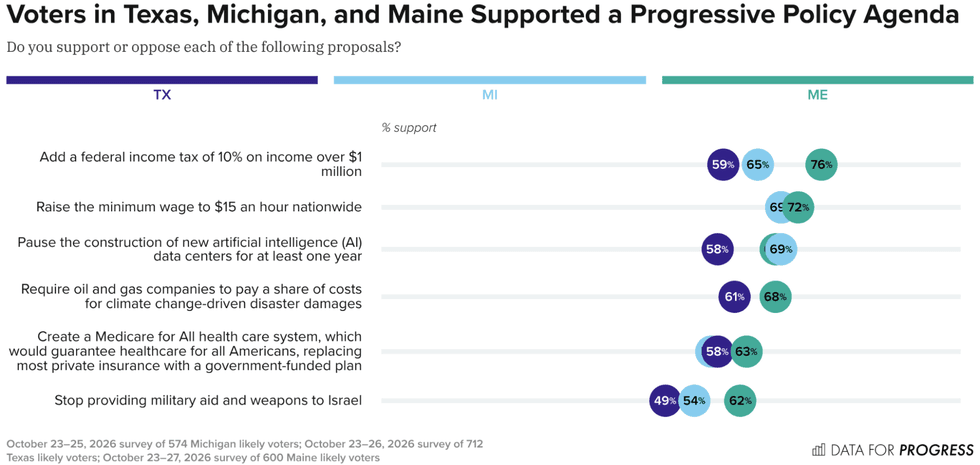
While some Democratic leaders and consultants have argued that the party's candidates need to embrace "moderate" platforms to get elected—particularly in districts or states previously won by Trump—Data for Progress found that this cycle, voters "associated Democrats with an economic populist platform" and "the more centrist messages registered far less."
As for Republicans, likely voters believed congressional candidates would "mostly support" the president's agenda if elected, and residents of Maine, Michigan, and Texas similarly thought the party's Senate candidates "would mostly follow Trump's lead." Majorities said that the president hasn't kept key campaign promises, including gasoline below $2, no more wars, ending inflation, cutting electricity prices in half, eradicating veteran homelessness, and capping credit card interest rates.
During Republicans' federal trifecta over the past nearly two years, their biggest legislative "accomplishment" was passing the 2025 budget package they dubbed the One Big Beautiful Bill Act (OBBBA). The Data for Progress report points out that with Trump's popularity tanking, some GOP candidates tried to focus on that law—but "the argument wasn't convincing."
"When asked if Republican claims that their tax cuts had helped working families were mostly true or false, a majority (61%) said false," the document details. "In the days ahead of the election, a majority of voters (54%), including 61% of independents, also said wealthy people and large corporations benefited most from the bill's tax cuts."
When voters were asked which Trump administration policies concerned them most, passage of the OBBBA ranked second, only behind the Iran War. Other top issues included directing US Immigration and Customs Enforcement to conduct mass deportations, the tariff regime, Trump promoting his family's cryptocurrency and enriching properties like Mar-a-Lago, and the Department of Justice withholding files about his dead former friend, sex criminal Jeffrey Epstein, while probing the president's political enemies.
Political advertisements attacking Democrats that caught the attention of voters this round often focused on socialism, immigration, and transgender girls and women participating in sports. The report says that the GOP's "focus on culture war issues—and on attacking transgender people specifically—was misaligned with what voters wanted to hear from their candidates."
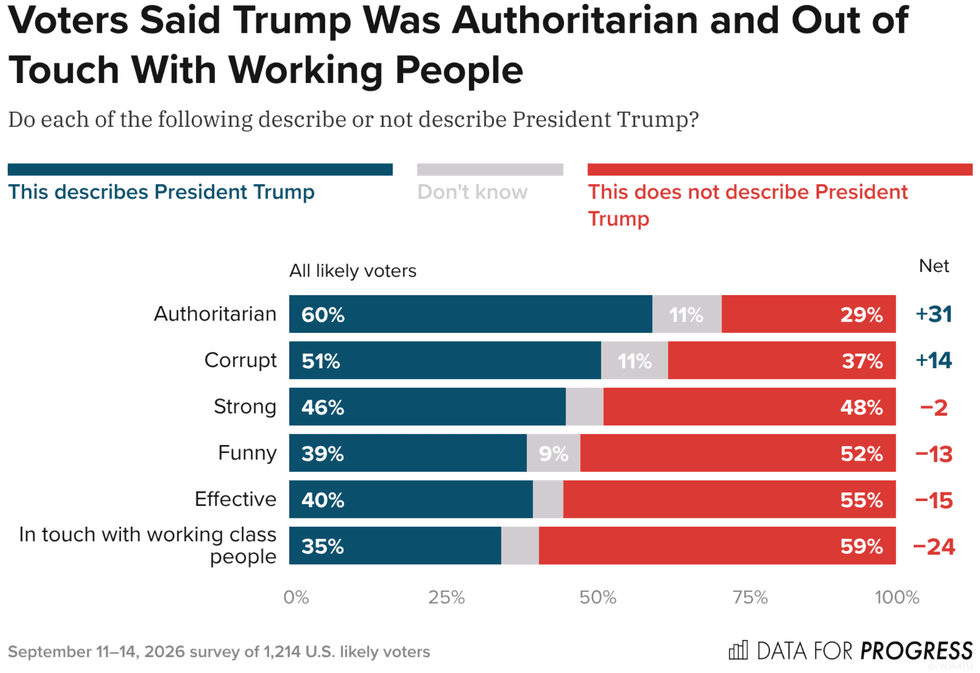
A majority of all voters told Data for Progress that they wanted candidates to talk more about food prices, fuel prices, healthcare costs, and political corruption—topics that have long been key focuses of Sen. Bernie Sanders (I-Vt.), who caucuses with Democrats and ran for the party's presidential nomination in 2016 and 2020. In the wake of the "blue tsunami," as some have described Tuesday's results, Sanders has been widely recognized for his impact on the Democratic Party and its priorities over the past decade.
"The Bernie Sanders economic playbook is now mainstream in the Democratic Party—the data is clear that economic populism was central to these historic election results," Data for Progress executive director Ryan O'Donnell said in a statement about the group's new report.
"Candidates across the country made fighting billionaires, elites, and corporations the centerpiece of their campaigns, successfully connecting affordability and anti-corruption," he continued. "But while swing voters strongly rejected Trump and the Republican Party's handling of the cost of living, our data underscores that they are not yet convinced Democrats have a solution either. This gap presents both a risk and an opportunity."
"Data for Progress has found that voters' trust in the Democratic Party increases after hearing it supports anti-corruption and economic populist policies," he added. "Americans are hungry for leadership that challenges the status quo, ends America's forever wars, and takes on entrenched wealth and corporate power."
Sanders himself argued after the midterms that the job of the new Democratic majorities in Congress "is to represent where working families are." Citing a poll that found "well over 60% of the American people want Medicare for All," the senator proposed passing his longtime healthcare policy—and said that "if Trump wants to veto it, that's his constitutional right."
Medicare for All is just part of what many progressive lawmakers and advocacy groups want Democrats to take on in the next two years, whether or not the White House fights back. Other priorities include a federal wealth tax, ending the Iran War, and possibly even impeaching Trump a third time.
While the New York Democrats who currently lead the party in the Senate and House of Representatives, Chuck Schumer and Hakeem Jeffries, may become majority leader and speaker in January, progressives have emphasized that "we need commitments" from them, as Sen. Chris Van Hollen (D-Md.) put it, because "it's not a time for incrementalism. It's a time to move forward a very bold kitchen table agenda."
US Sen. Elizabeth Warren's (D-Mass.) similarly stressed in a post-election op-ed that "now, Democrats must deliver," and the party should force Trump "to do that on the affordability and corruption issues that drove this election—or call his bluff."
As Google faces allegations that its Gemini chatbot helped a 13-year-old girl plan how to kill herself, the company, plus Meta and TikTok, sued to block a California law meant to safeguard minors from social media addiction.
The parents of a 13-year-old girl who allegedly used Google's Gemini artificial intelligence chatbot to plan her suicide sued the tech titan Wednesday on the child's behalf, a move that came as Google, Meta, and TikTok filed lawsuits to block California from enforcing a new law designed to protect children from the addictive features of social media platforms.
Parents of a girl identified as "Emma" in a lawsuit filed in Santa Clara County Superior Court in California alleged that Google effectively turned a school-issued Chromebook laptop computer into a tool allowing a dangerous psychological relationship between their daughter and Gemini.
Although Emma ultimately did not attempt to kill herself, the lawsuit states that she "told her mother that she had thought about wanting to be dead."
"Over several months, [Google's] Gemini chatbot diagnosed a previously active, well-adjusted 13-year-old girl with a battery of severe psychological disorders, helped her plan her suicide and funeral, and coached her to conceal her distress and self-harm from her family—all without providing a single alert to school personnel or her parents," EdTech Law Center, which is representing the plaintiffs along with the firm Quereshi Law, said in a statement.
According to the lawsuit, at one point, Emma reportedly pleaded with the chatbot, "How do i stop my addiction of asking AI random questions and yappi[n]g with AI?"
"Emma never sought out Gemini—it just showed up in [a] Google search one day—but by March 2026, she was exchanging thousands of messages a month, unable to free herself from the chatbot’s grip," EdTech said.
"The complaint alleges that Google executives knew that the Gemini model it released in December 2025 was the most dangerous yet but rushed it out anyway to gain ground on its competitors," the firm explained. "Emma brings claims for defective design, failure to warn, negligence, fraudulent concealment, and infliction of emotional distress, as well as a claim under California’s Companion Chatbot Law (Cal. Bus. & Prof. § 22601), which took effect in 2026."
Google spokesperson José Castañeda said Thursday in a statement that “for years, we’ve shown hotline information directly in search when someone may be experiencing a mental health crisis."
"We’ve built those same protections into search AI features, connecting people with real-world support," he added.
Brendan Bouffard, associate general counsel for AI and privacy at the children's advocacy group Fairplay, said Thursday: "The idea of an untested AI chatbot helping a 13-year-old girl plan her own suicide should terrify all of us, but this is the sick new reality Google has created by forcing its AI products onto school-issued devices."
"Google claims its Chromebooks are there to help students learn, but in reality, the company was experimenting on kids like Emma by pushing them to use Gemini, a product the company knew was dangerous but rushed out anyway," Bouffard continued.
“As this lawsuit shows, AI chatbots are not safe for kids," he added. "They also undermine students’ ability to learn and think critically. Yet just this week, Google announced it would turn off 'search' for schools that refuse to use its AI products. It’s clear this massive corporation does not care about children’s safety—it only cares about profits."
There has been an increasing number of lawsuits targeting AI companies whose chatbots have allegedly helped users plan to kill themselves or others.
Emma's suit was filed on the same day that Google, TikTok, and Meta—which operates platforms including Facebook, Instagram, and Threads—launched separate lawsuits seeking to stop California from enforcing AB 1709, a law signed by outgoing Democratic Gov. Gavin Newsom in September prohibiting social media platforms from providing children under 16 with features deemed psychologically exploitative and addictive.
The tech titans argue that the restrictions violate their First Amendment rights and Section 230 of the Communications Decency Act, which generally shields online platforms from liability for content posted by third parties.
Meta's lawyers asserted that California's attempt to “appoint the state as the editor, curator, and controller of online speech” and “override Meta’s editorial judgment about how to curate and display these billions of posts of third-party speech" runs afoul of the Constitution.
In 2023, Democratic California Attorney General Rob Bonta joined dozens of other states in suing Meta, alleging that the company deliberately designed Facebook and Instagram to addict children and teenagers through features such as infinite scrolling, personalized recommendations, and constant notifications, while concealing evidence of the platforms' mental health harms.
A proposed $17 billion settlement was announced in August, under which Meta agreed to changes including restrictions on nighttime use, notifications, and certain features available to minors.
A Los Angeles jury found in March that Meta and Google acted negligently by harming a child user with their social media platforms’ addictive design features in a landmark verdict that came on the heels of a $375 million fine imposed on Meta by a New Mexico jury, which found that the company violated the state’s Unfair Practices Act by misleading users and exposing children to harm.
The 988 Suicide & Crisis Lifeline—which offers 24/7, free, and confidential support—can be reached by calling or texting 988, or through chat at 988lifeline.org.
"The death penalty is a flawed, expensive, and error-filled practice that fails us all," said Equal Justice Initiative's Bryan Stevenson, urging other elected officials to follow the California governor's lead.
Opponents of capital punishment applauded on Thursday after Gov. Gavin Newsom moved to commute all of California's death sentences, sparing up to 548 lives as the term-limited Democrat prepares to leave office with eyes on the White House.
The New York Times had reported last month that Newsom was mulling the move, which he addressed in a Thursday letter initially obtained by The Sacramento Bee: "After nearly 30 years in public office, I have come to understand the limits of what government can justly accomplish. I take this action because I firmly believe that state-sanctioned killing is incompatible with California's values, undermines the foundations of our legal system, and diminishes each of us."
The Bee explained that "Newsom can commute single-felony sentences, but must receive the California Supreme Court’s approval to commute sentences for people with multiple convictions. Four of the seven justices must approve those requests, though there is no time limit for them to do so. If they do not approve before Newsom leaves office on January 3, 2027, the requests lapse and do not roll over to the next governor, according to attorney Natasha Minsker, an anti-death penalty advocate."
However, Democratic Gov.-elect Xavier Becerra has pledged to maintain the death penalty moratorium that Newsom issued in 2019, and could keep pushing to make all 548 sentences life without parole if the state's high court doesn't initially sign off. In his letter, Newsom cited his decades of publicly opposing state-sanctioned killings and his executive order seven years ago, which "formalized the de facto moratorium on executions in place since 2006, the last year California executed anyone."
"The people sentenced to death in California caused indescribable suffering to victims, their families, communities, and our state as a whole," but "I have concluded the state cannot morally kill them," Newsom wrote. "Because the death penalty is inherently incompatible with our legal system's commitment to justice, I have determined that this clemency decision, while difficult in many respects, will ultimately affirm the strength and integrity of our state and its justice system."
The outgoing governor called the decision "among the most difficult" of his career, but also "a righteous action." He said it follows "the moral leadership of past presidents, including our Founding Fathers, and governors across America," and is informed by what he has heard from "crime victims and survivors, public safety experts, and religious, civil rights, and other community leaders."
Coalitions of civil rights groups, business executives, faith leaders, victims' family members, former corrections professionals, and ex-prosecutors have recently urged Newsom to take this action before leaving office. According to the Death Penalty Information Center, he is now among a dozen state and federal leaders who have made sweeping clemency grants to death row inmates since capital punishment was reinstated in the United States in 1976.
It is arguably the most significant of those actions because of its scope. California has the largest death row in not only the United States, but the Western Hemisphere, according to the governor's letter. The Times reported that "Newsom's action cancels approximately one-fourth of all death sentences nationwide."
The national ACLU and its three affiliates in the state were among the groups pressuring the governor to act. The organization's executive director, Anthony Romero, declared Thursday that Newsom "made history" and "honored his commitment to end a system that conflicts with human dignity, fairness, and the values enshrined in our Constitution."
"These commutations reflect what justice demands: an end to a racist, error-prone, and inhumane punishment that has burdened California for far too long," Romero continued. "By taking this step, Gov. Newsom has affirmed that the death penalty has no place in California, and he showed real courage by confronting racialized injustice head-on."
US Campaign to End the Death Penalty's executive director, Laura Porter, also offered praise: "We are grateful that Gov. Newsom, like other Republican and Democratic leaders across the country, has decided to grant clemency to individuals on death row. The historic number of commuted sentences would set a new record and offer an acknowledgment that the death penalty process is flawed."
Bryan Stevenson, Equal Justice Initiative's founder and executive director and the author of the award-winning memoir Just Mercy, similarly welcomed the development, saying: "The death penalty is a flawed, expensive, and error-filled practice that fails us all. I commend Gov. Newsom for this historic act and hope that other state elected officials follow his lead... Now more than ever, Americans need leaders who act on our beliefs, protect the vulnerable, and stand up for human rights and human dignity."
As the Times noted:
Death penalty opponents have planned a national ad campaign praising him for the move. The minute-long commercial casts the governor’s decision as an act of courage and leadership inspired by the Rev. Dr. Martin Luther King Jr., Dolores Huerta, and Robert F. Kennedy. It will air on dozens of news and political shows nationwide, said Dan Newman, a Democratic strategist who advises both Mr. Newsom and the anti-death penalty groups sponsoring the ad.
Mr. Newman said that the governor had been motivated by personal conviction. But the ad could also help Mr. Newsom in a 2028 presidential campaign.
Among the Californians cheering Newsom's move is Jeanne Woodford, who presided over four executions as warden of San Quentin State Prison, signed a recent letter to Newsom, and shared that "as someone who has carried out executions in California, I am haunted by the fear that we will execute an innocent person."
"Innocent people have been sentenced to death in California," she stressed. "Since 1973, more than 200 individuals nationwide, including eight in California, have been freed from death row after they were found to have been innocent. Gov. Newsom will ensure that California will never execute an innocent person."
Newsom's move may save some innocent prisoners, but it is also set to spare some notorious ones. The Times pointed out that the state's death row includes "Richard Allen Davis, who murdered Polly Klaas, a 12-year-old, after kidnapping her from her home in 1993," as well as "Cary Stayner, who killed four women near Yosemite in 1999, and the 1980s serial killer Charles Ng."
Relatives of the 12-year-old are divided: Her father, Marc Klaas, has criticized Newsom for the 2019 moratorium, but her stepsister, Jess Nichol, recently met with the governor and encouraged his action. She said in a statement that "I won't pretend I've always opposed the death penalty. I used to think the man who killed my sister deserved execution. But over time I've realized that whether he's executed has absolutely nothing to do with my recovery or with real public safety."
"The system tells survivors that execution matters to our healing," Nichol added. "It doesn't. It's a distraction from what we actually need."
While President Donald Trump—whose Republican Party just lost its majorities in Congress—is infamously pro-death penalty, fresh calls for ending capital punishment nationwide have mounted since late September, when Christa Pike survived two injections of pentobarbital from a doctor involved with an earlier botched execution at the maximum security prison in Tennessee.
"There hasn't been a moment since that night when I haven't been in pain," Pike said last week. "My body hurts. My arms hurt. My hands hurt. My throat hurts. I still struggle to speak. And the pain isn't just physical. There is pain in my mind and in my soul. I had not contemplated life beyond that night, and I'm deeply hurt by the incompetence that has put so many people in this terrible position. I continue to think about my victim's family and the terrible pain and loss they have endured. I am recovering, and I know that I am getting stronger. But healing is not the same as being okay."