SUBSCRIBE TO OUR FREE NEWSLETTER
Daily news & progressive opinion—funded by the people, not the corporations—delivered straight to your inbox.
5
#000000
#FFFFFF
To donate by check, phone, or other method, see our More Ways to Give page.
Daily news & progressive opinion—funded by the people, not the corporations—delivered straight to your inbox.
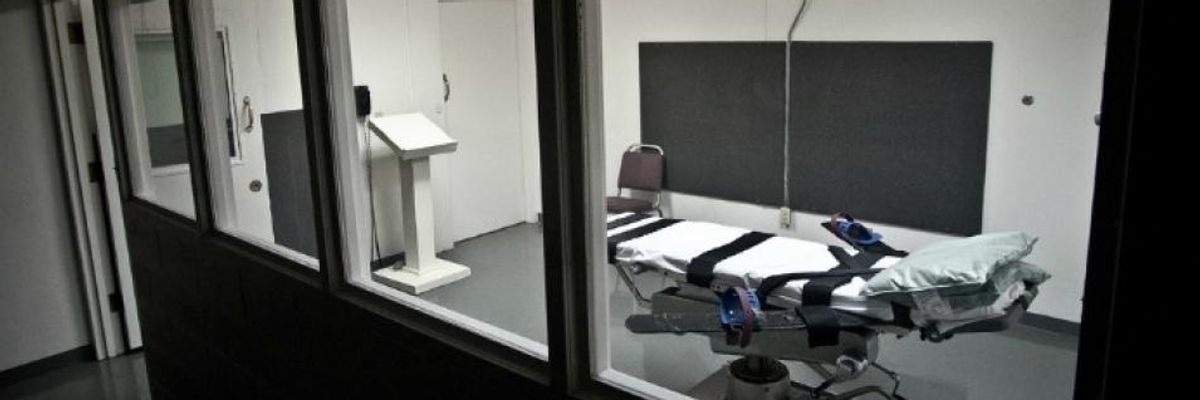
California Gov. Gavin Newsom was expected to announce a moratorium on capital punishment in California Wednesday, giving reprieve to 737 inmates on death row. (Photo: Josh Rushing/flickr/cc)
Anti-death penalty activists applauded California Gov. Gavin Newsom's planned executive order announcing a moratorium on capital punishment in the state on Wednesday.
The order will grant reprieve to 737 death row inmates, a quarter of all prisoners awaiting execution in the United States. California's prison system has the largest death row population in the Western Hemisphere.
Newsom, in his prepared remarks, called the death penalty "inconsistent with our bedrock values" and noted that 164 inmates--including five in California--have been released from death row over the past 45 years after being exonerated of their convictions.
The governor is expected to outline the long history of discrimination within the criminal justice system, making mentally ill, black, brown, and poor convicts more likely to face the death penalty.
"Our death penalty system has been--by any measure--a failure," the remarks state. "The intentional killing of another person is wrong. And as governor, I will not oversee the execution of any individual."
When Newsom signs the executive order Wednesday, he will also order the closure of San Quentin State Prison's execution chamber and repeal the state's official lethal injection protocol.
Abolitionists expressed hope that Newsom's decision will convince other states across the country to institute their own moratoriums.
"It is a state people look to to set the tone for national policy," Shilpi Agarwal, a staff attorney at the American Civil Liberties Union (ACLU), told the Times. "The fact that so many states have abolished the death penalty--but California hasn't--has given people cover for this narrative that people are still supportive the death penalty."
Newsom followed the lead of the governors of Colorado, Oregon, and Pennsylvania, who also recently announced moratoriums on capital punishment, as well as Washington State's Supreme Court, which banned the practice last year.
"A moratorium in California has enormous symbolic value," Robert Dunham, the executive director of the Death Penalty Information Center, told the Times. "It's part of the momentum we are seeing."
Some supporters of the move pointed out that despite California's status as a blue state, Newsom's decision was a bold one in light of voters' recent support for state-sponsored executions. Californians rejected a ballot measure which would have ended the death penalty in 2016.
"I do not believe that a civilized society can claim to be a leader in the world as long as its government continues to sanction the premeditated and discriminatory execution of its people," Newsom plans to say Wednesday.
Dear Common Dreams reader, It’s been nearly 30 years since I co-founded Common Dreams with my late wife, Lina Newhouser. We had the radical notion that journalism should serve the public good, not corporate profits. It was clear to us from the outset what it would take to build such a project. No paid advertisements. No corporate sponsors. No millionaire publisher telling us what to think or do. Many people said we wouldn't last a year, but we proved those doubters wrong. Together with a tremendous team of journalists and dedicated staff, we built an independent media outlet free from the constraints of profits and corporate control. Our mission has always been simple: To inform. To inspire. To ignite change for the common good. Building Common Dreams was not easy. Our survival was never guaranteed. When you take on the most powerful forces—Wall Street greed, fossil fuel industry destruction, Big Tech lobbyists, and uber-rich oligarchs who have spent billions upon billions rigging the economy and democracy in their favor—the only bulwark you have is supporters who believe in your work. But here’s the urgent message from me today. It's never been this bad out there. And it's never been this hard to keep us going. At the very moment Common Dreams is most needed, the threats we face are intensifying. We need your support now more than ever. We don't accept corporate advertising and never will. We don't have a paywall because we don't think people should be blocked from critical news based on their ability to pay. Everything we do is funded by the donations of readers like you. When everyone does the little they can afford, we are strong. But if that support retreats or dries up, so do we. Will you donate now to make sure Common Dreams not only survives but thrives? —Craig Brown, Co-founder |
Anti-death penalty activists applauded California Gov. Gavin Newsom's planned executive order announcing a moratorium on capital punishment in the state on Wednesday.
The order will grant reprieve to 737 death row inmates, a quarter of all prisoners awaiting execution in the United States. California's prison system has the largest death row population in the Western Hemisphere.
Newsom, in his prepared remarks, called the death penalty "inconsistent with our bedrock values" and noted that 164 inmates--including five in California--have been released from death row over the past 45 years after being exonerated of their convictions.
The governor is expected to outline the long history of discrimination within the criminal justice system, making mentally ill, black, brown, and poor convicts more likely to face the death penalty.
"Our death penalty system has been--by any measure--a failure," the remarks state. "The intentional killing of another person is wrong. And as governor, I will not oversee the execution of any individual."
When Newsom signs the executive order Wednesday, he will also order the closure of San Quentin State Prison's execution chamber and repeal the state's official lethal injection protocol.
Abolitionists expressed hope that Newsom's decision will convince other states across the country to institute their own moratoriums.
"It is a state people look to to set the tone for national policy," Shilpi Agarwal, a staff attorney at the American Civil Liberties Union (ACLU), told the Times. "The fact that so many states have abolished the death penalty--but California hasn't--has given people cover for this narrative that people are still supportive the death penalty."
Newsom followed the lead of the governors of Colorado, Oregon, and Pennsylvania, who also recently announced moratoriums on capital punishment, as well as Washington State's Supreme Court, which banned the practice last year.
"A moratorium in California has enormous symbolic value," Robert Dunham, the executive director of the Death Penalty Information Center, told the Times. "It's part of the momentum we are seeing."
Some supporters of the move pointed out that despite California's status as a blue state, Newsom's decision was a bold one in light of voters' recent support for state-sponsored executions. Californians rejected a ballot measure which would have ended the death penalty in 2016.
"I do not believe that a civilized society can claim to be a leader in the world as long as its government continues to sanction the premeditated and discriminatory execution of its people," Newsom plans to say Wednesday.
Anti-death penalty activists applauded California Gov. Gavin Newsom's planned executive order announcing a moratorium on capital punishment in the state on Wednesday.
The order will grant reprieve to 737 death row inmates, a quarter of all prisoners awaiting execution in the United States. California's prison system has the largest death row population in the Western Hemisphere.
Newsom, in his prepared remarks, called the death penalty "inconsistent with our bedrock values" and noted that 164 inmates--including five in California--have been released from death row over the past 45 years after being exonerated of their convictions.
The governor is expected to outline the long history of discrimination within the criminal justice system, making mentally ill, black, brown, and poor convicts more likely to face the death penalty.
"Our death penalty system has been--by any measure--a failure," the remarks state. "The intentional killing of another person is wrong. And as governor, I will not oversee the execution of any individual."
When Newsom signs the executive order Wednesday, he will also order the closure of San Quentin State Prison's execution chamber and repeal the state's official lethal injection protocol.
Abolitionists expressed hope that Newsom's decision will convince other states across the country to institute their own moratoriums.
"It is a state people look to to set the tone for national policy," Shilpi Agarwal, a staff attorney at the American Civil Liberties Union (ACLU), told the Times. "The fact that so many states have abolished the death penalty--but California hasn't--has given people cover for this narrative that people are still supportive the death penalty."
Newsom followed the lead of the governors of Colorado, Oregon, and Pennsylvania, who also recently announced moratoriums on capital punishment, as well as Washington State's Supreme Court, which banned the practice last year.
"A moratorium in California has enormous symbolic value," Robert Dunham, the executive director of the Death Penalty Information Center, told the Times. "It's part of the momentum we are seeing."
Some supporters of the move pointed out that despite California's status as a blue state, Newsom's decision was a bold one in light of voters' recent support for state-sponsored executions. Californians rejected a ballot measure which would have ended the death penalty in 2016.
"I do not believe that a civilized society can claim to be a leader in the world as long as its government continues to sanction the premeditated and discriminatory execution of its people," Newsom plans to say Wednesday.