

SUBSCRIBE TO OUR FREE NEWSLETTER
Daily news & progressive opinion—funded by the people, not the corporations—delivered straight to your inbox.
5
#000000
#FFFFFF
To donate by check, phone, or other method, see our More Ways to Give page.
Daily news & progressive opinion—funded by the people, not the corporations—delivered straight to your inbox.
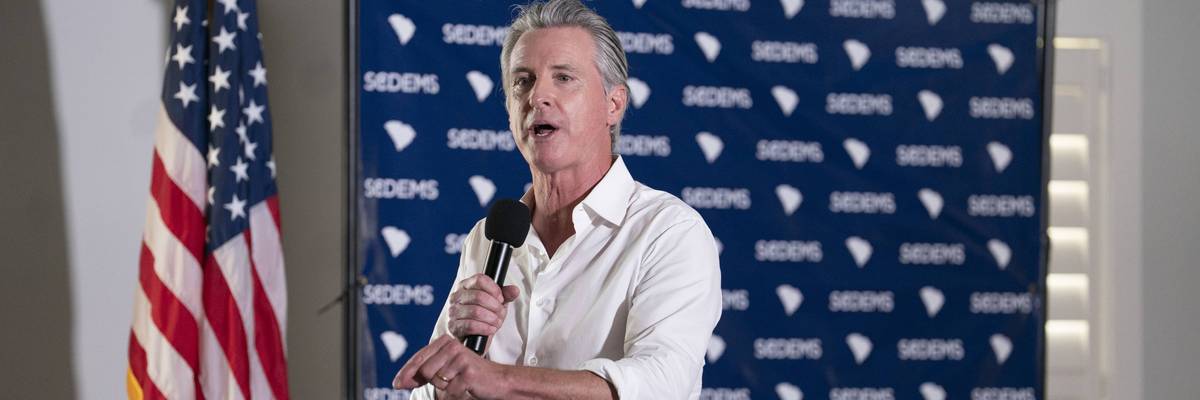
Democratic California Gov. Gavin Newsom, a potential 2028 presidential candidate, speaks at the Clubhouse at King's Grant on September 3, 2026 in Summerville, South Carolina.
"The death penalty is a flawed, expensive, and error-filled practice that fails us all," said Equal Justice Initiative's Bryan Stevenson, urging other elected officials to follow the California governor's lead.
Opponents of capital punishment applauded on Thursday after Gov. Gavin Newsom moved to commute all of California's death sentences, sparing up to 548 lives as the term-limited Democrat prepares to leave office with eyes on the White House.
The New York Times had reported last month that Newsom was mulling the move, which he addressed in a Thursday letter initially obtained by The Sacramento Bee: "After nearly 30 years in public office, I have come to understand the limits of what government can justly accomplish. I take this action because I firmly believe that state-sanctioned killing is incompatible with California's values, undermines the foundations of our legal system, and diminishes each of us."
The Bee explained that "Newsom can commute single-felony sentences, but must receive the California Supreme Court’s approval to commute sentences for people with multiple convictions. Four of the seven justices must approve those requests, though there is no time limit for them to do so. If they do not approve before Newsom leaves office on January 3, 2027, the requests lapse and do not roll over to the next governor, according to attorney Natasha Minsker, an anti-death penalty advocate."
However, Democratic Gov.-elect Xavier Becerra has pledged to maintain the death penalty moratorium that Newsom issued in 2019, and could keep pushing to make all 548 sentences life without parole if the state's high court doesn't initially sign off. In his letter, Newsom cited his decades of publicly opposing state-sanctioned killings and his executive order seven years ago, which "formalized the de facto moratorium on executions in place since 2006, the last year California executed anyone."
"The people sentenced to death in California caused indescribable suffering to victims, their families, communities, and our state as a whole," but "I have concluded the state cannot morally kill them," Newsom wrote. "Because the death penalty is inherently incompatible with our legal system's commitment to justice, I have determined that this clemency decision, while difficult in many respects, will ultimately affirm the strength and integrity of our state and its justice system."
The outgoing governor called the decision "among the most difficult" of his career, but also "a righteous action." He said it follows "the moral leadership of past presidents, including our Founding Fathers, and governors across America," and is informed by what he has heard from "crime victims and survivors, public safety experts, and religious, civil rights, and other community leaders."
Coalitions of civil rights groups, business executives, faith leaders, victims' family members, former corrections professionals, and ex-prosecutors have recently urged Newsom to take this action before leaving office. According to the Death Penalty Information Center, he is now among a dozen state and federal leaders who have made sweeping clemency grants to death row inmates since capital punishment was reinstated in the United States in 1976.
It is arguably the most significant of those actions because of its scope. California has the largest death row in not only the United States, but the Western Hemisphere, according to the governor's letter. The Times reported that "Newsom's action cancels approximately one-fourth of all death sentences nationwide."
The national ACLU and its three affiliates in the state were among the groups pressuring the governor to act. The organization's executive director, Anthony Romero, declared Thursday that Newsom "made history" and "honored his commitment to end a system that conflicts with human dignity, fairness, and the values enshrined in our Constitution."
"These commutations reflect what justice demands: an end to a racist, error-prone, and inhumane punishment that has burdened California for far too long," Romero continued. "By taking this step, Gov. Newsom has affirmed that the death penalty has no place in California, and he showed real courage by confronting racialized injustice head-on."
US Campaign to End the Death Penalty's executive director, Laura Porter, also offered praise: "We are grateful that Gov. Newsom, like other Republican and Democratic leaders across the country, has decided to grant clemency to individuals on death row. The historic number of commuted sentences would set a new record and offer an acknowledgment that the death penalty process is flawed."
Bryan Stevenson, Equal Justice Initiative's founder and executive director and the author of the award-winning memoir Just Mercy, similarly welcomed the development, saying: "The death penalty is a flawed, expensive, and error-filled practice that fails us all. I commend Gov. Newsom for this historic act and hope that other state elected officials follow his lead... Now more than ever, Americans need leaders who act on our beliefs, protect the vulnerable, and stand up for human rights and human dignity."
As the Times noted:
Death penalty opponents have planned a national ad campaign praising him for the move. The minute-long commercial casts the governor’s decision as an act of courage and leadership inspired by the Rev. Dr. Martin Luther King Jr., Dolores Huerta, and Robert F. Kennedy. It will air on dozens of news and political shows nationwide, said Dan Newman, a Democratic strategist who advises both Mr. Newsom and the anti-death penalty groups sponsoring the ad.
Mr. Newman said that the governor had been motivated by personal conviction. But the ad could also help Mr. Newsom in a 2028 presidential campaign.
Among the Californians cheering Newsom's move is Jeanne Woodford, who presided over four executions as warden of San Quentin State Prison, signed a recent letter to Newsom, and shared that "as someone who has carried out executions in California, I am haunted by the fear that we will execute an innocent person."
"Innocent people have been sentenced to death in California," she stressed. "Since 1973, more than 200 individuals nationwide, including eight in California, have been freed from death row after they were found to have been innocent. Gov. Newsom will ensure that California will never execute an innocent person."
Newsom's move may save some innocent prisoners, but it is also set to spare some notorious ones. The Times pointed out that the state's death row includes "Richard Allen Davis, who murdered Polly Klaas, a 12-year-old, after kidnapping her from her home in 1993," as well as "Cary Stayner, who killed four women near Yosemite in 1999, and the 1980s serial killer Charles Ng."
Relatives of the 12-year-old are divided: Her father, Marc Klaas, has criticized Newsom for the 2019 moratorium, but her stepsister, Jess Nichol, recently met with the governor and encouraged his action. She said in a statement that "I won't pretend I've always opposed the death penalty. I used to think the man who killed my sister deserved execution. But over time I've realized that whether he's executed has absolutely nothing to do with my recovery or with real public safety."
"The system tells survivors that execution matters to our healing," Nichol added. "It doesn't. It's a distraction from what we actually need."
While President Donald Trump—whose Republican Party just lost its majorities in Congress—is infamously pro-death penalty, fresh calls for ending capital punishment nationwide have mounted since late September, when Christa Pike survived two injections of pentobarbital from a doctor involved with an earlier botched execution at the maximum security prison in Tennessee.
"There hasn't been a moment since that night when I haven't been in pain," Pike said last week. "My body hurts. My arms hurt. My hands hurt. My throat hurts. I still struggle to speak. And the pain isn't just physical. There is pain in my mind and in my soul. I had not contemplated life beyond that night, and I'm deeply hurt by the incompetence that has put so many people in this terrible position. I continue to think about my victim's family and the terrible pain and loss they have endured. I am recovering, and I know that I am getting stronger. But healing is not the same as being okay."
This country and this world are at a monumental crossroads. US voters have an opportunity to beat back the forces of fascism and confront the billionaires who are rigging the economy, our media system, and our democracy, making it increasingly impossible for ordinary people to get by. We’re not just talking about the election. We’re talking about what must be done once these fascist elements are vanquished from power. We need a bolder set of solutions than what either major party has so far been willing to offer and a working-class movement ready to fight like hell for it. Trump didn't emerge from nowhere. The conditions that fueled MAGA authoritarianism were created by decades of radical neoliberal economic policies and a corrupt political system dominated by corporate interests. They slashed taxes on the super-rich, promising that the benefits would trickle down. They said giveaways to the corporate titans would make life more affordable for the rest of us. It was all bullshit. And when a bitter, betrayed populace searches for someone to blame, right-wing demagogues have little trouble finding scapegoats. People know when they're being lied to, but you won't hear any of this from the corporate media. Only independent journalism—powered and funded by people who believe in building a better world—can deliver truly trustworthy daily news. If you share our vision, please contribute whatever you can to sustain our work. |
Opponents of capital punishment applauded on Thursday after Gov. Gavin Newsom moved to commute all of California's death sentences, sparing up to 548 lives as the term-limited Democrat prepares to leave office with eyes on the White House.
The New York Times had reported last month that Newsom was mulling the move, which he addressed in a Thursday letter initially obtained by The Sacramento Bee: "After nearly 30 years in public office, I have come to understand the limits of what government can justly accomplish. I take this action because I firmly believe that state-sanctioned killing is incompatible with California's values, undermines the foundations of our legal system, and diminishes each of us."
The Bee explained that "Newsom can commute single-felony sentences, but must receive the California Supreme Court’s approval to commute sentences for people with multiple convictions. Four of the seven justices must approve those requests, though there is no time limit for them to do so. If they do not approve before Newsom leaves office on January 3, 2027, the requests lapse and do not roll over to the next governor, according to attorney Natasha Minsker, an anti-death penalty advocate."
However, Democratic Gov.-elect Xavier Becerra has pledged to maintain the death penalty moratorium that Newsom issued in 2019, and could keep pushing to make all 548 sentences life without parole if the state's high court doesn't initially sign off. In his letter, Newsom cited his decades of publicly opposing state-sanctioned killings and his executive order seven years ago, which "formalized the de facto moratorium on executions in place since 2006, the last year California executed anyone."
"The people sentenced to death in California caused indescribable suffering to victims, their families, communities, and our state as a whole," but "I have concluded the state cannot morally kill them," Newsom wrote. "Because the death penalty is inherently incompatible with our legal system's commitment to justice, I have determined that this clemency decision, while difficult in many respects, will ultimately affirm the strength and integrity of our state and its justice system."
The outgoing governor called the decision "among the most difficult" of his career, but also "a righteous action." He said it follows "the moral leadership of past presidents, including our Founding Fathers, and governors across America," and is informed by what he has heard from "crime victims and survivors, public safety experts, and religious, civil rights, and other community leaders."
Coalitions of civil rights groups, business executives, faith leaders, victims' family members, former corrections professionals, and ex-prosecutors have recently urged Newsom to take this action before leaving office. According to the Death Penalty Information Center, he is now among a dozen state and federal leaders who have made sweeping clemency grants to death row inmates since capital punishment was reinstated in the United States in 1976.
It is arguably the most significant of those actions because of its scope. California has the largest death row in not only the United States, but the Western Hemisphere, according to the governor's letter. The Times reported that "Newsom's action cancels approximately one-fourth of all death sentences nationwide."
The national ACLU and its three affiliates in the state were among the groups pressuring the governor to act. The organization's executive director, Anthony Romero, declared Thursday that Newsom "made history" and "honored his commitment to end a system that conflicts with human dignity, fairness, and the values enshrined in our Constitution."
"These commutations reflect what justice demands: an end to a racist, error-prone, and inhumane punishment that has burdened California for far too long," Romero continued. "By taking this step, Gov. Newsom has affirmed that the death penalty has no place in California, and he showed real courage by confronting racialized injustice head-on."
US Campaign to End the Death Penalty's executive director, Laura Porter, also offered praise: "We are grateful that Gov. Newsom, like other Republican and Democratic leaders across the country, has decided to grant clemency to individuals on death row. The historic number of commuted sentences would set a new record and offer an acknowledgment that the death penalty process is flawed."
Bryan Stevenson, Equal Justice Initiative's founder and executive director and the author of the award-winning memoir Just Mercy, similarly welcomed the development, saying: "The death penalty is a flawed, expensive, and error-filled practice that fails us all. I commend Gov. Newsom for this historic act and hope that other state elected officials follow his lead... Now more than ever, Americans need leaders who act on our beliefs, protect the vulnerable, and stand up for human rights and human dignity."
As the Times noted:
Death penalty opponents have planned a national ad campaign praising him for the move. The minute-long commercial casts the governor’s decision as an act of courage and leadership inspired by the Rev. Dr. Martin Luther King Jr., Dolores Huerta, and Robert F. Kennedy. It will air on dozens of news and political shows nationwide, said Dan Newman, a Democratic strategist who advises both Mr. Newsom and the anti-death penalty groups sponsoring the ad.
Mr. Newman said that the governor had been motivated by personal conviction. But the ad could also help Mr. Newsom in a 2028 presidential campaign.
Among the Californians cheering Newsom's move is Jeanne Woodford, who presided over four executions as warden of San Quentin State Prison, signed a recent letter to Newsom, and shared that "as someone who has carried out executions in California, I am haunted by the fear that we will execute an innocent person."
"Innocent people have been sentenced to death in California," she stressed. "Since 1973, more than 200 individuals nationwide, including eight in California, have been freed from death row after they were found to have been innocent. Gov. Newsom will ensure that California will never execute an innocent person."
Newsom's move may save some innocent prisoners, but it is also set to spare some notorious ones. The Times pointed out that the state's death row includes "Richard Allen Davis, who murdered Polly Klaas, a 12-year-old, after kidnapping her from her home in 1993," as well as "Cary Stayner, who killed four women near Yosemite in 1999, and the 1980s serial killer Charles Ng."
Relatives of the 12-year-old are divided: Her father, Marc Klaas, has criticized Newsom for the 2019 moratorium, but her stepsister, Jess Nichol, recently met with the governor and encouraged his action. She said in a statement that "I won't pretend I've always opposed the death penalty. I used to think the man who killed my sister deserved execution. But over time I've realized that whether he's executed has absolutely nothing to do with my recovery or with real public safety."
"The system tells survivors that execution matters to our healing," Nichol added. "It doesn't. It's a distraction from what we actually need."
While President Donald Trump—whose Republican Party just lost its majorities in Congress—is infamously pro-death penalty, fresh calls for ending capital punishment nationwide have mounted since late September, when Christa Pike survived two injections of pentobarbital from a doctor involved with an earlier botched execution at the maximum security prison in Tennessee.
"There hasn't been a moment since that night when I haven't been in pain," Pike said last week. "My body hurts. My arms hurt. My hands hurt. My throat hurts. I still struggle to speak. And the pain isn't just physical. There is pain in my mind and in my soul. I had not contemplated life beyond that night, and I'm deeply hurt by the incompetence that has put so many people in this terrible position. I continue to think about my victim's family and the terrible pain and loss they have endured. I am recovering, and I know that I am getting stronger. But healing is not the same as being okay."

