

SUBSCRIBE TO OUR FREE NEWSLETTER
Daily news & progressive opinion—funded by the people, not the corporations—delivered straight to your inbox.
5
#000000
#FFFFFF
To donate by check, phone, or other method, see our More Ways to Give page.
Daily news & progressive opinion—funded by the people, not the corporations—delivered straight to your inbox.
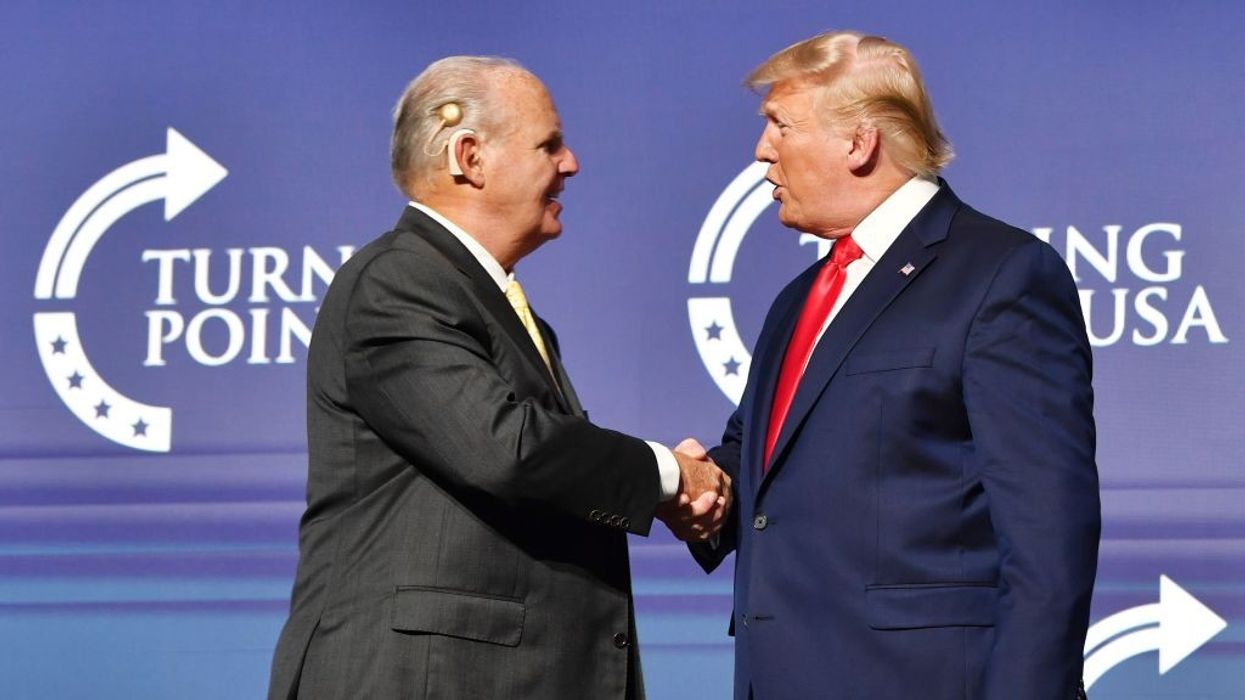
The GOP hold on most of American radio seems pretty unshakable, but Democrats must get into the talk-radio game before ever more damage is done.
“Whoever controls the media controls the mind.” — Jim Morrison
After Ronald Reagan struck down the Fairness Doctrine and the Equal Time Rule, Republican money men got the memo. Whichever party controlled the most states would have a big edge in both the Senate (and thus control of the Supreme Court nominations) and the Electoral College, and most of the low- and medium-population states had relatively inexpensive media markets.
You could buy or lease radio stations for less than a party might spend over a four-year electoral cycle on advertising, so why not simply acquire a few hundred stations across a dozen or more states and program them with rightwing talk radio 24/7?
This became particularly easy after Bill Clinton signed the neoliberal Telecommunications Act of 1996 that ended limits on how many radio or TV stations a single corporation or billionaire could own. Within months of that bill passing into law, Clear Channel and other networks had gone from small regional groups to massive nationwide radio empires.The strategy worked, and today there are over 1,500 rightwing radio stations in America, along with another 700 or so religious stations that regularly endorse Republican memes and candidates for office.
I wrote the original business plan for Air America Radio back in December of 2002 with an article I published that month on Common Dreams.
Right-wing talk radio has been integral to Republican strategy for decades. In 1994, when Newt Gingrich took control of the House of Representatives, he understood the power of talk radio.
“For the first 100 days of the congressional session,” writes Randy Bobbit in his book Us Against Them, “talk radio hosts broadcast live from the capitol building…. When the talk radio throng outgrew the working spaces available, Gingrich allowed some hosts to work in the extra space in his office.”
George W. Bush repeatedly invited talk-radio hosts to broadcast from the White House lawn, although Obama cancelled the tradition; Trump then continued the Republican seduction of the media that dated back to the 1990s.
And the GOP hold on most of American radio seems pretty unshakable.
A few years ago, a billionaire acquired one of the largest networks of these stations (800+ stations) and a senator I’ve known for years invited him and me to meet in his office near the US Capitol. The Senator asked the billionaire — who then owned several hundred stations programming exclusively rightwing content — if he’d ever considered putting some progressive content on the air.
Right-wing talk radio has been integral to Republican strategy for decades.
The billionaire leaned back in his chair, took a deep breath, tented his fingers in front of his mouth, and then said, carefully but emphatically:
“I’ll never put anybody on my air who wants to raise my taxes.”
A few years earlier, I’d sat at lunch at a Talkers Magazine conference with a vice president of what is arguably the most influential of the rightwing radio station networks; the company had started out as a bible publishing business and moved from there into radio and then into political radio.
I asked him if he’d consider putting a progressive show on any of his stations (they were all 100% conservative talk) and he bluntly told me it was “never going to happen” because, he said, “It’s impossible for a liberal to be a true Christian.”
Along with Fox “News,” rightwing talk radio is the main way Republicans have seized and held control over multiple red states. History shows that putting progressive programming on the air in those states could reverse that trend.
Back in 2008, Air America was broadcasting on 62 radio stations that covered a large part of America, including rural areas that had never before experienced progressive talk radio. Most of the stations were leased from Clear Channel, which also owned and programmed rightwing radio on several hundred of its stations.
I’m not aware of any studies proving or disproving the hypothesis, but I believe a large factor in President Obama’s election in 2008 was Air America promoting his candidacy relentlessly. It certainly didn’t hurt: we reached millions of people every single day during that election.
Liberal talk radio carried important messages that were vital to the rural parts of America. That we are all interdependent; that none of us can entirely stand alone unless we are fabulously rich, which is the sales pitch the billionaires try to sell us with their libertarianism; that without government supports and a social safety net, farming would be so vulnerable and financially dangerous (particularly with our weather emergency) that it wouldn’t be viable.
Think about it — political campaigns will pay thousands for a minute of advertising, and find that to be so effective that they continue to buy ads year after year. If that minute can be so influential, how about a host — who’s built a relationship with his or her listeners — telling them dozens of times a day who they should vote for and why? You literally can’t buy promotion like that; you have to buy the station instead.
I wrote the original business plan for Air America Radio back in December of 2002 with an article I published that month on Common Dreams.
Sheldon and Anita Drobney, two venture capitalists from Chicago, read the article and called me up; the next thing I knew I was in the Midwest helping them and Jon Sinton game out how to bring a progressive network into being. Sheldon wrote about it in his book, The Road to Air America, including reprinting my original article.
Impatient to prove the concept of progressive talk radio could work, I started my own program on a local Vermont station in March, 2003, and then moved it to a radio network in 2004. When Air America came online in 2005, we moved it to that network and picked up SiriusXM.
Then Mitt Romney decided he was going to run for president. No slouch, Mr. Romney: he understood the power of media and so apparently directed his private equity firm, Bain Capital, to purchase the entire portfolio of Clear Channel radio stations in the summer of 2008.
Within two years, heading toward the 2012 election when Romney challenged Obama, most all of their stations had flipped their programming from Air America to sports. It killed Air America, although my show was the lone survivor and is still on SiriusXM, Free Speech TV, and stations across the country.
Around the time Romney was buying Clear Channel, a group of Air America talent and I met in DC with a group of Democratic members of the House and Senate. We suggested they should reach out to big Democratic donors and encourage them to buy stations, so if Clear Channel ever pulled the plug on our leases we’d still be on the air.
We argued that, just as Republicans have discovered, it would be a lot cheaper than spending billions on advertising every two or four years.
Initially, the response was positive until one of the senators, who later ran for president, threw cold water on the idea, arguing that the “free market” should determine things like who owns radio stations, rather than a political party or people aligned with it.
Time has passed and word has spread. Entrepreneurs across America have bought or started radio stations — some normal, some “low-power FM” that works just fine in urban areas — to carry progressive programming. It’s a growing trend, and there are even rumors that George Soros is investing in the business.
I’ll be the opening keynote speaker for the Grassroots Radio Conference this week in New Orleans; progressive radio station owners, operators, programmers, and talent from more than half the American states will be there. This is a big step.
A Pew study found that 16 percent of Americans get their election-year information from talk radio. In rural states, where radio stations are cheap, people are far more likely to drive long distances and listen to local radio than in cities; flipping smaller red states shouldn’t be impossible if progressives could put up a few good stations in each state.
While Democrats spend over a billion dollars on paid advertising every two years, and several billion every four years, Republicans use this model of long-term trusting relationships with radio hosts to get out the vote for the GOP.
They know the truth of the old advertising saying, “Nothing beats word-of-mouth.” And a recent Neilson survey supports that adage when it found that 92 percent of consumers “believe recommendations from friends and family over all forms of advertising.”
In 2016, right-wing talk radio gave Donald Trump the boost he needed to put him in the White House. The hosts loved him and promoted him relentlessly. The same went for George W. Bush in 2000 and 2004, as talk radio became the primary locus for swift-boating John Kerry.
It works. Every weekday, all across America, people get into their cars and drive to or from work listening to the radio; as the nation’s largest statistics organization, Statista, notes, “During an average week in September 2020, radio reached 90.9 percent of all American men aged between 35 and 64 years of age.”
Radio engages, persuades, and informs — and, when done right, builds trust. And the first rule of politics is that trust wins elections.
In politics, just a few points usually decides winners and losers — and talk radio has reliably delivered that incremental edge to the GOP for three decades.
Democrats must get into the talk-radio game. As the old saying goes, “You can’t win if you don’t play.”
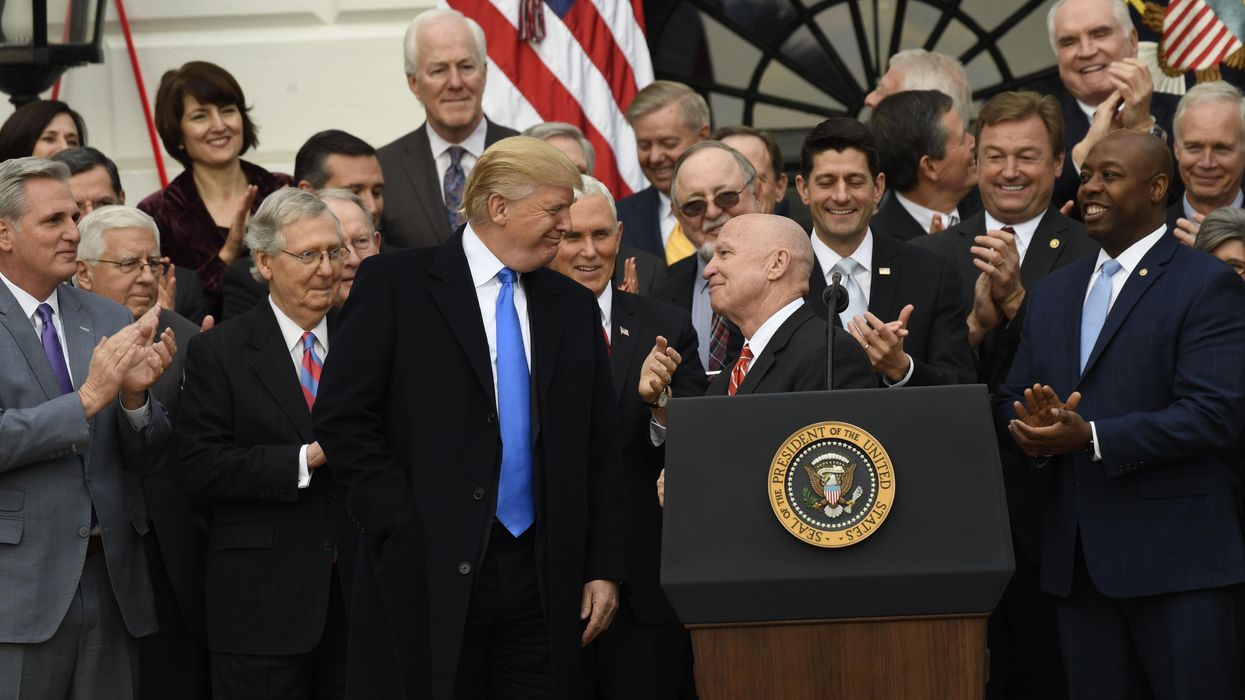
Republican Party leaders have designs to push for the extension of corporate tax cuts and permanently reduce the rate for the wealthiest Americans if they regain control of Congress in the upcoming midterm elections, according to new reporting out Monday.
"Never, ever, ever allow any Republican to claim they can't support legislation because 'it's not paid for' or there are no 'offsets.'"
Derisively referred to as the "GOP tax scam" of 2017, the legislation signed by Trump was disingenuously touted by the former president as "a bill for the middle class," but in reality resulted in a massive windfall for large corporations and the wealthy.
While Trump said that "corporations are literally going wild" over the measure that saw most of the $1.5 trillion in tax cuts go to the wealthiest 1% of Americans and corporations, the non-partisan Congressional Budget Office estimated the legislation would add $1.7 trillion to the national debt by 2027.
New reporting by The Washington Post on Monday details how Republicans believe, if they do retake the House and Senate, they can force through an extension of the Trump tax cuts for the rich by putting President Joe Biden in a political box ahead of the 2024 presidential campaign.
According to the Post:
Many economists say the GOP's plans to expand the tax cuts flies against their promises to fight inflation and reduce the federal deficit, which have emerged as central themes of their 2022 midterm campaign rhetoric. Tax cuts boost inflation just like new spending, because they increase economic demand and throw it out of balance with supply. But Republicans say they believe these efforts would put Biden in a political bind, requiring him to choose between vetoing the tax cuts--giving the GOP an attack line in the 2024 presidential election--or allowing Republicans to win on one of their central legislative agenda items.
In response to the Post's reporting, Democrats running for Congress underscored what's at stake in next month's midterms.
"The extreme MAGA Republicans' top priorities? Destroying Social Security and Medicare and criminalizing reproductive freedom," U.S. Rep. Bobby Scott (D-Va.) tweeted in response to the Post report. "Now they also want tax cuts for corporations and the super-wealthy which adds to the deficit and worsens inflation."
Pennsylvania Lt. Gov. John Fetterman, a Democrat running to represent the state in the U.S. Senate, said in a statement that his Republican opponent, TV doctor Mehmet Oz, "would be an automatic vote for this disastrous GOP agenda to cut taxes for the wealthy and corporations while making inflation worse."
Former House Speaker Newt Gingrich (D-Ga.) told the Post that Republicans successfully used a similar strategy to force former Democratic presidents Bill Clinton and Barack Obama to sign tax cuts they did not initially support.
"The trick is to put the president in a position of either getting defeated in 2024 or signing your stuff into law," Gingrich explained. "Republicans will make it a priority to continue the Trump tax cuts because it puts the Democrats in a position of being for tax increases and against economic growth."
However, White House Deputy Press Secretary Andrew Bates said that "the House GOP's top priority is to worsen inflation and raise energy and healthcare costs by repealing the Inflation Reduction Act. Then they want to further sell middle-class families out to the rich with another tax giveaway to rich special interests."
Social Security and Medicare defenders are also warning that those popular social programs, which each serve tens of millions of older Americans, face "grave danger" if Republicans retake Congress.
"Never, ever, ever allow any Republican to claim they can't support legislation because 'it's not paid for' or there are no 'offsets,'" said David Badash, founder and editor of The New Civil Rights Movement. "Not when they plan to expand the massive tax cuts for the rich and corporations if they win next month."

Five or ten years from now, seniors may wake up one morning and discover that their beloved Medicare program has been completely privatized. And it will not be because that's what seniors want; it will be due to corporate influence and profiteering. Medicare was not created as a private program. In fact, it was enacted in 1965 as federal health insurance for seniors because many private insurers refused to cover them. But over the past three decades, insurance companies and private investors have found a way to capture a growing share of federal Medicare dollars--money that should go toward patient care, not corporate profit.
The most recent sign of this trend: The Trump administration initiated a pilot program called Direct Contracting to improve upon the Accountable Care Organizations (ACOs) first authorized by the Affordable Care Act. ACOs were created to emphasize better care coordination for the purpose of managing chronic conditions rather than treating them episodically. But the problem with the Trump administration's version of ACOs--Direct Contracting Entities (DCEs)--is that it allowed 75 percent of their governance to be controlled by private insurers and other investor-backed companies. The Biden administration allowed part of this program to continue, but faced blowback from the National Committee to Preserve Social Security and Medicare and progressives concerned about for-profit interests expanding their role in traditional Medicare.
After drawing fire from seniors' champions on Capitol Hill and in the advocacy community, the Center for Medicare and Medicaid Services (CMS) re-branded the Direct Contracting program as Accountable Care Organization/REACH, changed the governing requirements to require 75 percent provider governance, and removed other objectionable aspects of the model. However, private insurers and other investor-backed entities can still fund traditional and REACH ACOs--and participate as significant minority representatives on their boards. Some investors view these care coordination models as ripe for financial exploitation.
While we commend CMS for revising the pilot program's rules, we continue to be troubled by the potential for REACH organizations to steer beneficiaries away from traditional Medicare providers outside the ACO network. Because of payment incentives in the pilot project (if not adequately designed to improve care), patients could be pushed toward in-network doctors and hospitals simply because they cost less, and not necessarily because they provide quality care.
In recent years, there has been tremendous growth of the Medicare Advantage (MA) program. MA plans are publicly financed, but privately run--a creation of the Medicare Modernization Act of 2003. The putative rationale for Medicare Advantage was that the private sector could theoretically manage patient care and contain costs better than the federal government, ostensibly saving the Medicare program money. While that may sound good in theory, it hasn't worked out that way where MA is concerned.
Between 2009 and 2021, the government paid Medicare Advantage plans $140 billion more than it would have if the same patients had stayed in traditional Medicare. In fact, the cost to taxpayers of switching seniors to MA plans "has exploded since 2018 and is likely to rise even higher," according to Kaiser Health News. As Axios reports, "Overpaying the Medicare Advantage plans as their enrollment continues to grow threatens Medicare's long-term finances." Meanwhile, writes Diane Archer of JustCare USA, "There's no one policing (Medicare Advantage companies) from taking taxpayer money and spending as little as possible on care."
Even as evidence against Medicare Advantage mounts, MA plans are capturing a larger and larger share of the market. In 2000, it was 17%. Today, more than 40% of Medicare patients are enrolled in MA plans. And little wonder. Medicare Advantage companies run television ads featuring celebrities like Joe Namath and Jimmy Walker, promising seniors a plethora of goodies like gym memberships and rides to the doctor. The ads do not mention MA's considerable limitations or that seniors have the option to enroll in traditional Medicare. In fact, the ads gloss over the difference between the two options, presenting MA as synonymous with Medicare itself. Of course, the more profits MA insurers reap, the more they can plow back into advertising.
Traditional Medicare does not advertise. Worse yet, during the Trump administration, the Centers for Medicare and Medicaid Services (CMS), actively promoted Medicare Advantage during enrollment season and downplayed the option of traditional Medicare. Not coincidentally, Medicare Advantage increased its market share by nearly 10% during the Trump years. Advocates, including the National Committee to Preserve Social Security and Medicare and the Center for Medicare Advocacy, decried the tilting of the playing field toward MA plans by the federal government itself, which should remain neutral with respect to enrollees' options.
In fairness, MA plans do offer coverages that traditional Medicare should offer but still doesn't - including vision, dental, and hearing care. (The President's Build Back Better plan finally would have expanded Medicare coverage, but it was effectively buried in the Senate.) However, Medicare Advantage plans come with several disadvantages that patients may not realize when they dial that 1-800 number on the tv screen.
Medicare Advantage plans offer limited networks of participating providers with whom they've negotiated lower rates. Many MA plans require pre-approval for procedures that traditional Medicare doesn't. And Medicare Advantage insurers often deny claims that traditional Medicare would have covered. All of this leaves seniors vulnerable to high out-of-pocket costs - in some cases, thousands of dollars per year--which many living on fixed incomes simply can't afford.
Unfortunately, most seniors do not discover MA's drawbacks until it's too late. There are myriad stories about MA patients who develop chronic or acute conditions only to find out that their preferred specialists or hospitals are out of network, or that their claims for care have been denied - leaving them to foot the bill. According to a 2017 report by the Government Accountability Office (GAO), seniors commonly cited problems with "coverage of preferred doctors and hospitals... and access to care," among other issues.
The GAO found that sicker beneficiaries are likelier to disenroll from MA, "a sign that the quality of plans with high turnover may be poor." But if patients want to switch from MA to traditional Medicare, they may not be able to obtain (or afford) supplementary Medigap insurance and can remain stuck in the MA program.
With Medicare Advantage's questionable track record, it would behoove CMS to be careful in how it sets parameters for any initiative that changes the way traditional Medicare operates. Traditional Medicare needs to remain a robust, viable option for seniors. Recent developments can be a lesson learned in proceeding cautiously so as not to undermine traditional Medicare.
The primary focus of Medicare should be patients' health and well-being, not corporate profits. Medicare Advantage has not lived up to its core promise to deliver comparable care for less money--while benefitting from government overpayments and billing schemes like "upcoding."
That hasn't stopped conservatives from trying to privatize Medicare through various means over the decades. As early as 1996, none other than Newt Gingrich gleefully predicted that privatization would cause Medicare to "wither on the vine." CMS has partly addressed this challenge in their restructured Direct Contracting/ACO REACH pilot program by limiting the participation of private insurers and other investor-backed companies to 25 percent, but concerns remain about how the demonstration's payment structure could result in a limited provider network being expanded to all of traditional Medicare.
Will traditional Medicare still have a primary role in the provision of quality, cost-effective care for seniors that get to choose their own doctors? That depends on whether Congress demands that CMS do a better job of determining what ACO REACHs are doing to improve the quality of care, enhance transparency of the contracts between ACOs and providers to ensure that financial incentives are not limiting physician choice, and develop better metrics to evaluate if ACOs are delivering on their mission of better management of chronic conditions. These steps must be taken to preserve our cherished Medicare program. They will determine whether the public program is turned over to private entities with limited provider networks and gatekeepers driven more by profit than patient care, or if an improved traditional program will continue to give seniors and people with disabilities access to most doctors and hospitals at a time in their lives when they need it the most. Let's save and expand traditional Medicare before Gingrich's ominous prediction comes true.
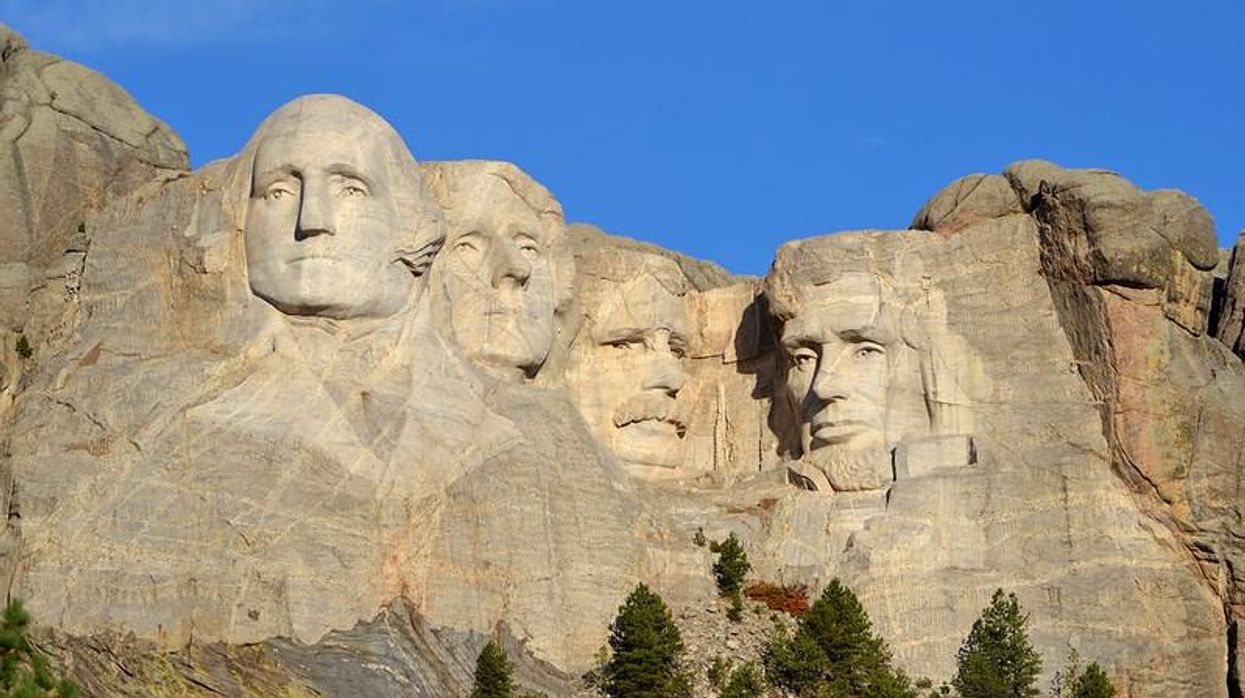
The news that President Trump is planning to stage a "massive fireworks display" before a sizeable crowd on Independence Day eve at the Mount Rushmore National Memorial (notwithstanding the prospect of both wildfires in the tinder-dry surroundings and the further spread of Covid-19) has left me mulling over once again the possible creation of another such epic-scale monument. Maybe it could even be incised into a nearby ridge in the same Black Hills area of South Dakota as the original, if the Lakota Sioux could be convinced to allow it, which they certainly didn't the first time around.
After all, back in the late 1920s, less than three decades and not 70 miles from the site of the ultimate treachery of the Wounded Knee massacre, that original undertaking to carve the faces of presidents George Washington, Thomas Jefferson, Abraham Lincoln, and Teddy Roosevelt into the side of Mount Rushmore barreled heedlessly along, oblivious to Native American concerns. In the process, it desecrated one of the Sioux's holiest sites (the stark cliff face the Lakota ironically called the Six Grandfathers) in order to celebrate the leaders of the very nation that had stolen their land and then so savagely repressed them.
Incidentally, did you know--I hadn't--that the sculptor of the original Rushmore monument, Gutzon Borglum, was an avid member of the Ku Klux Klan? In fact, his first stab at such a gargantuan effort, earlier in the 1920s, had been his proposed Stone Mountain Confederate Memorial, featuring the mounted figures of generals Robert E. Lee and Stonewall Jackson, as well as the president of the Confederacy, Jefferson Davis, leading their rebel armies.
That vast bas-relief was to grace the very site, half an hour outside Atlanta, where, on a cold Thanksgiving night in 1915, just a few months after the premiere of D.W. Griffith's movie Birth of a Nation (and shortly after that, the notorious mob-lynching of the falsely convicted Jewish factory superintendent Leo Frank in nearby Marietta), a select group of sheet-hooded men, led by William J. Simmons, founded the second iteration of the Ku Klux Klan. Their ceremony culminated with the burning of a 16-foot cross atop the dome of the mountain, an act commemorated there every Labor Day for the next 50 years with similarly festive cross burnings.
As it happened, Borglum only made it as far as sculpting Lee's head before the initial version of the project bogged down in financial difficulties and intra-Klan sectarian strife in 1925. A couple of years later, he moved on to the Mount Rushmore project. Several decades later, however, work on a variation of Borglum's Stone Mountain would be revived by others, long after Mount Rushmore's completion. Indeed, with work once again well underway toward what would become the largest bas-relief anywhere in the world, a vast state park at the bottom of the mountain was inaugurated on April 14, 1965, the 100th anniversary of Lincoln's assassination, and the place would quickly become Georgia's most visited tourist attraction. But that's another story, worthy perhaps of an entirely different reckoning.
As for my own fantasized Rushmore 2.0, perhaps the Lakota would be more amenable to this version than they were the first time around, since the project would be aimed at addressing our common future, maybe half a century from now, and represent a graven missive from our own time to our progeny's, an attempt to account for the botched and blighted world we'll likely have bequeathed them by then.
Whose Heads (and Whose Hands) in the Pillory Stockade?
Rather than gazing off with visionary zeal toward some divinely sanctioned manifest destiny, as in the original, the foursome on my Mount Rushmore 2.0 would be lined up in a pillory stockade, each with his downcast face bracketed by similarly yoked hands. (The encasing yoke-planks would be meticulously carved into that granite cliff as well.) These would be the four men (and yes, of course, they would all be white men) from our era who, perhaps more than any others, could be deemed responsible for the dire endgame into which the world by that time might well have plunged: Four men who had the resources and intelligence to have known better but instead chose to swap out the long-term fate of their grandchildren (and the rest of the human progeny) in relentless pursuit of short-term profit and power.
The way I envision it, the first slot on that mountain would be reserved for media baron Rupert Murdoch who, by way of his News Corp empire, so single-handedly poisoned the well of public discourse with denial and obfuscation, not only in the United States, but in Britain as well as in his native Australia (where he controls 60% of all daily newspaper sales). For that matter, his damage extends globally, thanks to Fox News, the editorial pages of the Wall Street Journal, the Sun, the News of the World, and their ilk (and recently, he even chose to solidify his malign record by installing his ideologically matched son Lachlan atop the firm's line of succession in conspicuous stead of his more circumspect and reportedly reform-minded son James).
The next slot over should surely go to Senate Majority Leader Mitch McConnell. After all, across a single crucial decade--and how long can scientists and others keep insisting that we only have 10 or 12 years left to avert planetary ecological calamity before those years run out?--he managed to upend virtually every effort of the Obama administration, no matter how deeply inadequate, to deal with the burning of fossil fuels. Then he abetted every anti-ecological, anti-climate-change initiative of the Trump administration, with immediate short-term benefits to his billionaire (often fossil-fueled) donors. Meanwhile, he succeeded in packing the courts with similarly blinkered reactionaries as a way of forestalling future efforts to reverse any of this.
And no, Donald J. Trump wouldn't even come close to qualifying for the third spot on that cliffside commemorative relief. The candidates, after all, would have to demonstrate enough intellectual bandwidth to grasp, however faintly, the stakes involved, and Trump demonstrably lacks any grasp whatsoever of the future he's leaving our children and their children. In any case, his hands are way too small. They'd keep slipping out of the stockade's granite boreholes and, as for his hair, how could any sculptor, no matter how gifted, be expected to reproduce such a mare's nest? Moreover, merely excluding him from such dubious company should be enough to provoke a veritable tweet storm of umbrage, which could, at least, provide the rest of us with a tad of dark entertainment across these dismal times, even if the project itself never advanced to the chiseling stage.
So what of slot three? On that one, I'm of at least two minds and, in any case, why should I be the only one who gets to decide? Shouldn't these choices be a matter for public conversation and deliberation? Still, for my money, one-time Republican House Speaker Newt Gingrich and former Vice President Dick Cheney would definitely be in the running, given their formative roles in fomenting the sort of dyspeptic politics that made the current Trumpian moment possible.
And don't forget Bill Clinton either. (No reason not to be bipartisan on such a monument.) Too clever by half in his zeal to be loved by those at the top of the financial pyramid, President Clinton didn't even begin to rebalance the neoliberal excesses of President Ronald Reagan and George H.W. Bush. Given the craven surrender of Gingrich, Cheney, and Clinton to the short-term needs and dictates of financial and technological monopolies at the expense of longer-term environmental initiatives, all three would surely merit consideration.
The Fourth Slot for the Fifth Vote?
Which brings me to that fourth slot, one that could well be determined in the next six months and, at least to my mind, is Supreme Court Chief Justice John Roberts's to lose.
Yes, the current administration botched its response to the Covid-19 pandemic and the unprecedented financial collapse that resulted, and yes, Trump and his minions have appallingly racist instincts in their treatment of immigration, police violence, systemic discrimination, and the widening chasms of economic inequality. Still, the single most crucial issue in the upcoming November election should surely be the environmental future of our planet and, let's face it, in that regard the United States remains the decisive battleground in determining all humanity's collective fate. (And it's hard to overstate the terminal devastation four more years of Trumpian governance could wreak in this regard.)
Of course, with each passing week, Trump's defeat in any sort of fairly conducted election seems ever more assured (though no thanks to the issue of climate change, which is still being widely ignored). Still, whether the coming election will, in fact, be fairly conducted, with widespread access to the ballot guaranteed, is fast becoming the defining question of this electoral season.
From President Trump and Mitch McConnell to local operatives in key swing states, the Republicans have made no secret of their determination to shrink suffrage through voter suppression tactics like mass purges of voting lists; arbitrary registration requirements blatantly tilted against people of color and young people generally; flagrant efforts to prevent mail-in balloting (even in the face of a likely autumn upsurge of the Covid-19 pandemic and even if it takes bankrupting the Postal Service in order to do so); the conspicuously uneven distribution of polling places on Election Day, along with the assignment of more breakdown-prone polling machines to key opposition districts; all of that to be supplemented by massive, secretly funded efforts at voter intimidation--and that's not even to mention complications that might arise in the subsequent counting of the ballots. Most of these gambits will provoke urgent legal challenges that will undoubtedly quickly wend their way to an already highly politicized Supreme Court. There, Trump and his fellow Republicans can count on at least four stalwart votes (that being in large part why those judges, most recently Neil Gorsuch and Brett Kavanaugh, were put there in the first place).
This, in turn, means that the fate of both the republic and the human future could come down to the jurisprudence of just one man: Chief Justice John Roberts, the fifth vote (and the only one that may matter in the end). In this context, much is made of the chief justice's supposedly overriding concern for the historical reputation of the institution he presides over, its nonpartisan majesty, and its abiding place in the constitutional firmament. After all, wasn't he the one who found a way to salvage the Affordable Care Act, secure the employment rights of LGBTQ workers, and forestall both the deportation of the DACA Dreamers and the obliteration of abortion, at least for the time being?
It's worth noting, however, that the absolute right of states and localities to control access to voting in any way they see fit (without regard to gerrymandering or ongoing racial discrimination) has been a fundamentally unswerving feature of Roberts's legal philosophy since long before he was on the Supreme Court. After all, from July 1980 through August 1981, he clerked for Justice William Rehnquist, who'd made it his own life's work to roll back much of the liberal Supreme Court's jurisprudence of the previous three decades, particularly with regard to voting rights. On leaving that clerkship, Roberts joined the Justice Department's civil rights division where he served under Kenneth Starr in the newly installed administration of President Ronald Reagan. There, his portfolio was particularly focused on undercutting the 1975 Voting Rights Act, even if to only limited effect, owing to congressional opposition at the time. In 1986, he left government to enter private practice.
But after the November 2000 Florida presidential election debacle (remember those "hanging chads"?), Roberts was one of the first outside lawyers selected by 29-year old Republican campaign adviser Ted Cruz (another onetime Rehnquist clerk) to fashion a legal strategy for a preemptive appeal to the Supreme Court. Thereafter, working behind the scenes on behalf of Florida Governor Jeb Bush, the brother of Republican presidential candidate George W. Bush, Roberts fashioned a gambit designed to force the suspension of any recount in that state. He would thereby award the narrowest possible electoral college victory to the younger Bush over Democratic candidate Al Gore (who had actually won the national popular vote by more than 500,000 votes).
Roberts's strategy proved entirely successful--in partial appreciation for which, as one of his first acts, the newly installed president nominated Roberts to a seat on the Washington, D.C., Circuit Court of Appeals (a nomination that languished for two years until the Republicans secured control of the Senate). Then, in 2005, Bush nominated him to succeed the recently deceased Rehnquist as chief justice of the Supreme Court in which capacity Roberts promptly resumed his lifelong focus on systematically eviscerating most forms of federal electoral supervision.
In 2010, Roberts was the fifth vote in the notorious Citizens United decision that effectively equated money with speech and opened the floodgates to unprecedented private spending in election campaigns, virtually without regulatory oversight. Three years later, he was the fifth vote in Shelby County v. Holder, a case that gutted major provisions of the Voting Rights Act of 1965, the crown jewel of the Civil Rights Movement, radically undercutting the federal government's capacity to address clearly documented discriminatory practices at the state and local level.
At the end of the 2019 term, Roberts provided the fifth vote in a case ensuring that federal courts couldn't review even the most egregiously partisan gerrymanders by state legislatures. On the eve of the recent Wisconsin primary, his was the fifth vote overturning the ability of that state's governor, acting at the behest of his health commissioner, to suspend or extend primary voting thanks to the rampaging coronavirus. Roberts and crew thereby sentenced tens of thousands of voters to wait in dangerous lines for hours on end at polling places, especially in urban districts like Milwaukee, where a total of only five polling stations were able to open to service the entire city.
In the Balance
So, we'll see. In the wake of the November 3rd election, will yet another set of fifth votes, this time in defense of a slew of Trumpian election outrages, net him that fourth slot on Rushmore 2.0, or might some sudden, otherwise unaccountable about-face on his part spare us the need even to erect such a monument?
If, however, Roberts does provide those deciding votes for the Republican side, will democracy as we know it even survive a second Trump term, so that anyone might ever again even be allowed to muse over and plan, let alone erect, a Rushmore 2.0 monument? On the other hand, were Roberts to demur, who knows whether achingly conventional Joe Biden will be able to rise to the historic occasion of his own election or might he, in the fullness of time, yet find himself becoming worthy of insertion into the fourth slot in that stockade?
History will tell: some of us may even live to see it.

The opioid abuse epidemic is one of the worst public-health crises in American history. According to the Centers for Disease Control and Prevention (CDC), between 1999 and 2017, almost 400,000 people died in the U.S. from an overdose of either prescription or illicit opioids. In 2017 alone, opioids, more than one-third involving prescriptions, killed more than 47,000 individuals. And today, on average 130 people die each day from opioid overdoses.
The root cause of most cases of opioid addiction, particularly prescription-initiated addiction, is pain, a devastating but sometimes overlooked symptom. As a recent American Industrial Hygiene Association paper argues, "the opioid crisis should be seen primarily as a pain crisis, much of which is related to work." Addressing that crisis precipitated another: treatment regimes that relied heavily on opioids. Today there's little awareness that almost two decades ago, conservative members of Congress, in a burst of anti-regulatory zeal, championed the fight to eliminate the very ergonomics standard that was designed to reduce the high incidence of a number of common workplace injuries.
The tale of that misguided effort begins with the Occupational Safety and Health Act, which was signed into law by President Richard Nixon in 1970, following decades of unregulated, preventable workplace deaths, injuries, and illnesses. Its goal was to "assure safe and healthful working conditions for working men and women" and included "authorizing enforcement of the standards developed under the Act."
The act incorporated existing industry safety standards and adopted new ones to cover an array of workplace hazards, such as work-related musculoskeletal disorders (WMSDs). These disorders included a wide range of conditions like carpal tunnel syndrome, back pain, and tendonitis that are related to repetitive stress, or sustained or sudden exertions resulting from lifting, pushing, and pulling; carrying many or irregularly shaped objects; maintaining awkward or unnatural positions; or handling vibrating machinery and tools.
By the 1980s, labor health and safety activists recognized that alarming rates of disabling WMSDs were occurring in a wide variety of workplaces, including auto manufacturers, garment factories, office environments, and meatpacking and poultry plants. New modes of assembly line production exacerbated these long-standing problems. The need to implement an ergonomics standard, one that would require employers to systematically address the hazards that give rise to musculoskeletal injuries suffered by their workers, became even more urgent.
There were several false starts for the controversial provisions, but OSHA began working in earnest on the standard in 1993. However, the resulting proposals soon ran into trouble on Capitol Hill. The Democrats lost control of Congress in 1994, and Newt Gingrich's "Contract with America" heralded the new Republican majority's deregulatory push. Bemoaning the costs that an ergonomics standard would entail for the private sector, industry lobbyists derided OSHA's ergonomic proposal as the poster child for government overregulation. The agency estimated that the new rule would require $4.5 billion in annual compliance costs, but would generate $9.1 billion in benefits every year in the first ten years, and prevent hundreds of thousands of musculoskeletal disorders each year.
Gingrich's acolytes fought the development of the standard tooth and nail, despite a 1997 General Accounting Office report that found that "billions of dollars are spent by private sector employers on workers' compensation claims associated with WMSDs," and that "employers can reduce these costs and injuries and thereby improve employee health and morale, as well as productivity and product quality" by implementing effective ergonomics programs in their workplaces.
After a decade of research and heated political debate, OSHA finally prevailed. On November 14, 2000, during the final weeks of the Clinton administration, the agency issued its ergonomics regulation. It applied to more than six million worksites covering 102 million workers and required all general-industry employers (excluding the agriculture, maritime, and construction sectors) to establish an ergonomics program if triggered by reports of a worker's WMSD or persistent evidence of WMSDs in the workplace.
The standard went into effect days before George W. Bush was inaugurated. But a few months later, Congress used the Congressional Review Act of 1996 to obliterate the regulation, the first and only time the act had been used to rescind an agency regulation (until President Trump began to make frequent use of it). Usually, if a new administration dislikes a regulation and wants it revised or revoked, it needs to engage in rulemaking all over again and must justify the desired changes. The ergonomics standard escaped this process. In his first legislative act as president, Bush signed the rescission resolution on March 20, 2001, taking the standard off the books and prohibiting OSHA from ever issuing a substantially similar one. A regulation designed to protect workers from debilitating workplace injuries--that frequently required painkilling treatment regimes--had been completely destroyed.
The Bush administration paid lip service to the value of ergonomics programs. Administration officials noted that employers who ignored obvious problems with WMSDs might be cited under OSHA's "general duty" to provide a workplace reasonably free from recognized hazards. But, as a June 2004 memo to OSHA's regional administrators made clear, any new guidelines for the prevention of WMSDs "are not new standards or regulations and do not create any new OSHA duties for employers" (emphasis in original). Today, no federal ergonomics regulation exists. (Some states run their own OSHA programs, with federal financial and technical assistance and oversight. They are required to provide worker protections at least as vigorous as federal OSHA regulations require. Of these states, only California has specific ergonomics regulations currently on the books.)
But the hazardous workplace conditions that give rise to musculoskeletal injuries, and the chronic pain that so often accompanies those injuries, haven't gone away. According to the Bureau of Labor Statistics, musculoskeletal injuries are the most prevalent occupational injury in the United States today, totaling, in 2017, 32 percent of serious nonfatal occupational injuries and illnesses. The CDC, meanwhile, continues to claim that "together, employers, workers, and other parties with an understanding of ergonomics can design effective programs to prevent and minimize WMSDs."
In 2017, there were 344,970 cases of workplace musculoskeletal injuries involving days away from work. How many of those cases represent workers who are being treated or are self-medicating with opioids today? How many are addicted? And how many of their injuries could have been prevented with an effectively enforced standard designed to reduce the hazards that cause WMSDs, like the short-lived 2001 rule?
Today, the CDC points out that the best ways to prevent opioid overdose deaths include improving prescribing through revamped clinical-practice guidelines and treatment and preventing opioid use disorder. But there's little discussion even now about preventing the workplace injuries that cause the pain that contribute to opioid use and abuse. Federally enforceableworker-informed ergonomics programs continue to be urgently needed in every workplace where these hazards exist. If only Congress and President Bush had understood that 18 years ago.

As I write, Boris Johnson has just been confirmed as Britain's new Prime Minister. A highly controversial and devisive figure, there are millions who are shocked at his offensive sexist, racist, Islamophobic, and homophobic views, amongst others.
It is hardly surprising that Donald Trump is an ardent fan.
Yesterday, Trump tweeted:
Newt Gingrich even calls Boris the "Donald Trump of Britain":
No wonder the Republicans are excited, as Boris Johnson is one of their own. He is cut from the same cloth.
It is ironic that today Europe is experiencing record temperatures with neighbouring Belgium and the Netherlands announcing record maximum temperatures.
On his way to Buckingham Palace, Johnson's motorcade was blocked by climate protesters from Greenpeace.
One of those who attempted to give Johnson a 134-point "climate emergency" manifesto was John Sauven, the head of Greenpeace UK. Sauven said, "Boris Johnson must get to grips with the climate emergency or be remembered as the prime minister who jeopardised our children's future."
But Johnson will jeopardize our children's future, because he is a climate denier.
As Desmog UK pointed out yesterday, "for the increasing number of people loudly calling for climate action," Johnson's views on climate make "uncomfortable reading."
DeSmog points out that the UK's new Prime Minister has "rejected climate science a number of times over the years," including in December 2015, praising the work of notorious climate science denier Piers Corbyn, who he called a "great physicist and meteorologist."
During the Conservative leadership campaign, he received a PS25,000 donation from Terence Mordaunt, who is a director of the leading climate denier organization in the UK, the Global Warming Policy Forum. Last year, Johnson went on an all-expenses-paid trip to a dinner at the Koch-funded think tank the American Enterprise Institute.
Next year, the UK will host the most important climate talks since Paris and at the moment, Johnson looks set to be at the political helm. It is a disaster for the climate, as Johnson will do nothing.
In contrast, as the Overseas Development Insitute points out, there are really simple things Johnson could do tomorrow.
In a letter to Johnson, the ODI states: "First, the UK must end tax breaks and fiscal concessions for oil and gas production, including in the North Sea." It must also stop subsidizing fossil fuels abroad too.
Indeed, new research published by the ODI yesterday revlealed that the UK government provided support for energy in developing countries with a total value of PS7.8 bn from 2010 to 2017. Of that a whopping 60 percent still went to fossil fuels.
Dr Sarah Wykes, the Catholic Agency For Overseas Development (CAFOD) Lead Climate Analyst, said: "The UK wants to be a leader on climate change, so it's shocking that UK aid money is still being spent on fossil fuels overseas."
She continued: "At a time when we are reducing the UK's own reliance on fossil fuels, why are we spending billions of pounds saddling poorer nations with outdated technologies that will cause more climate damage?"
Boris could stop this funding tomorrow. But he won't. He could act immediately to stop climate change, but he won't. He will bluster and bluster and bluster his way through our climate emergency.
President-elect Donald Trump's campaign trail refrain of "drain the swamp" was "cute" while it lasted--but don't expect to hear much of it from here on out, Newt Gingrich told NPR this week.
"I'm told he now just disclaims that," Trump ally Gingrich said to NPR's Rachel Martin of the phrase. "He now says it was cute, but he doesn't want to use it anymore."
Gingrich learned as much after posting a "drain the swamp"-inspired tweet that "somebody" reproached him for. "Somebody wrote back and said they were tired of hearing this stuff," he said.
While Gingrich attributed the newfound distaste for the phrase to Trump's feeling that "as the next president of the United States...he should be marginally more dignified than talking about alligators in swamps," others pointed to a different explanation: With his cabinet choices, Trump isn't actually draining the swamp, he's restocking it.
As the Washington Post reported:
As admissions of political expediency go, this is pretty forthcoming.
But it's also worth noting here that Trump's flip on this phrase seems to have come pretty suddenly. Just a day before Gingrich's first tweet above, Trump promised in Alabama to "drain the swamp of corruption in Washington, D.C." He said the same in Orlando the day before and in Hershey, Pa., the day before that.
So it's not clear whether a specific story or cable news item--which have a tendency to draw instant Trump policy directives and declarations--might have influenced this change of course, if indeed it sticks. But what's clear is that Trump's efforts to "drain the swamp" have increasingly been derided and scoffed at as he has named a Goldman Sachs executive to head the Treasury Department and politicians and fellow billionaires to lead other departments. And then there are the many possible conflicts of interest.
Indeed, Gingrich may just be confirming what many observers already feared. Sen. Bernie Sanders (I-Vt.) put it bluntly last month: "A lot of what Mr. Trump was saying to get votes turns out to be not what he intends to do as the president of the United States."
Seventy-five years ago this past January, President Franklin Delano Roosevelt went before Congress and the American people to declare that a generation's "rendezvous with destiny" had come, that the Nazis, Fascists, and Imperialists would strike without warning and Americans had to not only ready themselves for that possibility, but also turn the nation into the Arsenal of Democracy.
Seventy-five years ago this past January, President Franklin Delano Roosevelt went before Congress and the American people to declare that a generation's "rendezvous with destiny" had come, that the Nazis, Fascists, and Imperialists would strike without warning and Americans had to not only ready themselves for that possibility, but also turn the nation into the Arsenal of Democracy.
The President did not speak from fear or seek to incite it. He had faith in Americans. He knew what they had accomplished in fighting the Great Depression. He knew they had not only rejected authoritarianism, but also redeemed the nation's historic promise by initiating revolutionary changes in American government and public life. He knew that they had subjected big business to public account, empowered the federal government to address the needs of working people, organized unions, fought for their rights, broadened and leveled the "We" in "We the People," established a social security system, expanded the nation's public infrastructure, improved the environment, built schools and municipal buildings, cultivated the arts and refashioned popular culture, and imbued themselves with fresh democratic convictions, hopes, and aspirations. Indeed, he knew that while there was much still to be done, they had made the United States both stronger and richer and freer, more equal, and more democratic.
Knowing all of that, Roosevelt projected a vision of a nation and a world characterized by four fundamental freedoms - Freedom of speech and worship, Freedom from want and fear - a vision that would guide not only the ensuing war effort, but also the postwar labors that were to make America ever stronger, richer, and more democratic, labors that included enacting the Civil Rights, Voting Rights, Economic Opportunity, and Fair Housing acts, expanding Social Security to encompass Medicare and Medicaid, passing immigration reform, instituting environmental, workplace, and consumer protections, creating new universities and establishing public endowments for the arts and humanities, and establishing a public broadcasting system.
All that our parents and grandparents achieved, however, is now in jeopardy.
"Most Americans did not vote for Donald Trump and the great majority definitely did not vote to end Social Security, Medicare, Medicaid, and environmental regulation and protection. But we can take little solace in that. The Republican right rules - not just in too many states, but all too soon in every branch of government - and, as Gingrich's remarks make clear, they have the legacy of FDR, the Greatest Generation, and the fight for the Four Freedoms in their sights."
For the past forty years the GOP right and reactionary rich, abetted by neoliberal Democrats, have laid siege to the promise of the Four Freedoms and the legacy of FDR and those we have rightly come to call the Greatest Generation. And in the wake of November, they seem poised to renew their campaigns.
Just last week, former Republican Speaker of the House Newt Gingrich, a fervent ally of Donald Trump, took to the stage at the Heritage Foundation to rally the right's forces around the President-elect in favor of launching a final assault on what remains of the New Deal and Great Society.
Utterly disregarding the fact that Trump lost the popular vote by nearly 3,000,000, and haughtily dismissing the fact that his Electoral College victory may be due to Russian interference in our electoral process, Gingrich spoke of Trump in the most fantastic terms. Gleefully noting that politicians and pundits other than himself had completely underestimated the real estate mogul; bluntly assailing the media as "the propaganda media" and calling it a bunch of "idiots" (which is truly startling in light of how the "MSM" had helped to "normalize the Donald" to the public); and unashamedly hawking his own new e-book Electing Trump; Gingrich celebrated Trump's business and political savvy, his salesmanship and showmanship, and his determination to "drain the swamp" and "kick over the table."
But the real message Gingrich was bringing to Heritage was that right-wingers should stop worrying about whether they could trust Trump and start recognizing him as one of their own (notably, the editors of both the classically conservative National Review and the neo-conservative Weekly Standard had distanced themselves from Trump's campaign and candidacy). Portraying Trump as their new champion, Gingrich assured them that the President-elect was someone they could count on, someone who was seemingly prepared to lead them against the left and the Roosevelt legacy.
Gingrich began by announcing that Trump's impending presidency represents "the third great effort to break out of the Franklin Delano Roosevelt model." The first, Gingrich stated, was Ronald Reagan's 1980 election victory and ensuing two-term presidency (aka "the Reagan Revolution") and the second, Gingrich proudly recalled, was the 1994 Republican takeover of Congress (the so-called Gingrich Revolution that briefly shut down the Federal government).
Gingrich then really took off. And his smarminess knew no bounds.
Professor Gingrich the historian - yes, he has a PhD in History, and they don't call it "piled higher and deeper" for nothing - referred to "Trumpism" as a set of ideas and practices worthy of serious study. He then proceeded to not only dub his friend and idol the "Tribune of the American People," but also proclaim that Trump was destined for Presidential Greatness. He stands, Gingrich announced, "in the tradition of Washington, Jefferson, Jackson, Lincoln, Theodore Roosevelt, FDR and Ronald Reagan, and by that I mean, in every case, they believed in the American people, they aroused the American people, and they led the American people to victory over entrenched powerful interests."
Believe in the American people - but repeatedly lie on the campaign trail? Arouse the American people - to new heights of racial and religious hatred and fear? Lead the American people to victory over entrenched interests - while appointing a coterie of billionaires and generals to his Cabinet? If the dead actually can roll over in their graves, there must be a lot of tossing and turning going on right now at Mount Vernon, Monticello, Hermitage Gardens, Oyster Bay, Hyde Park, and, maybe even, Simi Valley.
Gingrich, who was pressured by his own colleagues to give up the House Speakership in 1998 due to ethics violations, may present something of a comic figure. But don't let the fact that soon-to-be President Trump left him off the Republican ticket, and has now apparently left him out of his Cabinet, lead you to believe he is irrelevant.
We underestimated Donald. We should not underestimate Newt. He is smart, connected, well-funded, and entrepreneurial. His histories - most notably, Rediscovering God in America: Reflections on the Role of Faith in Our Nation's History and Future and A Nation Like No Other: Why American Exceptionalism Matters - are as faithful to historical truths as Trump's speeches are to contemporary truths. And yet they not only have been commercial successes. They also have been ideologically influential on the religious and political right. Gingrich successfully led the GOP to hijack the idea of American exceptionalism and, following suit, Trump emblazoned Make America Great Again on millions of red caps.
In fact, Donald may well have told Newt he needs him more as a publicist than as a department head and Gingrich himself told the press he would not hold a post in the Trump Administration because he wants to work on "strategic planning.... I want to be free to network across the whole system and look at what we have to do to succeed."
Don't scoff. Gingrich, like Trump, is a showman and even more than Trump he is a pontificator. But he is also arguably the one Republican who can fuse the ambitions of Trump and the aspirations of the Congressional Republicans. Don't forget, Newt captured public attention and Congress for the GOP in 1994 by issuing a Contract With America (an idea Trump also picked up on to issue a Contract for the American Voter).
Gingrich surely sees himself as the grand figure who can harness together President Trump and the Congressional Republicans in favor of pursuing a Trumpian Revolution. As Gingrich told the Heritage folks: If Trump can "dance" effectively through two terms; if Republicans can band together as a "movement" against the elitist, politically correct left; and if they can elect another president in 2024; then they will all be able to confidently say "we have replaced the FDR model and we are now in a period of very different government."
Of course, most Americans did not vote for Donald Trump and the great majority definitely did not vote to end Social Security, Medicare, Medicaid, and environmental regulation and protection. But we can take little solace in that. The Republican right rules - not just in too many states, but all too soon in every branch of government - and, as Gingrich's remarks make clear, they have the legacy of FDR, the Greatest Generation, and the fight for the Four Freedoms in their sights. Led by opportunists, reactionaries, and crazies, they are ready to do battle.
Our only chance of defeating Trump, Gingrich, Ryan and the rest is to start doing as FDR did, but as Democrats for too long have failed to do. In the words of no less an authority than Professor Gingrich: Believe in the American people, arouse the American people, and lead the American people to victory over the entrenched powerful interests.
As President-elect Donald Trump began his transition to power on Thursday, early reporting has opened a window into what the nation can expect as his "cabinet of horrors," as AFP put it, takes shape.
New Jersey Gov. Chris Christie, Rudy Giuliani, Ben Carson, Newt Gingrich, Florida Gov. Rick Scott, and former Alaskan Gov. Sarah Palin are among the more high-profile individuals named on a shortlist of potential appointees leaked to several news outlets.
On Wednesday, BuzzFeed News published a list of 41 names suggested for 13 positions, including attorney general, secretary of state, White House chief of staff, and White House counsel.
And while some, like Christie, were unsurprising, as Salon's Brendan Gauthier wrote, "The people whose names you don't recognize are as bad or worse as those whose names you're sick of hearing."
For example, Retired Lt. Gen. Michael Flynn, who is being considered to head the Department of Defense, "was fired from his post as head of the Defense Intelligence Agency in 2014, which he attributed to his hawkishness," Gauthier reports.
Oil executive Forrest Lucas is favored to take over the Department of the Interior, multiple outlets have reported. "That's a position that oversees land management, national parks and wildlife reserves, and Lucas at the helm would represent a nightmare scenario for environmentalists," AFP reported.
Also being considered for that position is Palin, the former vice presidential candidate made famous for her love of hunting and frequent chants of "drill, baby, drill."
It has previously been revealed that top climate skeptic Myron Ebell, who serves as director of the Center for Energy and Environment at the conservative Competitive Enterprise Institute, is spearheading transition plans for the Environmental Protection Agency (EPA)--a department Trump repeatedly vowed to dismantle during his run-up to the election.
"In some cases," BuzzFeed reports, "it appears the transition team is looking to find a home for a particularly loyal ally--Ben Carson, for instance, is listed as a potential candidate to be the secretary of education and secretary of health and human services, while Sen. Jeff Sessions is listed as a possible attorney general, head of the Office of Management and Budget, or secretary of defense."
As for the heavy-hitters, former Republican House speaker Gingrich is being floated for the position of secretary of state, which AFP notes, "would have major implications for U.S. foreign policy and Washington's role in the international community."
Gingrich, who has lauded Trump's approach to foreign policy, has had his own international views described as "unpredictable," "hawkish," and "shameless."
Meanwhile, Christie and Giuliani--each with their own questionable interpretations of the law--are reportedly in competition for the role of attorney general. This particular appointment, Maurice Chammah wrote at the criminal justice-focused Marshall Project on Wednesday, is "poised to upend...[o]ne of the Obama administration's most aggressive civil rights tactics--the investigation and forced reform of local police departments."
"Under a new attorney general," Chammah wrote, "priorities could shift practically overnight. New investigations could grind to a halt, and court-ordered consent decrees could stall as career [Department of Justice] lawyers are ordered to abandon their efforts"--which would be a serious blow to the criminal justice reform movement.
The list provided to BuzzFeed is included below, but these 41 names only scratch the surface of a Trump administration. As the recently-launched transition website Greatagain.gov notes, the incoming administration is responsible for selecting candidates for "approximately 4,100 presidential appointments."
List of Potential Trump Cabinet Nominees:
Attorney General:
Secretary of Commerce:
Agriculture Secretary:
Secretary of Education:
Secretary of Energy:
Secretary of Health and Human Services:
Secretary of Homeland Security:
Secretary of the Interior:
Secretary of Defense:
Secretary of State:
Treasury Secretary:
Chief of Staff:
Director of Office of Management and Budget:
Secretary of Labor:
Veterans Affairs:
White House Counsel:
When the stunning article "Why the Future Doesn't Need Us" by Bill Joy, chief scientist for Sun Microsystems, made the cover of Wired Magazine in April 2000, it created quite a rumble in high-tech circles. It argued that "our most powerful 21st-century technologies--robotics, genetic engineering, and nanotech--threaten to make humans an endangered species."
Bill Joy was writing about out-of-control, self-replicating technologies that, once the stuff of science fiction, were now on the way in decades, if not years. Tens of thousands of scientists, engineers, mathematicians, and systems analysts are working in countries worldwide, churning out theories and specialized applications without much consideration of their overall impacts.
The funding has come from various governments' military budgets, heavily contracted out to industrial corporations, and, now increasingly, from the commercial pursuits of global corporations. The rate of knowledge production has been exponential as computers become faster and are programmed to become more self-reliant.
Seventy percent of the volume of stock trading in the U.S. is now driven by computers and their algorithms--a mere glimmer of the future pictured by Mr. Joy.
Sensitive futurists worry about both the intended and unintended consequences. Government militaries may intend autonomous weaponry for certain purposes, but the more dreaded unintended consequences arise when these weapons decide when and whom to strike.
Last month, astrophysicist Stephen Hawking, Apple co-founder Steve Wozniak, and Elon Musk of Tesla Motors were some specialists who signed an open letter that called for a ban on autonomous weapons. The letter says, "If any major military power pushes ahead with artificial intelligence weapons, a global arms race is virtually inevitable," adding that "unlike nuclear weapons, they require no costly or hard-to-obtain raw materials, so they will become ubiquitous and cheap for all significant military powers to mass-produce."
Artificial intelligence (AI) or "thinking machines" are worrying far more of the serious scientists/technologists than those few who speak out publically.
In a BBC interview last December, Stephen Hawking, using a computer-generated voice, warned that "the development of full artificial intelligence could spell the end of the human race... It would take off on its own and re-design at an ever-increasing rate." Hawking, a big thinker, noted that "humans, who are limited by slow biological evolution, couldn't compete and would be superseded."
Self-restraint is not a characteristic of companies developing robotics for businesses that want to replace tens of millions of white-collar and blue-collar jobs. Look at the latest factories, refineries, and warehouses to illustrate what is coming fast. Even the work of lawyers is being automated.
But the warnings of people like Nassim Taleb, author of the runaway best-seller Black Swan, and Stuart Russell, a computer scientist at the University of California, Berkeley, co-author of the textbook on artificial intelligence, who writes about "risks that could lead to human extinction," need to reach wider audiences.
Complex systems can be very fragile in ways not foreseen until they happen! That is why Bill Joy saw all three of these technologies--nanotechnology, genetic engineering, and artificial intelligence--as interwoven systems expanding over the globe beyond human control.
In a recent interview (July 17, 2015) with Science magazine, Professor Russell was asked, "What do you see as a likely path from artificial intelligence (AI) to disaster?" He replied, " The routes could be varied and complex—corporations seeking a super-technological advantage, countries trying to build AI systems before their enemies, or a slow-boiled frog kind of evolution leading to dependence and enfeeblement, not unlike E.M. Forster's The Machine Stops."
He told Science he "is unaware of any large movement calling for regulation either inside or outside AI because we don't know how to write such regulation." Such, he noted, is the "bewildering variety of software."
In the meantime, Congress is oblivious to these grim scenarios. The Republicans in charge have no interest in holding educational public hearings because the corporations who own them have no such interest. Meanwhile, the myopic Democrats are too busy dialing for commercial campaign dollars to grease their campaigns to retake Congress in 2016.
Some of these Democrats know better. They championed the Office of Technology Assessment (OTA), an arm of Congress established to research and advise members of Congress about such matters. When Congressman Newt Gingrich toppled the Democrats in 1994, one of his first acts was to defund and shut down OTA.
Congress has played ostrich ever since. The American people will surely pay the price unless a few, including leaders of the scientific community, organize and demand that Congress reinstate this technical warning system that OTA provided. With a tiny annual budget of $22 million, OTA saved far more in preventing boondoggles circulating on Capitol Hill.
None of this domestic inaction should preclude international efforts to expand the Geneva Conventions against chemical and biological warfare to cover these latest mass destruction weapons against humanity. This initiative would constitute an updated declaration of profound human rights.