
SUBSCRIBE TO OUR FREE NEWSLETTER
Daily news & progressive opinion—funded by the people, not the corporations—delivered straight to your inbox.
5
#000000
#FFFFFF
To donate by check, phone, or other method, see our More Ways to Give page.


Daily news & progressive opinion—funded by the people, not the corporations—delivered straight to your inbox.
“It’s hard to fathom how deeply evil this is,” said Sen. Chris Murphy.
The US government advises Americans not to travel to the Central African Republic "for any reason." But it just deported nearly two dozen people to the war-torn country, including several refugees who fled persecution in other nations.
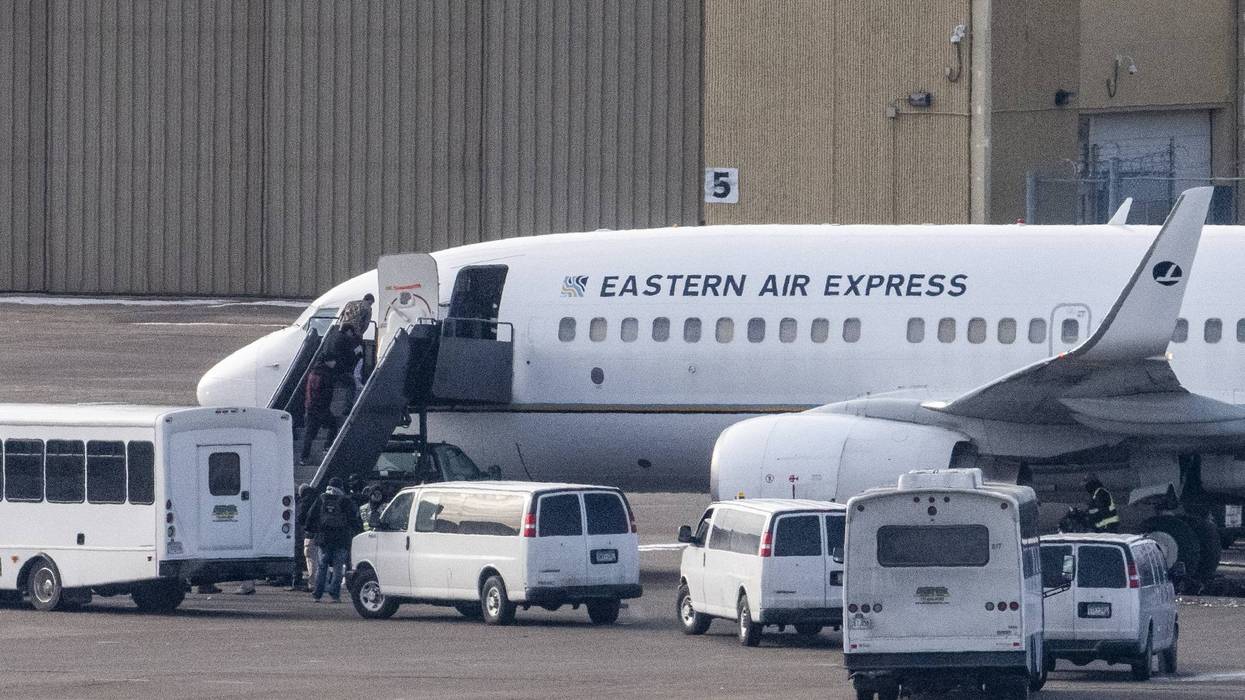
On Friday morning, Human Rights First's deportation flight tracker reported that a plane used by Immigration and Customs Enforcement (ICE) had landed in Accra, Ghana, after departing from Louisiana the previous day and was believed to be en route to the CAR's capital, Bangui.
Per The New York Times on Thursday, the administration was preparing to deport "at least two Iranian women who had sought refuge in the United States" as well as "migrants from Afghanistan and Syria."
According to their lawyers, several of the migrants had received court orders from judges prohibiting their deportation to their home countries, citing the risk of persecution there.
A lawyer for one of the Iranian women told the Times that neither of them has a criminal record and that they both have been granted court protection due to fear of threats to their freedom or lives if they returned to Iran. One is a Christian convert, and the other is a pro-democracy activist.
According to Reuters, just the activist ended up on the flight from Louisiana. But the Christian woman is still at risk, along with another Iranian national.
Human Rights First's @ICEFlightM is monitoring this egregious situation, and we urge our policy makers to decry this life-threatening flight and other deals that send people seeking safety back to the very harms from which they fled.
https://t.co/ABZZMTQNuS
— Human Rights First (@humanrights1st) June 11, 2026
The burden of proof to receive what is known as a “withholding of removal” status from an immigration judge is even higher than that needed for migrants to qualify for asylum.
Those seeking their deportations to be halted must demonstrate that it’s more likely than not that their life or freedom would be threatened if they returned to a specific country due to their race, religion, nationality, or political or social affiliation.
In order to get around orders protecting these migrants from deportation to their home countries, the administration is instead dumping them in what have been described as "third countries."
The flight departed on Thursday is the first US deportation flight to the CAR, which is one of the poorest countries in the world and is reeling from a civil war that's displaced more than a million people both inside and outside the country.
The country is under the State Department's highest travel advisory, warning US citizens not to go there "due to risk of unrest, crime, kidnapping, landmines, health, and terrorism."
This is the @StateDept travel advisory for the Central African Republic.
The United States—a self-proclaimed nation of refuge—is about to send refugees here. https://t.co/uxfexS5S73 pic.twitter.com/pvYyxIQHdN
— Sarah Pierce (@SarahPierceEsq) June 11, 2026
"People on this flight proved to a judge that they were likely to be persecuted in their home countries," said Aaron Reichlin-Melnick, a senior fellow at the American Immigration Council. "This is profoundly unjust."
Human rights law experts Anjli Parrin and Savi Arvey wrote on Wednesday for Just Security that the administration was putting "lives at risk" by sending these migrants to a dangerous country where they know nobody and where basic healthcare infrastructure hardly exists.
They said the administration's deportation of these migrants "is the latest example of its dangerous and potentially life-threatening strategy: using secretive deals with countries to expel asylum seekers and migrants with no legal or personal connection to the places where they are being sent."
"Since early last year, the US government has signed a growing number of third-country forced transfer agreements with over 30 countries worldwide to expel and deport people to places where they have no legal or personal ties," they said.
"These deportations are often carried out in secrecy and without any semblance of due process," they added. "Individuals are often not given any advance warning or the opportunity to challenge their deportation to a third country—with many only discovering they are being sent to a country they may have never heard of while airborne."
Emily Trostle, a lawyer for the Iranian activist, told Reuters that the migrants facing deportation to the CAR "have absolutely no connection to this place."
“These individuals are being removed from the United States and abandoned in a country where they have no status, no connection, and no support network,” she said. “We fear they will ultimately be forced to return to the countries they originally fled.”
According to Human Rights First's Third Country Deportation Watch, governments around the world have been given $44 million from US taxpayers to receive these migrants. More than 19,000 people, it found, have been deported across 24 countries.
Most of them have been sent to Mexico, but the US has also shipped migrants to some of the poorest, most unstable nations in sub-Saharan Africa, including Eswatini, Equatorial Guinea, and Sierra Leone. Many have faced arbitrary detention and torture or been returned to the country where they fled persecution.
In order to avoid having to allow over 1,000 Afghans who fought alongside US soldiers to settle as refugees in the US as planned, the Trump administration is reportedly trying to ink a deal with the Democratic Republic of the Congo to take them instead, but the plan was stalled amid public backlash, and the administration is seeking other options.
It's hard to fathom how deeply evil this is, and that we have people running our country who get sick pleasure from sending women fleeing violence in Iran to an African country in the middle of a brutal civil war. https://t.co/JaN8z2LFI2
— Chris Murphy 🟧 (@ChrisMurphyCT) June 11, 2026
The Iranian American Legal Defense Fund said on Thursday that the deportation of Iranian nationals was a “potentially fatal action,” as they could face danger in the CAR or be sent back to Iran.
Another person scheduled to be deported to the CAR was an elderly man from Syria, whose immigration attorney, Margaret Stock, told the Times that he had scars all over his body due to torture in his home country.
He is a Sufi Muslim and feared persecution if he returned there, and is in danger of lacking access to care for his diabetes if sent to the CAR. According to Stock, he received an emergency temporary order halting his deportation.
Sen. Chris Murphy (Conn.), the ranking Democrat on the subcommittee in charge of funding for the Department of Homeland Security and its immigration agencies, responded to the Times report on the deportations with outrage.
"It's hard to fathom how deeply evil this is, and that we have people running our country who get sick pleasure from sending women fleeing violence in Iran to an African country in the middle of a brutal civil war," he said.
Reichlin-Melnick agreed: "Evil is the right word for... taking people who are safe in the United States, who have proven to a judge they would be persecuted in their home country, and dumping them in a random country in the middle of a civil war."
"No previous administration would have done this, despite it likely being legal," he added.
"If Ireland is facilitating the monstrous ICE project, then we fear the government has lost its way. Rather than cower and capitulate, it must show courage, compassion, and principle," said the head of Amnesty International Ireland.
A pair of human rights groups on Thursday called for the Irish government to stop letting the administration of US President Donald Trump use Shannon Airport as a refueling stop for Immigration and Customs Enforcement's deportation flights.
In a joint letter to Ireland’s transport minister, Darragh O’Brien, and foreign affairs and trade minister, Helen McEntee, Amnesty International Ireland and Human Rights First urged the Irish government to stop cooperating with President Donald Trump's efforts to deport migrants to third countries.
Using data from its ICE Flight Monitor, Human Rights First determined that Shannon Airport has been used to refuel deportation planes during at least five of these removal operations, which involved what the groups described as "transfers of individuals to countries... they have no ties to and where they have faced arbitrary and prolonged detention and other abuse."
After one of the flights in May 2025, eight migrants from several countries, including Cuba, Mexico, Myanmar, Laos, Vietnam, and Sudan—some of whom had legally been resettled as refugees—were dropped in the East African nation of Djibouti. There, they were held in a shipping container at a US base for at least six weeks before being sent to war-torn South Sudan, where they were promptly detained by authorities. Six of them remain in detention today, with little ability to communicate with their lawyers.
Another group of five men from Cuba, Yemen, Vietnam, and Laos was taken to the southern African country of Eswatini in July. Four of them remain in state custody more than eight months later, despite the authorities giving no official reason for their ongoing detention.
Another flight stopped in Ireland on its way back from dumping eight Palestinian men, who were shackled for the entire journey, on the side of the road in the occupied West Bank. Some of the men had green cards in the United States, and several had wives and children from whom they had been forcibly separated, despite facing no accusations of having committed a crime. Two such flights have taken place.
In total, the groups found that at least 28 migrants had traveled through the Shannon Airport on their way to third countries.
About 300 migrants have been sent to third countries as part of the Trump administration's "mass deportation" campaign, according to a February report by Democrats on the Senate Foreign Relations Committee.
The administration has spent more than $40 million, part of which has gone to countries willing to take in deportees, including Equatorial Guinea, Rwanda, El Salvador, Eswatini, and Palau, each of which has received multimillion-dollar lump sums.
Most infamously, the administration last year secretly sent more than 280 young men, most without criminal records, to the Terrorism Confinement Center (CECOT), a megaprison in El Salvador, where they were subjected to torture and cut off from communication with their families and lawyers for more than four months before a judge ordered most of them released.Amnesty and Human Rights First have described this practice as a form of "enforced disappearance" under international law.
"To carry out its mass deportation campaign, the Trump administration is flouting international law and cutting deals with dictators. It is also endangering lives, through its opaque web of third country agreements to send people against their will to countries where they have no connection”, said Uzra Zeya, the CEO of Human Rights First.
“Beyond their cruelty, these agreements reflect a transactional foreign policy driven by xenophobia, and they undermine due process and human rights globally," she said. "Ireland should play no part in facilitating these unlawful removals, including to third countries notorious for rights abuses.”
Shannon Airport has become a target of protest over its use as a hub for American military planes, which many in Ireland see as an affront to the country's long history of military neutrality. It has previously come under scrutiny for helping transport detainees renditioned for torture by the CIA during the post-9/11 global War on Terror.
Last week, a man was arrested for allegedly breaking into the facility and damaging a US military plane that was en route to a bilateral military exercise in Poland, according to The New York Times. Though no motive has been made public, the incident evoked other acts of vandalism by anti-war activists opposed to the US military presence.
"People across Ireland and the world look on in horror as the Trump administration continues implementing its vile, racist, and xenophobic executive orders that dehumanize and criminalize people who are, or are perceived to be, migrants and refugees. The administration has brazenly violated the right to due process by unlawfully removing people and subjecting some to enforced disappearance,” said Stephen Bowen, the executive director of Amnesty International Ireland.
Following a request last month for it to stop US deportation flights from using Shannon to refuel, Ireland’s Department of Transport contended that under the 1944 Chicago Convention on International Civil Aviation, US aircraft do not require permission to refuel at Shannon. Transport Minister O’Brien has said the US did not request authorization for the flights to land and that his department had no knowledge of them.
But Bowen says that even though states are not required to obtain permission to land, the convention still requires them to abide by international law, and that the Irish government ultimately has the power to decide how its sovereign airspace is used.
“The Department of Transport’s public responses are just not good enough,” he said. “There are depressing parallels with Ireland’s failure two decades ago to stop CIA-leased civil aircraft using Shannon as a stopover for rendition operations during the US ‘War on Terror’. Despite promises to ‘enforce the prohibition on the use of Irish airspace, airports, and related facilities for purposes not in line with the dictates of international law’, it appears that no concrete actions were ever taken.”
“The government’s timidity in its dealings with President Trump is already a cause for concern," Bowen added. "If Ireland is facilitating the monstrous ICE project, then we fear the government has lost its way. Rather than cower and capitulate, it must show courage, compassion, and principle."
"Banning asylum and punishing people seeking safety only causes more chaos and dysfunction at the border, and more refugee deaths," said one advocacy center.
While fearful of what a second Trump administration would mean for immigrants, rights advocates this weekend sounded the alarm over messaging on the southern border from Vice President Kamala Harris, the Democratic presidential nominee.
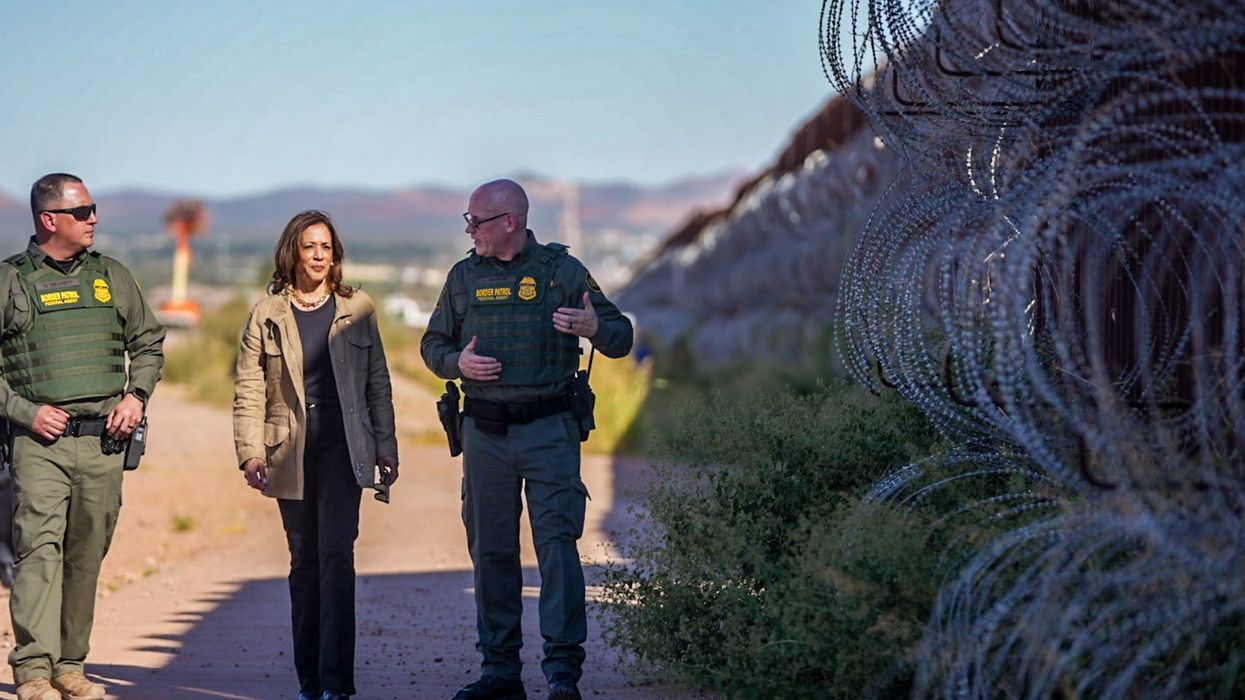
The vice president traveled to Douglas, Arizona on Friday for her first campaign trip to the U.S.-Mexcio border. There, she met with Border Patrol agents—she was photographed walking with them next to a barbed-wire-covered wall—and delivered what The New York Times called "one of her party's toughest speeches on immigration and border policy in a generation."
After Harris' address, the Center for Gender & Refugee Studies (CGRS)
expressed agreement with her that "we need to build a fair, orderly, and humane immigration system," while also warning that her "proposed border policies would do the opposite."
"Banning asylum and punishing people seeking safety only causes more chaos and dysfunction at the border, and more refugee deaths," CGRS said. "We want real solutions to the humanitarian challenges at our border, too. But these policies of cruelty and exclusion fail us, every single time."
CGRS urged Harris to embrace the #WelcomeWithDignity Campaign's policy
solutions: restore access to asylum at the border; support existing systems and launch new ones to receive and integrate people seeking safety; create a more effective and timely immigration system; and strengthen refugee resettlement programs and other pathways to the United States.
During the speech and on social media, Harris emphasized combating drugs. She said: "As attorney general of California, I prosecuted transnational criminal organizations that trafficked guns, drugs, and human beings. I know the importance of safety and security, especially at our border. Today, I visited the U.S.-Mexico border and spoke with Customs and Border Protection officials about our progress to secure our border and disrupt the flow of illegal fentanyl into our nation."
She also took aim at her GOP opponent, former President Donald Trump, for his infamous family separation policy and for killing a bipartisan border bill. While the Republican attacked the legislation so he could campaign on immigration and promise mass deportations, progressives in Congress and rights advocates opposed its "extreme and unworkable enforcement-only policies."
The Democratic nominee also vowed to strengthen asylum restrictions that President Joe Biden imposed in June, which are being challenged in court by critics including the ACLU. The administration's policy change has been followed by a drop in border numbers but also "rampant rights violations," according to migrant rights groups.
Pushing back against Harris' framing that asylum-seekers simply need to go to legal entry points rather than crossing the border unlawfully, Christina Asencio, a research director at Human Rights First, explained on Friday that the border bill would do what the June asylum ban has already done: suspend processing at ports of entry unless people obtain an appointment.
"Human Rights First has documented the life-threatening harm families with children and adults face in Mexico while forced to wait up to nine months for an appointment [through] an app that's only available in three languages," she added. "This is not a solution."
In a social media thread highlighting reports of agents "removing asylum-seekers who explicitly communicated their fear of return in violation of refugee law" since the introduction of Biden's ban, Robyn Barnard, an attorney with the group, said:
Human Rights First and others have interviewed asylum-seekers who expressly requested asylum, relayed their past persecution, explained their asylum claims, showed agents their injuries, had anxiety attacks, sobbed, and begged to be heard, but were ignored.
Other families recounted that not only were they not asked whether they had a fear of return or why they came to the United States, they were not even allowed to speak.
Harris' pledge to toughen the June policy followed Thursday reporting by CBS News that the Biden-Harris administration "is planning to soon issue a regulation to cement the sweeping asylum restrictions it enacted at the southern border" earlier this year.
In response to the reporting, the immigrant youth-led group United We Dream (UWD)
declared, "There's no other way to say this: Turning your backs on people seeking asylum is WRONG and it keeps us stuck in the past with failed policies."
"Communities nationwide agree that our immigration system must be humane, efficient, and fair above all else. Those seeking safety deserve respect and dignity," UWD said. "Our message to the Biden-Harris administration remains clear: We will organize—now and in the future—against any attempts to gut asylum and put our people's lives on the line."
UWD also pointed to a September 4 letter in which it led over 80 groups in warning Biden and Harris that the bipartisan Border Act of 2024 "would cause irreparable harm to our asylum system, our standing on the global stage, and most importantly, it would cause countless deaths at our borders and in other countries."
While many immigrant rights advocates are frustrated with both Biden and Harris, multiple groups continue to support her candidacy—given that the alternative is Trump—and even some critics praised certain parts of her Friday remarks.
"It was good to hear [Harris] recognize the need for more asylum officers and immigration judges, which are a must to tackle asylum backlogs and enable timely asylum decisions," said Eleanor Acer, director of Human Rights First's refugee protection program. "Real solutions like these are needed, NOT bans and bills that cut due process and deny access to asylum."
Immigrant rights advocate Erika Andiola, "who has lived through some of the most traumatic experiences because of our broken immigration system," said that "I was so glad to hear her talk about our undocumented community and a promise to fight for a path to citizenship."
"I'm so glad to see Harris pushing back on Trump's scapegoating of immigrants," she continued. "I wish she would have also talked about his plan for mass deportations and the consequences that could have. Consequences not only for our immigrant community, but also for millions of mixed-status families and our economy overall."
The advocate also expressed sadness over her "promise to criminalize reentries" and urged Harris to "move away from starting the conversation on this issue speaking about drugs and criminal activity at the border," stressing that "yes, those are important issues for voters, but conflating security with human migration just creates more fear in the public about our people."
"We must change the narrative about our immigrant community," she argued. "We must show the humanity, tell the stories, and detangle the problems we as immigrants face from the need of the American people to feel safe. Immigrants, we are part of the fabric of this country. We are your neighbors, classmates, and coworkers. That's where the conversation should start."
"The use of the death penalty in the United States is one of the ugliest stains on our broken criminal justice system," said Congresswoman Barbara Lee.
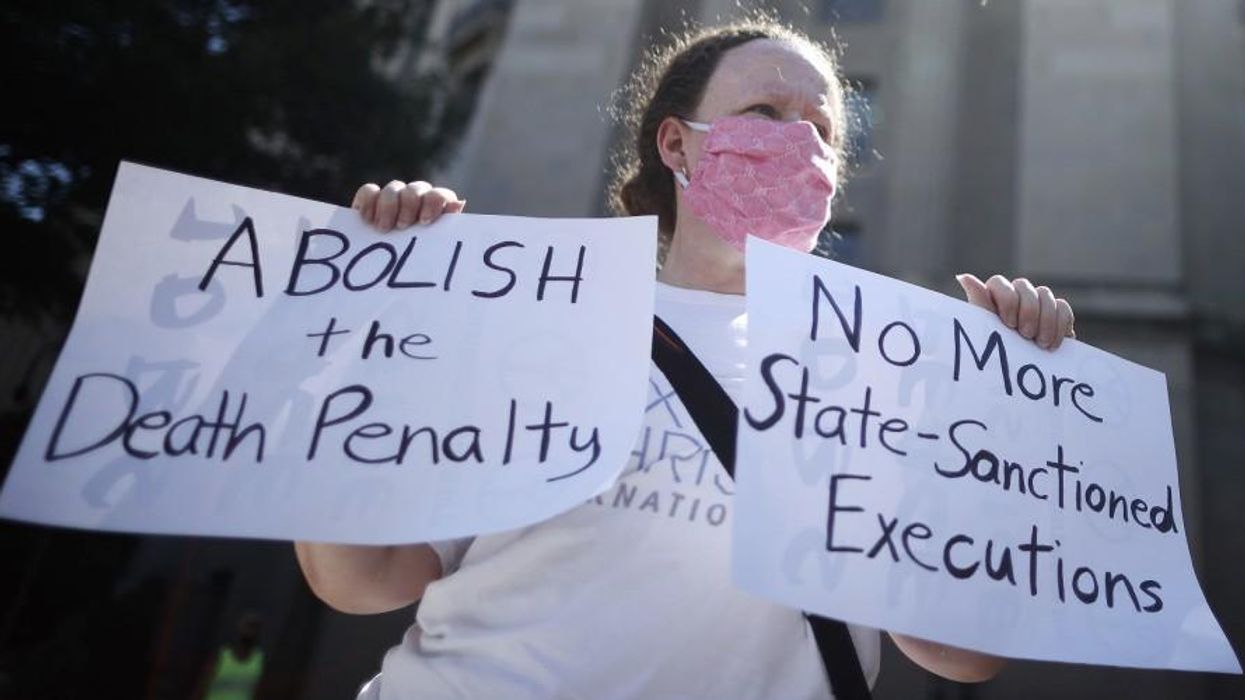
Amid a wave of executions in Republican-led states—including Tuesday's lethal injection of Marcellus Williams in Missouri—progressive U.S. lawmakers and groups renewed calls to "abolish the death penalty."
Congressional Progressive Caucus Chair Pramila Jayapal (D-Wash.) and Congresswomen Alexandria Ocasio-Cortez (D-N.Y.), Rashida Tlaib (D-Mich.), Ilhan Omar (D-Minn.), and Cori Bush (D-Mo.) were among those who took to social media to demand an end to capital punishment following Williams' execution.
"The use of the death penalty in the United States is one of the ugliest stains on our broken criminal justice system," said Rep. Barbara Lee (D-Calif.). "It is disproportionately imposed against poor people and people of color. We must abolish it once and for all."
Williams, 55, was killed by the state of Missouri via lethal injection—a method known for botched executions—despite serious doubts about his guilt. The office that prosecuted him sought to have his murder conviction overturned and members of the victim's family pleaded for clemency.
"Sometimes injustice is so glaring that it leaves us struggling to comprehend how such events could happen in the first place," Bush said in a statement released after Williams' execution.
The congresswoman continued:
The deadly decision to execute Williams came despite urgent pleas from Missourians and people all across the country... who called for clemency. Gov. Mike Parson didn't just ignore these pleas and end Williams' life, he demonstrated how the death penalty is wielded without regard for innocence, compassion, equity, or humanity. He showed us how the standard of "beyond a reasonable doubt" can be applied selectively, depending on who stands accused and who stands in power.
"The state of Missouri and our nation's legal system failed Marcellus Williams, and as long as we uphold the death penalty, we continue to perpetuate this depravity—where an innocent person can be killed in the name of justice," Bush stressed. "We have a moral imperative to abolish this racist and inhumane practice, and to work towards building a just legal system that values humanity and compassion over criminalization and violence."
"Rest in power, Marcellus Williams," she added.
Williams wasn't the only one executed on Tuesday. Travis Mullis—a 38-year-old autistic man who murdered his infant son—was killed by lethal injection in Texas after waiving his right to appeal.
Last week, South Carolina executed Freddie Owens by lethal injection after Republican state Attorney General Alan Wilson brushed off a key prosecution witness' bombshell claim that the convicted man did not commit the murder for which his life was taken.
Although the number of U.S. executions has been steadily decreasing from 85 in 2000 to 24 last year, there is currently a surge in state killings, with five more people set to be put to death in three states by October 17.
On Thursday, Alabama is scheduled to kill Alan Eugene Miller using nitrogen gas, despite the inmate suffering severe mental illness. Miller was meant to be put to death in 2022; however, prison staff could not find a vein in which to inject the lethal cocktail and his execution was postponed.
That same day, Emmanuel Antonio Littlejohn is set to be executed by lethal injection in Oklahoma, even after the state's Pardon and Parole Board voted to recommend clemency.
According to a 2014 study, over 4% of people on U.S. death rows did not commit the crime for which they were condemned. The Death Penalty Information Center found that since 1973, at least 200 people who were wrongly convicted and sentenced to death in the U.S. have been exonerated.
"The only way to eliminate the possibility of executing an innocent person is to do away with the death penalty altogether," the advocacy group Human Rights First said Wednesday.
"The Biden administration and Congress must not erect any more unjust barriers to asylum that will sow further disorder and result in irreparable harm," said one migrant rights advocate.
Immigrant rights advocates on Thursday slammed the Biden administration's proposal to fast-track the rejection of certain migrants seeking asylum in the United States.
On Thursday the U.S. Department of Homeland Security (DHS) proposed a rule that would empower immigration officials to disqualify certain asylum-seekers during their initial eligibility screening—called the credible fear interview (CFI)—using existing national security and terrorism-related criteria, or bars.
DHS said the rule would apply to noncitizens who have "engaged in certain criminal activity, persecuted others, or have been involved in terrorist activities."
"I urge President Biden to embrace our values as a nation of immigrants and use this opportunity to instead provide relief for the long-term immigrants of this nation."
Homeland Security Secretary Alejandro Mayorkas called the proposed rule "yet another step in our ongoing efforts to ensure the safety of the American public by more quickly identifying and removing those individuals who present a security risk and have no legal basis to remain here."
However, Greg Chen, senior director of government relations for the American Immigration Lawyers Association, argued that while "bars are an important feature of our immigration laws to ensure that dangerous individuals are not allowed into the country," they must be "accurately applied where warranted."
"This change could make the process faster by excluding people who would not be entitled to stay," he noted. "However, due process will likely be eroded by accelerating what is a highly complex legal analysis needed for these bars and conducting them at the preliminary CFI screening."
As Chen explained:
At that early stage, few asylum seekers will have the opportunity to seek legal counsel or time to understand the consequences of a bar being applied. Under the current process, they have more time to seek legal advice, to prepare their case, and to appeal it or seek an exemption. Ultimately to establish a fair and orderly process at the border, Congress needs to provide the Department of Homeland Security with the resources to meet its mission and also ensure the truly vulnerable are not summarily denied protection without due process.
Democratic lawmakers—some of whom held a press conference Wednesday on protecting undocumented immigrants in the U.S.—also criticized the proposal.
"As the Biden administration considers executive actions on immigration, we must not return to failed Trump-era policies aimed at banning asylum and moving us backwards," said Sen. Alex Padilla (D-Calif.), referring to former Republican President Donald Trump, the presumptive 2024 GOP nominee to face President Joe Biden in November.
"I urge President Biden to embrace our values as a nation of immigrants and use this opportunity to instead provide relief for the long-term immigrants of this nation," he added.
One year ago, critics accused Biden of "finishing Trump's job" by implementing a crackdown on asylum-seekers upon the expiration of Title 42—a provision first invoked during Trump administration at the onset of the Covid-19 pandemic and continued by Biden to expel more than 1 million migrants under the pretext of public safety.
Earlier this week, the advocacy group Human Rights First released a report detailing the harms of the policy on its anniversary. The group held a press conference to unveil the report and warn of the dangers of further anti-migrant policies.
"The interviews with hundreds of asylum-seekers make clear that the asylum ban and related restrictions strands in danger children and adults seeking asylum, punishes people for seeking protection, leads to the return of refugees to persecution, spurs irregular crossings, and denies equal access to asylum to people facing the most dire risks," Human Rights First director of research and analysis of refugee protection Christina Asencio said during the press conference.
"The Biden administration and Congress must not erect any more unjust barriers to asylum that will sow further disorder and result in irreparable harm," Asencio added.
On Wednesday, three advocacy groups—Al Otro Lado, the Civil Rights Education and Enforcement Center, and the Texas Civil Rights Project—sued the federal government on behalf of noncitizens with disabilities seeking more information regarding CBP One, the problem-plagued Customs and Border Protection app migrants must use to schedule asylum interviews at U.S. ports of entry.
"We have and continue to see migrants with disabilities facing unlawful discrimination and unequal access to the asylum process due to the inaccessibility of the app," said Laura Murchie, an attorney with the Civil Rights and Education Enforcement Center involved in the case.
"CBP needs to release these documents so we can advocate for and ensure compliance with the law so asylum-seekers with disabilities do not continue to be harmed by CBP's disregard for rights that are guaranteed by federal disability law," she added.
"The idea that 5,000 or even 10,000 people might overwhelm us trivializes both what our government is capable of and our nation's capacity to welcome. Those of us living at the border know this," said one El Paso-based advocate.
Progressives on Saturday urged U.S. President Joe Biden to halt his immigration-related appeals to "a voter who doesn't exist" as he promised voters at a campaign event in South Carolina that he would immediately "shut down the border" between the U.S. and Mexico if Congress passes a bipartisan immigration bill.
Senators are expected to release the legislative text of the bill this week, but Capitol Hill sources have said the bipartisan deal—negotiated chiefly by Sens. Chris Murphy (D-Conn.), Kyrsten Sinema (I-Ariz.), and James Lankford (R-Okla.)—would include a new executive authority to halt asylum screenings on days when border crossings by undocumented immigrants reaches 5,000 over the five-day average.
Under the provision, migrants would be expelled indefinitely until crossings decreased to 3,750 per day. A set amount of asylum claims would be granted at official ports of entry, but the standard for migrants making an asylum claim would be raised, making it harder for people—many of whom have been arriving at the border after fleeing violence and poverty—to get approval to stay in the United States.
"A bipartisan bill would be good for America and help fix our broken immigration system and allow speedy access for those who deserve to be here, and Congress needs to get it done," Biden said in South Carolina, a day after the White House released a written statement on the legislation. "It'll also give me as president the emergency authority to shut down the border until it could get back under control. If that bill were the law today, I'd shut down the border right now and fix it quickly."
Immigrant rights advocates were quick to denounce Biden's promise to eliminate asylum protections for thousands of people, while U.S. House Speaker Mike Johnson (R-La.) said the bill would be "dead on arrival" if it arrives on the House floor and demanded that Biden close the border immediately with his executive authority—something Biden cannot do under federal and international law, said American Immigration Council (AIC) policy director Aaron Reichlin-Melnick.
Although Republicans have insisted on border restrictions in exchange for more military aid for Ukraine and Israel, Oklahoma Republicans passed a resolution condemning Lankford for working with Democrats on the deal.
Johnson complained that the deal would allow "as many as 150,000 illegal crossings each month (1.8 million per year) before any new 'shutdown' authority could be used. At that point, America will have already been surrendered."
"How weak do you have to think the USA is if you're claiming that adding 1.8 million undocumented immigrants a year would "surrender" the nation?" asked Reichlin-Melnick.
Meanwhile, Eleanor Acer, refugee protection director for Human Rights First, warned that former Republican President Donald Trump's anti-migration Title 42 policy already proved to "be a human rights and migration management fiasco."
The U.S. turned away migrants under Title 42 more than 2.8 million times between March 2020—when it was imposed as the coronavirus pandemic began, ostensibly to protect public health—and May 2023. Human Rights First tracked more than 10,000 cases of migrants being kidnapped or physically or sexually assaulted after being expelled under Biden's continuation of Title 42 after he took office. The Kaiser Family Foundation also reported that the policy contributed to the separation of families.
"There are real challenges at the border, and now is the moment that we need our leaders to move forward effective policy solutions that will improve port processing, support communities receiving migrants, and create lawful pathways to citizenship for Dreamers and others," said Deirdre Schifeling, chief political and advocacy officer at the ACLU, on Saturday. "But let's be clear: Cruelty is not a policy solution—and barring people from seeking protection is both callous and unworkable."
"We've already had an expulsion authority before—Title 42—and we know that it did not stop people from coming to the U.S.," added Schifeling. "Instead, we saw record numbers of families and individuals arriving at our border seeking protection, and Title 42 caused tremendous harm to people fleeing danger."
Marisa Limón Garza, executive director of Las Americas Immigrant Advocacy Center in El Paso, Texas, accused Biden of playing "political games" and demanded that he keep his campaign promises to "restore a humane and orderly asylum and immigration system."
"The idea that 5,000 or even 10,000 people might overwhelm us trivializes both what our government is capable of and our nation's capacity to welcome. Those of us living at the border know this," said Limón Garza. "One's commitment to their children is a powerful force that drives parents and children to seek a better life in the U.S... Here in the Borderland we believe in supporting families and keeping them together, not turning our backs on them or tearing them apart.
“We call on Congress and the Biden administration to reverse course and turn away from the political games that drive us toward these reckless immigration proposals," she added.
Author and historian Dan Berger compared Biden's push for new anti-immigration authority to his enthusiasm for a "tough on crime" approach by the Democratic Party three decades ago.
Biden has "won no one over" with his statements on immigration since Friday, said author and podcaster Kate Willett. "It's cruelty for recreation."
"The Biden administration should focus on measures like increasing refugee resettlement and regular pathways and abandon its plan to impose an asylum ban that would be a legal, moral, and political mistake," said one advocate.
While welcoming parts of the Biden administration's newly announced plans to expand refugee resettlement and family reunification parole in the Americas, migrant rights advocates on Thursday warned that provisions restricting the rights of asylum-seekers undermined the policy.
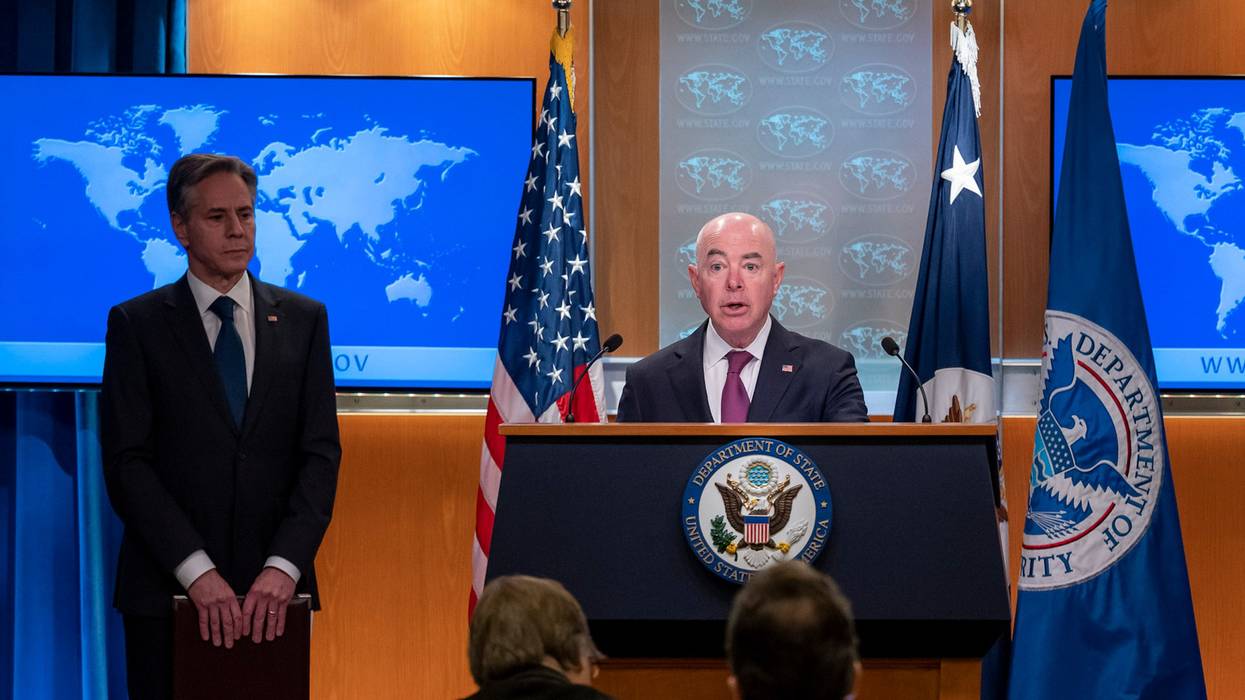
U.S. Homeland Security Secretary Alejandro Mayorkas and Secretary of State Antony Blinken on Thursday unveiled sweeping measures to address migration from Latin American and Caribbean nations to the United States ahead of next month's termination of Title 42, a public health order invoked by the Trump and Biden administrations to deport more than 2.7 million asylum-seekers under pretext of the Covid-19 pandemic.
Title 42 is set to expire on May 11 with the end of the Covid-19 national public health emergency. Experts say as many as 10,000-13,000 migrants could arrive at the southern border each day after Title 42 ends.
The administration will open immigration processing centers throughout Latin America, while expanding access to CBP One, a U.S. Customs and Border Protection mobile app through which asylum-seekers can schedule an appointment to present themselves at a port of entry.
U.S. partners, including the United Nations High Commissioner for Refugees and the U.N.'s International Organization for Migration, will screen migrants at the processing centers to determine if they are eligible to enter the United States before they travel to the southern border.
Additionally, the Department of Homeland Security is creating a new family reunification parole process for El Salvador, Guatemala, Honduras, and Colombia.
The U.S. is also doubling the number of refugees from Western Hemisphere nations while continuing to accept up to 30,000 individuals per month from Venezuela, Nicaragua, Cuba, and Haiti as part of an expanded parole process announced earlier this year.
However, the new policy will prohibit asylum-seekers who crossed through a third country on their way to the U.S.-Mexico border, unless they had previously applied for and been denied asylum elsewhere or used CBP One to obtain an appointment at a U.S. point of entry.
"The Biden administration is rightly expanding refugee resettlement from the Americas, an overdue step towards addressing a longstanding gap for people in need of international protection," said Eleanor Acer, senior director of refugee protection at Human Rights First.
"This initiative should swiftly bring refugees to safety and not be used to reduce the resettlement of refugees from other regions," Acer added. "The Biden administration should focus on measures like increasing refugee resettlement and regular pathways and abandon its plan to impose an asylum ban that would be a legal, moral, and political mistake."
The International Refugee Assistance Project (IRAP), a New York-based legal aid organization, summed up the sentiment of numerous advocacy groups, writing that while it "welcomes the expansion of family reunification parole programs and refugee processing in the Americas," it "strongly opposes doing so as a trade-off for limiting the legal rights of people seeking asylum in the United States."
"While today’s announcement recognizes the protection needs of people seeking asylum at the border, the administration's simultaneous pursuit of an asylum ban and other immigration restrictions runs counter to the aim of expanding humanitarian protections," the group added.
IRAP policy director Sunil Varghese said in a statement that "expanding family reunification parole pathways and refugee processing for displaced people in the Americas is long overdue, but we cannot ignore that the Biden administration is proposing a Faustian bargain by simultaneously seeking to implement a Trump-era asylum ban at the U.S-Mexico border, effectively slamming the door shut on countless others in need."
"Framing USRAP as a border management tool risks further politicizing a program already at a crossroads, and should not come at the expense of asylum protections," Varghese added. "There should be more pathways to safety for people in the Americas, not fewer."
IRAP recommends the Biden administration expand its capacity to adjudicate asylum applications, improve the efficiency of the interview and vetting process—including by incorporating video technology—and ensure due process and transparency in refugee processing.
Katharina Obser, director of the Migrant Rights and Justice program at the Women's Refugee Commission, an international advocacy group, said in a statement that WRC "welcomes the administration's recognition of the need for more pathways to protection for people displaced in Latin America and the Caribbean."
"However, WRC remains deeply concerned that these measures come at the expense of the ability to seek asylum at the U.S.-Mexico border," she continued. "Although today's announcement suggests more appointments will become available for people seeking asylum using the CBP One application—and WRC supports increasing capacity for asylum processing at ports of entry—the administration should also maintain the right to seek asylum without an appointment for those who cannot wait or cannot use the application."
"Ultimately, the expansion of access to one set of protections—such as resettlement, parole, and family reunification—should not come at the expense of others, such as access to asylum at the border," Obser added. "We had hoped to be able to express more support and optimism about the administration's proposed plans as Title 42 finally comes to a long overdue end. Ultimately, while we welcome additional migration pathways and regional processes, we call on the administration to again reconsider its approach to asylum at the U.S. border."
Since 2009, U.S. drone strikes have killed between 64 and 116 civilians in areas outside of active hostilities, the Obama administration claimed in a report released on Friday afternoon, just hours before the start of the Fourth of July holiday weekend.
That number of civilian casualties is much lower than the assessments of independent groups, including the Bureau of Investigative Journalism, which puts the number at between 380 and 801.
Indeed, said Jennifer Gibson of the international human rights group Reprieve: "The only thing those numbers tell us is that this Administration simply doesn't know who it has killed."
The report (pdf) was the subject of advance criticism. Human rights advocates doubted that the government would offer accurate accounting or, as the ACLU's Jameel Jaffer wrote this week, "provide the kind of specificity that would actually be useful to journalists, human rights researchers, and the general public. "
Such predictions appear to have been prescient, as the New York Times reported:
The report named Afghanistan, Iraq and Syria as "areas of active hostilities" excluded from the policy. A senior administration official said tribal Pakistan -- which the government treats as an extension of the Afghan battlefield in certain contexts -- is not such an area; so casualties there are part of the official civilian death numbers.
It is an open secret that the majority of America's drone strikes have taken place in tribal Pakistan as Central Intelligence Agency covert operations, which has meant that the administration's periodic pledges to be more transparent about targeted killings have not been completely fulfilled.
[...] The administration also declined to break down its retroactive estimate of civilian death by year, a decision that permits it to avoid fights about how it addressed several well-known American airstrikes that generated accusations of dozens of civilian deaths -- including one in Yemen in December 2009 and another in Pakistan in March 2011 that together would seem to surpass the low end of its range.
The names and stories of drone victims are also omitted from the report.
Bottom line, said Hina Shamsi, director of the ACLU's National Security Project in a press statement, "The American public can't be confident that the government is using lethal force legally and wisely with a disclosure that's so limited as to be virtually meaningless."
President Barack Obama also on Friday signed an executive order requiring the annual release of civilian casualties caused by drone strikes--described by the Guardian's Spencer Ackerman as Obama's "favored tactic of war"--by future presidents.
Responding on social media, drone experts cataloged how the report fell short.
"Today's casualty data release and issuance of the executive order is a concrete step in the right direction, but more information is still needed for the public to meaningfully evaluate the lawfulness and effectiveness of the targeted killing program," said Human Rights First's Rita Siemion.
"For data on the number of non-combatant deaths to be meaningful, the administration should clarify how it classifies individuals as combatants, name the armed groups those classified as combatants are alleged to be members of, specify the legal basis for using lethal force, and provide strike locations and dates," she added.
And while Friday's revelations may mark Obama "starting to dismantle his own dangerous legacy," as Amnesty International's Naureen Shah put it in an op-ed at the Guardian, "the drone data could be completely misleading--and provide a veneer of legitimacy to unlawful killings."
She wrote:
The drone numbers could also wrongly obscure how entrenched and systematic impunity has become. The CIA, an agency with an extremely poor record of accountability to the public, is still conducting strikes. Indeed, it is remarkable that on the heels of its abusive program of torture and secret detention under former president Bush, the CIA was entrusted with the authority to conduct hundreds of drone strikes, killing thousands of people. Its continued role is likely one reason we aren't getting fuller answers to our questions about drones.
Today's disclosures aren't enough to guard against future abuse by the CIA or other government agencies. Congress, while welcoming the transparency, should scrutinize the drone casualty numbers. And the drone data should not be the government's last word on the impact of drone strikes: it should acknowledge, apologize and compensate civilian victims.
The Obama administration's assessment comes just one day after Reprieve released a report exposing the U.S. government's pattern of lying about the human toll of its aerial bombing campaign.
Meanwhile, a former U.S. drone technician, who spoke out Thursday in Europe about the targeted killing program, described the report on Twitter as "complete & utter horse shit, as expected."