SUBSCRIBE TO OUR FREE NEWSLETTER
Daily news & progressive opinion—funded by the people, not the corporations—delivered straight to your inbox.
5
#000000
#FFFFFF
To donate by check, phone, or other method, see our More Ways to Give page.
Daily news & progressive opinion—funded by the people, not the corporations—delivered straight to your inbox.
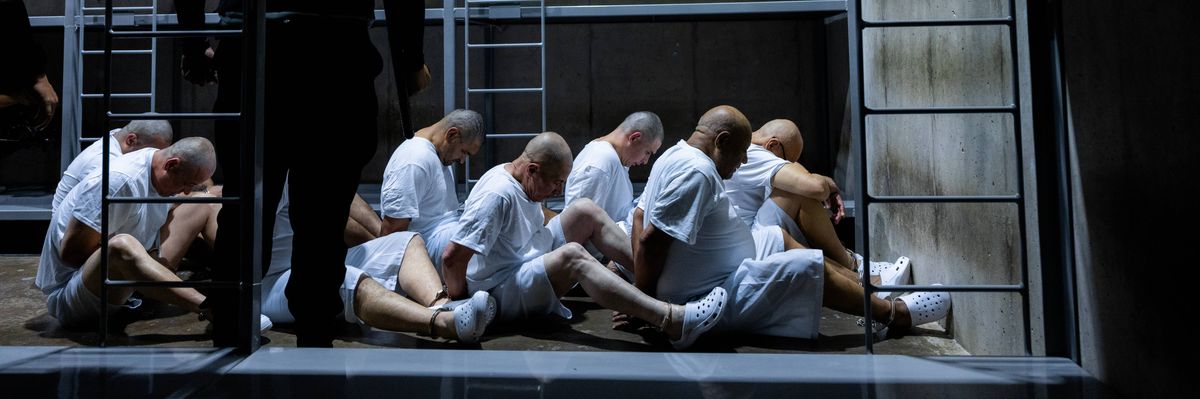
Seventeen Venezuelan nationals who were deported by the US are seen in San Salvador, El Salvador, on March 31, 2025.
"This ruling makes clear the government can't just send people off to a brutal foreign prison with zero due process and simply walk away," said an ACLU lawyer representing the men.
A federal judge has ruled that the Trump administration acted illegally when it deported over 200 Venezuelan nationals to a notorious prison in El Salvador without due process earlier this year.
On Monday, Judge James Boasberg of the US District Court for the District of Columbia ordered the Trump administration to submit plans by January 5 for 137 men to contest their designation under the Alien Enemies Act of 1798, which allows foreign nationals from "hostile" nations to be removed without hearings.
In March, Trump invoked the Alien Enemies Act to deport two planeloads of Venezuelan nationals to El Salvador without any explanation or court hearing. They were sent to a mega-prison known as the Terrorism Confinement Center, or CECOT, which is known to subject inmates to torture and severe deprivation, with zero contact with the outside world.
The administration claimed the men were members of the Venezuelan gang Tren de Aragua, which the administration referred to as a "hybrid criminal state" invading the United States. In reality, only a few dozen of the 238 men sent to CECOT had any criminal charges against them. As part of the US Immigration and Customs Enforcement's (ICE) efforts to fast-track their deportations, many were rounded up based solely on the fact that they had tattoos.
“Plaintiffs should not have been removed in the manner that they were, with virtually no notice and no opportunity to contest the bases of their removal, in clear contravention of their due-process rights,” Boasberg wrote.
Boasberg is the same judge who launched criminal contempt proceedings against the Trump administration in April for "willful disregard" of his order to stop the flights to El Salvador. A pair of Trump-appointed judges later halted those proceedings.
In a "60 Minutes" special that was recently spiked by CBS News' Trump-friendly editor-in-chief, Bari Weiss, several inmates testified to the conditions they were subject to inside CECOT.
"The first thing they told us was that we would never see the light of day or night again," said college student Luis Muñoz Pinto, who came to the US from Venezuela in 2024 through the legal asylum process. He said the CECOT director told prisoners, "Welcome to hell. I'll make sure you never leave."
According to a report published by Human Rights Watch in November, inmates were beaten daily, subject to sexual violence by guards, deprived of basic food, medical treatment, and hygiene, and forced to participate in degrading torture rituals.
Pinto, who now lives in Colombia, has no criminal record. "I never even got a traffic ticket," he said.
While the Trump administration claimed it no longer had jurisdiction over the prisoners once they were in El Salvador, and therefore could not follow court orders to bring them back to the US, this was belied by filings from the government of the far-right Salvadoran President Nayib Bukele at the United Nations, which stated that "the jurisdiction and legal responsibility for these persons lie exclusively" with the US.
The men detained at CECOT were then transferred, mainly to Venezuela, in July as part of a prisoner exchange for 10 US nationals.
Boasberg says the US government "maintained constructive custody" of the men while they were interned in CECOT and that it violated their rights to due process by not allowing them to contest the accusations that they were gang members.
He said the Trump administration must give them a "meaningful opportunity to contest their designation," by allowing them to return to the US for a court hearing. He said the government "could also theoretically offer plaintiffs a hearing without returning them to the United States so long as such a hearing satisfied the requirements of due process."
"This ruling makes clear the government can't just send people off to a brutal foreign prison with zero due process and simply walk away," said Lee Gelernt, an attorney for the ACLU, who served as lead counsel for the plaintiffs.
The Trump administration will almost certainly appeal the ruling. And while many of the former CECOT inmates may seek to return for their day in court, some say the experience has left them traumatized and fearful of returning to the United States.
Jerce Reyes Barrios, a professional soccer player and youth coach, returned to Venezuela after being released in July. According to his attorney, he was falsely accused due to a tattoo that the government claimed was a gang symbol, but was actually based on the Real Madrid soccer logo.
"I've focused my time on taking care of my daughters, coaching young kids, all to avoid those thoughts. At night, I sometimes have nightmares, and I feel like I'm still in CECOT," Reyes Barrios told ABC News. "At this moment, I'm not ready to decide if I want to fight this case."
Dear Common Dreams reader, It’s been nearly 30 years since I co-founded Common Dreams with my late wife, Lina Newhouser. We had the radical notion that journalism should serve the public good, not corporate profits. It was clear to us from the outset what it would take to build such a project. No paid advertisements. No corporate sponsors. No millionaire publisher telling us what to think or do. Many people said we wouldn't last a year, but we proved those doubters wrong. Together with a tremendous team of journalists and dedicated staff, we built an independent media outlet free from the constraints of profits and corporate control. Our mission has always been simple: To inform. To inspire. To ignite change for the common good. Building Common Dreams was not easy. Our survival was never guaranteed. When you take on the most powerful forces—Wall Street greed, fossil fuel industry destruction, Big Tech lobbyists, and uber-rich oligarchs who have spent billions upon billions rigging the economy and democracy in their favor—the only bulwark you have is supporters who believe in your work. But here’s the urgent message from me today. It's never been this bad out there. And it's never been this hard to keep us going. At the very moment Common Dreams is most needed, the threats we face are intensifying. We need your support now more than ever. We don't accept corporate advertising and never will. We don't have a paywall because we don't think people should be blocked from critical news based on their ability to pay. Everything we do is funded by the donations of readers like you. When everyone does the little they can afford, we are strong. But if that support retreats or dries up, so do we. Will you donate now to make sure Common Dreams not only survives but thrives? —Craig Brown, Co-founder |
A federal judge has ruled that the Trump administration acted illegally when it deported over 200 Venezuelan nationals to a notorious prison in El Salvador without due process earlier this year.
On Monday, Judge James Boasberg of the US District Court for the District of Columbia ordered the Trump administration to submit plans by January 5 for 137 men to contest their designation under the Alien Enemies Act of 1798, which allows foreign nationals from "hostile" nations to be removed without hearings.
In March, Trump invoked the Alien Enemies Act to deport two planeloads of Venezuelan nationals to El Salvador without any explanation or court hearing. They were sent to a mega-prison known as the Terrorism Confinement Center, or CECOT, which is known to subject inmates to torture and severe deprivation, with zero contact with the outside world.
The administration claimed the men were members of the Venezuelan gang Tren de Aragua, which the administration referred to as a "hybrid criminal state" invading the United States. In reality, only a few dozen of the 238 men sent to CECOT had any criminal charges against them. As part of the US Immigration and Customs Enforcement's (ICE) efforts to fast-track their deportations, many were rounded up based solely on the fact that they had tattoos.
“Plaintiffs should not have been removed in the manner that they were, with virtually no notice and no opportunity to contest the bases of their removal, in clear contravention of their due-process rights,” Boasberg wrote.
Boasberg is the same judge who launched criminal contempt proceedings against the Trump administration in April for "willful disregard" of his order to stop the flights to El Salvador. A pair of Trump-appointed judges later halted those proceedings.
In a "60 Minutes" special that was recently spiked by CBS News' Trump-friendly editor-in-chief, Bari Weiss, several inmates testified to the conditions they were subject to inside CECOT.
"The first thing they told us was that we would never see the light of day or night again," said college student Luis Muñoz Pinto, who came to the US from Venezuela in 2024 through the legal asylum process. He said the CECOT director told prisoners, "Welcome to hell. I'll make sure you never leave."
According to a report published by Human Rights Watch in November, inmates were beaten daily, subject to sexual violence by guards, deprived of basic food, medical treatment, and hygiene, and forced to participate in degrading torture rituals.
Pinto, who now lives in Colombia, has no criminal record. "I never even got a traffic ticket," he said.
While the Trump administration claimed it no longer had jurisdiction over the prisoners once they were in El Salvador, and therefore could not follow court orders to bring them back to the US, this was belied by filings from the government of the far-right Salvadoran President Nayib Bukele at the United Nations, which stated that "the jurisdiction and legal responsibility for these persons lie exclusively" with the US.
The men detained at CECOT were then transferred, mainly to Venezuela, in July as part of a prisoner exchange for 10 US nationals.
Boasberg says the US government "maintained constructive custody" of the men while they were interned in CECOT and that it violated their rights to due process by not allowing them to contest the accusations that they were gang members.
He said the Trump administration must give them a "meaningful opportunity to contest their designation," by allowing them to return to the US for a court hearing. He said the government "could also theoretically offer plaintiffs a hearing without returning them to the United States so long as such a hearing satisfied the requirements of due process."
"This ruling makes clear the government can't just send people off to a brutal foreign prison with zero due process and simply walk away," said Lee Gelernt, an attorney for the ACLU, who served as lead counsel for the plaintiffs.
The Trump administration will almost certainly appeal the ruling. And while many of the former CECOT inmates may seek to return for their day in court, some say the experience has left them traumatized and fearful of returning to the United States.
Jerce Reyes Barrios, a professional soccer player and youth coach, returned to Venezuela after being released in July. According to his attorney, he was falsely accused due to a tattoo that the government claimed was a gang symbol, but was actually based on the Real Madrid soccer logo.
"I've focused my time on taking care of my daughters, coaching young kids, all to avoid those thoughts. At night, I sometimes have nightmares, and I feel like I'm still in CECOT," Reyes Barrios told ABC News. "At this moment, I'm not ready to decide if I want to fight this case."
A federal judge has ruled that the Trump administration acted illegally when it deported over 200 Venezuelan nationals to a notorious prison in El Salvador without due process earlier this year.
On Monday, Judge James Boasberg of the US District Court for the District of Columbia ordered the Trump administration to submit plans by January 5 for 137 men to contest their designation under the Alien Enemies Act of 1798, which allows foreign nationals from "hostile" nations to be removed without hearings.
In March, Trump invoked the Alien Enemies Act to deport two planeloads of Venezuelan nationals to El Salvador without any explanation or court hearing. They were sent to a mega-prison known as the Terrorism Confinement Center, or CECOT, which is known to subject inmates to torture and severe deprivation, with zero contact with the outside world.
The administration claimed the men were members of the Venezuelan gang Tren de Aragua, which the administration referred to as a "hybrid criminal state" invading the United States. In reality, only a few dozen of the 238 men sent to CECOT had any criminal charges against them. As part of the US Immigration and Customs Enforcement's (ICE) efforts to fast-track their deportations, many were rounded up based solely on the fact that they had tattoos.
“Plaintiffs should not have been removed in the manner that they were, with virtually no notice and no opportunity to contest the bases of their removal, in clear contravention of their due-process rights,” Boasberg wrote.
Boasberg is the same judge who launched criminal contempt proceedings against the Trump administration in April for "willful disregard" of his order to stop the flights to El Salvador. A pair of Trump-appointed judges later halted those proceedings.
In a "60 Minutes" special that was recently spiked by CBS News' Trump-friendly editor-in-chief, Bari Weiss, several inmates testified to the conditions they were subject to inside CECOT.
"The first thing they told us was that we would never see the light of day or night again," said college student Luis Muñoz Pinto, who came to the US from Venezuela in 2024 through the legal asylum process. He said the CECOT director told prisoners, "Welcome to hell. I'll make sure you never leave."
According to a report published by Human Rights Watch in November, inmates were beaten daily, subject to sexual violence by guards, deprived of basic food, medical treatment, and hygiene, and forced to participate in degrading torture rituals.
Pinto, who now lives in Colombia, has no criminal record. "I never even got a traffic ticket," he said.
While the Trump administration claimed it no longer had jurisdiction over the prisoners once they were in El Salvador, and therefore could not follow court orders to bring them back to the US, this was belied by filings from the government of the far-right Salvadoran President Nayib Bukele at the United Nations, which stated that "the jurisdiction and legal responsibility for these persons lie exclusively" with the US.
The men detained at CECOT were then transferred, mainly to Venezuela, in July as part of a prisoner exchange for 10 US nationals.
Boasberg says the US government "maintained constructive custody" of the men while they were interned in CECOT and that it violated their rights to due process by not allowing them to contest the accusations that they were gang members.
He said the Trump administration must give them a "meaningful opportunity to contest their designation," by allowing them to return to the US for a court hearing. He said the government "could also theoretically offer plaintiffs a hearing without returning them to the United States so long as such a hearing satisfied the requirements of due process."
"This ruling makes clear the government can't just send people off to a brutal foreign prison with zero due process and simply walk away," said Lee Gelernt, an attorney for the ACLU, who served as lead counsel for the plaintiffs.
The Trump administration will almost certainly appeal the ruling. And while many of the former CECOT inmates may seek to return for their day in court, some say the experience has left them traumatized and fearful of returning to the United States.
Jerce Reyes Barrios, a professional soccer player and youth coach, returned to Venezuela after being released in July. According to his attorney, he was falsely accused due to a tattoo that the government claimed was a gang symbol, but was actually based on the Real Madrid soccer logo.
"I've focused my time on taking care of my daughters, coaching young kids, all to avoid those thoughts. At night, I sometimes have nightmares, and I feel like I'm still in CECOT," Reyes Barrios told ABC News. "At this moment, I'm not ready to decide if I want to fight this case."