

SUBSCRIBE TO OUR FREE NEWSLETTER
Daily news & progressive opinion—funded by the people, not the corporations—delivered straight to your inbox.
5
#000000
#FFFFFF
To donate by check, phone, or other method, see our More Ways to Give page.
Daily news & progressive opinion—funded by the people, not the corporations—delivered straight to your inbox.
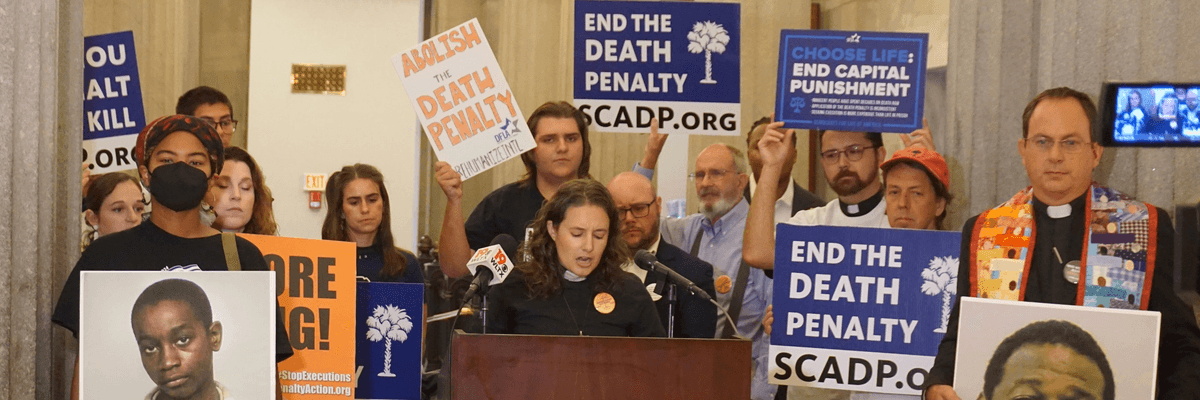
People opposed to capital punishment and the impending execution of Freddie Owens rally outside the office of Republican South Carolina Gov. Henry McMaster in Columbia on September 12, 2024.
The witness—who claims he falsely identified Owens as the killer because he feared for his life—said that barring a stay, the condemned man "will die for a crime that he did not commit."
Barring an unlikely 11th-hour reprieve from South Carolina's governor or U.S. Supreme Court, correctional officials are set to carry out the state's first execution in 13 years after its attorney general brushed off a key prosecution witness' bombshell claim that the convicted man did not commit the murder for which he is condemned to die.
Freddie Owens—who legally changed his name to Khalil Divine Black Sun Allah while imprisoned—was convicted and sentenced to die by lethal injection for the shooting death of convenience store cashier Irene Graves, a 41-year-old mother of three, during a 1997 robbery.
Although there was no forensic evidence linking the then-19-year-old man to the murder, state prosecutors relied upon the testimony of co-defendant Steven Golden, who pleaded guilty and agreed to testify against Owens as part of a plea deal to spare his own life.
On Wednesday Golden filed an affidavit in the South Carolina Supreme Court in which he declared that he lied about the identity of Graves' killer.
"If this court does not grant a stay, Freddie will die for a crime he did not commit," he wrote.
However, on Thursday the state's highest court rejected Owens' bid.
"Freddie Owens is not the person who shot Irene Graves at the Speedway on November 1, 1997," Golden's filing stated. "Freddie was not present when I robbed the Speedway that day."
"The detectives told me they knew Freddie was with me when I robbed the Speedway," wrote Golden, who was 18 years old at the time of the crime. "They told me I might as well make a statement against Freddie because he already told his side to everyone and they were just trying to get my side of the story."
"I was scared that I would get the death penalty if I didn't make a statement," he continued. "I signed a waiver of rights form and then signed a statement on November 11, 1997."
"In that statement, I substituted Freddie for the person who was really with me in the Speedway that night," Golden claimed. "I did that because I knew that's what the police wanted me to say, and also because I thought the real shooter or his associates might kill me if I named him to the police. I am still afraid of that. But Freddie was actually not there."
Golden—who said he did not name the person who he says killed Graves for fear of his life—added: "I'm coming forward now because I know Freddie's execution date is September 20 and I don't want Freddie to be executed for something he didn't do. This has weighed heavily on my mind and I want to have a clear conscience."
The office of Republican South Carolina Attorney General Alan Wilson responded to Golden's affidavit on Thursday, calling his claim "inherently suspect" and stating that he "has now made a sworn statement that is contrary to his multiple other sworn statements over 20 years."
The attorney general's statement came after a federal judge on Wednesday declined to halt Owens' execution over his legal team's concerns about the provenance of South Carolina's supply of pentobarbital, which is used in lethal injections.
South Carolina unofficially paused executions in 2011 as lethal injection drugs became increasingly difficult to obtain because pharmaceutical companies enacted bans on their use for capital punishment. The state subsequently passed a law protecting the identity of drug suppliers, resulting in renewed stocks.
Additionally, the state Supreme Court ruled in July that executions by firing squad and electrocution do not violate the U.S. Constitution's ban on cruel and unusual punishment, validating a law signed in 2021 by Republican Gov. Henry McMaster that forces condemned inmates to choose between the two methods of execution at a time when lethal injection drugs were still scarce.
Anti-death penalty campaigners on Wednesday submitted a petition with more than 10,000 signatures asking McMaster to grant Owen clemency.
Although the number of U.S. executions has been steadily decreasing from 85 in 2000 to 24 last year, a flurry of impending state killings has raised alarm among human rights activists. Amnesty International says that in addition to Owens, seven men are scheduled to be put to death in the coming month.
"No government should give itself the power to execute people," Amnesty said Thursday on social media. "It is past time for the U.S. to align with other countries that no longer carry out this cruel and inhuman punishment."
A 2014 study determined that at least 4% of people on U.S. death rows were likely innocent.
Dear Common Dreams reader, It’s been nearly 30 years since I co-founded Common Dreams with my late wife, Lina Newhouser. We had the radical notion that journalism should serve the public good, not corporate profits. It was clear to us from the outset what it would take to build such a project. No paid advertisements. No corporate sponsors. No millionaire publisher telling us what to think or do. Many people said we wouldn't last a year, but we proved those doubters wrong. Together with a tremendous team of journalists and dedicated staff, we built an independent media outlet free from the constraints of profits and corporate control. Our mission has always been simple: To inform. To inspire. To ignite change for the common good. Building Common Dreams was not easy. Our survival was never guaranteed. When you take on the most powerful forces—Wall Street greed, fossil fuel industry destruction, Big Tech lobbyists, and uber-rich oligarchs who have spent billions upon billions rigging the economy and democracy in their favor—the only bulwark you have is supporters who believe in your work. But here’s the urgent message from me today. It's never been this bad out there. And it's never been this hard to keep us going. At the very moment Common Dreams is most needed, the threats we face are intensifying. We need your support now more than ever. We don't accept corporate advertising and never will. We don't have a paywall because we don't think people should be blocked from critical news based on their ability to pay. Everything we do is funded by the donations of readers like you. When everyone does the little they can afford, we are strong. But if that support retreats or dries up, so do we. Will you donate now to make sure Common Dreams not only survives but thrives? —Craig Brown, Co-founder |
Barring an unlikely 11th-hour reprieve from South Carolina's governor or U.S. Supreme Court, correctional officials are set to carry out the state's first execution in 13 years after its attorney general brushed off a key prosecution witness' bombshell claim that the convicted man did not commit the murder for which he is condemned to die.
Freddie Owens—who legally changed his name to Khalil Divine Black Sun Allah while imprisoned—was convicted and sentenced to die by lethal injection for the shooting death of convenience store cashier Irene Graves, a 41-year-old mother of three, during a 1997 robbery.
Although there was no forensic evidence linking the then-19-year-old man to the murder, state prosecutors relied upon the testimony of co-defendant Steven Golden, who pleaded guilty and agreed to testify against Owens as part of a plea deal to spare his own life.
On Wednesday Golden filed an affidavit in the South Carolina Supreme Court in which he declared that he lied about the identity of Graves' killer.
"If this court does not grant a stay, Freddie will die for a crime he did not commit," he wrote.
However, on Thursday the state's highest court rejected Owens' bid.
"Freddie Owens is not the person who shot Irene Graves at the Speedway on November 1, 1997," Golden's filing stated. "Freddie was not present when I robbed the Speedway that day."
"The detectives told me they knew Freddie was with me when I robbed the Speedway," wrote Golden, who was 18 years old at the time of the crime. "They told me I might as well make a statement against Freddie because he already told his side to everyone and they were just trying to get my side of the story."
"I was scared that I would get the death penalty if I didn't make a statement," he continued. "I signed a waiver of rights form and then signed a statement on November 11, 1997."
"In that statement, I substituted Freddie for the person who was really with me in the Speedway that night," Golden claimed. "I did that because I knew that's what the police wanted me to say, and also because I thought the real shooter or his associates might kill me if I named him to the police. I am still afraid of that. But Freddie was actually not there."
Golden—who said he did not name the person who he says killed Graves for fear of his life—added: "I'm coming forward now because I know Freddie's execution date is September 20 and I don't want Freddie to be executed for something he didn't do. This has weighed heavily on my mind and I want to have a clear conscience."
The office of Republican South Carolina Attorney General Alan Wilson responded to Golden's affidavit on Thursday, calling his claim "inherently suspect" and stating that he "has now made a sworn statement that is contrary to his multiple other sworn statements over 20 years."
The attorney general's statement came after a federal judge on Wednesday declined to halt Owens' execution over his legal team's concerns about the provenance of South Carolina's supply of pentobarbital, which is used in lethal injections.
South Carolina unofficially paused executions in 2011 as lethal injection drugs became increasingly difficult to obtain because pharmaceutical companies enacted bans on their use for capital punishment. The state subsequently passed a law protecting the identity of drug suppliers, resulting in renewed stocks.
Additionally, the state Supreme Court ruled in July that executions by firing squad and electrocution do not violate the U.S. Constitution's ban on cruel and unusual punishment, validating a law signed in 2021 by Republican Gov. Henry McMaster that forces condemned inmates to choose between the two methods of execution at a time when lethal injection drugs were still scarce.
Anti-death penalty campaigners on Wednesday submitted a petition with more than 10,000 signatures asking McMaster to grant Owen clemency.
Although the number of U.S. executions has been steadily decreasing from 85 in 2000 to 24 last year, a flurry of impending state killings has raised alarm among human rights activists. Amnesty International says that in addition to Owens, seven men are scheduled to be put to death in the coming month.
"No government should give itself the power to execute people," Amnesty said Thursday on social media. "It is past time for the U.S. to align with other countries that no longer carry out this cruel and inhuman punishment."
A 2014 study determined that at least 4% of people on U.S. death rows were likely innocent.
Barring an unlikely 11th-hour reprieve from South Carolina's governor or U.S. Supreme Court, correctional officials are set to carry out the state's first execution in 13 years after its attorney general brushed off a key prosecution witness' bombshell claim that the convicted man did not commit the murder for which he is condemned to die.
Freddie Owens—who legally changed his name to Khalil Divine Black Sun Allah while imprisoned—was convicted and sentenced to die by lethal injection for the shooting death of convenience store cashier Irene Graves, a 41-year-old mother of three, during a 1997 robbery.
Although there was no forensic evidence linking the then-19-year-old man to the murder, state prosecutors relied upon the testimony of co-defendant Steven Golden, who pleaded guilty and agreed to testify against Owens as part of a plea deal to spare his own life.
On Wednesday Golden filed an affidavit in the South Carolina Supreme Court in which he declared that he lied about the identity of Graves' killer.
"If this court does not grant a stay, Freddie will die for a crime he did not commit," he wrote.
However, on Thursday the state's highest court rejected Owens' bid.
"Freddie Owens is not the person who shot Irene Graves at the Speedway on November 1, 1997," Golden's filing stated. "Freddie was not present when I robbed the Speedway that day."
"The detectives told me they knew Freddie was with me when I robbed the Speedway," wrote Golden, who was 18 years old at the time of the crime. "They told me I might as well make a statement against Freddie because he already told his side to everyone and they were just trying to get my side of the story."
"I was scared that I would get the death penalty if I didn't make a statement," he continued. "I signed a waiver of rights form and then signed a statement on November 11, 1997."
"In that statement, I substituted Freddie for the person who was really with me in the Speedway that night," Golden claimed. "I did that because I knew that's what the police wanted me to say, and also because I thought the real shooter or his associates might kill me if I named him to the police. I am still afraid of that. But Freddie was actually not there."
Golden—who said he did not name the person who he says killed Graves for fear of his life—added: "I'm coming forward now because I know Freddie's execution date is September 20 and I don't want Freddie to be executed for something he didn't do. This has weighed heavily on my mind and I want to have a clear conscience."
The office of Republican South Carolina Attorney General Alan Wilson responded to Golden's affidavit on Thursday, calling his claim "inherently suspect" and stating that he "has now made a sworn statement that is contrary to his multiple other sworn statements over 20 years."
The attorney general's statement came after a federal judge on Wednesday declined to halt Owens' execution over his legal team's concerns about the provenance of South Carolina's supply of pentobarbital, which is used in lethal injections.
South Carolina unofficially paused executions in 2011 as lethal injection drugs became increasingly difficult to obtain because pharmaceutical companies enacted bans on their use for capital punishment. The state subsequently passed a law protecting the identity of drug suppliers, resulting in renewed stocks.
Additionally, the state Supreme Court ruled in July that executions by firing squad and electrocution do not violate the U.S. Constitution's ban on cruel and unusual punishment, validating a law signed in 2021 by Republican Gov. Henry McMaster that forces condemned inmates to choose between the two methods of execution at a time when lethal injection drugs were still scarce.
Anti-death penalty campaigners on Wednesday submitted a petition with more than 10,000 signatures asking McMaster to grant Owen clemency.
Although the number of U.S. executions has been steadily decreasing from 85 in 2000 to 24 last year, a flurry of impending state killings has raised alarm among human rights activists. Amnesty International says that in addition to Owens, seven men are scheduled to be put to death in the coming month.
"No government should give itself the power to execute people," Amnesty said Thursday on social media. "It is past time for the U.S. to align with other countries that no longer carry out this cruel and inhuman punishment."
A 2014 study determined that at least 4% of people on U.S. death rows were likely innocent.

