December, 16 2019, 11:00pm EDT

NIAC Commends Reps. Grijalva, Omar and Lee for Calling on Trump Administration to Protect Humanitarian Trade with Iran
WASHINGTON
Jamal Abdi, President of the National Iranian American Council (NIAC), released the following statement regarding the letter from Reps. Raul Grijalva, Ilhan Omar and Barbara Lee calling for the Trump administration to protect humanitarian trade with Iran:
"After the Trump administration took two key steps in recent months to restrict humanitarian trade with Iran, this letter comes at a critical time. Even as the Iranian people contend with brutal repression from their own government, they are being simultaneously squeezed by crushing U.S. sanctions that have led to shortages of life-saving medicine. Reps. Grijalva, Omar and Lee and all the signers of the letter deserve tremendous credit for highlighting the devastating consequences of Trump's maximum pressure campaign and urging steps to ensure that food and life-saving medicine are not blocked by U.S. sanctions.
"You can't support the Iranian people by banning them, and you can't support them by depriving them of food and medicine. The Trump administration needs to halt its deflection on the humanitarian impact of its sanctions, which is well-documented, and work on a real solution. We urge the administration to halt its targeting of humanitarian trade and respond in good faith to the legislators' inquiry."
The National Iranian American Council (NIAC) is a nonpartisan, nonprofit organization founded in 2002 to give voice to the Iranian-American community. From being the trusted voice on U.S.- Iran relations, to pushing forth legislation that protects individuals of Iranian heritage from systematic discrimination, to celebrating our cultural heritage, NIAC creates a lasting impact in the lives of the members of our community.
(202) 386-6325LATEST NEWS

Mahmoud Khalil Asks Supreme Court to Weigh In On Fights Against 'Unlawful Attempts to Detain and Deport People'
"The Supreme Court must uphold the power of habeas courts to free people from retaliatory detention and prevent the weaponization of the immigration system to punish dissent."
Oct 19, 2026
Attorneys representing former Columbia University student organizer Mahmoud Khalil on Monday asked the US Supreme Court to hear a challenge to an appellate ruling that overturned a judge's determination that his 2025 detention by federal immigration officials was unconstitutional.
Khalil, a legal US permanent resident who was born in a Palestinian refugee camp in Syria, was arrested by US Immigration and Customs Enforcement (ICE) agents in March 2025 and detained on claims that his activism was "adverse to the foreign policy interests of the United States."
US District Judge Michael Farbiarz, an appointee of former President Joe Biden, freed Khalil from ICE custody, arguing that his detention was unwarranted since he was neither a flight risk nor a danger to the community.
However, the 3rd Circuit Court of Appeals overruled Farbiarz's decision on the grounds that federal courts did not have jurisdiction to rule on immigration cases.
In making his appeal to the Supreme Court to hear his case, Khalil said the outcome would determine "whether I, and all immigrants in this country, can actually challenge this administration’s unlawful attempts to detain and deport people solely in retaliation for their First Amendment protected speech."
Baher Azmy, legal director of the Center for Constitutional Rights, which represents Khalil, argued that the appeals court's decision was in error because federal courts should always have jurisdiction over cases involving core rights such as habeas corpus petitions.
"Our most fundamental constitutional principles have always prevented the president from sending people into detention on a whim or out of spite," said Azmy. "Access to the critical protections of habeas corpus is an essential check on the kind of arbitrary detention here, which the administration wants free rein to accomplish, by punishing Mr. Khalil for nothing other than constitutionally protected speech."
Alina Das, director of the New York University Immigrant Rights Clinic, which is also representing the former student, said the Trump administration's detention of Khalil violated his core constitutional rights, while also chilling the speech of both US citizens and noncitizens who "fear retaliation against themselves or their loved one."
"The Supreme Court must uphold the power of habeas courts to free people from retaliatory detention," said Das, "and prevent the weaponization of the immigration system to punish dissent."
Keep ReadingShow Less
Senate Democrats Demand Public Release of Pentagon's Secret Data Detailing Costs of Iran War
"Congress and the public need this information to determine the steps necessary to recover from this debacle," the lawmakers wrote.
Oct 19, 2026
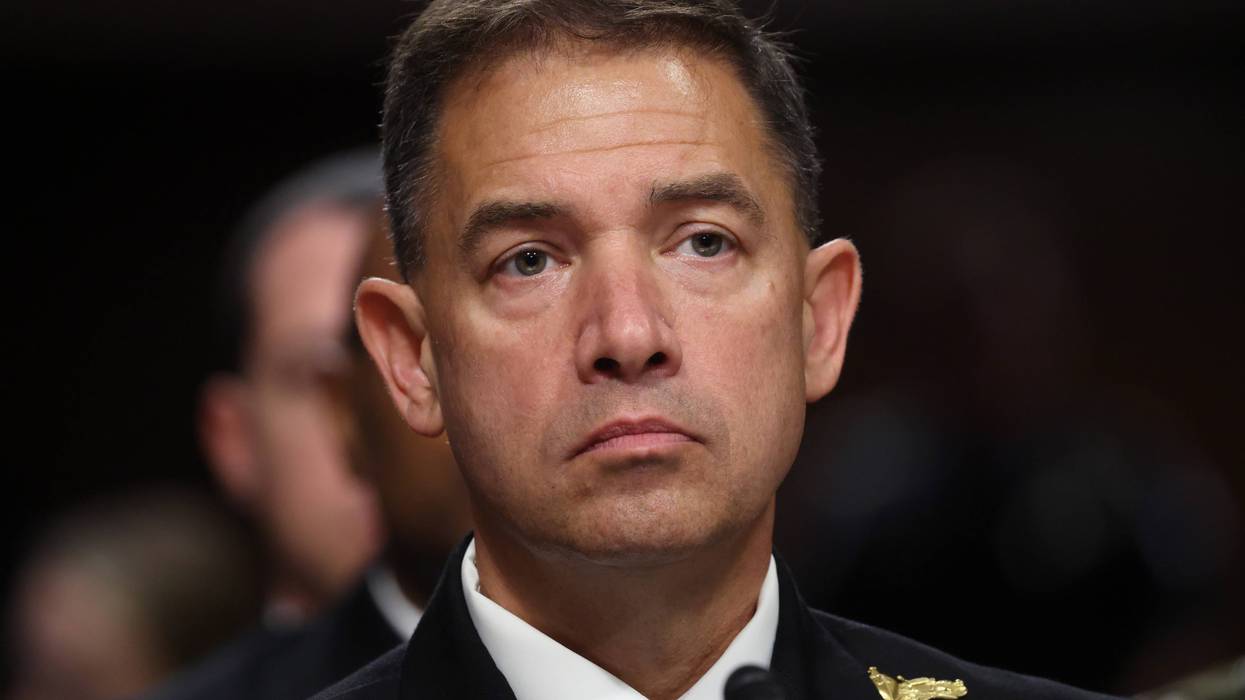
Democrats on the US Senate Armed Services Committee called on the Pentagon on Monday to reveal how much President Donald Trump's Iran War is costing American taxpayers, citing "ongoing efforts to hide the true cost."
US Central Command (CENTCOM) told Congress that the war had cost $43.6 billion as of September 3. But in Monday's letter, Democratic lawmakers noted that this figure excluded the cost of damage caused by Iranian attacks on US bases and other facilities in the region. That estimate remains classified, but lawmakers have seen it.
Sen. Elizabeth Warren (D-Mass.) led the letter, which was also signed by Sens. Mazie Hirono (D-Hawaii), Richard Blumenthal (D-Conn.), Tammy Duckworth (D-Ill.), and Gary Peters (D-Mich.). They called on CENTCOM commander Adm. Brad Cooper to release the estimate publicly.
"There is no rationale for classifying that cost estimate," the lawmakers wrote. "Our allies and our adversaries are, unfortunately, keenly aware of the extraordinary toll that this reckless war has taken on military readiness, and Congress and the public need this information to determine the steps necessary to recover from this debacle."
Iranian strikes have damaged or destroyed hundreds of buildings and structures at US bases across eight Middle Eastern countries, according to a report released in September by the Pentagon's inspector general.
“Despite a lack of clarity and candor from [the Department of Defense], press reports of attacks, video footage, satellite images, and photos leaked to the media by active US service members have painted a dire picture of US bases and facilities damaged and destroyed by Iran,” the lawmakers wrote.
US officials and congressional aides have previously said the damage was far more extensive than the administration had publicly acknowledged and was expected to cost billions of dollars to repair.
More than 50,000 US troops have been deployed to support the Iran War. At least 23 US service members have died, and another 865 have been injured since Trump launched the war. The Pentagon has repeatedly failed to disclose casualties from the war, including dozens of troops injured in Iranian strikes, while moving other casualties out of its official Iran War tally.
At least 1,700 Iranian civilians have also been killed, according to the US-based Human Rights Activists News Agency (HRANA). Iran's Health Ministry reported that more than 26,500 people were injured in the war's first 40 days. HRANA has reported more than 2,200 children injured.
Since the war began in late February, independent analysts have argued that the Pentagon has presented an incomplete picture of the war's costs.
The Center for Strategic and International Studies projected that the war had already cost roughly $40 billion by June, including an estimated $4 billion to $9.4 billion to repair and rebuild damaged US bases. At that time, the Pentagon's most recent public tally was just $29 billion, issued the previous month.
In May, Stephen Semler of the Center for International Policy argued that the Pentagon was also overlooking other critical war costs—underestimating the expense of replacing weapons and repairing bases, and ignoring spending outside the Pentagon, including military aid to Israel, which has joined the US in bombing Iran.
Accounting for those expenses, Semler estimated that the war had cost nearly $72 billion in just its first 60 days—about three times the Pentagon's estimate at the time.
Americans are also paying for the war beyond government spending. Last week, Moody's Analytics chief economist Mark Zandi estimated that the war had cost the average US household nearly $2,000—including $1,100 in higher energy prices, $540 in higher interest rates, and $360 in military costs.
Urging the military to respond to the letter, Warren said on Monday that “Americans deserve to know how much of their money is being burned on Trump’s war with Iran.”
Keep ReadingShow Less

'Hands Off Our People!': Fury After ICE Agents Break US-Born Man's Arm in Long Beach
“ICE has no place terrorizing our streets or subjecting our residents to random stops and harassment simply because of the color of their skin," said the city councilwoman representing the district.
Oct 19, 2026
Residents of Long Beach, California and their elected officials are among those condemning a Saturday assault by US Immigration and Customs Enforcement agents that left a US citizen hospitalized with a broken arm and a community demanding an end to ICE terror.
Ricardo Gonzalez, a 40-year-old former Long Beach city employee born in Hanford, California, was riding his electric bicycle near Elm Avenue and 56th Street in North Long Beach on Saturday when federal agents in an unmarked vehicle allegedly struck him, tased him twice, and handcuffed him, his daughter, Leslie Gonzalez, told the Long Beach Watchdog.
In a differing account, a neighbor who witnessed the incident told The Long Beach Post that an agent jumped out of the unmarked vehicle and tackled Gonzalez to the ground.
Video recorded by Sherman Austin, founder of stopice.net, shows ICE agents handcuffing Ricardo, who is lying face-down in the gutter repeatedly screaming that his arm is broken and that he needs medical aid.
As the incident unfolded, community members, including volunteers with anti-ICE rapid response groups, converged on the area to confront the agents and warn residents of their presence. But instead of staying inside, many people came out to intervene as Gonzalez was brutalized.
Residents were reportedly already on edge due to the presence of numerous unmarked law enforcement vehicles in the neighborhood since early Saturday morning.
According to the Post, neighbors demanded to see a warrant for Gonzalez's arrest and placed trash cans and their own bodies in the way of agents' vehicles to stop them from leaving.
“If they try to take one of us, they’re going to have to take all of Long Beach,” resident Patricia Velazquez told the Post.
One neighborhood resident accused agents of making racist remarks to people who gathered to confront them, including saying that they didn't "look legal."
During a roughly hourlong standoff, agents grabbed two women—both US citizens—and forced them into the backs of different vehicles, according to the Post. One bystander told the outlet that community members distracted agents while others freed the detained women by sneaking up and opening the doors of the cars in which they were held.
"I’m proud of the neighbors who documented and stood up for the family being terrorized by ICE," Congressman Robert Garcia (D-Calif.) said Sunday on social media. "[President] Donald Trump and his inhumane and illegal deportation machine must be stopped. Long Beach stands with our community and our immigrant families. ICE is not welcome in Long Beach. Abolish ICE."
ICE is not welcome in Long Beach.
[image or embed]
— Rep. Robert Garcia (@robertgarcia.house.gov) October 18, 2026 at 5:45 PM
Long Beach Mayor Rex Richardson, a Democrat, said in a video posted to Instagram that "ICE doesn’t belong in our city and this activity undermines community safety and public trust."
"No family should have to live in fear in their own neighborhood," Richardson stressed. "Our residents deserve to feel safe."
"To our immigrant communities: You are part of Long Beach. You belong here. And you deserve to feel safe here," the mayor added. "Whatever happens at the federal level, our responsibility remains the same: protect our residents, respond to emergencies, and keep our community informed."
Long Beach City Councilmember Tunua Thrash-Ntuk, a Democrat who represents the district where the incident took place, said Sunday that ICE agents need to keep their “hands off our people!”
“In a free country, no one should be riding their bike in their own neighborhood only to be subjected to an unprovoked assault by a government agent,” she argued. “ICE has no place terrorizing our streets or subjecting our residents to random stops and harassment simply because of the color of their skin. This lawless chaos demands our universal condemnation.”
Local police also faced criticism for their handling of the incident. Videos posted to social media showed Long Beach Police Department (LBPD) vehicles blocking streets and residents asking why officers were assisting in a federal immigration operation in apparent violation of state law.
LBPD subsequently issued a statement saying that ICE "requested emergency assistance" and that the department "does not enforce civil immigration law and does not participate in federal immigration enforcement," but also "cannot legally obstruct or interfere with federal enforcement operations."
It is unclear why ICE agents attacked Gonzalez. A neighbor told the Post that an agent accused Gonzalez of throwing something at their vehicle.
Despite his injuries, Gonzalez put his arm in a sling to go to a local park and watch his son play in a soccer match on Sunday.
“He’s just in pain. He can’t really sit down; it hurts when he gets up,” Leslie Gonzalez, his daughter, told the Watchdog on Sunday. “He’s just trying to get out of the house and move around. He didn’t just want to sit in the house and dwell all day.”
In a GoFundMe page titled "Support Ricardo's Fight for Justice and Recovery," Leslie Gonzalez wrote: "My dad is one of the hardest working men out there. Because of him I have a roof over my head and I have all the opportunities around me. Our family is everything because of him. We ask for your support and prayers during this awful time."
Leslie Gonzalez told the Watchdog: “I wouldn’t have believed in a million years that this would ever happen to my family."
“But that’s just a bad mindset to put yourself in," she added, "because it could happen to anyone.”
A ProPublica investigation published earlier this month documented more than 500 cases of US citizens detained by immigration agents since the start of the second Trump administration, including more than 100 people held after agents questioned their citizenship and at least 70 children and teenagers.
At least four US citizens—Ruben Ray Martinez, Keith Porter Jr., Renee Good, and Alex Pretti—have been killed by Department of Homeland Security agents during Trump's second term. More than 50 immigrants have died in ICE custody since January 2025.
“I've never seen so many US citizen encounters in all my years,” Darius Reeves, who oversaw ICE's Baltimore office before retiring last year, told ProPublica. “It’s an embarrassment.”
Keep ReadingShow Less
'The Risk Here Is Severe': Schumer Warns Trump FCC Against Approving AI Robocalls Ahead of Midterms
"Putting Americans in a position where they can be fed misinformation through AI-generated deception ahead of a crucial election is yet another attempt by Republicans to mislead voters."
Oct 19, 2026
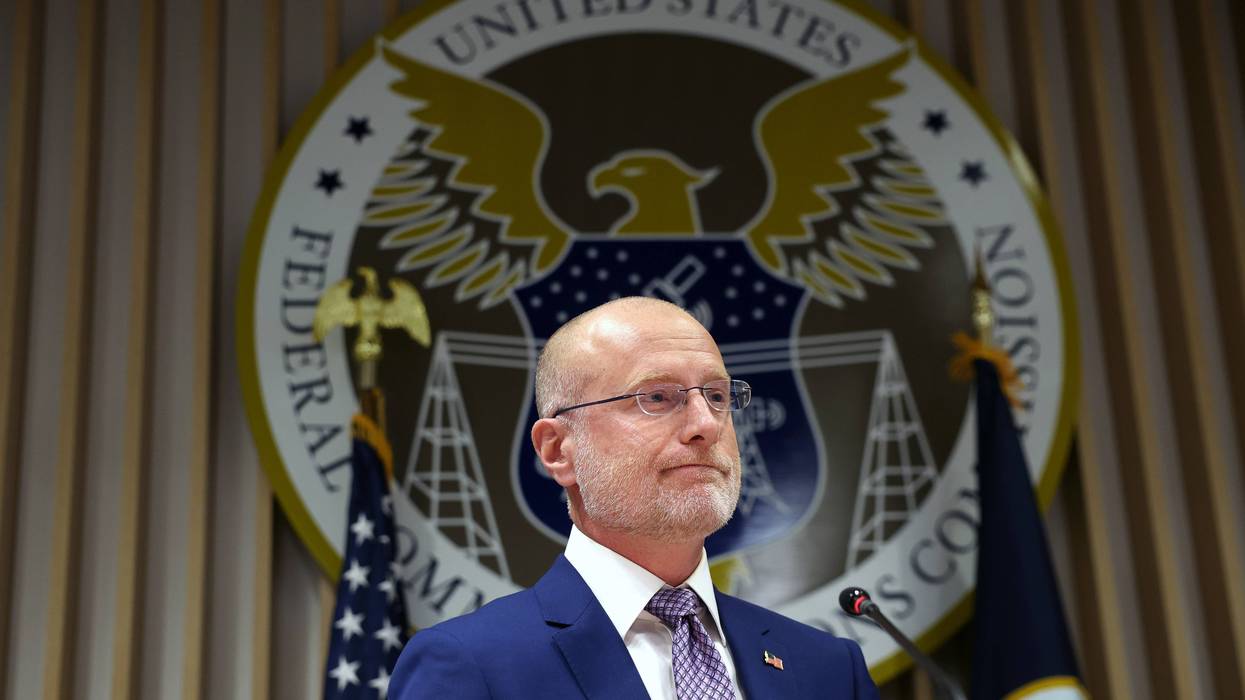
The leader of the Senate Democratic caucus on Monday urged the Republican-controlled Federal Communications Commission to reject a petition by a right-wing group to allow unsolicited, artificial intelligence-generated robocalls ahead of next month's midterm elections.
Senate Minority Leader Chuck Schumer (D-NY) warned that granting Club for Growth's request would mean "unleashing a Pandora’s box of election mis- and disinformation made more believable with AI." Monday is the final day for public comment on the group's petition.
"The FCC MUST reject the request made by a Republican group that would allow political groups to make robocalls to cellphones without people’s permission," Schumer wrote in a social media post. "Putting Americans in a position where they can be fed misinformation through AI-generated deception ahead of a crucial election is yet another attempt by Republicans to mislead voters."
"The risk here is severe," Schumer added. "The approaching election is a reason to preserve safeguards, not suspend them."
Club for Growth—a conservative nonprofit that pushes for tax cuts, deregulation, and school privatization—petitioned the FCC in August for an exemption from federal rules to permit "political calls that utilize artificial intelligence" without prior express consent. The group argued that existing regulations barring such calls "chill important political speech, creating serious First Amendment problems."
Leading consumer advocacy groups countered in a submission to the FCC earlier this month that "political robocalls are deeply invasive of privacy and removing the prior express consent requirement is wholly inconsistent with the public interest and the objectives of the [Telephone Consumer Protection Act]."
"Political robocalls are widely regarded as an annoyance and cause visceral anger among many, in addition to being a vehicle for spreading AI-generated misinformation and delusions," the groups wrote. "Furthermore, the prohibition on automated calls to cellphones without prior express consent is one of the few protections in the TCPA that applies to small businesses that rely on cell phones to operate. Many small businesses must answer every incoming call to avoid missing a potential customer, and granting the waiver petition will result in more unwanted calls that waste small businesses’ time and money."
Schumer told Reuters on Monday that "there is absolutely no excuse to relax" the TCPA standards and "allow special interests to flood our cellphone lines with deepfakes or dark-money-funded AI voices" just two weeks ahead of the midterm elections.
Anna Gomez, the FCC's lone Democratic commissioner, said in a CNN appearance on Monday that "no consumer wants" robocalls and that they are the top complaint the agency hears from the public.
"This dark money group wants permission from the FCC to flood cellphones with these ads generated using artificial intelligence," said Gomez, adding that the agency's Republican commissioners "should not do this."
Keep ReadingShow Less

As Biodiversity Summit Begins, 'Systems That Sustain Life on Earth Are Under Threat'
Governments can't keep "promising to protect nature while supporting its destruction through harmful subsidies and incoherent policies," said one campaigner. "Any more delay is a threat to our survival on the planet."
Oct 19, 2026
Four years after world leaders agreed to the Kunming-Montreal Global Biodiversity Framework, representatives from nearly 200 nations gathered in the Armenian capital on Monday for a summit to review progress on the agreement and discuss future actions to protect nature.
In the lead-up to the 17th Conference of the Parties to the Convention on Biological Diversity (COP17) in Yerevan, the United Nations Environment Program released a "State of Biodiversity Action" report. UN Secretary-General António Guterres said that the framework "has inspired action across the globe," with nearly 90% of parties establishing national targets, but "progress is uneven, and far too slow."
The framework—sometimes called the "Paris Agreement for Nature"—features 23 targets for 2030 and four for 2050. The world isn't on track to meet any of them, including its key goal to protect 30% of all land and water by the end of this decade. Guterres noted that "even if current national commitments are met, only 26% of terrestrial and 12% of marine ecosystems would be protected" on that timeline.
The Guardian pointed out that "the last biodiversity summit, COP16 in Cali, Colombia, ended in disarray with no clear agreement on key topics after negotiations ran out of time. Another round of talks were needed in Rome to finish the meeting."
Agence France-Presse reported Monday that "only a handful of world leaders, including UN chief Antonio Guterres but mostly heads of state from nearby Central Asian nations, turned up for a high-level session on Friday ahead of the formal negotiations."
Armenian Environment Minister Hambardzum Matevosyan, who is presiding over the summit, told AFP that success "will not be measured simply by the number of participants, high-level statements, or decisions adopted," but whether nations actually take action. He added at the opening session that "over the next two weeks, our task will be to bridge the differences, build consensus, and ensure that COP17... deliver[s] results commensurate with the urgency of the challenges before us."
Those who are participating in the summit and parties to the convention face pressure from conservation leaders, including Jeffrey Parrish, the Nature Conservancy's global managing director for nature protection, who declared that "our planet is in peril. The biodiversity that sustains us is being lost faster than ever, and ecosystems that fuel our health and economies are fraying."
Parrish called on those in Yerevan to turn the review process "into an acceleration agenda" to boost progress on the 2030 goals, "transform our financial systems" to mobilize investment at the necessary scale, "integrate biodiversity into infrastructure and development decision-making," and "strengthen policy frameworks to deliver durable, area-based conservation outcomes."
Nature COP17 starts today, with governments gathering to assess progress towards restoring nature The target to protect 30% of land for nature by 2030 seems within reach, but ‘paper parks’ won’t cut it - eg just 7% of England is *properly* protected for naturewww.theguardian.com/environment/...
[image or embed]
— Guy Shrubsole (@guyshrubsole.bsky.social) October 19, 2026 at 3:34 AM
An Lambrechts, head of advocacy group Greenpeace's delegation to the summit, said in a statement that "we're halfway to 2030 and the evidence is clear: We are far off track to reach the 30×30 targets. The systems that sustain life on Earth are under threat, and decisions made at COP17 must deliver a clear course correction to protect our planet's ecosystems."
"This COP can't become a mere entry in a vast log of destruction," she argued. "Governments need to agree on concrete actions that tackle the drivers of biodiversity loss, increase finance, and redirect money flows to where they are needed. But decisions in Yerevan will only matter if governments follow through at home. They cannot continue promising to protect nature while supporting its destruction through harmful subsidies and incoherent policies. Any more delay is a threat to our survival on the planet."
Nichanan Tanthanawit, global project lead for Greenpeace's Ocean Justice Campaign, stressed that "protecting 30% of the planet by 2030 is not just a numerical target. Our ambition must be centered around justice, equity, and those who protect nature. Indigenous Peoples and local communities have cared for these lands and waters for generations, yet their knowledge, rights, and leadership are still too often overlooked."
Camila Jardim, an international political expert at Greenpeace Brazil, highlighted how biodiversity concerns connect to the fossil fuel-driven climate crisis—which world leaders have also failed to adequately address, despite scientists' warnings.
"The world is moving towards a looming 1.5ºC overshoot and the sixth mass extinction, with the human-caused climate and biodiversity crises already severely impacting people all over the world," Jardim said, referring to the Paris Agreement's temperature rise target for this century. "Those are not separate issues, but pieces of the same puzzle, and action is more urgent than ever."
"Governments can make the most impact with aligned policies to address both crises... together, with clear actions for the short, medium and long term," she continued. "This is especially critical for primary forests, which are essential for both climate stability and biodiversity protection, and the Brazil-led roadmap to halt and reverse deforestation and forest degradation by 2030 offers a real opportunity for strengthening synergies between conventions. Protection means tackling not only deforestation but also degradation, and ensuring that climate and biodiversity commitments reinforce each other rather than pull in different directions."
Europe can’t lead on nature at COP17 while cutting biodiversity cash at home
[image or embed]
— euobserver — EU news that matters (@euobserver.com) October 18, 2026 at 3:08 PM
Also attentive to the talks in Armenia on Monday, the International Union for Conservation of Nature (IUCN) released recommendations and guidance on how to incorporate ecological integrity—or "how closely an ecosystem’s species, structure, functions, and ecological processes remain within their natural range of variation"—into relevant policies and practices.
"The world has made ambitious commitments to halt and reverse biodiversity loss, but success cannot be measured by simply counting the number of conservation areas established, the species protected, or the amount of land and water conserved," said John G. Robinson, a Wildlife Conservation Society scientist who co-chairs the IUCN Task Force on Ecological Integrity.
"The real test is whether natural ecosystems—forests, grasslands, freshwater systems, and oceans—are maintaining or recovering the ecological integrity needed to sustain life," Robinson explained. "Do these places continue to support healthy wildlife populations, functioning ecosystems, and the natural processes that make life possible? By focusing on ecological integrity, we can make conservation more effective, and governments can be more accountable for results."
Keep ReadingShow Less
Roberts' Supreme Court Has Made Prosecuting Corrupt Politicians Nearly Impossible: Veteran Prosecutor
"This behavior should be illegal because corruption is poison to democracy."
Oct 19, 2026
Corruption has become a leading issue for US voters heading into the 2026 midterm elections, driven in no small part by concerns about President Donald Trump's unprecedented self-enrichment while in office.
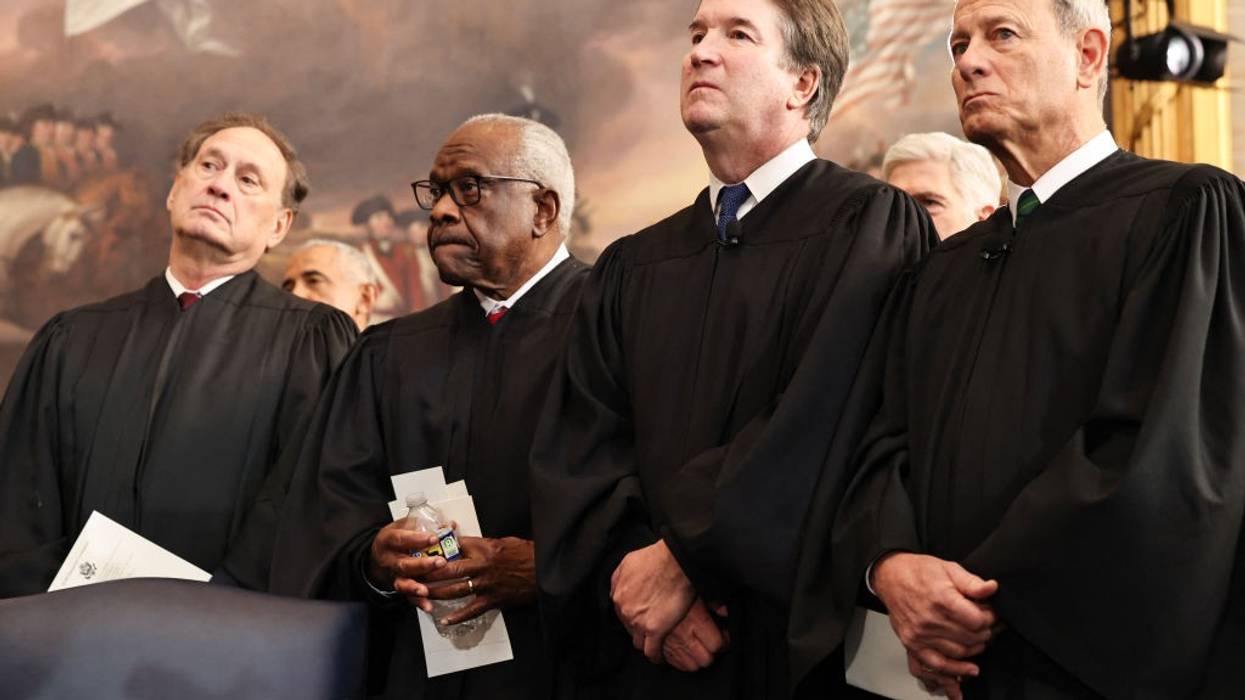
But even as Americans express greater worry about corruption in government, actually prosecuting corrupt politicians has grown significantly more difficult over the last 40 years—and one legal expert places blame for this directly on the US Supreme Court.
In an essay published by The Atlantic on Monday, former federal prosecutor Leo Wise argued that the Supreme Court since the 1980s has "interpreted anti-corruption laws in ways so narrow as to effectively legalize flat-out corruption," thus putting "whole categories of politicians' conduct beyond a prosecutor’s reach."
The trend began in 1987, Wise explained, when the court overturned a mail fraud conviction of a member of the Kentucky governor’s Cabinet, which relied upon proving that the official had violated the public's right to "honest services" from its government.
In its ruling, the court declared that federal mail and wire fraud statutes only protected money and property, and did not apply to abstract principles like the right to an honest government.
Wise noted that Congress would subsequently step in and pass bipartisan legislation that effectively overturned the court's ruling, although this kind of congressional action would grow increasingly rare in the coming years.
Far greater damage would come after John Roberts took over as chief justice of the court in 2005, Wise continued, starting with a 2010 case that overturned former Enron CEO Jeff Skilling's conviction of conspiring to commit honest-services fraud.
The majority opinion, written by the late Justice Ruth Bader Ginsburg, claimed that "because bribery and kickbacks were the 'basis of most honest-services prosecutions,' that’s what the statute’s application would be limited to," Wise explained.
The impact of this decision, Wise added, was to further restrict prosecutors' ability to bring corruption charges.
Wise then singled out the 2016 decision that overturned the bribery conviction of former Republican Virginia Gov. Robert McDonnell, which he described as the court's "grossest" intervention.
"A jury had convicted the former governor on bribery charges for accepting $175,000 in loans and gifts from the CEO of a nutritional-supplement company that wanted Virginia’s public universities to run clinical trials on his product," Wise wrote. "The court held that what McDonnell did for the CEO—setting up meetings, hosting events, talking to other elected officials, all to benefit his company—did not qualify as 'official acts,' for which McDonnell could be bribed."
In 2024, the court took another major step forward in legalizing corruption with its ruling granting US presidents absolute immunity from criminal prosecution for carrying out official acts.
This decision was particularly egregious, Wise contended, because "unlike the earlier decisions that interpreted statutes and that therefore Congress can reverse by passing new legislation, the Court claimed that presidential immunity was required by the Constitution itself," thus making it vastly more difficult to overturn.
Nonetheless, Wise said that Congress could chip away at presidents' ability to act corruptly by "prohibiting the US government from accepting gifts such as the Qatari plane" that Trump accepted last year, as well as "disqualifying companies that invest in a president’s businesses or donate to his library from bidding on government contracts."
"This behavior should be illegal," Wise emphasized, "because corruption is poison to democracy."
Keep ReadingShow Less
Student Loans on Ballot as Trump Officials Gear Up to Garnish Wages From Defaulted Borrowers After Midterms
"Democrats need to get LOUD," said one political strategist.
Oct 19, 2026
As the Trump administration makes plans to task private debt collectors with going after millions of student borrowers in default on their federal loans, officials are reportedly pushing for the effort to begin after the midterm elections—as they grapple with the fact that many supporters of President Donald Trump are likely to be affected.
The Washington Sun reported Monday that the US Department of the Treasury is planning to move forward with punitive measures after previously blocking a push by the Education Department and Office of Management and Budget to garnish wages and seize people's benefits if their loans are in default.
As the Center for American Progress (CAP) said in a report Monday, defaults on student loans have reached record levels, with 9.5 million—or 1 in 5—borrowers unable to make scheduled payments following the passage of the One Big Beautiful Bill Act (OBBBA).
The law eliminated the Saving on a Valuable Education (SAVE) program and forced borrowers into the Repayment Assistance Plan instead, bringing the average annual cost to $2,163 per borrower, according to CAP.
According to the Sun, administration staffers have advised officials to consider the impact that more upheaval for student borrowers—in the form of debt collectors either following through on the earlier wage-garnishing plan or seizing tax refunds and payments—would likely have on Trump voters.
“This is not who you think it is. The demographics are not good for us,” aides told officials last year when they pushed for a delay on the wage-garnishment plan.
An Associated Press analysis in July found that states with the highest rates of student loan defaults were overwhelmingly Republican-leaning, with Mississippi, Louisiana, and Alabama leading the way.
The advocacy group Protect Borrowers also found earlier this year that roughly two-thirds of all defaulted borrowers live in states Trump won in 2024.
Sources in the administration told the Sun that some officials are pushing for a further delay of the debt collection, as they ensure the Treasury Department's portal for defaulted borrowers is working. The Defaulted Loans Support Center was launched last month with the stated goal of giving borrowers "a simple, streamlined way to understand the consequences of default and apply online to either rehabilitate or consolidate their loans."
Others want to begin garnishing wages or seize tax payments for the current tax year ending in April 2027.
One source told the Sun that they expect many calls to government agencies "from borrowers saying: ‘What’s going on? How do I make sure this won’t happen again?'"
"It would be politically insane to do this before the midterms—but 2027 probably makes a little more sense to give Treasury time to get contracts [with debt collectors] signed, up and running," they said.
Democratic strategist Michelle Kinney called on Democratic candidates to "get LOUD" about the reported plan to shield the White House and the GOP from accountability.
Michael Pierce, executive director of Protect Borrowers, told the Sun that if the administration follows through with the plan—as families struggle with rising gas and grocery prices resulting from Trump's tariff policy and illegal war on Iran—"what comes next will be a catastrophe for families across the country," who will have "even less money to put food on the table or make rent.”
"Restarting debt collection the moment any political accountability has passed just shows how little interest Trump has in helping working families stay afloat,” Pierce told the Sun.
On social media, Pierce noted that despite its threats against borrowers, the administration and any debt collectors it contracts with must ensure the defaulted debts are valid for collection.
Along with the Project on Predatory Student Lending and the Debt Collection Lab at Princeton University, Protect Borrowers wrote to Treasury Secretary Scott Bessent last week, noting the "mounting evidence that the US Department of Education may not have the data it needs to certify these debts for collection in the first place."
Persis Yu, deputy executive director and managing counsel at Protect Borrowers, told Common Dreams that should the administration move forward with the debt collection, "they may be illegally collecting from large swaths of people," many of whom likely don't have the resources to protect themselves from the unjust practice.
"There are people who you look in their federal records, and there's decades missing, years missing. And so they're collecting on people who they don't have complete payment histories for," Yu said. "And it can be a lot of money. Wage garnishment can be up to 15% of somebody's paycheck."
If the Treasury Department decides to seize people's tax payments instead of their wages through their employers, the debt collection could impact the earned income tax credit—"one of our largest anti-poverty programs," Yu said.
The credit "can be several thousand dollars, which many working families use to repair cars or catch up on rent or [pay] childcare payments," she added.
"Because these are some of the most vulnerable borrowers, they're not folks who necessarily understand their rights and are going to be able to access the records and understand their records," said Yu. "And so it is going to hurt some of the most vulnerable borrowers.
Marshall Steinbaum, an associate economics professor at the University of Utah, emphasized that defaulted student loan borrowers are "overwhelmingly people whose debts would have been erased" by the student debt cancellation plan by the Biden administration, which was blocked after Republican states and other plaintiffs challenged it in court.
"Congratulations to everyone who blocked that," said Steinbaum, "on their glorious policy success."
This article has been updated to include comments from Persis Yu.
Keep ReadingShow Less
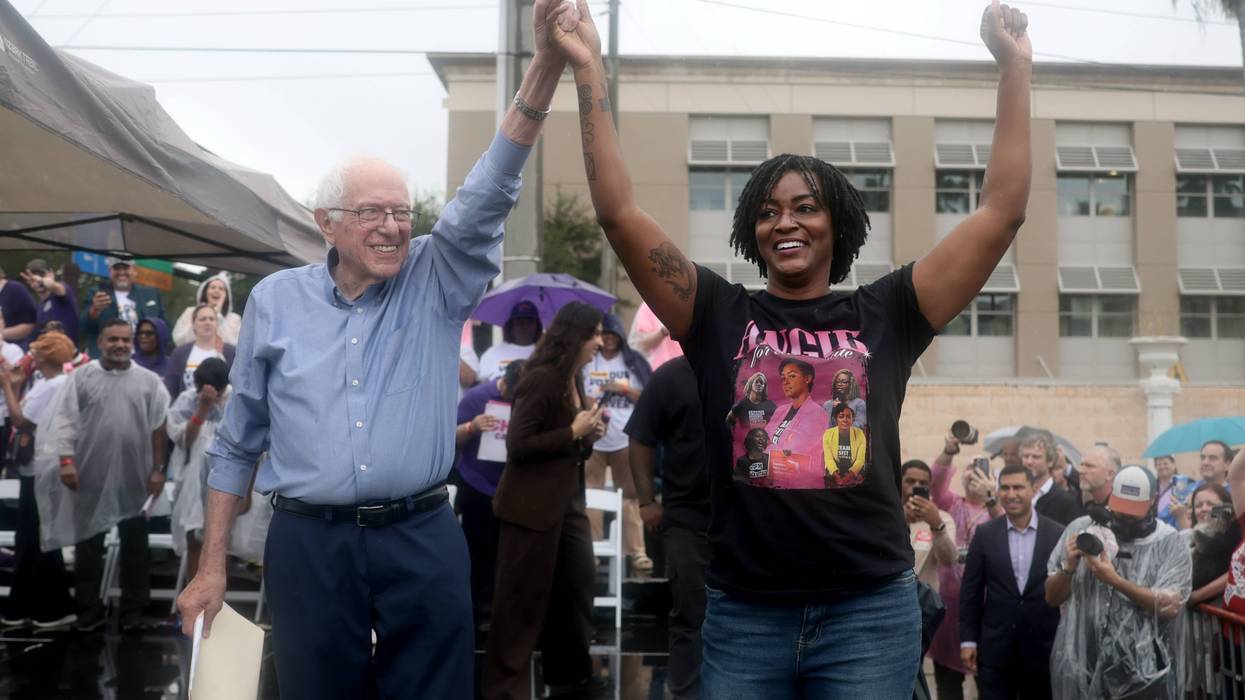
'She’s Going to Win,' Says Bernie Sanders After Weekend in Florida Backing Angie Nixon
"Trust me on this," Sanders said. "This is going to be a spark that is going to ignite the entire country."
Oct 19, 2026
Judging by the polls, progressive Democrat Angie Nixon faces an uphill battle as she contends for Florida’s US Senate seat. But after campaigning with her this weekend, Sen. Bernie Sanders is confident she's being underestimated.
"She’s going to win," Sanders (I-Vt.) wrote on social media Sunday night, after making four stops across a state that's long been written off as a GOP stronghold.
"They say Florida is a red state, but you know what I'm hearing?" Sanders said. "Working people everywhere are sick and tired of the same old politics and policies. They want real change."
Nixon, a state representative and former labor leader, has already shown that calls for change can galvanize voters. Running on what she's called a "Working Families Guarantee"—which includes Medicare for All, free childcare, paid leave, and stronger bargaining power for workers—she unexpectedly defeated the better-funded, establishment-backed centrist Alex Vindman in August's Democratic primary.
In an election season where Republicans are expected to face a reckoning over rising prices and shameless self-enrichment by President Donald Trump and his allies, Nixon's message seems to be resonating in Florida. Despite the past decade's massive influx of wealthy retirees, a strong base of working-class supporters, particularly in Florida's politically neglected Black communities, has mobilized behind her.
At a rain-drenched rally in Tampa on Saturday, about 2,200 people watched as Nixon spoke with what the Tampa Bay Times called "a preacher’s charisma," hitting back at Republican Sen. Ashley Moody’s attempts to characterize her platform as "radical."
"If believing that a child with cancer should get treatment they need whether their parents can afford it or not is radical, then call me radical," Nixon thundered. "Then I guess I'm a radical, Ashley. I guess I'm radical as hell."
"Where I come from, none of that is radical," she continued. "That is just plain common sense. That is basic human decency."
Nixon has called for Moody to be jailed over her actions as the state's attorney general. In 2024, Moody approved the diversion of $10 million from a Medicaid fraud settlement—which would have benefited low-income Floridians, including children—to political campaigns supporting Gov. Ron DeSantis (R-Fla.) and other Republicans.
"Are you all ready to fight back?" Nixon shouted to a roaring crowd in Tallahassee on Sunday. "Are you all ready to put an end to the corruption that's driving up our prices and ruining our democracy?"
"Well, I am ready, too!" she said, as supporters stood behind her waving signs reading "Freeze the Rent," "Tax Billionaires," and "Protect Social Security."
While recent polls still show Nixon trailing Moody in the final weeks of the campaign, her fundraising in the third quarter of the year has soared, and other major figures in the Democratic Party from progressives like Rep. Maxwell Frost (D-Fla.) to establishment liberals like Sen. Ruben Gallego (D-Ariz.) have campaigned with her in person.
With gas prices continuing to soar as Trump threatens dramatic escalations in his war with Iran, signs of a coming electoral apocalypse for Republicans are flashing ever brighter.
Democrats now lead by around nine points on the generic congressional ballot, and Trump's approval has dipped to historic lows. The GOP's fundraising arms have begun diverting resources initially for swing states like Georgia and North Carolina to protect territory once thought safe—in South Carolina, Kansas, Ohio, and, yes, even Florida.
The 2026 cycle has already challenged the long-standing conventional wisdom that chasing Republicans to the right is a necessity to win voters in purple and red states.
With similar populist messaging, Abdul El-Sayed and Troy Jackson are leading Republican opponents in Michigan and Maine, respectively. James Talarico is favored to become the first Democrat to win a statewide election in Texas since the Clinton administration. Meanwhile, Dan Osborn, Josh Turek, Adam Hamilton, and Sherrod Brown are all hanging tough in states that Trump won by double digits in 2024.
But a win by Nixon—a member of the Democratic Socialists of America who, unlike other progressives, won her primary largely with support from the state's lowest-income, least college-educated constituencies—would signify more than just a backlash to "the most dangerous president in the history of the United States," Sanders said.
"This election is not only important for the people of Florida in getting a senator who is going to fight for you," Sanders told the Tallahassee crowd. "Trust me on this, after Angie wins, this is going to be a spark that is going to ignite the entire country."
Keep ReadingShow Less
Half a Million People in Gaza to Lose Food Aid Due to Funding Shortages: UN
The World Food Program said the fiscal shortfalls came after it received "less than half as much funding for its Palestine operation in 2026 as in previous years."
Oct 19, 2026
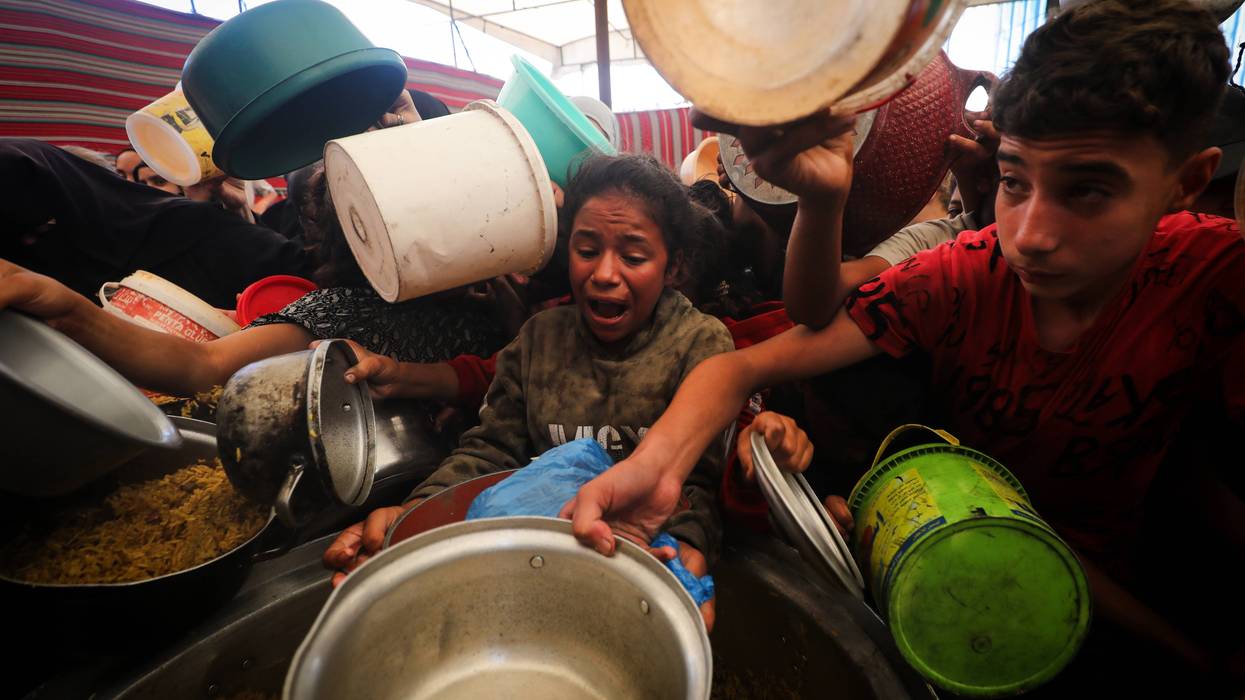
The United Nations's World Food Program announced on Monday that funding shortages were forcing it to significantly reduce assistance in Gaza, where it projected half a million people would lose access to food aid.
The WFP said the cuts would also mean that families still receiving assistance will only get half of the rations they previously received.
WFP has cut the number of hot meals it provides in Gaza by 40%, while reducing the value of cash assistance it provides to 75,000 families.
The agency also said that it would be reducing its operations in the West Bank, where an estimated 200,000 people are projected to lose access to food assistance.
The WFP said the fiscal shortfalls came after it received "less than half as much funding for its Palestine operation in 2026 as in previous years," adding that it needs $450 million to maintain its critical operations in the two Palestinian territories over the next six months.
"As winter approaches," WFP said, "additional resources are urgently needed to sustain emergency food assistance, provide critical engineering support and prevent malnutrition among young children and pregnant and breastfeeding women."
Shaun Hughes, WFP's representative and country director for Palestine, told The Guardian that the cuts were coming after the program had made steady progress in reducing hunger in Gaza, while emphasizing that "these are very fragile gains, easily reversed, and the situation is still brutal."
"We need to invest in recovery," Hughes added. "This humanitarian operation isn’t affordable or sustainable in the long term. Ultimately that’s also what everyone in Gaza is telling us. They really don’t want to be reliant on these handouts, don’t want to stand in the hot meals queue every day. They want to have some chance of stability and recovery."
Some Palestinians who spoke with BBC on Monday expressed horror at news of the cuts, which come as Gaza is still under attack by Israeli forces.
Mervat al-Satari, a displaced Palestinian mother, told BBC that the cuts were "a disaster" and asked "how will we provide for the little ones?"
Palestinian mother Dalal al-Dahdouh, who is living in the ruins of her home in Gaza City, told BBC that WFP rations were already insufficient before the cuts took effect.
"In the past, thank God, we had our own home and a wonderful life," al-Dahdouh said. "We had fresh vegetables, proper sanitation facilities, and our own land. Now we live entirely on aid, including WFP vouchers."
Keep ReadingShow Less
As Millions Struggle to Get By, Plutocrat Working to Kill California Billionaire Tax Dines With Trump
"He’d rather working class kids die because they can’t afford healthcare than pay his fair share in taxes," Sen. Bernie Sanders said of Google co-founder Sergey Brin.
Oct 19, 2026
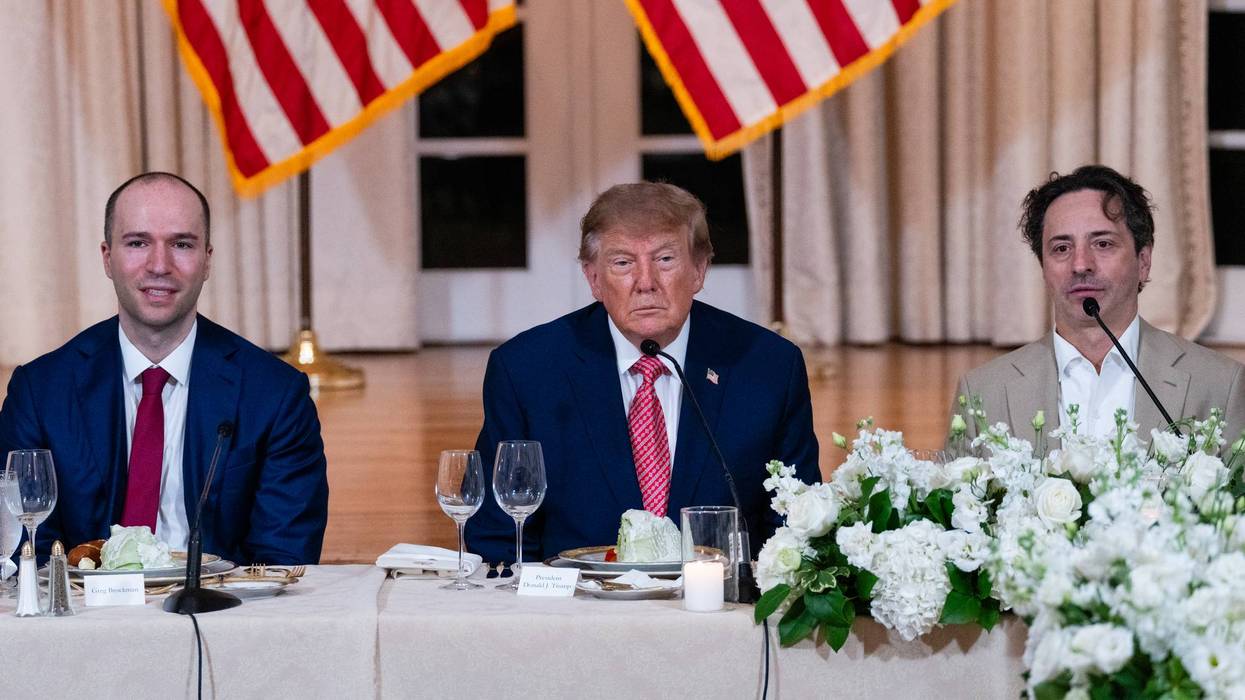
Billionaire Google co-founder Sergey Brin, who has spent more than $100 million fighting a proposed wealth tax in California, shared a lavish dinner with billionaire US President Donald Trump over the weekend at his Mar-a-Lago estate in Palm Beach, Florida as millions of American families struggle to afford groceries, healthcare, and other necessities.
Brin was seated directly to the billionaire president's left during the fundraising dinner, which was hosted by the pro-Trump super PAC MAGA Inc. On Trump's right was Greg Brockman, president of the leading artificial intelligence firm OpenAI.
The proposal that Brin is trying to defeat would impose a one-time, 5% tax on California's billionaire residents and use the revenue to offset the damage of unprecedented federal Medicaid cuts, which Trump signed into law last year. The proposal will appear on California's November ballot as Proposition 40.
"When Sergey Brin, the 4th richest man alive, isn’t dining with Trump, what’s he doing? He’s spending $138 million against California’s 5% billionaire wealth tax," Sen. Bernie Sanders (I-Vt.) wrote in response to pictures of Brin and the president.
"He’d rather working class kids die because they can’t afford healthcare than pay his fair share in taxes," added Sanders, a vocal proponent of the tax. "Obscene."
Brin, who moved his primary residence from California to Nevada late last year to avoid the potential tax, is the primary funder of Building a Better California, a group that is trying to defeat the proposed levy and sponsoring competing measures.
Earlier this month, Democratic California Gov. Gavin Newsom—who opposes the billionaire wealth tax—endorsed Proposition 42, a measure backed by Building a Better California. If passed, the initiative would cancel out the proposed billionaire tax and prohibit future wealth taxes.
In an op-ed for The Guardian on Monday, US Rep. Ro Khanna (D-Calif.) wrote that he stands "with the nurses and healthcare workers who put Prop 40 on the ballot."
"Newsom stands with Peter Thiel, Sergey Brin, and Elon Musk, Trump backers who all oppose it," wrote Khanna, who is considering a presidential run in 2028. "If they paid this tax, they would be worth the same as they were on Labor Day of this year. That’s the speed at which their wealth is growing. The tax would raise about $100 billion, 90% of it for healthcare. It would help keep 3 million Californians from losing coverage. Trump’s cuts could cost Medi-Cal more than $30 billion a year, and this tax would help fill that gigantic hole."
"In Trump’s America, working people pay more than they should, while billionaires are so unburdened that they are becoming trillionaires. In the America we seek, billionaires and trillionaires will pay their fair share, while working people will be unburdened," the congressman added. "Will California this November stand with the working class or the oligarchs?"
Keep ReadingShow Less
See More
Most Popular