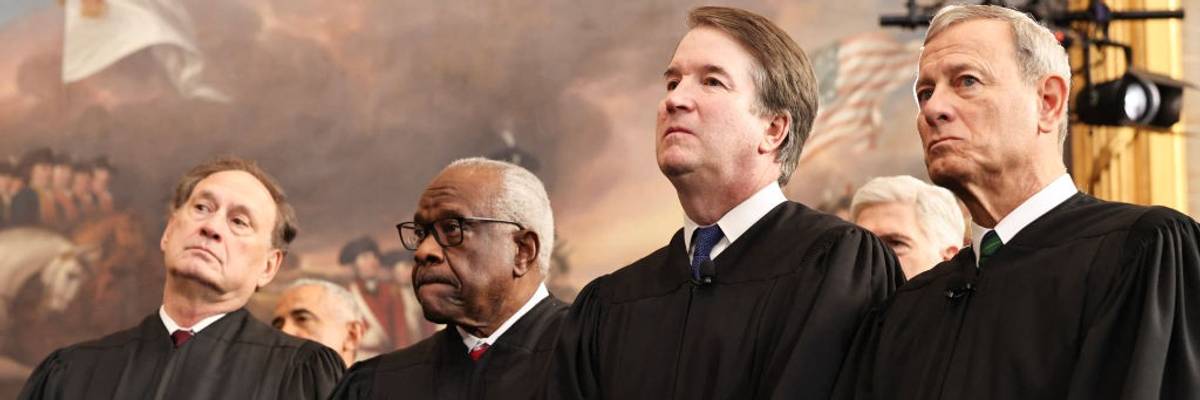
US Supreme Court Justices Samuel Alito, Jr., Clarence Thomas, Brett Kavanaugh, and John Roberts look on during inauguration ceremonies on January 20, 2025 in Washington, DC.
Roberts' Supreme Court Has Made Prosecuting Corrupt Politicians Nearly Impossible: Veteran Prosecutor
"This behavior should be illegal because corruption is poison to democracy."
Corruption has become a leading issue for US voters heading into the 2026 midterm elections, driven in no small part by concerns about President Donald Trump's unprecedented self-enrichment while in office.
But even as Americans express greater worry about corruption in government, actually prosecuting corrupt politicians has grown significantly more difficult over the last 40 years—and one legal expert places blame for this directly on the US Supreme Court.
In an essay published by The Atlantic on Monday, former federal prosecutor Leo Wise argued that the Supreme Court since the 1980s has "interpreted anti-corruption laws in ways so narrow as to effectively legalize flat-out corruption," thus putting "whole categories of politicians' conduct beyond a prosecutor’s reach."
The trend began in 1987, Wise explained, when the court overturned a mail fraud conviction of a member of the Kentucky governor’s Cabinet, which relied upon proving that the official had violated the public's right to "honest services" from its government.
In its ruling, the court declared that federal mail and wire fraud statutes only protected money and property, and did not apply to abstract principles like the right to an honest government.
Wise noted that Congress would subsequently step in and pass bipartisan legislation that effectively overturned the court's ruling, although this kind of congressional action would grow increasingly rare in the coming years.
Far greater damage would come after John Roberts took over as chief justice of the court in 2005, Wise continued, starting with a 2010 case that overturned former Enron CEO Jeff Skilling's conviction of conspiring to commit honest-services fraud.
The majority opinion, written by the late Justice Ruth Bader Ginsburg, claimed that "because bribery and kickbacks were the 'basis of most honest-services prosecutions,' that’s what the statute’s application would be limited to," Wise explained.
The impact of this decision, Wise added, was to further restrict prosecutors' ability to bring corruption charges.
Wise then singled out the 2016 decision that overturned the bribery conviction of former Republican Virginia Gov. Robert McDonnell, which he described as the court's "grossest" intervention.
"A jury had convicted the former governor on bribery charges for accepting $175,000 in loans and gifts from the CEO of a nutritional-supplement company that wanted Virginia’s public universities to run clinical trials on his product," Wise wrote. "The court held that what McDonnell did for the CEO—setting up meetings, hosting events, talking to other elected officials, all to benefit his company—did not qualify as 'official acts,' for which McDonnell could be bribed."
In 2024, the court took another major step forward in legalizing corruption with its ruling granting US presidents absolute immunity from criminal prosecution for carrying out official acts.
This decision was particularly egregious, Wise contended, because "unlike the earlier decisions that interpreted statutes and that therefore Congress can reverse by passing new legislation, the Court claimed that presidential immunity was required by the Constitution itself," thus making it vastly more difficult to overturn.
Nonetheless, Wise said that Congress could chip away at presidents' ability to act corruptly by "prohibiting the US government from accepting gifts such as the Qatari plane" that Trump accepted last year, as well as "disqualifying companies that invest in a president’s businesses or donate to his library from bidding on government contracts."
"This behavior should be illegal," Wise emphasized, "because corruption is poison to democracy."
We are at a crossroads
This country and this world are at a monumental crossroads. In a few short weeks, US voters will have an opportunity to beat back the forces of fascism and confront the billionaires who are rigging the economy, our media system, and our democracy, making it increasingly impossible for ordinary people to get by. We’re not just talking about the election. We’re talking about what must be done once these fascist elements are vanquished from power. We need a bolder set of solutions than what either major party has so far been willing to offer and a working-class movement ready to fight like hell for it. Trump didn't emerge from nowhere. The conditions that fueled MAGA authoritarianism were created by decades of radical neoliberal economic policies and a corrupt political system dominated by corporate interests. They slashed taxes on the super-rich, promising that the benefits would trickle down. They gutted Wall Street regulations, claiming that government oversight was choking off prosperity. They knee-capped organized labor, insisting the free market would deliver better jobs, higher wages, and lower costs. It was all bullshit. And when a bitter, betrayed populace searches for someone to blame, right-wing demagogues have little trouble finding scapegoats. Now, Big Tech oligarchs are selling us another utopian fantasy: AI will usher in a world where jobs may disappear, but everyone will be so wealthy that work itself becomes unnecessary. People know when they're being lied to. Yet without a bottom-up political movement that restores power to ordinary people and forces the billionaire class to pay its fair share, we will only repeat the cycle that brought us MAGA to begin with. You won't hear any of this from the corporate media. Only independent journalism—powered and funded by people who believe in building a better world—can deliver truly trustworthy daily news. Our Fall Campaign is underway, and we need your help. To power our newsroom through the rest of the year, we need to raise $125,000 by midnight on October 31. So if you share our vision, please contribute whatever you can to sustain our work. |
Corruption has become a leading issue for US voters heading into the 2026 midterm elections, driven in no small part by concerns about President Donald Trump's unprecedented self-enrichment while in office.
But even as Americans express greater worry about corruption in government, actually prosecuting corrupt politicians has grown significantly more difficult over the last 40 years—and one legal expert places blame for this directly on the US Supreme Court.
In an essay published by The Atlantic on Monday, former federal prosecutor Leo Wise argued that the Supreme Court since the 1980s has "interpreted anti-corruption laws in ways so narrow as to effectively legalize flat-out corruption," thus putting "whole categories of politicians' conduct beyond a prosecutor’s reach."
The trend began in 1987, Wise explained, when the court overturned a mail fraud conviction of a member of the Kentucky governor’s Cabinet, which relied upon proving that the official had violated the public's right to "honest services" from its government.
In its ruling, the court declared that federal mail and wire fraud statutes only protected money and property, and did not apply to abstract principles like the right to an honest government.
Wise noted that Congress would subsequently step in and pass bipartisan legislation that effectively overturned the court's ruling, although this kind of congressional action would grow increasingly rare in the coming years.
Far greater damage would come after John Roberts took over as chief justice of the court in 2005, Wise continued, starting with a 2010 case that overturned former Enron CEO Jeff Skilling's conviction of conspiring to commit honest-services fraud.
The majority opinion, written by the late Justice Ruth Bader Ginsburg, claimed that "because bribery and kickbacks were the 'basis of most honest-services prosecutions,' that’s what the statute’s application would be limited to," Wise explained.
The impact of this decision, Wise added, was to further restrict prosecutors' ability to bring corruption charges.
Wise then singled out the 2016 decision that overturned the bribery conviction of former Republican Virginia Gov. Robert McDonnell, which he described as the court's "grossest" intervention.
"A jury had convicted the former governor on bribery charges for accepting $175,000 in loans and gifts from the CEO of a nutritional-supplement company that wanted Virginia’s public universities to run clinical trials on his product," Wise wrote. "The court held that what McDonnell did for the CEO—setting up meetings, hosting events, talking to other elected officials, all to benefit his company—did not qualify as 'official acts,' for which McDonnell could be bribed."
In 2024, the court took another major step forward in legalizing corruption with its ruling granting US presidents absolute immunity from criminal prosecution for carrying out official acts.
This decision was particularly egregious, Wise contended, because "unlike the earlier decisions that interpreted statutes and that therefore Congress can reverse by passing new legislation, the Court claimed that presidential immunity was required by the Constitution itself," thus making it vastly more difficult to overturn.
Nonetheless, Wise said that Congress could chip away at presidents' ability to act corruptly by "prohibiting the US government from accepting gifts such as the Qatari plane" that Trump accepted last year, as well as "disqualifying companies that invest in a president’s businesses or donate to his library from bidding on government contracts."
"This behavior should be illegal," Wise emphasized, "because corruption is poison to democracy."
- The Billionaires Who Have Purchased the US Supreme Court May Soon Have Their Dreams Come True ›
- 'Bribery Has a Green Light' as Supreme Court Overturns Mayor's Conviction ›
- The Self-Serving Supreme Court Is Exonerating Corrupt Officials For Its Own Benefit ›