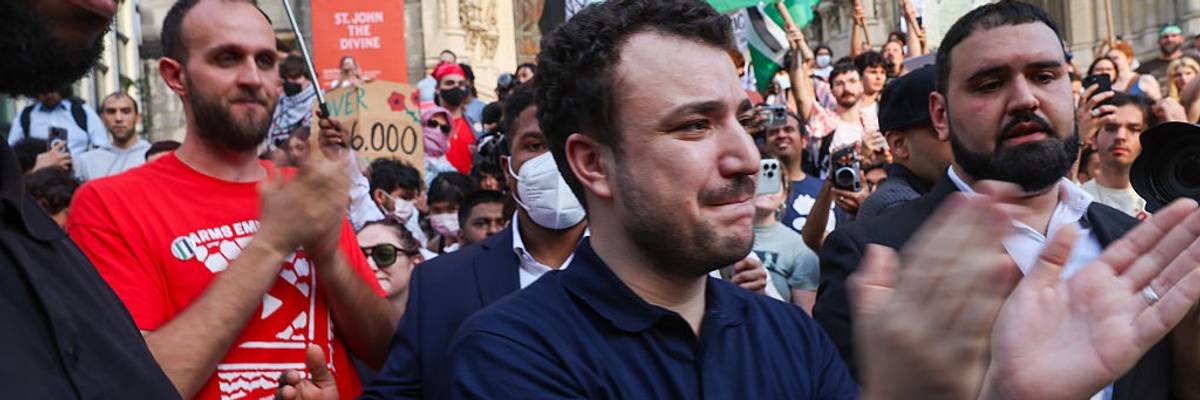
Palestinian activist Mahmoud Khalil marches with supporters after he was released from detention during a rally on June 22, 2025 in New York City.
Mahmoud Khalil Asks Supreme Court to Weigh In On Fights Against 'Unlawful Attempts to Detain and Deport People'
"The Supreme Court must uphold the power of habeas courts to free people from retaliatory detention and prevent the weaponization of the immigration system to punish dissent."
Attorneys representing former Columbia University student organizer Mahmoud Khalil on Monday asked the US Supreme Court to hear a challenge to an appellate ruling that overturned a judge's determination that his 2025 detention by federal immigration officials was unconstitutional.
Khalil, a legal US permanent resident who was born in a Palestinian refugee camp in Syria, was arrested by US Immigration and Customs Enforcement (ICE) agents in March 2025 and detained on claims that his activism was "adverse to the foreign policy interests of the United States."
US District Judge Michael Farbiarz, an appointee of former President Joe Biden, freed Khalil from ICE custody, arguing that his detention was unwarranted since he was neither a flight risk nor a danger to the community.
However, the 3rd Circuit Court of Appeals overruled Farbiarz's decision on the grounds that federal courts did not have jurisdiction to rule on immigration cases.
In making his appeal to the Supreme Court to hear his case, Khalil said the outcome would determine "whether I, and all immigrants in this country, can actually challenge this administration’s unlawful attempts to detain and deport people solely in retaliation for their First Amendment protected speech."
Baher Azmy, legal director of the Center for Constitutional Rights, which represents Khalil, argued that the appeals court's decision was in error because federal courts should always have jurisdiction over cases involving core rights such as habeas corpus petitions.
"Our most fundamental constitutional principles have always prevented the president from sending people into detention on a whim or out of spite," said Azmy. "Access to the critical protections of habeas corpus is an essential check on the kind of arbitrary detention here, which the administration wants free rein to accomplish, by punishing Mr. Khalil for nothing other than constitutionally protected speech."
Alina Das, director of the New York University Immigrant Rights Clinic, which is also representing the former student, said the Trump administration's detention of Khalil violated his core constitutional rights, while also chilling the speech of both US citizens and noncitizens who "fear retaliation against themselves or their loved one."
"The Supreme Court must uphold the power of habeas courts to free people from retaliatory detention," said Das, "and prevent the weaponization of the immigration system to punish dissent."
We are at a crossroads
This country and this world are at a monumental crossroads. In a few short weeks, US voters will have an opportunity to beat back the forces of fascism and confront the billionaires who are rigging the economy, our media system, and our democracy, making it increasingly impossible for ordinary people to get by. We’re not just talking about the election. We’re talking about what must be done once these fascist elements are vanquished from power. We need a bolder set of solutions than what either major party has so far been willing to offer and a working-class movement ready to fight like hell for it. Trump didn't emerge from nowhere. The conditions that fueled MAGA authoritarianism were created by decades of radical neoliberal economic policies and a corrupt political system dominated by corporate interests. They slashed taxes on the super-rich, promising that the benefits would trickle down. They said giveaways to the corporate titans would make life more affordable for the rest of us. It was all bullshit. And when a bitter, betrayed populace searches for someone to blame, right-wing demagogues have little trouble finding scapegoats. People know when they're being lied to, but you won't hear any of this from the corporate media. Only independent journalism—powered and funded by people who believe in building a better world—can deliver truly trustworthy daily news. Our Fall Campaign is underway, and we need your help. To power our newsroom through the rest of the year, we need to raise $125,000 by midnight on October 31. So if you share our vision, please contribute whatever you can to sustain our work. |
Attorneys representing former Columbia University student organizer Mahmoud Khalil on Monday asked the US Supreme Court to hear a challenge to an appellate ruling that overturned a judge's determination that his 2025 detention by federal immigration officials was unconstitutional.
Khalil, a legal US permanent resident who was born in a Palestinian refugee camp in Syria, was arrested by US Immigration and Customs Enforcement (ICE) agents in March 2025 and detained on claims that his activism was "adverse to the foreign policy interests of the United States."
US District Judge Michael Farbiarz, an appointee of former President Joe Biden, freed Khalil from ICE custody, arguing that his detention was unwarranted since he was neither a flight risk nor a danger to the community.
However, the 3rd Circuit Court of Appeals overruled Farbiarz's decision on the grounds that federal courts did not have jurisdiction to rule on immigration cases.
In making his appeal to the Supreme Court to hear his case, Khalil said the outcome would determine "whether I, and all immigrants in this country, can actually challenge this administration’s unlawful attempts to detain and deport people solely in retaliation for their First Amendment protected speech."
Baher Azmy, legal director of the Center for Constitutional Rights, which represents Khalil, argued that the appeals court's decision was in error because federal courts should always have jurisdiction over cases involving core rights such as habeas corpus petitions.
"Our most fundamental constitutional principles have always prevented the president from sending people into detention on a whim or out of spite," said Azmy. "Access to the critical protections of habeas corpus is an essential check on the kind of arbitrary detention here, which the administration wants free rein to accomplish, by punishing Mr. Khalil for nothing other than constitutionally protected speech."
Alina Das, director of the New York University Immigrant Rights Clinic, which is also representing the former student, said the Trump administration's detention of Khalil violated his core constitutional rights, while also chilling the speech of both US citizens and noncitizens who "fear retaliation against themselves or their loved one."
"The Supreme Court must uphold the power of habeas courts to free people from retaliatory detention," said Das, "and prevent the weaponization of the immigration system to punish dissent."
- Court Rules Mahmoud Khalil’s Lawsuit Challenging His Unlawful Detention by ICE Should Move Forward in New Jersey ›
- In Rebuke to Trump, Court Orders Mahmoud Khalil Case Moved to New Jersey ›
- Democracy for Some 'Is No Democracy at All,' Writes Mahmoud Khalil From ICE Detention ›